Kara Walker: The Shadow of History and the Ethics of Visibility — Revealing What History Tried to Erase
Kara Walker’s artistic proposal stands as one of the most radical and intellectually uncompromising interventions in contemporary art. Through silhouettes, monumental installations, sculpture, film, and architectural environments, Walker forces audiences to confront the traumatic foundations of American history without the comforting filters of nostalgia, patriotism, or historical euphemism. Her work does not seek to aestheticize violence, nor to sensationalize suffering. Rather, Walker constructs a visual language designed to expose what dominant historical narratives have systematically attempted to conceal: the psychological, racial, and sexual violence embedded within the cultural construction of the United States.
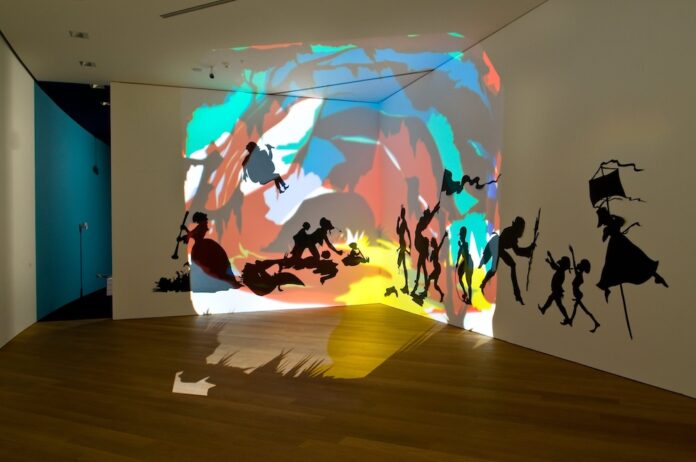
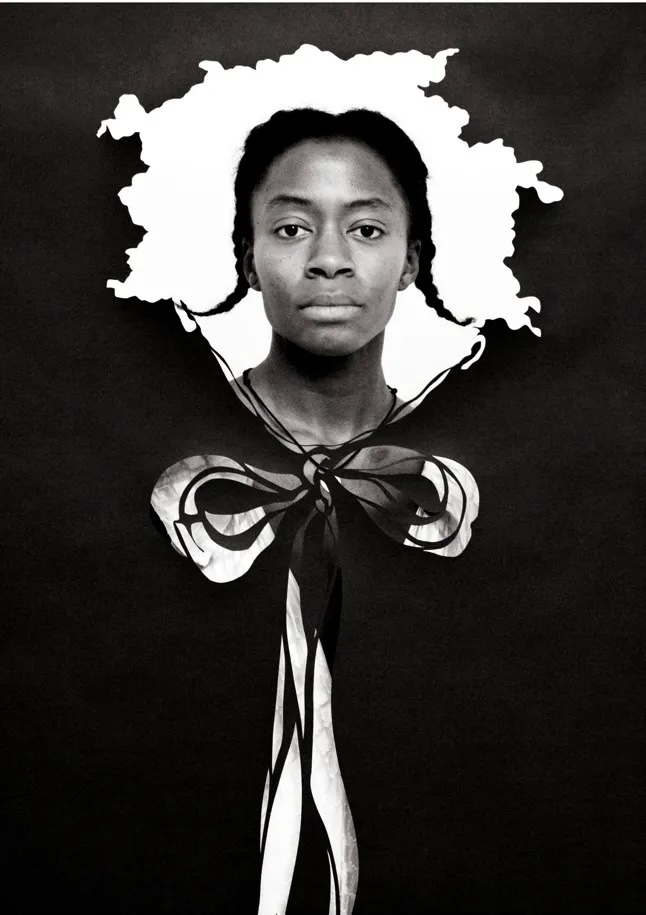
Walker’s genius lies in her ability to transform historical memory into a theatrical and immersive experience. Her iconic cut-paper silhouettes initially appear deceptively elegant, recalling the refined domestic portraiture popular during the eighteenth and nineteenth centuries. Yet this visual familiarity quickly collapses. As viewers approach the works, scenes of brutality, sexual exploitation, racial caricature, and grotesque power relations emerge with disturbing clarity. Walker weaponizes the silhouette itself, a medium historically associated with decorum and social refinement, transforming it into a mechanism of historical revelation.
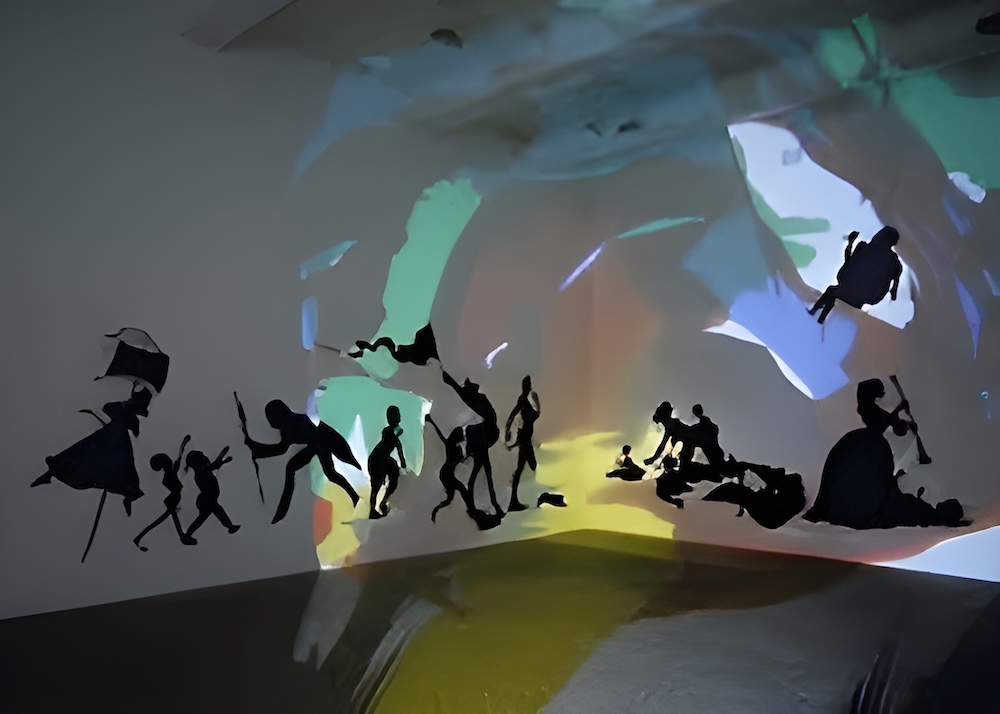
What Walker ultimately seeks is not simply to represent slavery, but to reveal how its psychological structures continue to inhabit the present. Her installations operate as spaces of discomfort where viewers become implicated within the narrative. In works such as Darkytown Rebellion or Insurrection!, the spectator’s own shadow merges with the projected imagery, dissolving the safe distance between observer and history. The audience is no longer external to the violence; it becomes part of the visual and moral architecture of the work.
This is why Walker’s proposal cannot be reduced to political provocation alone. Her work functions as a critical archaeology of visual culture. She dismantles the sentimental mythology of the antebellum South and exposes how popular imagery, literature, monuments, and historical narratives have sanitized slavery into a consumable fiction. Pieces such as Gone: An Historical Romance of a Civil War… parody the romanticized imagery of the Old South, revealing beneath its aesthetic surface a theater of coercion, domination, and abuse.
Walker’s monumental works further expand this critique. In A Subtlety, the colossal sugar sphinx installed in Brooklyn’s former Domino Sugar Factory transformed sugar itself into a material witness to histories of colonial exploitation, forced labor, and transatlantic commerce. Likewise, Fons Americanus reimagined imperial monumentality as a counter-history of the Atlantic world, centering drowned bodies, displacement, and racial violence rather than triumphalist narratives of empire.
What makes Kara Walker’s artistic proposal so profoundly important is that she insists history is not finished. The past is not distant; it continues to structure contemporary consciousness. Her work asks viewers to inhabit the “queasy space” between memory and denial, forcing society to recognize the invisible psychological injuries inherited through generations of racial violence.
Walker does not offer redemption or easy reconciliation. Instead, she asks us to see clearly — perhaps for the first time — what really happened, and to understand how deeply those histories continue to shape the present. Her art becomes both accusation and mirror: a theater of shadows where collective memory can no longer hide from itself.
Contemporary textile art has undergone a profound transformation over the past decades, evolving from a historically marginalized category—often relegated to craft—into a central discourse within contemporary art. Today, practices rooted in weaving, embroidery, tapestry, and other fiber-based techniques operate not merely as decorative or functional traditions, but as critical, conceptual, and spatial investigations into identity, labor, history, and materiality.
From Craft to Concept
Traditionally, textile practices such as weaving, embroidery, and quilting were associated with domestic labor and artisanal production. However, contemporary artists have recontextualized these techniques, repositioning them within the expanded field of sculpture and installation. This shift reflects a broader museological revision—one that challenges the hierarchy between fine art and craft, recognizing textile as a site of intellectual and aesthetic rigor.
At its core, weaving—the interlacing of warp and weft—remains a foundational act. Yet in contemporary practice, it is no longer confined to flat surfaces. Artists stretch, suspend, and fragment woven structures, transforming them into architectural environments or sculptural forms. Similarly, tapestry has moved beyond narrative decoration into a medium capable of abstraction, political commentary, and spatial intervention.
Techniques as Language
Each textile technique carries its own conceptual and material vocabulary:
Embroidery, once associated with ornamentation, is now used to inscribe narratives of identity, trauma, and memory. Its slow, repetitive gesture becomes a form of temporal resistance in an accelerated digital culture.
Macramé and crochet have been reimagined as structural systems, producing intricate, often large-scale installations that engage with gravity, tension, and fragility.
Felt, with its process of compression through heat and pressure, offers a metaphor for transformation—matter shifting states under invisible forces.
Dyeing and printing techniques—from batik to indigo—are increasingly explored not only for their visual qualities but for their cultural and historical embeddedness, linking contemporary practice to global traditions and colonial histories.
These methods are no longer ends in themselves; they function as languages through which artists articulate complex ideas.
Fiber Art and the Expanded Field
The term fiber art encapsulates the contemporary expansion of textile practice into three-dimensional and conceptual realms. No longer bound to the wall, textile works now occupy space, envelop the viewer, and often incorporate found materials, industrial fibers, or organic matter.
From a curatorial perspective, fiber art aligns with what Rosalind Krauss termed the “expanded field” of sculpture. Textile becomes a mediating structure between object and environment, between body and architecture. Installations made of thread, fabric, or rope can evoke systems—biological, social, or political—rendering visible the invisible networks that shape contemporary life.
The Politics of Soft Materials
One of the most compelling aspects of contemporary textile art is its political resonance. The use of “soft” materials—traditionally coded as feminine or domestic—becomes a deliberate strategy to challenge dominant narratives within art history.
Quilting, for instance, has been reclaimed as a form of collective storytelling, often addressing themes of community, migration, and resistance. Similarly, textile practices have been central to decolonial and diasporic discourses, where techniques and motifs carry ancestral knowledge and cultural memory.
In this sense, textile art operates as both material practice and cultural archive.
Temporality, Labor, and the Hand
Unlike many contemporary mediums, textile work foregrounds time and labor. The repetitive processes of stitching, knotting, and weaving embed duration into the object itself. This temporality resists the immediacy of digital production, reasserting the value of the handmade as a site of contemplation and care.
For the viewer, this translates into a different mode of engagement—one that is tactile, intimate, and often immersive. Textile works invite not only visual perception but a sensory and emotional response, bridging the gap between object and body.
Summary: Textile as Contemporary Condition
In 2026, contemporary textile art is no longer peripheral; it is structural to the way we understand contemporary practice. It merges technique with concept, tradition with innovation, and material with meaning.
What makes textile art so vital today is its ability to operate simultaneously on multiple levels:
as form, through its rich visual and spatial possibilities
as process, through its embodied labor
as discourse, through its engagement with history, identity, and politics
Ultimately, textile art reveals that the most fundamental gestures—thread passing through fabric, fibers interlacing—can still produce some of the most complex and resonant expressions in contemporary art.
crochet artist Kimberley Cookey-Gam (crochetcookey)
Crochet — From Ancestral Loop to Contemporary Structure
Crochet, the technique of creating textiles through the interlocking of loops using a single hook, occupies a unique position within the history of fiber arts. Unlike weaving or knitting, crochet is built from a continuous line—one thread, one hook, one evolving structure. From its uncertain ancestral origins to its contemporary expansion into sculpture, mathematics, and social practice, crochet has transformed from domestic craft into a critical language of contemporary art.
Origins Without a Single Origin
The history of crochet is not linear but diffuse and trans-cultural. While the term “crochet” appears in Europe in the early 19th century, its technical logic—looping thread with a hooked tool—likely evolved from earlier practices such as tambouring, found across China, Turkey, India, and North Africa.
Some historians trace similar looping techniques even further back, suggesting parallel developments in ancient China, Egypt, and South America. This multiplicity of origins situates crochet not as a singular invention, but as a recurring human solution to structure through flexibility.
By the 19th century, crochet had become widely established in Europe, particularly as a lace-making technique. Irish crochet, developed during the Great Famine, became both an economic lifeline and a refined aesthetic practice, demonstrating how textile labor could intersect with survival and global trade.
The Logic of the Loop
Technically, crochet differs fundamentally from other textile systems:
it uses a single hook rather than multiple needles
it builds structure through interlocking loops, one at a time
it allows for continuous expansion, contraction, and improvisation
This gives crochet a distinct conceptual quality. Where weaving is grid-based and macramé is knot-based, crochet is loop-based—fluid, organic, and inherently adaptable.
Its basic stitches—chain, single crochet, double crochet—function as modular units, capable of generating both flat surfaces and complex volumetric forms. This flexibility has made crochet uniquely suited to contemporary experimentation.
Domesticity and Its Discontents
For centuries, crochet was embedded within the domestic sphere—associated with decoration, clothing, and household textiles. Like embroidery, it was historically feminized and marginalized within art history.
Yet this marginalization became a site of critical reversal. In the 20th century, particularly from the 1960s onward, artists began reclaiming crochet as a medium of resistance and redefinition, challenging the boundaries between craft and fine art.
The rise of freeform crochet—unconstrained by patterns or repetition—marked a decisive break from tradition. It introduced irregularity, improvisation, and abstraction, aligning crochet with broader movements in contemporary art.
Crochet in Contemporary Art: Structure, Space, and System
In contemporary practice, crochet has expanded far beyond its traditional applications. It now operates as:
sculpture
installation
social practice
scientific and mathematical modeling
Artists use crochet to construct complex three-dimensional forms, exploring tension, gravity, and organic growth. Mathematicians have even employed crochet to model hyperbolic geometry—forms that cannot be easily represented through conventional means—demonstrating its capacity to visualize abstract spatial concepts.
Large-scale installations, such as crocheted coral reefs, merge art, science, and environmental activism, transforming crochet into a tool for understanding ecological systems.
Crochet in Public Space and Social Practice
One of the most visible contemporary manifestations of crochet is yarn bombing—the act of covering public objects with crocheted or knitted material. Emerging in the early 21st century, this practice transforms urban space into a site of soft intervention, challenging the visual language of graffiti with textile tactility.
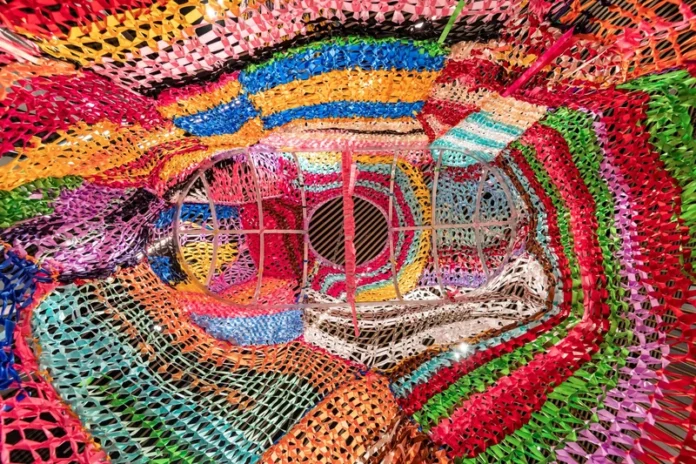
Similarly, community-based projects such as large-scale crocheted installations in public spaces—like those created in Mexico by collective initiatives—demonstrate crochet’s capacity to function as a collective and participatory art form.
In these contexts, crochet becomes less about object-making and more about social connection, shared labor, and communal identity.
Material, Time, and the Hand
Crochet is inherently temporal. Each loop records a gesture; each row accumulates time. This makes the medium particularly resonant in an era dominated by speed and digital production.
Its handmade nature foregrounds:
labor
repetition
care
From a museological perspective, crochet challenges institutions to reconsider value—not in terms of scale or spectacle, but in terms of process and duration.
Crochet as Contemporary Metaphor
In 2026, crochet resonates as a metaphor for:
networks (interconnected loops)
growth (expansion from a single point)
systems (complex structures from simple rules)
It embodies a logic of emergence—where complexity arises from repetition and variation.
Summary, The Endless Thread
Crochet endures because it is both elementary and infinite. From ancestral lace to contemporary installations, it transforms a single thread into complex structures of meaning.
What begins as a loop becomes a surface, a form, a system, a space.
In this sense, crochet is not merely a technique—it is a method of thinking, one that reveals how continuity, variation, and connection can generate forms that are at once intimate and expansive.
In the hands of contemporary artists, crochet is no longer confined to tradition. It is a living, evolving medium, capable of articulating the complexities of our time—one loop at a time.
Positioned at the intersection of art, science, and philosophy, this practice proposes a radical rethinking of perception and existence. Grounded in the understanding of nature as an indivisible, active, and self-organizing system, the work dissolves the boundaries between human and non-human, visible and invisible, material and energetic. Through immersive environments, vibrational objects, and the integration of analog systems with digital technologies, the artist does not merely represent phenomena, but reveals them—making perceptible forces that typically remain beyond sensory experience.
In this context, art operates not only as aesthetic expression, but as a form of knowledge—an epistemological field where perception becomes inquiry and experience becomes understanding. What emerges is a body of work that invites the viewer into a state of heightened awareness, where intuition, sensation, and reflection converge.
The following conversation explores the conceptual, technical, and philosophical dimensions of this practice, opening a space to reflect on the evolving relationship between art, technology, and the fundamental structures that shape reality.
AAM. In your practice, where analog technologies, code, and physical phenomena converge, at what point does an experiment become an artwork? Is there a moment of “aesthetic revelation,” or is it the result of an accumulated sequence of decisions?
AT. An experiment becomes an artwork at the moment it reveals something that exceeds its own conditions. In the studio, I work through iterative processes—testing, observing, refining—but there is a point at which what I am engaging with begins to articulate with a certain coherence and autonomy. It is no longer only a phenomenon, but something that has the potential to induce a transformative experience in the person who is witnessing it—something that holds internal relationships and sustains a new layer of perceptual and conceptual depth.
I wouldn’t call it a purely aesthetic revelation, nor simply a sequence of decisions. It is more a recognition—a moment in which I understand that what is emerging carries its own logic, its own presence, and can exist as an artwork. From there, my role shifts—from searching to accompanying and refining what is already there.
Over the years, I have trained myself to become a vehicle for the work to emerge. It is not only about doing what I rationally think, but about allowing a powerful revelatory content to manifest. I try not to impose or interfere, but to follow the work’s needs with precision and attention until it fully comes into existence.
AAM. You work with the imperceptible—vibration, electromagnetism, energy—to make it sensible. How do you negotiate the risk of “translating” these phenomena without reducing their complexity or falling into an excessive aestheticization of the scientific?
AT. On the intention and scope of your artistic proposal
I don’t approach these phenomena as something to be translated or illustrated, but rather as something to be revealed. This distinction is crucial. Translation implies a shift from one language to another, often simplifying or losing its essence. What I seek instead is to create the conditions in which this nonperceptible activity can be encountered directly in physical space.
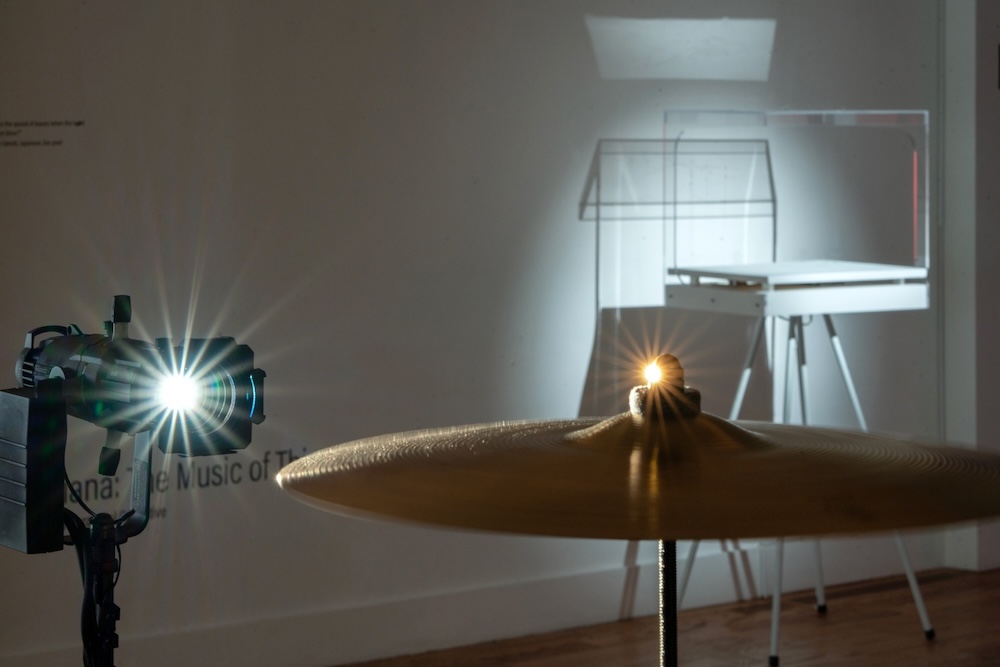
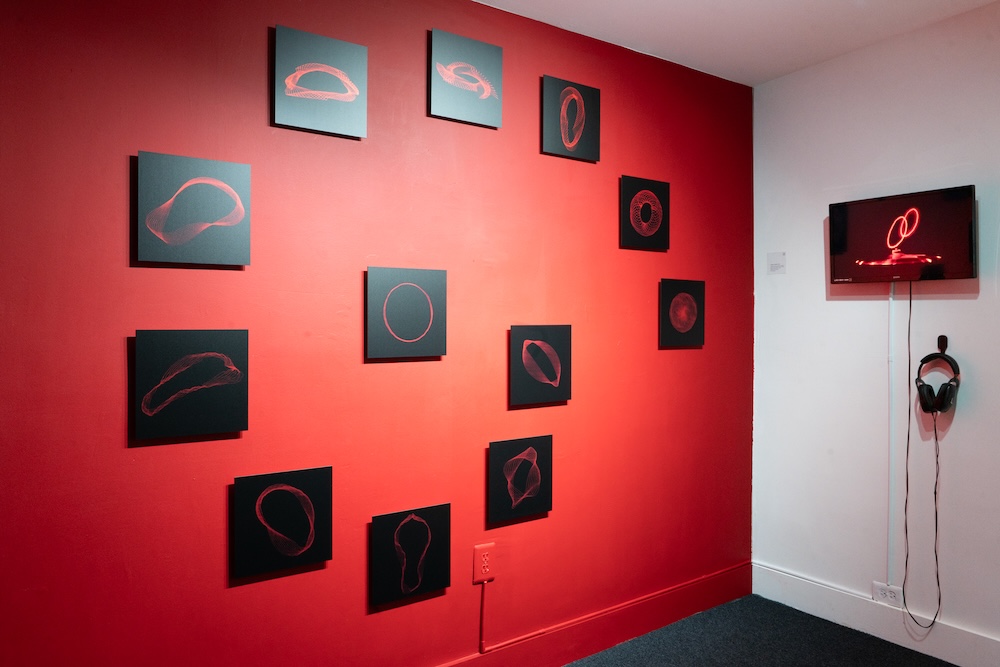
This is why I mostly work with analog systems and real physical interactions. The phenomena are not represented—they are manifested, without relying on digital simulations. What we perceive is not an interpretation of vibration or electromagnetism, but their actual behavior unfolding before us.
The aesthetic dimension emerges from this encounter, not as a goal imposed onto it. Complexity is not reduced—it remains active, expressing itself in real time.
The material carries its own layers of content. My role as an artist is to articulate that potential into a work—one that can induce an abstract, transformative experience in the spectator, while opening space for new inquiries and conceptual reflection.
AAM. Your work proposes a continuity between the human and the non-human. Within a cultural context that remains deeply anthropocentric, are you aiming to provoke a perceptual, ethical, or even political transformation in the viewer?
AT. I approach the human–non-human relationship as a continuum, not as a contrast. In my work, humanity is situated within a natural structure that is active, interconnected, and self-organized—where everything, even what we perceive as inert, participates in a shared field of activity and transformation.
Within this framework, the natural world unfolds as a continuum that extends from the most minuscule components of matter, through biology and society, to technological beings. I give form to the idea that everything carries a certain vitality, and that agency is not exclusive to us, but distributed across different scales and forms of existence.
This perspective opens a shift in how we understand our place within the natural world—moving away from an anthropocentric position toward an awareness of being embedded within a larger system of interactions.
From there, ethical and even political implications may emerge, but they are not imposed. The work does not instruct or argue—it is an invitation; a contemplative encounter that fosters a state of communion, of common-union.
AAM. By positioning art as a form of knowledge, do you see your works operating more as epistemological devices than as aesthetic objects? Where do you situate the boundary—if any—between art, science, and philosophy in your practice?
AT. I see art not only as a form of expression, but also as a powerful form of knowledge. It does not operate solely through rational conceptualization, but has the capacity to engage with abstract, transformative content that may not carry fixed or concrete meaning. Yet, it can induce a deep sense of connection with the essential elements that animate and connect us, accessing forms of understanding that emerge through intuition, perception, and direct experience—beyond language and rational thought.
In that sense, my works can function as epistemological devices, but they are not reducible to that. The knowledge they offer is embodied and often ambiguous. They do not aim to provide concrete answers, but to sustain a state of inquiry and openness—where awareness and insight can emerge, while holding complexity and multiple layers of meaning.
The boundaries between art, science, and philosophy are porous and situational. Each field brings different tools and ways of engaging with reality. In my practice, they coexist as complementary modes of inquiry that inform one another, each with its own capacities.
I seek in art its potential to engage the full spectrum of human intelligence—where rationality, intuition, perception, and direct experience converge, becoming revelatory of the depth and multidimensional nature of human experience.
AAM. Our series such as Resonant Bodies and Delirious Fields suggest a sustained line of research. Where is this investigation heading in the future? Are you interested in delving into more invisible scales (quantum, biological), or expanding toward broader social and collective contexts?
AT. Looking ahead, and recognizing the technological era as a continuation of the natural evolutionary process, I aim to further integrate bio-technological interfaces, AI, and robotics into my practice.
On one hand, I am interested in exploring the human body as a vibrational entity, shaped by its interactions with its environment and its sociocultural context. By working with biometric signals and bio-technological interfaces, I investigate how internal states—such as emotions, thoughts, and physiological responses to stimuli—express an underlying natural structure that is active, interconnected, and self-organized.
On the other hand, I am interested in expressing nature as a continuum that extends across non-living, living, and technological beings. To explore this, I develop performative works that are autonomous and responsive—systems that can self-generate, adapt, and evolve over time. These works rely on the possibilities enabled by intelligent systems and human–machine collaboration.
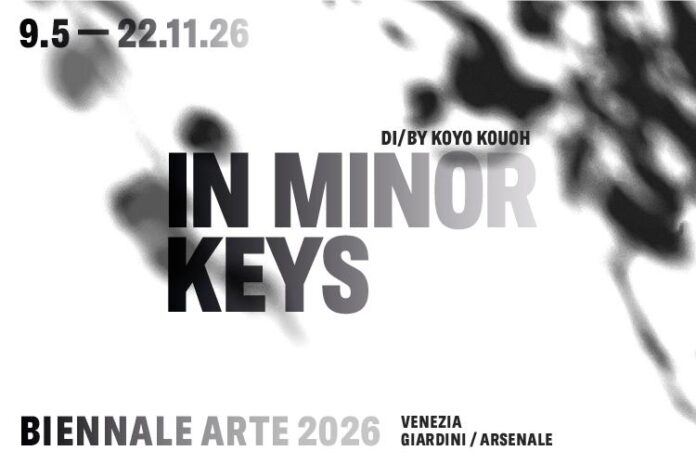
Venice (Giardini, Arsenale and city-wide venues) May 9 – November 22, 2026 Pre-opening: May 6, 7, 8 Opening & Awards Ceremony: May 9, 2026
Curatorial Framework
In Minor Keys is the curatorial project developed by Koyo Kouoh, appointed Artistic Director in November 2024. Following her passing in May 2025, La Biennale chose to realize the exhibition in full, preserving the conceptual and structural integrity of her vision.
Kouoh established the theoretical framework, selected the artists and works, defined the spatial and graphic identity, and initiated the curatorial dialogue that continues to shape the exhibition.
Curatorial Method
The exhibition emerges from a relational process grounded in dialogue and collaboration, notably through a key working session in Dakar at RAW Material Company.
Concepts such as enchantment, collective practice, and generative exchange were not imposed but developed through shared research and conversation. This approach reflects Kouoh’s understanding of curating as a practice rooted in relationships rather than fixed structures.
Artists and Scope
The exhibition brings together 111 participants, including artists, collectives, and organizations from multiple geographies. The selection is based on resonance and affinity rather than geographic representation, forming what can be understood as a relational cartography shaped over time.
Conceptual Structure
Rather than being divided into sections, the exhibition is organized through conceptual motifs.
Shrines function as spaces of tribute and continuity, foregrounding practices that exceed the logic of the object.
Procession introduces a spatial and social dynamic informed by collective movement, where participation replaces observation.
Schools operate as ecosystems of knowledge production, linking artistic practice with social and pedagogical frameworks.
Spaces of rest and contemplation offer an alternative temporality, emphasizing slowness, perception, and multisensory engagement.
Literary References
The exhibition draws from literary works such as Beloved by Toni Morrison and One Hundred Years of Solitude by Gabriel García Márquez, particularly in their treatment of time, memory, and layered realities.
Performance and Embodiment
The performance program centers the body as a site of memory and knowledge, including a procession of poets in the Giardini inspired by Kouoh’s Poetry Caravan.
Exhibition Design
Designed by Wolff Architects, the spatial approach emphasizes thresholds as transitional experiences. Textile elements and atmospheric shifts guide visitors through changing perceptual states.
Key Perspective
In Minor Keys resists traditional exhibition logic. It operates as a compositional field in which perception, memory, and relational experience unfold through layered encounters rather than fixed narratives.
AURÈLIA MUÑOZ: Esculpir el vacío, tejer el espíritu
La obra de Aurelia Muñoz ocupa un lugar singular dentro de la historia del arte textil contemporáneo. Nacida en Barcelona en 1926, la artista desarrolló una práctica profundamente experimental que desdibujó las fronteras entre artesanía, escultura, arquitectura y arte conceptual. Su investigación transformó radicalmente el estatuto del textil, liberándolo de la bidimensionalidad decorativa para convertirlo en un cuerpo escultórico suspendido en el espacio.
Formada inicialmente bajo la influencia del método Montessori —centrado en el trabajo manual y la organización espacial— Muñoz desarrolló desde temprana edad una sensibilidad hacia la materia y la construcción táctil. Más adelante, sus estudios en la Escuela Massana y en la Escuela de Artes Aplicadas de Barcelona consolidaron un lenguaje visual profundamente conectado con las tradiciones populares, el románico catalán y las vanguardias europeas.
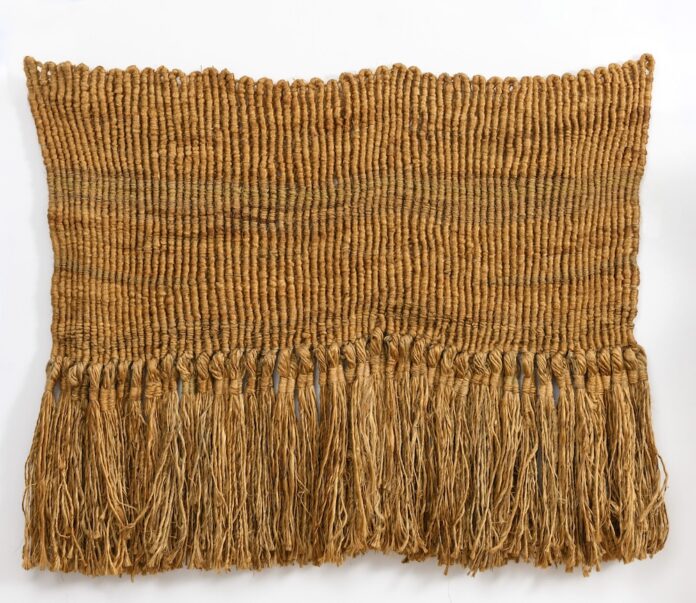
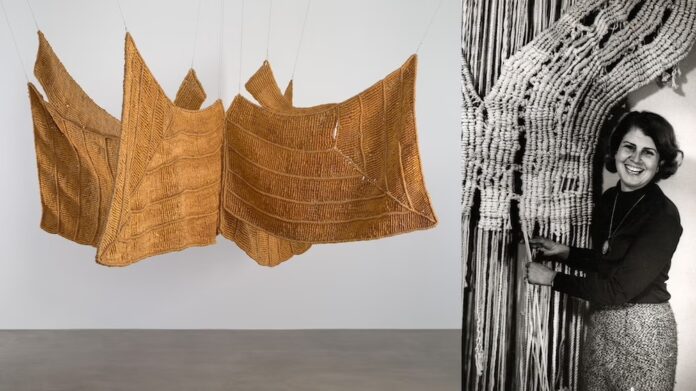
A partir de la década de 1970, Muñoz emprendió una investigación decisiva sobre el tapiz y el macramé, inspirándose tanto en técnicas textiles ancestrales como en la necesidad de expandir el tejido hacia el espacio tridimensional. Obras como Fuente de Vida (1966) o Homenaje a Jerónimo Bosch (1971) evidencian una síntesis extraordinaria entre bordado, pintura y arquitectura simbólica. En ellas, la puntada funciona como gesto pictórico y estructura espacial simultáneamente, creando superficies vibrantes donde conviven abstracción geométrica, surrealismo e imaginarios medievales.
Sin embargo, es en sus esculturas de macramé donde Muñoz alcanza una radicalidad excepcional. Piezas monumentales como Águila Beige (1977), adquirida por el Museum of Modern Art de Nueva York, convierten el nudo en una unidad arquitectónica capaz de desafiar la gravedad. Suspendidas en el aire, sus estructuras dialogan con el vacío, la luz y el movimiento atmosférico, generando una experiencia casi espiritual.
La crítica ha señalado cómo Muñoz desmanteló las jerarquías tradicionales entre bellas artes y artes aplicadas. La historiadora del arte Pilar Parcerisas ha destacado que su trabajo introdujo una nueva dimensión escultórica en el arte textil español, vinculada tanto al movimiento de la Nouvelle Tapisserie como a las búsquedas espaciales de la escultura contemporánea. Asimismo, investigadores del Museo Reina Sofía han subrayado cómo su obra articula tradición artesanal, pensamiento ecológico y sensibilidad mística desde una perspectiva radicalmente contemporánea.
Durante las últimas décadas de su vida, Muñoz expandió su investigación hacia el papel hecho a mano y las formas orgánicas inspiradas en ecosistemas marinos. Series como Washi revelan una poética de la fragilidad y la transparencia donde el material parece oscilar entre presencia física y desaparición lumínica.
Más allá de su virtuosismo técnico, la obra de Aurelia Muñoz constituye una filosofía material. Sus tejidos no buscan decorar; buscan habitar el espacio, alterar la percepción y activar una experiencia contemplativa. En sus manos, el hilo deja de ser ornamento para convertirse en pensamiento estructural, en arquitectura espiritual y en una meditación sobre la relación entre cuerpo, materia e infinito.
Referencias
Museo Nacional Centro de Arte Reina Sofía, Madrid.
Parcerisas, Pilar. Aurelia Muñoz y la renovación del arte textil contemporáneo.
Catálogos de la exposición Aurelia Muñoz: Ente y Espacio.
Alejandro Caiazza, SoHo Studio, (NYC art residency)
Bridges and Heritage with the Neo-Expressionism of Alejandro Caiazza
By José Gregorio Noroño
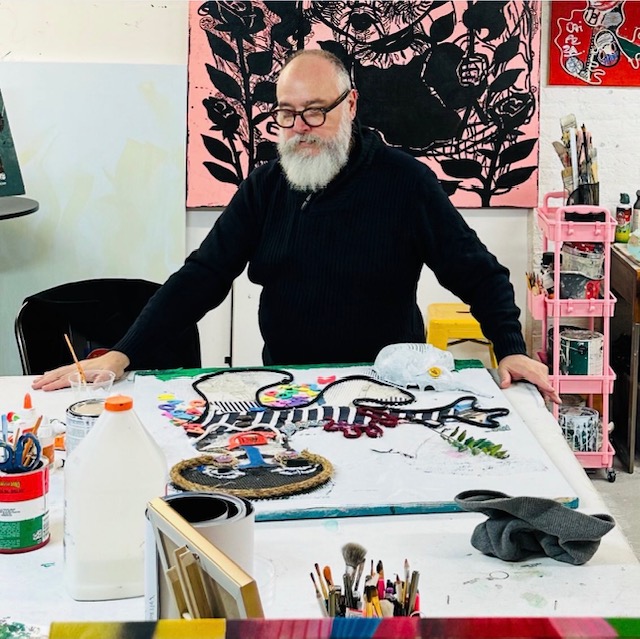
From April 13 to June 14, 2026, the Betsy Frank Gallery presents a collection of recent works by the artist Alejandro Caiazza, under the title “Bridges and Heritage with the Neo-Expressionism of Alejandro Caiazza.” His artistic language is characterized by a mixed amalgamation of artistic movements—outsider art, art brut, bad painting, neo-expressionism, and pop art—as well as a diversity of techniques and materials, a visual narrative that alludes to the experiences of a migrant.
Caiazza was born in Argentina, but spent his childhood, adolescence, and early adulthood in Ciudad Guayana, Venezuela, the country to which his parents emigrated when he was just a child. In this adopted country, he began his art studies and his career as an artist, holding his first solo exhibition in 1999 at the Sidor Art Gallery.
Screenshot
Then, around the year 2000, he decided to continue his artistic career in Europe and settled in Paris. There, he studied briefly at the École Supérieure des Beaux-Arts de Paris, where he was taught by the painter Ouanes Amor, who encouraged him to forge his own path. Perhaps because he did not formalize his academic art studies, either in Venezuela or in Europe, opting instead for independent studies outside established aesthetic norms, Caiazza prefers to define himself as a self-taught artist.
During his time in Paris, He exhibited his work in France, Italy, Japan, and Venezuela. From there, He migrated, once again in his life, to New York City, where He has resided for the past 16 years, developing and exhibiting her work in group and solo shows at various art galleries.
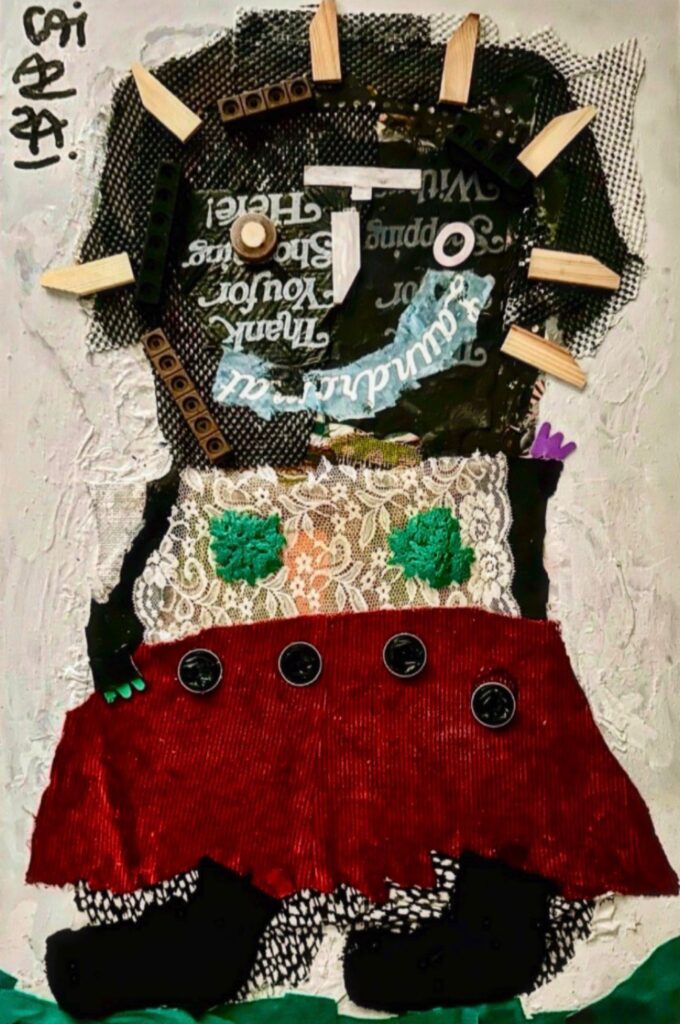
Alejandro Caiazza, Daughter of exile, 2026
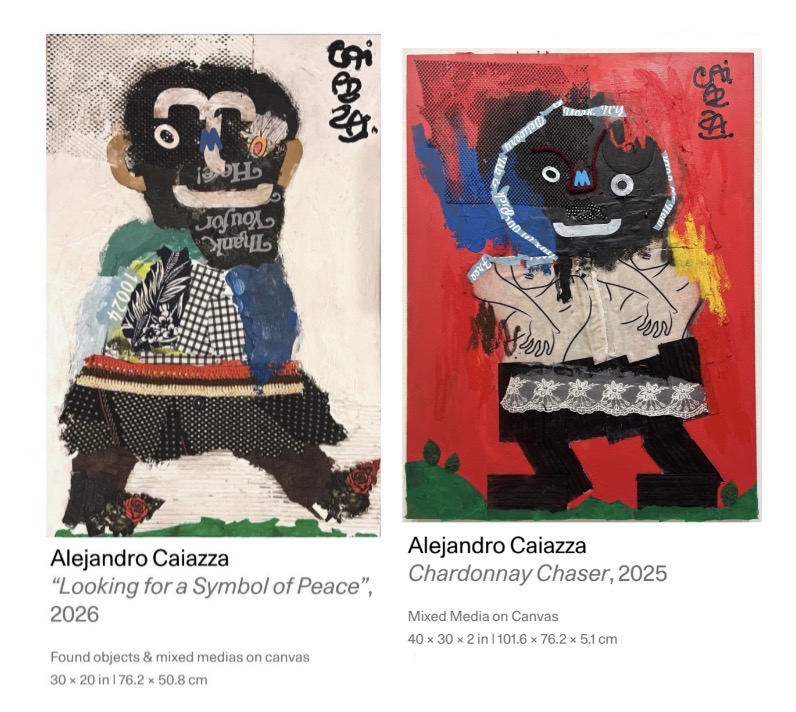
This solo exhibition comprises a body of work created using the technique known as collage, highlighting the texture of the pieces, which are made with a wide variety of pictorial and non-pictorial materials: acrylics, found objects, fabrics, strings, mesh, pieces of wood, leaves, and organic forms alluding to nature. His compositions are distinguished by the use of a palette of bold, contrasting colors; gestural brushstrokes, broad stains and drips, as well as the use of thick, irregular lines and contours.
The human figure is a central motif, approached in an almost childlike manner, framed within the aesthetic category of the grotesque; imbued with humor and irony. Through his proposals, Caiazza addresses social and political issues such as migration, for example, a consequence of the search for a better life far from one’s country of origin—a displacement in which migrants experience, according to Caiazza, love, madness, and death. For him, his work is, in a way, about those who seek a home outside their homeland. In this vein, Caiazza created a work entitled “Daughter of Exile,” which he conceived as the daughter of the Statue of Liberty, “The Mother of Exile,” who opens her arms to welcome every migrant who arrives in the United States.
Hence, the curatorial text of the Betsy Frank Gallery establishes an intermedial bridge by placing Caiazza’s work in dialogue with the poem “The New Colossus,” written in 1883 by the American poet Emma Lazarus, inscribed on a bronze plaque located on the pedestal upon which the Statue of Liberty rests, whose verses read: “Mother of Exiles. From the beacon of your hand / shines welcome to all the world (…).”
An important detail of this curatorial text, the exhibition’s guiding thread, is its use of the metaphor of the “Mother of Exiles” to elevate Caiazza’s work from a purely aesthetic plane to a socio-political one. By linking it to the history of New York as a port of refuge—as the great home of migrants—the exhibition proposes a mixed repertoire: a hybrid heritage defined by multiethnic and multicultural fusion.
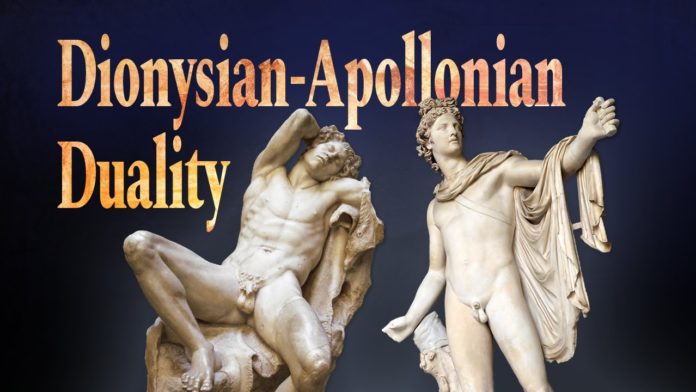
Desde una lectura rigurosa de El nacimiento de la tragedia, lo apolíneo puede entenderse como el principio de orden, medida y estructuración: aquello que organiza la experiencia a través de la forma, la disciplina y la claridad. En contraste, lo dionisíaco encarna la dimensión primaria de la existencia: la irrupción de la emoción, la intensidad del instante y la disolución de los límites racionales en favor de una vivencia directa y total.
Lo dionisíaco no es una abstracción, sino una condición vivida. Se manifiesta en la inmediatez de la experiencia: en la conmoción ante un amanecer, en el impulso erótico, en la violencia emocional de la traición o en el flujo creativo que emerge cuando el sujeto se pierde en aquello que ama. Es una forma de estar en el mundo donde la conciencia se concentra en el presente absoluto, sin mediación ni distancia crítica. Su carácter no es reflexivo, sino intensivo: no interpreta la experiencia, la encarna.
Frente a ello, lo apolíneo introduce distancia, organización y forma. Es el dominio de la representación, de la construcción racional que permite ordenar el caos de la existencia. Sin embargo, Nietzsche advierte que este principio puede excederse: cuando la razón se desplaza hacia la especulación metafísica —como ocurre en la tradición cartesiana— se desvincula de la vida concreta y cae en un ejercicio de abstracción infinita, ajeno a las urgencias de la existencia humana.
En este sentido, la metafísica no constituye el núcleo de la experiencia estética ni vital, sino un posible desvío de lo apolíneo. El pensamiento, cuando se emancipa de la vida, se convierte en una estructura vacía, incapaz de sostener la intensidad de lo real. Por ello, Nietzsche no propone la eliminación de la razón, sino su reinscripción en el ámbito de lo viviente.
La figura del individuo virtuoso, en este marco, no es aquella que elige entre razón o impulso, sino la que logra sostener una tensión dinámica entre ambos. Lo dionisíaco aporta la energía, el deseo, la fuerza vital; lo apolíneo introduce medida, dirección y conciencia de las consecuencias. La razón no existe para negar el deseo, sino para organizarlo en función de una vida más plena.
Desde esta perspectiva, el equilibrio no implica neutralidad, sino una forma activa de navegación entre fuerzas. El exceso dionisíaco conduce a la dispersión y la autodestrucción; el exceso apolíneo, a la parálisis intelectual y a la desconexión de la experiencia. La virtud, en términos nietzscheanos, consiste en una coreografía entre intensidad y forma, entre impulso y conocimiento.
Lo decisivo aquí es que esta ética no requiere recurrir a categorías metafísicas. La pregunta no es qué es “verdadero” en un sentido abstracto, sino qué intensifica o empobrece la experiencia de estar vivo. Cuando lo apolíneo se pierde en definiciones universales —por ejemplo, sobre la moralidad en abstracto— abandona su función vital. Y cuando lo dionisíaco se despliega sin mediación alguna, ignora las condiciones que hacen posible la continuidad del deseo.
Así, más que una teoría moral, Nietzsche propone una estética de la existencia: una forma de vida donde el sujeto no se somete ni al caos ni al orden absoluto, sino que aprende a componer con ambos.
Lo apolíneo y lo dionisíaco en los estilos de pintura
Apolíneo
Dionisíaco
Arte más mental
Arte más emocional
Hincapié en las formas
Hincapié en los contenidos
Arte sosegado, reposado
Subraya la tensión y los contrastes
Vinculado con las ideas puras
Vinculado con las pasiones
Racionalidad
Vitalidad, mundo onírico
Orden matemático
Resalta lo caótico
Escultura clásica
Escultura helenística
La distinción entre lo apolíneo y lo dionisíaco, formulada por Friedrich Nietzsche en El nacimiento de la tragedia, puede leerse no solo como una categoría filosófica, sino como una herramienta crítica para comprender la historia de la pintura. Numerosos estilos se sitúan dentro de este campo de tensión, donde orden y caos, forma e intensidad, estructura e impulso coexisten en una relación productiva.
Lo apolíneo: orden, claridad y construcción
En el ámbito pictórico, lo apolíneo se manifiesta en prácticas que privilegian la forma, la proporción y el control visual. Se trata de una voluntad de organización que transforma la experiencia en una imagen estable, inteligible y contenida.
Entre los principales estilos asociados a esta tendencia se encuentran el Renacimiento, con su énfasis en la proporción y la perspectiva; el Neoclasicismo, caracterizado por su claridad formal y disciplina narrativa; la abstracción geométrica, representada por figuras como Piet Mondrian; el Minimalismo, centrado en la reducción y la precisión; el hard-edge painting, definido por sus bordes nítidos y control absoluto; y el Op Art, que estructura la percepción a través de sistemas visuales rigurosos.
Estas prácticas comparten una serie de rasgos: líneas limpias, composiciones estables, control técnico, claridad formal y un cierto distanciamiento emocional. Se trata, en términos generales, de un arte que se construye.
Lo dionisíaco: intensidad, impulso y disolución
En contraste, lo dionisíaco introduce una dimensión de inestabilidad, emoción y desbordamiento. Aquí la pintura no se organiza desde la forma, sino que emerge como acontecimiento.
Entre los estilos que encarnan esta tendencia se encuentran el Expresionismo, con su intensidad emocional; el Expresionismo Abstracto, ejemplificado por Jackson Pollock; el Neoexpresionismo; el Art Informel; la pintura gestual; y ciertos aspectos de la obra de Francis Bacon.
Sus características incluyen el gesto libre, la distorsión de la forma, la visibilidad de la materia, composiciones inestables y una fuerte carga emocional. Se trata, en esencia, de un arte que acontece más que construirse.
El territorio decisivo: la síntesis de fuerzas
Sin embargo, la práctica artística más significativa no se sitúa en uno de estos polos, sino en su articulación. Nietzsche señala que la forma más alta del arte surge de la tensión entre lo apolíneo y lo dionisíaco.
Artistas como Mark Rothko, Cy Twombly, Gerhard Richter y Anselm Kiefer operan precisamente en ese umbral donde estructura y desbordamiento se entrelazan. En estos casos, la pintura no resuelve la tensión, sino que la sostiene como condición de su potencia.
Implicación para el artista contemporáneo
Esta lectura no es únicamente histórica, sino operativa. Una obra excesivamente apolínea corre el riesgo de volverse rígida y distante; una obra puramente dionisíaca, de perder dirección y consistencia.
El problema no es elegir entre orden o caos, sino mantener una relación activa entre ambos. Podría decirse que lo apolíneo corresponde a aquello que puede ser explicado, mientras que lo dionisíaco pertenece al ámbito de lo incontrolable. La obra relevante emerge cuando logra articular claridad sin eliminar el misterio, y control sin suprimir el accidente.
Resumen
Los estilos no deben entenderse como categorías fijas, sino como posiciones dentro de un campo dinámico de fuerzas. Un artista no se define por su adhesión a un lenguaje determinado, sino por su capacidad de operar en esa tensión.
En última instancia, toda práctica artística madura implica una comprensión —explícita o no— de que el arte no consiste en elegir un extremo, sino en equilibrar fuerzas.
ApolíneoDionisíaco Arte más mentalArte más emocionalHincapié en las formasHincapié en los contenidosArte sosegado, reposado. Subraya la tensión, los contrastesVinculado con las ideas puras Vinculado con las pasionesRacionalidad Vitalidad, mundo oníricoOrden matemá co Resalta lo caó coEscultura clásicaEscultura helénic
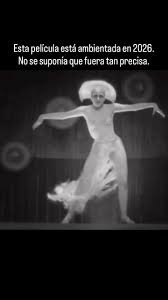
El clásico del cine mudo de 1927 está ambientado en el año 2026,
En 1927, Fritz Lang imaginó el año 2026
En 1927, cuando Europa aún intentaba recomponerse de las ruinas físicas y psicológicas de la Primera Guerra Mundial, Fritz Lang estrenó Metrópolis, una de las obras cinematográficas más influyentes y visionarias del siglo XX. Lo que entonces parecía una fantasía expresionista sobre un futuro lejano, hoy —casi exactamente un siglo después— adquiere la perturbadora densidad de una profecía cultural. Lang imaginó el año 2026 como una civilización vertical, tecnocrática y fracturada: una ciudad dividida entre las élites que habitan las alturas y las masas obreras condenadas al subsuelo. No era simplemente ciencia ficción; era una anatomía política del capitalismo moderno.
Resulta imposible observar nuestro presente sin advertir la vigencia inquietante de aquella visión. Metrópolis anticipó no solo la automatización extrema del trabajo y la concentración del poder económico, sino también la aparición de inteligencias artificiales capaces de reemplazar identidades humanas y manipular colectividades. El célebre robot María —una figura simultáneamente seductora y monstruosa— constituye una de las primeras representaciones culturales de una inteligencia artificial diseñada para alterar la percepción social y provocar el caos político. Hoy, en plena era de algoritmos, deepfakes y simulaciones digitales, la película parece menos una fantasía futurista que un espejo deformante de nuestra contemporaneidad.
Visualmente, Lang construyó una de las iconografías definitivas de la modernidad. Influenciada por el expresionismo alemán, el futurismo y las arquitecturas monumentales de la industrialización, Metrópolis estableció el imaginario visual que décadas después heredaría Blade Runner, el anime cyberpunk japonés y gran parte de la estética distópica contemporánea. La ciudad como máquina devoradora, los cuerpos convertidos en engranajes y la monumentalidad tecnológica siguen siendo imágenes centrales de nuestra cultura visual.
Pero quizá el aspecto más fascinante de Metrópolis sea su propia historia material. Tras su estreno, la película fue severamente mutilada por distribuidores y censores; durante décadas se creyó que una parte considerable del filme original estaba perdida. En 2008, sin embargo, ocurrió uno de los hallazgos más extraordinarios en la historia del cine: en el Museo del Cine de Buenos Aires apareció una copia casi completa de la versión original de Lang. El descubrimiento, liderado por Fernando Martín Peña y Paula Felix-Didier, permitió restaurar alrededor de 25 minutos desaparecidos desde 1927 y devolverle a la obra gran parte de su complejidad narrativa y ritmo original.
Ese hallazgo no fue únicamente arqueología cinematográfica; fue también un gesto profundamente simbólico. La película que advertía sobre los peligros de una modernidad deshumanizada sobrevivió fragmentada, mutilada y dispersa, hasta reaparecer en América Latina como una memoria rescatada del colapso tecnológico del siglo XX. La restauración de Metrópolis evidenció además cómo el cine, incluso en su deterioro físico, conserva la capacidad de dialogar con futuros aún no realizados.
Hoy, en 2026, habitamos el año que Fritz Lang imaginó. Las desigualdades urbanas son extremas, la automatización redefine la experiencia laboral y las inteligencias artificiales comienzan a sustituir voces, rostros y decisiones humanas. Sin embargo, la pregunta central de Metrópolis permanece abierta: ¿puede existir progreso tecnológico sin una ética capaz de sostener lo humano?
Lang no ofrecía una respuesta definitiva. Lo que dejó fue una advertencia visual de extraordinaria lucidez: toda civilización que adore la máquina y olvide el cuerpo termina construyendo su propia ruina.
2026 According to Fritz Lang_ The Mechanical Prophecy of Metropolis
2026 According to Fritz Lang: The Mechanical Prophecy of Metropolis
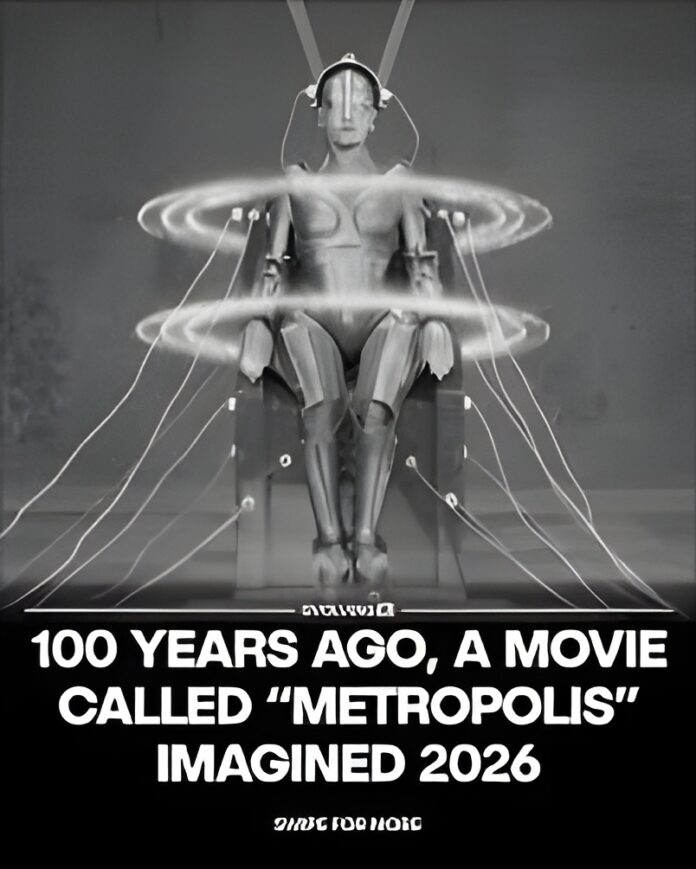
In 1927, while Europe was still attempting to recover from the physical and psychological ruins of the First World War, Fritz Lang released Metropolis, one of the most influential and visionary films of the twentieth century. What once appeared to be an expressionist fantasy about a distant future now — almost exactly a century later — acquires the disturbing density of cultural prophecy. Lang imagined the year 2026 as a vertical, technocratic, and fractured civilization: a city divided between elites living in the heights and working masses condemned to the underground. It was not merely science fiction; it was a political anatomy of modern capitalism.
It is impossible to look at our present without recognizing the unsettling relevance of that vision. Metropolis anticipated not only the extreme automation of labor and the concentration of economic power, but also the emergence of artificial intelligences capable of replacing human identities and manipulating collective consciousness. The iconic robot Maria — simultaneously seductive and monstrous — stands as one of the earliest cultural representations of an artificial intelligence designed to alter social perception and provoke political chaos. Today, in the age of algorithms, deepfakes, and digital simulations, the film appears less like futuristic fantasy and more like a distorted mirror of contemporary reality.
Visually, Lang created one of the definitive iconographies of modernity. Influenced by German Expressionism, Futurism, and the monumental architectures of industrialization, Metropolis established a visual language later inherited by Blade Runner, Japanese cyberpunk anime, and much of contemporary dystopian aesthetics. The city as devouring machine, bodies transformed into gears, and technological monumentality remain central images within our visual culture.
Yet perhaps the most fascinating aspect of Metropolis is its own material history. After its premiere, the film was severely mutilated by distributors and censors; for decades, significant portions of the original version were believed lost forever. In 2008, however, one of the most extraordinary discoveries in film history took place: at the Museo del Cine in Buenos Aires, archivists uncovered a nearly complete print of Lang’s original cut. The discovery, led by Fernando Martín Peña and Paula Felix-Didier, restored approximately twenty-five missing minutes and returned much of the film’s narrative complexity and original rhythm.
This discovery was not merely an act of cinematic archaeology; it was also profoundly symbolic. The film that warned about the dangers of dehumanized modernity survived fragmented, mutilated, and scattered, only to reappear in Latin America as a rescued memory from the technological collapse of the twentieth century. The restoration of Metropolis further demonstrated how cinema, even in physical deterioration, retains the power to converse with futures not yet fully realized.
Today, in 2026, we inhabit the very year Fritz Lang imagined. Urban inequalities have become extreme, automation is redefining human labor, and artificial intelligences are beginning to replace human voices, faces, and decisions. Yet the central question of Metropolis remains unresolved: can technological progress exist without an ethical structure capable of sustaining humanity?
Lang offered no definitive answer. What he left behind was a visual warning of extraordinary lucidity: every civilization that worships the machine while forgetting the body ultimately constructs its own ruin.