Crochet — From Ancestral Loop to Contemporary Structure
Crochet, the technique of creating textiles through the interlocking of loops using a single hook, occupies a unique position within the history of fiber arts. Unlike weaving or knitting, crochet is built from a continuous line—one thread, one hook, one evolving structure. From its uncertain ancestral origins to its contemporary expansion into sculpture, mathematics, and social practice, crochet has transformed from domestic craft into a critical language of contemporary art.
Origins Without a Single Origin
The history of crochet is not linear but diffuse and trans-cultural. While the term “crochet” appears in Europe in the early 19th century, its technical logic—looping thread with a hooked tool—likely evolved from earlier practices such as tambouring, found across China, Turkey, India, and North Africa.
Some historians trace similar looping techniques even further back, suggesting parallel developments in ancient China, Egypt, and South America. This multiplicity of origins situates crochet not as a singular invention, but as a recurring human solution to structure through flexibility.
By the 19th century, crochet had become widely established in Europe, particularly as a lace-making technique. Irish crochet, developed during the Great Famine, became both an economic lifeline and a refined aesthetic practice, demonstrating how textile labor could intersect with survival and global trade.
The Logic of the Loop
Technically, crochet differs fundamentally from other textile systems:
- it uses a single hook rather than multiple needles
- it builds structure through interlocking loops, one at a time
- it allows for continuous expansion, contraction, and improvisation
This gives crochet a distinct conceptual quality. Where weaving is grid-based and macramé is knot-based, crochet is loop-based—fluid, organic, and inherently adaptable.
Its basic stitches—chain, single crochet, double crochet—function as modular units, capable of generating both flat surfaces and complex volumetric forms. This flexibility has made crochet uniquely suited to contemporary experimentation.
Domesticity and Its Discontents
For centuries, crochet was embedded within the domestic sphere—associated with decoration, clothing, and household textiles. Like embroidery, it was historically feminized and marginalized within art history.
Yet this marginalization became a site of critical reversal. In the 20th century, particularly from the 1960s onward, artists began reclaiming crochet as a medium of resistance and redefinition, challenging the boundaries between craft and fine art.
The rise of freeform crochet—unconstrained by patterns or repetition—marked a decisive break from tradition. It introduced irregularity, improvisation, and abstraction, aligning crochet with broader movements in contemporary art.
Crochet in Contemporary Art: Structure, Space, and System
In contemporary practice, crochet has expanded far beyond its traditional applications. It now operates as:
- sculpture
- installation
- social practice
- scientific and mathematical modeling
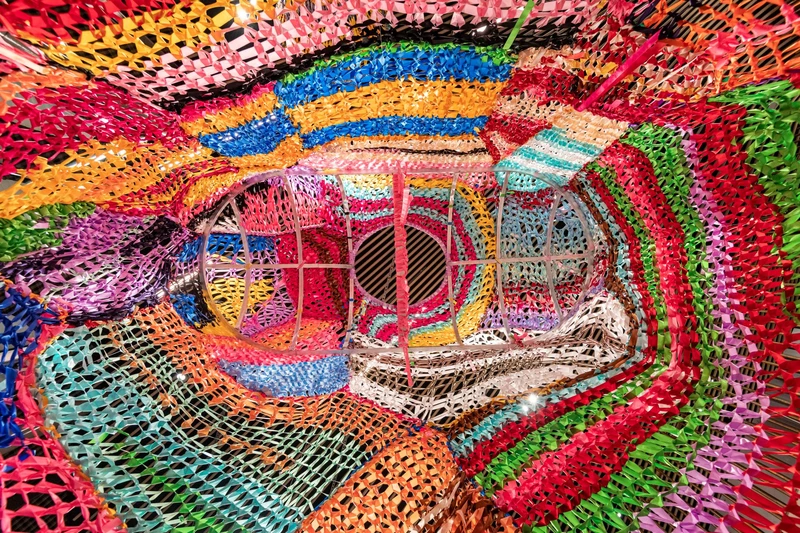
Artists use crochet to construct complex three-dimensional forms, exploring tension, gravity, and organic growth. Mathematicians have even employed crochet to model hyperbolic geometry—forms that cannot be easily represented through conventional means—demonstrating its capacity to visualize abstract spatial concepts.
Large-scale installations, such as crocheted coral reefs, merge art, science, and environmental activism, transforming crochet into a tool for understanding ecological systems.
Crochet in Public Space and Social Practice
One of the most visible contemporary manifestations of crochet is yarn bombing—the act of covering public objects with crocheted or knitted material. Emerging in the early 21st century, this practice transforms urban space into a site of soft intervention, challenging the visual language of graffiti with textile tactility.
Similarly, community-based projects such as large-scale crocheted installations in public spaces—like those created in Mexico by collective initiatives—demonstrate crochet’s capacity to function as a collective and participatory art form.
In these contexts, crochet becomes less about object-making and more about social connection, shared labor, and communal identity.
Material, Time, and the Hand
Crochet is inherently temporal. Each loop records a gesture; each row accumulates time. This makes the medium particularly resonant in an era dominated by speed and digital production.
Its handmade nature foregrounds:
- labor
- repetition
- care
From a museological perspective, crochet challenges institutions to reconsider value—not in terms of scale or spectacle, but in terms of process and duration.
Crochet as Contemporary Metaphor
In 2026, crochet resonates as a metaphor for:
- networks (interconnected loops)
- growth (expansion from a single point)
- systems (complex structures from simple rules)
It embodies a logic of emergence—where complexity arises from repetition and variation.
Summary, The Endless Thread
Crochet endures because it is both elementary and infinite. From ancestral lace to contemporary installations, it transforms a single thread into complex structures of meaning.
What begins as a loop becomes a surface, a form, a system, a space.
In this sense, crochet is not merely a technique—it is a method of thinking, one that reveals how continuity, variation, and connection can generate forms that are at once intimate and expansive.
In the hands of contemporary artists, crochet is no longer confined to tradition. It is a living, evolving medium, capable of articulating the complexities of our time—one loop at a time.