Bridges and Heritage with the Neo-Expressionism of Alejandro Caiazza
By José Gregorio Noroño
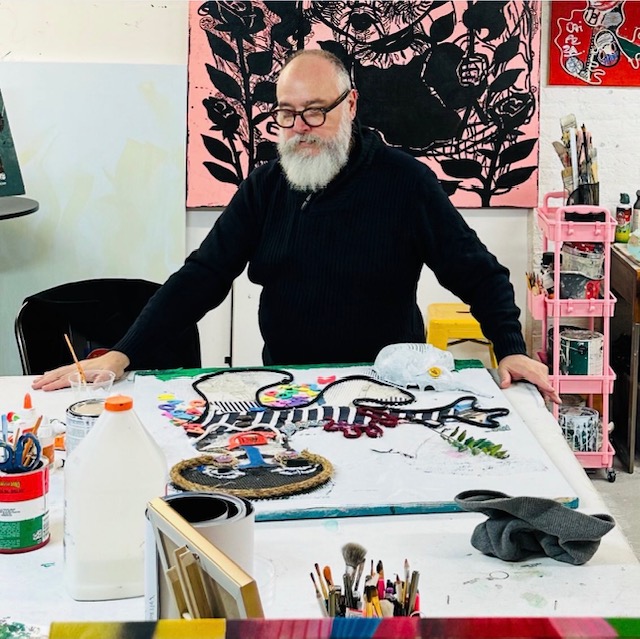
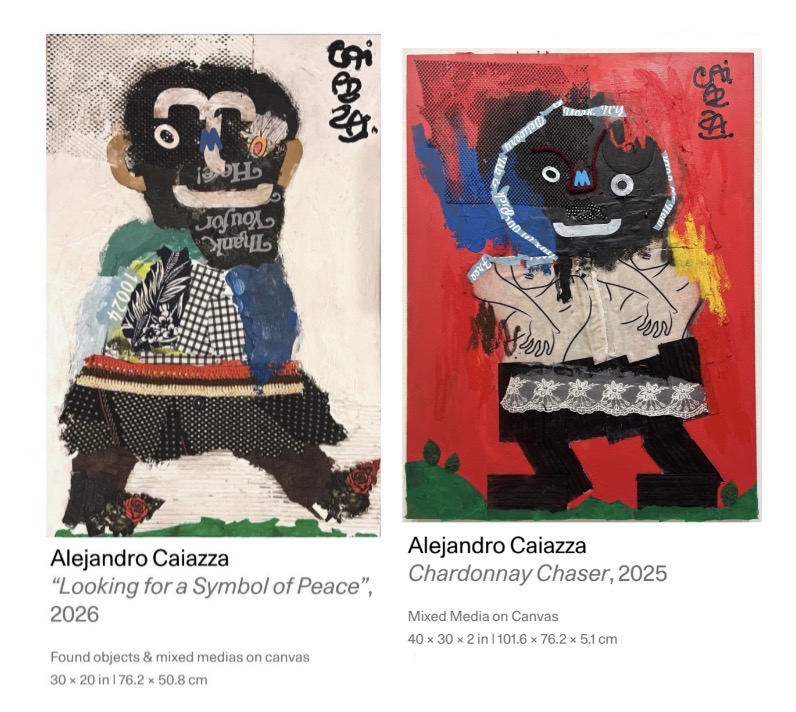
From April 13 to June 14, 2026, the Betsy Frank Gallery presents a collection of recent works by the artist Alejandro Caiazza, under the title “Bridges and Heritage with the Neo-Expressionism of Alejandro Caiazza.” His artistic language is characterized by a mixed amalgamation of artistic movements—outsider art, art brut, bad painting, neo-expressionism, and pop art—as well as a diversity of techniques and materials, a visual narrative that alludes to the experiences of a migrant.
Caiazza was born in Argentina, but spent his childhood, adolescence, and early adulthood in Ciudad Guayana, Venezuela, the country to which his parents emigrated when he was just a child. In this adopted country, he began his art studies and his career as an artist, holding his first solo exhibition in 1999 at the Sidor Art Gallery.
Then, around the year 2000, he decided to continue his artistic career in Europe and settled in Paris. There, he studied briefly at the École Supérieure des Beaux-Arts de Paris, where he was taught by the painter Ouanes Amor, who encouraged him to forge his own path. Perhaps because he did not formalize his academic art studies, either in Venezuela or in Europe, opting instead for independent studies outside established aesthetic norms, Caiazza prefers to define himself as a self-taught artist.
During his time in Paris, He exhibited his work in France, Italy, Japan, and Venezuela. From there, He migrated, once again in his life, to New York City, where He has resided for the past 16 years, developing and exhibiting her work in group and solo shows at various art galleries.
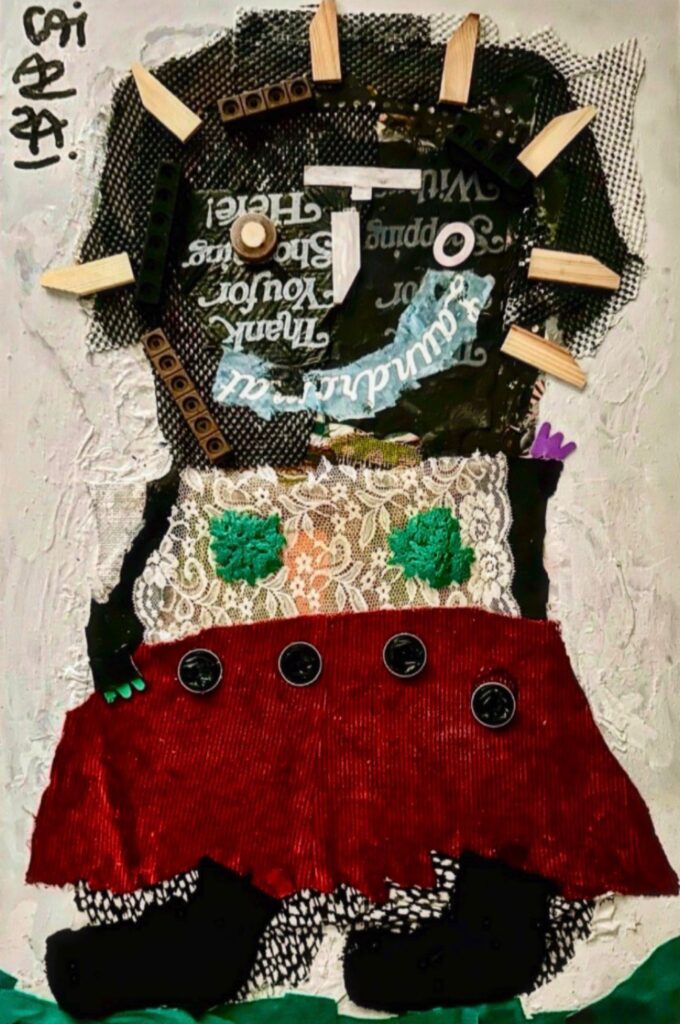
This solo exhibition comprises a body of work created using the technique known as collage, highlighting the texture of the pieces, which are made with a wide variety of pictorial and non-pictorial materials: acrylics, found objects, fabrics, strings, mesh, pieces of wood, leaves, and organic forms alluding to nature. His compositions are distinguished by the use of a palette of bold, contrasting colors; gestural brushstrokes, broad stains and drips, as well as the use of thick, irregular lines and contours.
The human figure is a central motif, approached in an almost childlike manner, framed within the aesthetic category of the grotesque; imbued with humor and irony. Through his proposals, Caiazza addresses social and political issues such as migration, for example, a consequence of the search for a better life far from one’s country of origin—a displacement in which migrants experience, according to Caiazza, love, madness, and death. For him, his work is, in a way, about those who seek a home outside their homeland. In this vein, Caiazza created a work entitled “Daughter of Exile,” which he conceived as the daughter of the Statue of Liberty, “The Mother of Exile,” who opens her arms to welcome every migrant who arrives in the United States.
Hence, the curatorial text of the Betsy Frank Gallery establishes an intermedial bridge by placing Caiazza’s work in dialogue with the poem “The New Colossus,” written in 1883 by the American poet Emma Lazarus, inscribed on a bronze plaque located on the pedestal upon which the Statue of Liberty rests, whose verses read: “Mother of Exiles. From the beacon of your hand / shines welcome to all the world (…).”
An important detail of this curatorial text, the exhibition’s guiding thread, is its use of the metaphor of the “Mother of Exiles” to elevate Caiazza’s work from a purely aesthetic plane to a socio-political one. By linking it to the history of New York as a port of refuge—as the great home of migrants—the exhibition proposes a mixed repertoire: a hybrid heritage defined by multiethnic and multicultural fusion.
https://www.artsy.net/show/betsy-frank-gallery-bridges-and-heritage-with-neo-expressionist-by-alejandro-caiazza/info