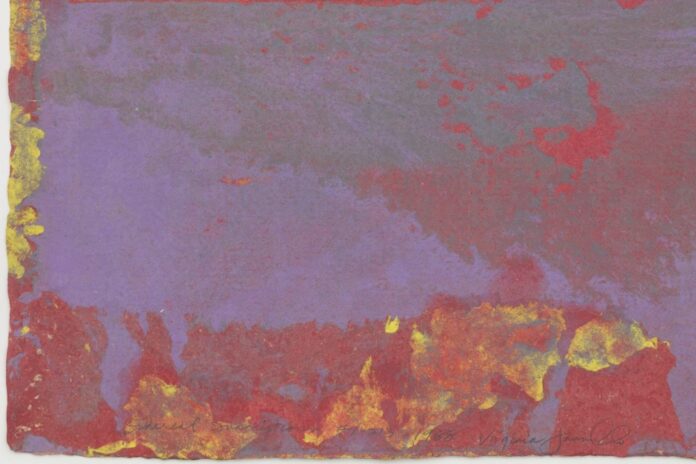
Virginia Jaramillo, Sidereal Inscriptions #1-213, 1988. Linen fiber with hand ground earth pigments on paper. Image courtesy of the artist and Hales Gallery.
At a moment when the United States marks 250 years since the signing of the Declaration of Independence, Abstraction as Legacy turns to painting as a way of reconsidering how American history has also been shaped through visual experimentation.
Presented by the Museum of Art and Design (MOAD) at Miami Dade College, the exhibition brings together several generations of artists whose work demonstrates that abstraction is not a single movement or aesthetic language, but a continually evolving field of cultural, formal, and personal inquiry.
While figurative painting has long played a central role in documenting historical figures and events, abstraction offers another way of recording experience. Through color, geometry, gesture, material, rhythm, and spatial tension, artists have addressed subjects ranging from the body and landscape to architecture, memory, emotion, and identity.
The exhibition traces some of the many directions abstraction has taken in the United States since the mid-twentieth century, a period when American art increasingly became central to international debates surrounding modernism and experimentation. Rather than presenting a singular history, Abstraction as Legacy emphasizes the plurality of those developments.
The exhibition also expands the conventional geography of American abstraction. Alongside artistic experimentation emerging from centers such as New York and Los Angeles, it acknowledges ideas and visual languages that traveled through migration, exile, and cultural exchange, including practices connected to Cuba, Latin America, Indigenous experience, and diasporic histories.
Featured artists include Young-Il Ahn, Sam Gilliam, Carmen Herrera, Hans Hofmann, Virginia Jaramillo, Lloyd Kiva New, Willem de Kooning, George Morrison, Noemí Ruiz, Zilia Sánchez, and Vaughn Spann.
Seen together, their works reveal abstraction as both inheritance and reinvention. Hard-edged geometry exists beside expressive gesture; disciplined structures coexist with intuitive marks; color can function as atmosphere, architecture, psychological space, or cultural memory.
The exhibition’s title therefore carries a dual meaning. “Legacy” refers not only to the history of abstraction already established in the United States, but also to the possibility that artistic languages are continuously transmitted, questioned, transformed, and redefined by subsequent generations.
Within the context of the nation’s 250th anniversary, Abstraction as Legacy offers an alternative way to think about American history. Rather than focusing solely on political events or recognizable historical imagery, the exhibition considers artistic innovation itself as part of the country’s cultural record.
Abstraction becomes, in this sense, a form of historical evidence: not a literal document of events, but a record of changing perceptions, identities, migrations, materials, and ways of seeing.
Abstraction as Legacy Museum of Art and Design (MOAD) at Miami Dade College Freedom Tower 600 Biscayne Blvd, Miami, Florida September 30 | 10:00 a.m.–6:00 p.m.
Image: Virginia Jaramillo, Sidereal Inscriptions #1-213, 1988. Linen fiber with hand-ground earth pigments on paper. Courtesy of the artist and Hales Gallery.
A Reflective Exhibition Exploring Personal Histories and Creative Journeys
Members’ exhibition opens October 2 alongside solo shows by
Marco Saint-Juste and Kaila Stutzmann
FORT LAUDERDALE, Fla. (September 28, 2026) – ArtServe will present “In Memory Of,” its upcoming members’ exhibition, from October 2 through December 4, 2026. The exhibition will open with a free public reception on Friday, October 2 at 6 p.m.
Closing out the season, “In Memory Of” invites ArtServe members to share a small piece of their past through art. Inspired by the emotions, memories and experiences that shape personal histories, the exhibition offers an open-ended exploration of self-expression, nostalgia, time, grief, joy and the moments that remain with us.
From meaningful milestones and cherished memories to difficult experiences, fleeting moments or even something as simple as a memorable meal, the works reflect the many ways people connect with their past. Together, the exhibition offers visitors an opportunity to consider how memory influences identity, creativity and the stories we tell.
The exhibition is supported by BrightStar Credit Union, the Broward County Cultural Division, and The Elizabeth Cotter Memorial Fund and the Hudson Fund through the Community Foundation of Broward.
“Art has a remarkable ability to preserve moments, express emotions and help us understand our own histories,” said Jason Hughes, president and CEO of ArtServe. “This exhibition gives our members the opportunity to reflect on the experiences that have shaped them as artists and to share those stories with the community through their creative work.”
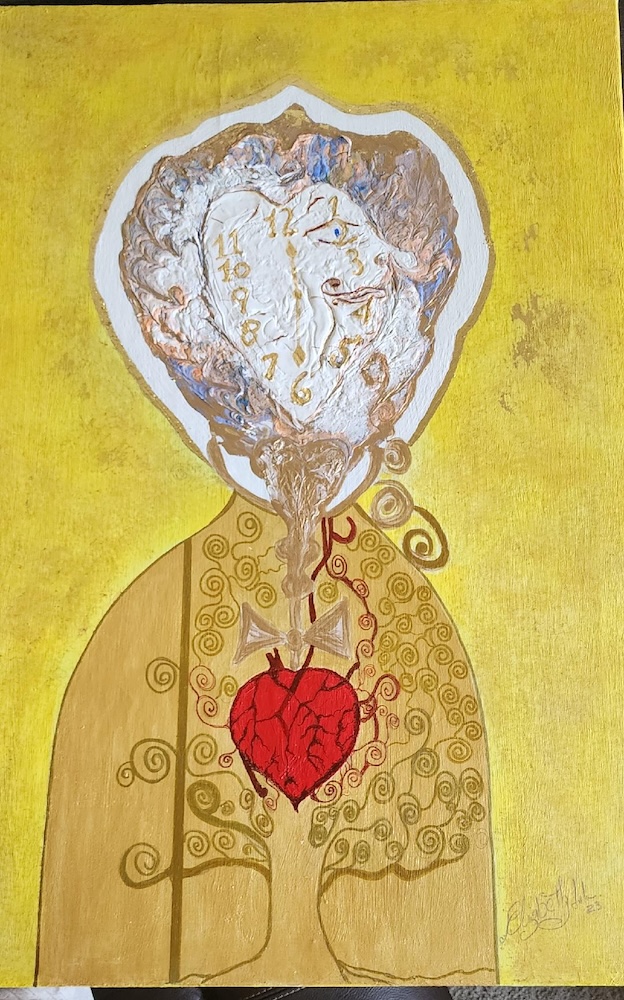
“Golden Time” by Elizabeth Lula
In conjunction with the members’ exhibition, ArtServe will also present two solo exhibitions in its side galleries: “Echoes of Her” by Kaila Stutzmann, which received a grant from the Broward County Cultural Division, and “Spark” by Marco Saint-Juste.
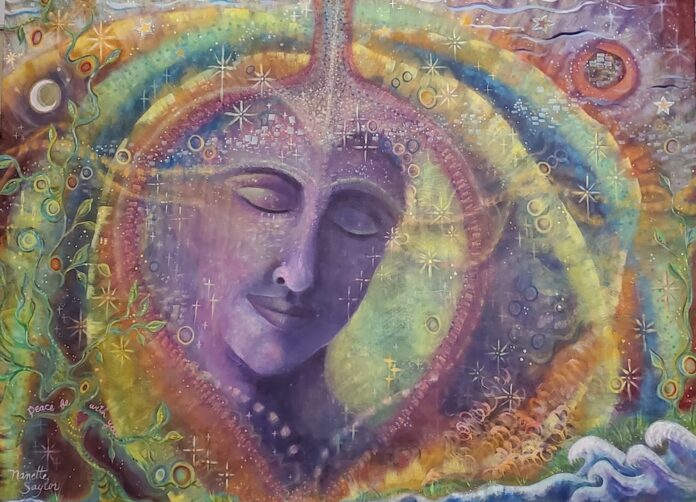
Among the works submitted for “In Memory Of” are “Golden Time” by Elizabeth Lula and “Peace by With You” by Nanette Saylor, offering individual perspectives on the exhibition’s themes of memory, experience and personal history.
Other member artists featured in the exhibition include Alviena, Angel Oddo, Cary Daly, Claudia Castillo, Debra Pierce, Diana Kullander, DJ Laoshi, Genhe Ding, Igal Hurvitz, Jeffrey Galin, Joe Korte, Joy Strempack, Julia Outland, Geraldine Bello, Kaila Stutzmann, Kamila Marrero, Kathy Kafka, Liora Davis, Marco Saint-Juste, Marilyn Johansen, Max Lazega, Michael Mills, Nanette Saylor, Pete Brown, Shahina Siddiqi, Sheila Alexander, Sharon Swift, Tina Wright and Tony Chimento.
Fort Lauderdale-based ArtServe is Broward County’s premier arts and culture incubator, advancing artistic development, education and prosperity through the visual and performing arts. For more than three decades, ArtServe has helped artists sell their work, build businesses and connect with the community through exhibitions, education and events. Each year, ArtServe supports more than 2,000 artists. ArtServe’s “Support Your Local Artist” campaign brings residents, businesses and organizations together to rally behind local artists and strengthen Broward County’s creative economy. Visit SupportLocalArt.org to learn more. In 2025, ArtServe was named Non-Profit Organization of the Year: The Arts by 211 Broward. ArtServe is supported in part by the Broward County Board of County Commissioners as recommended by the Broward Cultural Council and Community Foundation of Broward. For more information, visit ArtServe.org.
Quince artistas, seis preguntas, un retrato colectivo del ecosistema creativo de Miami.
Una investigación interna basada en una encuesta cualitativa a quince artistas de la comunidad de Art Miami Magazine. Identidad, diferenciación, brecha digital, coleccionismo, inteligencia artificial y proyección de ventas: lo que la comunidad piensa cuando nadie está mirando.
Tabla de contenidos
La voz de la comunidad: por qué escuchamos a nuestros propios artistas
El mensaje que resiste: la intención como núcleo de la obra
En un mercado saturado, la diferencia se construye desde la intención
La brecha Google: cuando la carrera real supera a la presencia digital
Boca a boca y redes sociales: el híbrido silencioso
Más curiosidad que temor, pero con reservas sobre la autenticidad
¿Garantizaría el SEO un aumento de ventas? Una pregunta incómoda
Cinco tesis sobre la comunidad artística de Miami
Tesis 1. La identidad se construye desde la intención, no desde la técnica
Tesis 2. Existe una brecha digital seria entre carrera y Google
Tesis 3. El boca a boca sigue siendo insustituible
Tesis 4. La IA genera curiosidad condicionada por la autenticidad
Tesis 5. El SEO se percibe como acelerador, no como sustituto de valor
Recomendaciones para la comunidad, las galerías y la revista
Para los artistas
Para galerías y curadores
Para Art Miami Magazine y el ecosistema editorial
Lo que la comunidad nos enseñó
Para WordPress, todavía sería mejor convertir cada título en un enlace interno que lleve directamente a esa sección del artículo. Eso mejora la navegación y también ayuda a estructurar el contenido para Google.
Nota metodológica
Este reportaje se construye a partir de una encuesta cualitativa aplicada a 14 artistas vinculados a la comunidad de Art Miami Magazine. El instrumento recogió respuestas escritas a seis preguntas abiertas sobre identidad artística, diferenciación en el mercado, presencia digital, conexión con coleccionistas, actitud frente a la Inteligencia Artificial y proyección futura de ventas. Las respuestas se procesaron combinando análisis de frecuencia de palabras clave, codificación manual de posturas y lectura cualitativa de los testimonios. La muestra es intencional y no estadísticamente representativa del ecosistema artístico de Miami en su conjunto; sus hallazgos deben leerse como un retrato de la comunidad directamente cercana a la revista, no como una radiografía exhaustiva del sector.
Frecuencia de palabras clave + codificación cualitativa
Limitaciones
Muestra intencional; no representa todo el ecosistema de Miami
CAPÍTULO I · APERTURA
Durante años, Art Miami Magazine ha documentado el pulso del ecosistema artístico del sur de Florida desde la orilla del observador. Hemos cubierto ferias, abierto estudios, reseñado exposiciones y conversado con cientos de creadores. Pero en algún momento de este recorrido, una pregunta empezó a incomodarnos: ¿cuánto sabemos realmente sobre lo que piensan los artistas que conforman nuestra propia comunidad? Las entrevistas individuales capturan la voz, pero rara vez el patrón. Decidimos, por una vez, hacer lo contrario: preguntar lo mismo a quince artistas a la vez y dejar que la suma hablara.
El instrumento fue deliberadamente simple: seis preguntas abiertas sobre identidad artística, diferenciación en un mercado saturado, presencia en Google, formas de conectar con coleccionistas, actitud frente a la Inteligencia Artificial y expectativa futura de ventas. No buscábamos respuestas cuantitativas limpias; queríamos testimonios, matices, contradicciones. La encuesta se envió a la base de contactos de la revista y recibió quince respuestas completas, suficientes para identificar tendencias, no para generalizar estadísticamente sobre el sector. La muestra, sin ser representativa del ecosistema completo de Miami, sí captura un estrato particularmente interesante: artistas con trayectoria, presencia en redes y vínculos con la comunidad editorial.
Lo que encontramos supera la hipótesis inicial. Esperábamos encontrar ansiedad digital, dependencia de las redes sociales y temor frente a la Inteligencia Artificial. Encontramos algo más complejo: una comunidad que defiende la intención sobre la técnica, que desconfía tanto del algoritmo como del ego, que mantiene el boca a boca como motor principal de coleccionismo y que, frente a la IA, responde con una curiosidad condicionada por la defensa de la autenticidad. Hay también una brecha silenciosa entre la carrera real y la presencia en Google, una grieta que muy pocos han logrado cerrar y que define con nitidez una nueva forma de desigualdad en el mercado del arte.
Este reportaje recorre seis hallazgos, los articula en una síntesis editorial y los cierra con recomendaciones accionables para artistas, galerías y para la propia revista. Las citas son literales; los nombres, completos, con el permiso de cada artista. No es un informe clínico: es la voz de una comunidad devuelta a sí misma, en formato de revista.
CAPÍTULO II · IDENTIDAD
El mensaje que resiste: la intención como núcleo de la obra
La primera pregunta pedía a cada artista definir el mensaje central que busca dejar en su obra y cómo percibe que el público actual lo recibe. Lo que se esperaría, en un ecosistema mediado por Instagram y Art Basel, sería una fragmentación de respuestas: algunos hablando de estilo, otros de técnica, otros de mercado. Lo que encontramos es algo distinto. La identidad artística se construye, casi unánimemente, en términos de intención transformadora, no de forma. La palabra “intención” aparece de manera recurrente; “energía”, “transformación”, “humanidad”, “autenticidad” y “memoria” operan como un léxico común que cruza disciplinas y generaciones.
Silvia Elena Parra Rangel, artista cuyo trabajo une pintura y práctica energética, lo formula con claridad casi manifiesta: el arte no es representación sino activador. Su respuesta recoge una idea que atraviesa muchos de los testimonios: el valor de la obra no reside en lo que muestra, sino en lo que opera sobre quien la observa.
“El mensaje central de mi obra siempre ha sido que el arte puede ir mucho más allá de lo que vemos. Mi intención es crear obras que transmitan paz y alegría, pero que además tengan un componente energético dirigido a sanar, equilibrar y generar bienestar en quien las observa. No solo ser vista, sino ser sentida.”— Silvia Elena Parra Rangel
Teresa Cabello, escultora que trabaja fragmentos de la figura humana modelada en arcilla, lleva la intención al territorio de la crítica social y la memoria. Su respuesta añade un matiz importante: la percepción del público no siempre acompaña la intención. Hay conciencia de una brecha entre lo que el artista quiere decir y lo que el público cree escuchar, y esa brecha se atribuye, en parte, al ritmo tecnológico del momento.
“Busco resaltar la humanidad. La memoria, la experiencia y la crítica a algunos aspectos sociales y políticos que son inherentes a la condición humana a través de la escultura de fragmentos de la figura humana modelada en arcilla. Creo que el público actual lo percibe como algo pasado de moda o que se ha quedado en el tiempo y que no se adapta a la realidad tecnológica actual.”— Teresa Cabello
Oscar Carvallo, que trabaja con la técnica de la encáustica inspirada en los retratos de Fayoum, plantea una variante del mismo leitmotiv: el arte no ofrece respuestas, sino que despierta preguntas. La obra como invitación a reconectar con el mundo interior. Marianela Pérez lo formula en términos de espacio contemplativo: “más que transmitir un mensaje único, mi intención es crear un espacio donde el espectador pueda detenerse, observar y reconstruir su propia experiencia”. Pablo Azar, artista plástico y actor, habla de “crear conexiones emocionales a través de historias e imágenes”. Rosa Landaez, con una directez que recorre toda su entrevista, lo sintetiza: “crear obras que trasciendan el momento y dejen una huella en quienes las contemplan”.
Esta unánime defensa de la intención sobre la forma tiene una implicación crítica para el mercado. Si la identidad artística se define por la intención, entonces la diferenciación entre artistas no se construye en el estilo sino en la voz. Y una voz, por definición, no se puede copiar. La autenticidad se convierte, así, en el último refugio de la diferencia. Lo veremos retornar en cada uno de los hallazgos siguientes, especialmente cuando hablemos de Inteligencia Artificial.
CAPÍTULO III · DIFERENCIACIÓN
En un mercado saturado, la diferencia se construye desde la intención
La segunda pregunta apuntaba directo al nervio del mercado: en un ecosistema tan saturado como el de Miami, ¿qué te diferencia de otros artistas de tu misma disciplina? La palabra “saturado” fue parte de la pregunta, como anzuelo. La respuesta más sorprendente vino de Rosa Landaez, que rechazó la premisa con una franqueza que recorre todo su testimonio. Para ella, la competencia es una categoría equivocada: hay campo para cada artista que expresa sus sentimientos. La diferencia no es estratégica, es existencial.
“No creo que esté saturado. Hay un campo para cada artista que expresa sus sentimientos en cada obra. Nada me diferencia de otros artistas; yo creo en mi trabajo y expreso mis sentimientos.”— Rosa Landaez
La mayoría de los entrevistados, sin embargo, sí opera bajo el supuesto de un mercado saturado, pero construye la diferencia desde lugares distintos a la técnica. Silvia Elena Parra Rangel apela a la intención energética: “yo no creo solamente para llenar o embellecer un espacio; creo para transformar la energía de ese espacio y generar una experiencia en quien lo habita”. Pablo Azar apela a la herencia de la actuación: “mi trabajo está profundamente influenciado por mi trayectoria como actor y narrador. Cada obra busca contar una historia y generar una conexión emocional, no solo ser una pieza visual”. Oscar Carvallo apela a la técnica de la encáustica, pero inmediatamente la subordina al universo simbólico. Marianela Pérez apela a la fragmentación como método de reconstrucción.
Teresa Cabello, con su escultura de arcilla, ofrece una formulación particularmente precisa: la diferencia reside en el contraste. No en qué se representa, sino en cómo dos fuerzas opuestas conviven en la misma pieza.
“Creo que puede ser el mensaje que quiero trasmitir y la manera de hacerlo, el uso de la escultura y el contraste de fortaleza y fragilidad que tienen mis piezas.”— Teresa Cabello
Alejandro Caiazza, pintor neoyorquino especializado en Art Brut y Neoexpresionismo, construye la diferencia desde la herencia personal y el desplazamiento geográfico. “Lo que me diferencia es mi herencia personal, mis extraordinarias vivencias en diferentes países y culturas, el sentido de adaptación y de desarrollo plástico a través de ello.” La biografía como activo. La vida como obra.
Lo interesante de este patrón es que ningún artista construye su diferencia en términos de precio, prestigio institucional o red de galerías. La diferencia se construye hacia adentro: intención, biografía, técnica subordinada al símbolo, contraste interno. Esto sugiere que la saturación del mercado, real o percibida, no se combate desde la estrategia comercial sino desde la profundización de la voz propia. Una conclusión que suena romántica pero que los datos sostienen: en una comunidad donde la identidad se define por la intención, la diferenciación también se define por la intención. La consecuencia comercial es directa: lo que se vende no es el objeto, es la voz. Y la voz, cuando es auténtica, no tiene sustituto.
CAPÍTULO IV · VISIBILIDAD DIGITAL
La brecha Google: cuando la carrera real supera a la presencia digital
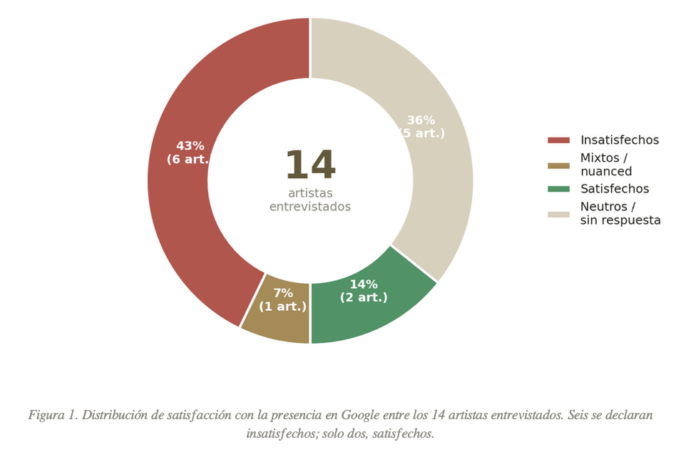
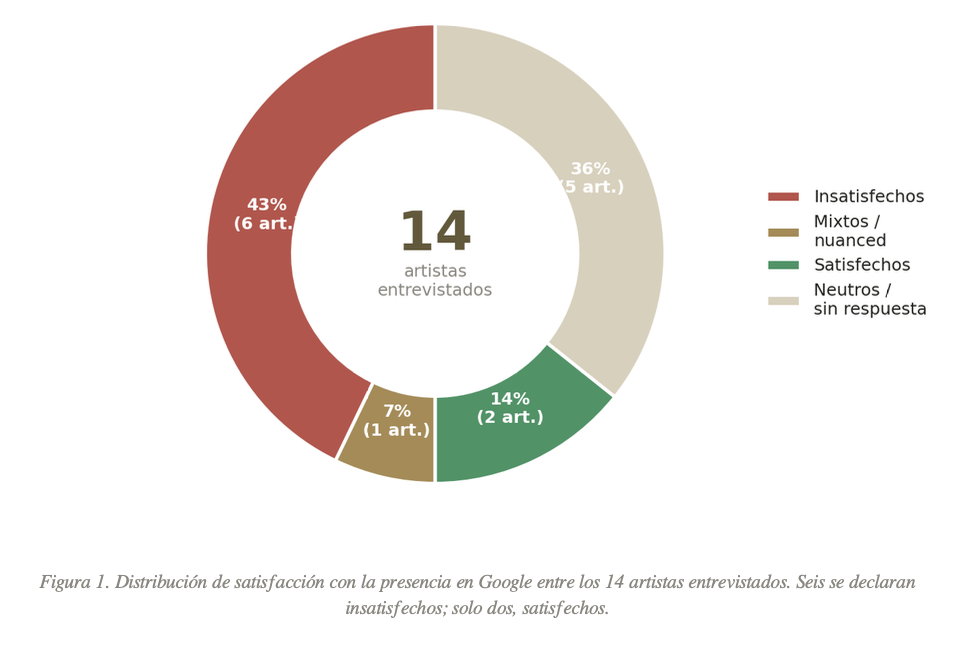
Si hubiera que escoger un solo hallazgo que justifique este reportaje, sería este: existe una brecha silenciosa entre la carrera real de los artistas y lo que Google muestra de ella. La tercera pregunta preguntaba directamente: cuando un coleccionista o una galería busca tu nombre en Google, ¿sientes que lo que encuentran hoy representa fielmente el nivel de tu carrera actual? Las respuestas, codificadas, arrojan el siguiente cuadro.
Figura 1. Distribución de satisfacción con la presencia en Google entre los 14 artistas entrevistados. Seis se declaran insatisfechos; solo dos, satisfechos.
El dato es contundente. Seis de cada quince artistas, el 43% de la muestra, se declaran abiertamente insatisfechos con lo que Google muestra de su carrera. Dos más ofrecen respuestas mixtas, reconociendo una diferencia entre carrera y huella digital. Solo dos se declaran satisfechos. El resto da respuestas neutras o evasivas. La brecha no es marginal: es estructural.
Silvia Elena Parra Rangel formula el problema con una precisión que podría firmar cualquier consultor de marca personal: la carrera evolucionó más rápido que la presencia digital, y ahora ambas cosas no hablan el mismo idioma. Es una imagen poderosa: la artista y su avatar digital como dos personas distintas que necesitan reconciliarse.
“Sinceramente, no del todo. He tenido una trayectoria muy rica, con proyectos, exposiciones y reconocimientos en distintos países, pero siento que una parte importante de ese recorrido todavía no está reflejado en el mundo digital con la fuerza que debería. Creo que hoy mi obra y mi carrera han evolucionado mucho más rápido que mi presencia en Google. Y justamente estoy trabajando para que ambas cosas comiencen a hablar el mismo idioma.”— Silvia Elena Parra Rangel
Oscar Carvallo habla explícitamente de “diferencia” entre trayectoria y entorno digital. Pablo Azar añade un matiz: lo que aparece en Google refleja una parte de su carrera (la actoral), pero no la faceta como artista plástico que ha crecido en los últimos años. Marianela Pérez lo formula con elegancia: “los artistas dedicamos más tiempo a crear que a documentar o actualizar nuestra presencia digital”. Hay conciencia generalizada de que el estudio y la pantalla exigen dos disciplinas distintas, y que muy pocos dominan ambas.
El caso más extremo es el de Joel Selmeier, artista basado en Cincinnati cuyo trabajo con materiales inusuales lo coloca fuera de cualquier categoría buscable. Su respuesta es breve y devastadora: “nadie me encuentra en Google, a menos que estén buscando una línea de trabajo que ya no hago”. La presencia digital no solo es insuficiente; es activamente engañosa, mostrando al artista que fue, no al que es.
Rosa Landaez y Teresa Cabello plantean una postura distinta: la presencia en Google, sencillamente, no es lo importante. Para Rosa, “el hecho de que mi nombre esté en Google no es lo más importante para mí; mi conexión está con las personas que se identifican con mi trabajo”. Teresa lo reformula en términos críticos: “Google se limita solo al aspecto social y más superficial del artista y la obra”. Hay aquí una tensión que recorre todo el reportaje: la presencia digital como necesidad práctica versus la presencia digital como concesión a la superficialidad. La mayoría de los entrevistados oscila entre ambas posturas sin resolver el dilema.
CAPÍTULO V · COLECCIONISTAS
Boca a boca y redes sociales: el híbrido silencioso
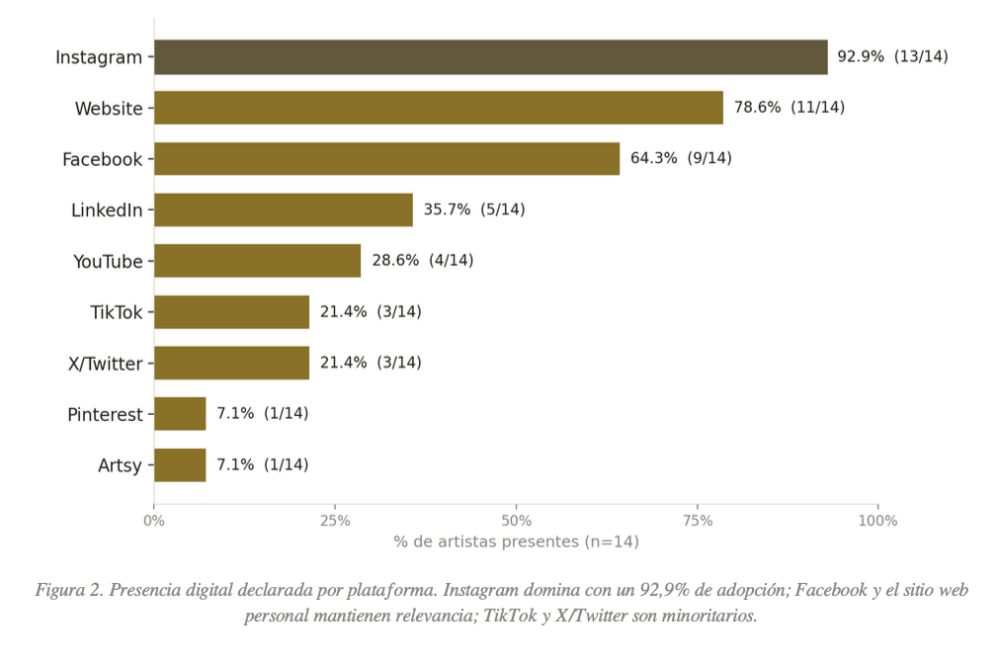
La cuarta pregunta interrogaba el cambio en las formas de conseguir coleccionistas en los últimos dos años. La expectativa razonable, en un ecosistema cada vez más digital, sería un desplazamiento hacia las redes sociales. Los datos muestran algo más matizado: las redes sociales funcionan como amplificador, pero el boca a boca sigue siendo el motor principal de coleccionismo. No hay desplazamiento; hay hibridación.
Figura 2. Presencia digital declarada por plataforma. Instagram domina con un 92,9% de adopción; Facebook y el sitio web personal mantienen relevancia; TikTok y X/Twitter son minoritarios.
El gráfico de plataformas revela una jerarquía clara. Instagram es ubicuo: el 92,9% de los artistas tiene presencia activa. El sitio web personal le sigue de cerca con un 78,6%, lo que indica que la profesionalidad digital sigue siendo un valor compartido. Facebook, aunque en declive general, mantiene un 64,3% de adopción, sobre todo entre artistas con trayectoria más larga. LinkedIn (35,7%) y YouTube (28,6%) ocupan posiciones secundarias. TikTok (21,4%) sigue siendo marginal: la comunidad artística de Miami no ha migrado masivamente al formato de video corto. Plataformas especializadas como Artsy (7,1%) o Behance (0%) son prácticamente inexistentes.
Pero la presencia en plataformas no equivale a conversión en coleccionistas. Las respuestas a la cuarta pregunta revelan un patrón más fino: las redes sociales muestran, el boca a boca convence. Silvia Elena Parra Rangel lo formula con una claridad que sintetiza el sentir de la mayoría.
“En estos últimos dos años ha sido una combinación de las dos, pero definitivamente el boca a boca ha tenido mucho peso. Muchos de mis nuevos contactos y coleccionistas llegan porque alguien conoce mi obra, ha vivido la experiencia y me recomienda. Las redes sociales me ayudan muchísimo a mostrar lo que hago y a mantenerme presente, pero creo que en mi caso la recomendación personal sigue siendo muy poderosa.”— Silvia Elena Parra Rangel
Pablo Azar añade un matiz importante: las redes sociales han permitido llegar a personas que nunca habría conocido, pero las mejores oportunidades surgen cuando alguien vive la experiencia del trabajo y lo recomienda. Oscar Carvallo, con más años de trayectoria, da testimonio de un equilibrio entre ambos mundos: “muchas de las relaciones más valiosas siguen naciendo de recomendaciones personales, de coleccionistas que presentan mi trabajo a otros coleccionistas, de galeristas y de contactos construidos a lo largo de los años”. Marianela Pérez ve las redes como “una ventana que permite que personas de distintos lugares descubran mi trabajo y luego, muchas veces, ese interés se transforma en un encuentro personal, una visita al estudio o una conversación más profunda”.
Alejandro Caiazza ofrece el testimonio más entusiasta sobre las redes: “sin duda tengo que reconocer que las redes sociales en los últimos 5 años o más me han aportado un público y una lista de coleccionistas que no hubiese imaginado anteriormente”. Pero inmediatamente matiza: ese efecto se debe también a la suma con exposiciones reales en galerías. La fórmula ganadora, una vez más, es híbrida: redes como amplificador de un trabajo que se valida en el espacio físico. En el extremo opuesto, Rosa Landaez rechaza de plano las redes sociales: “no me preocupan las redes sociales; es un mundo que quizás es vacío para mí; me gusta más conectar con las personas, ver sus inquietudes y observar qué es lo que realmente aprecian de mi trabajo”. Y Joel Selmeier, desde Cincinnati, confiesa depender casi por completo del open house mensual en su edificio de estudios. Dos modelos opuestos que coexisten en la misma encuesta.
La conclusión provisional es que el boca a boca no ha sido desplazado por las redes: ha sido amplificado por ellas. Las redes operan como capa de descubrimiento, pero la conversión final sigue ocurriendo en la recomendación personal, la visita al estudio, la conversación. Esto tiene implicaciones estratégicas serias para cualquier artista que se pregunte dónde invertir su tiempo: las redes son necesarias, pero no suficientes. Sin un sustrato de experiencia presencial y recomendación, su poder de conversión se diluye.
CAPÍTULO VI · INTELIGENCIA ARTIFICIAL
Más curiosidad que temor, pero con reservas sobre la autenticidad
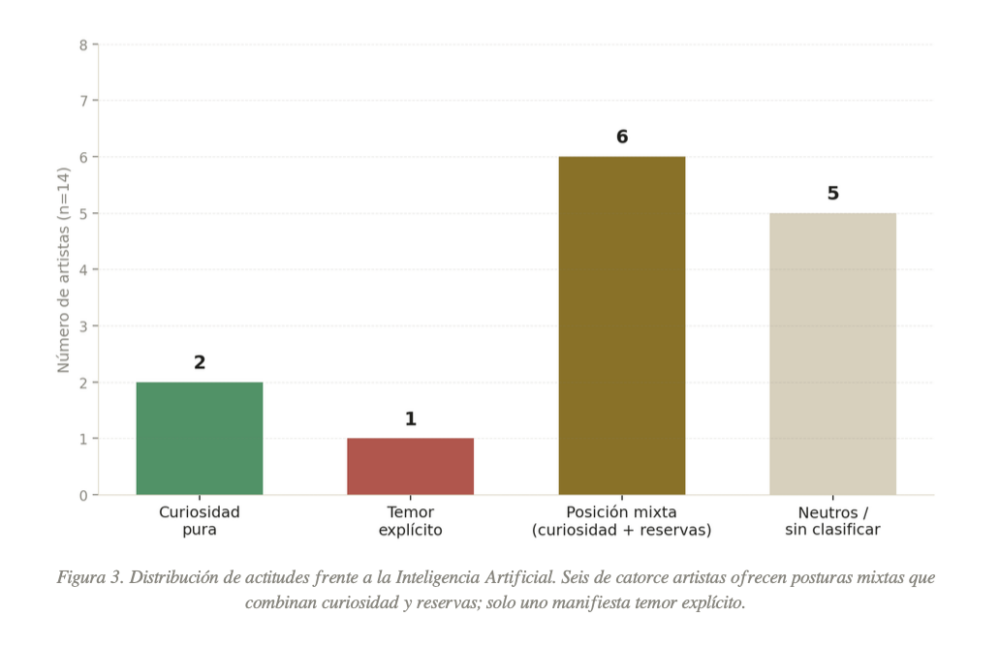
La quinta pregunta indagaba directamente sobre la actitud frente a la Inteligencia Artificial: ¿curiosidad por las nuevas oportunidades de visibilidad, o temor por cómo pueda afectar la autenticidad del arte? El resultado desmiente dos narrativas simultáneas. No es cierto que los artistas vivan la IA con terror; tampoco es cierto que la abracen sin reservas. Lo que existe es una postura matizada, curiosidad condicionada por la defensa de la autenticidad como valor último del arte.
Figura 3. Distribución de actitudes frente a la Inteligencia Artificial. Seis de quince artistas ofrecen posturas mixtas que combinan curiosidad y reservas; solo uno manifiesta temor explícito.
El gráfico es claro: seis de quince artistas ofrecen respuestas mixtas que combinan curiosidad y reservas. Solo uno, Alejandro Caiazza, manifiesta temor explícito, aunque matizado: “creo que la Inteligencia artificial puede afectar en forma negativa a la autenticidad en las artes. No reniego de una forma de ayuda, pero personalmente pienso de que es ambiguo y no lo considero una herramienta personal”. Dos artistas (Teresa Cabello y Joel Selmeier) se declaran abiertamente curiosos. Cinco ofrecen respuestas más neutras o no clasificables. La palabra “autenticidad” aparece trece veces en las quince respuestas: es el pivote sobre el que se articula toda la conversación sobre IA.
“A mí la Inteligencia Artificial me genera mucha más curiosidad que temor. Creo que es una herramienta extraordinaria y que, bien utilizada, puede abrirnos posibilidades que antes ni imaginábamos, también para dar mayor visibilidad a nuestro trabajo. No siento que amenace la autenticidad del arte, porque para mí el arte verdadero nace de algo profundamente humano: de lo que vivimos, sentimos y somos. La tecnología puede ayudarnos a expandirlo, pero esa esencia no la puede sustituir.”— Silvia Elena Parra Rangel
Teresa Cabello ofrece una formulación particularmente sofisticada: el arte como espejo de una sociedad en un tiempo determinado. Si la sociedad es la era de la IA, el arte será su reflejo, ya sea como crítica o como modelo. No hay aquí ni entusiasmo ni rechazo: hay una aceptación histórica del papel del arte como testigo de su tiempo.
“Me genera más curiosidad que temor. El arte es siempre el espejo de una sociedad en un tiempo determinado. Es la forma más honesta de revelar o explicar la condición humana. El arte indiscutiblemente será un reflejo de la inteligencia artificial, ya sea como una crítica o como un modelo.”— Teresa Cabello
Marianela Pérez ofrece el testimonio más rico en matices. Reconoce usar IA como herramienta para visualizar ideas, desarrollar maquetas y explorar posibilidades de montaje, pero subraya que “nunca sustituye el pensamiento, la intuición ni la experiencia que hay detrás de una obra”. Su distinción es clave: la IA puede generar imágenes, pero no puede reemplazar la historia personal, la sensibilidad ni el recorrido que dan significado a una obra. Es, en suma, aliado para expandir posibilidades, no amenaza para el arte auténtico. Oscar Carvallo, en una línea similar, reconoce el potencial de la IA para ampliar visibilidad y llegar a nuevos públicos, pero insiste en que una pintura no es solo una imagen: es el resultado de una historia, de emociones, de decisiones, de dudas, de errores y de una búsqueda personal que se desarrolla durante años. “Esa dimensión humana es irrepetible y es, precisamente, lo que da valor al arte”.
Rosa Landaez, una vez más, despacha el tema con franqueza: “no me preocupa la inteligencia artificial para nada; pero esa plataforma no nos quitará lo auténtico que es un artista cuando tiene talento”. Pablo Azar coincide: la tecnología puede ayudar a crear, pero la autenticidad sigue siendo profundamente humana. Hay aquí un consenso transversal que vale la pena subrayar: la IA se acepta como herramienta, se rechaza como sustituto. La línea roja es la autenticidad. Cualquier uso de IA que invada el territorio de la voz personal se considera una traición al oficio. Esta es una comunidad que no teme a la máquina; teme a la confusión entre lo que la máquina produce y lo que el artista firma.
CAPÍTULO VII · PROYECCIÓN FUTURA
¿Garantizaría el SEO un aumento de ventas? Una pregunta incómoda
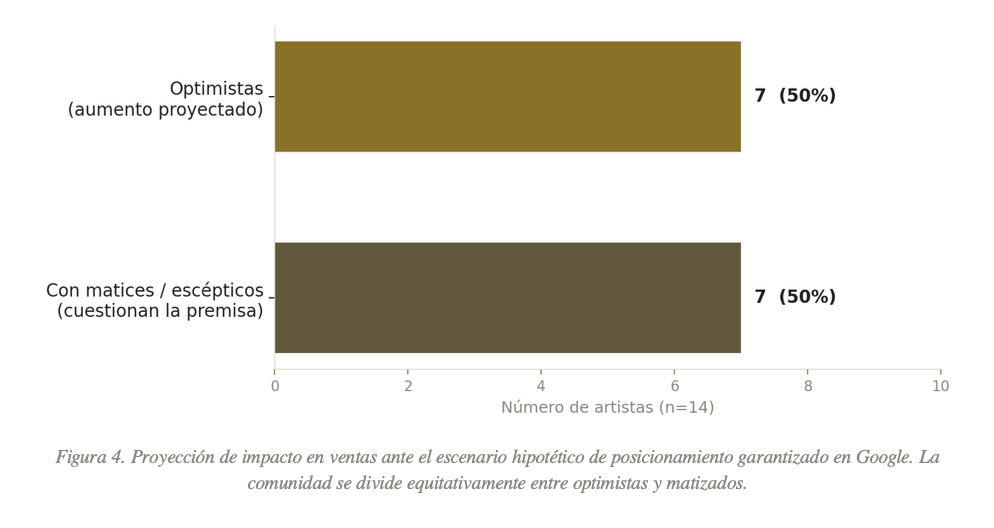
La sexta pregunta era un experimento mental. Si se garantizara que cada vez que alguien busque tu categoría de arte en Miami tu nombre aparezca en los primeros resultados, ¿cómo cambiaría tu ritmo de ventas en los próximos doce meses? La pregunta era deliberadamente provocadora: pedía a los artistas imaginar un escenario utópico de visibilidad y proyectar su impacto comercial. Las respuestas se dividen casi exactamente por la mitad.
Figura 4. Proyección de impacto en ventas ante el escenario hipotético de posicionamiento garantizado en Google. La comunidad se divide equitativamente entre optimistas y matizados.
Siete de quince artistas, exactamente el 50%, proyectan un aumento significativo de ventas. Los otros siete cuestionan la premisa o introducen matices que diluyen el optimismo. Lo interesante es que incluso quienes se declaran optimistas suelen acompañar la proyección con reservas: la visibilidad abre la puerta, pero no garantiza la venta. Oscar Carvallo lo formula con precisión: “no creo que la visibilidad por sí sola garantice una venta, pero sí multiplica las posibilidades de que una conversación ocurra”.
Silvia Elena Parra Rangel ofrece una de las respuestas más matizadas. Proyecta un aceleramiento significativo de las ventas, pero advierte que la visibilidad no se convierte automáticamente en compra: “seguirían siendo importantes la conexión con la obra, la confianza y la experiencia del comprador”. La visibilidad, en su lectura, genera un flujo más constante de oportunidades; la conversión sigue dependiendo de factores humanos. Marianela Pérez refuerza esta línea: “la visibilidad por sí sola no garantiza ventas. Lo esencial es que quien llegue a mi obra encuentre una identidad sólida, una trayectoria coherente y una propuesta auténtica. La presencia digital abre la puerta, pero es la calidad y la conexión con el espectador lo que convierte el interés en una relación con el coleccionista”.
Teresa Cabello, desde una posición más escéptica, reconoce que la popularidad ayuda y el conocimiento también, y que probablemente el posicionamiento garantizaría un aumento en el ritmo de ventas. Pero cierra con una afirmación que reordena las prioridades: “pero sigo pensando que el verdadero valor de una obra se debe a la presencia en instituciones de arte serias y reconocidas”. Para Teresa, la validación institucional pesa más que el algoritmo. Es una postura que tensiona la lógica del marketing digital con la lógica del campo artístico tradicional, y que muchos artistas comparten sin formularla tan explícitamente.
El caso más provocador es el de Rosa Landaez, que rechaza de plano la pregunta. Su respuesta es breve y afilada: “me da risa el ego de muchos artistas; cuando crees en ti, la única competencia eres tú mismo”. Y la de Joel Selmeier, desde Cincinnati, que detecta inmediatamente el sesgo comercial de la pregunta: “creo que estás a punto de hacerme un pitch para que te pague por poner mi nombre donde alguien en Miami pueda verlo”. Ambas respuestas, desde lugares opuestos, coinciden en una sospecha: la pregunta sobre visibilidad oculta una transacción comercial. Es una lectura cínica, pero instructiva: recuerda que el discurso del SEO no es neutral, y que muchos artistas lo perciben, con razón, como un producto que alguien está tratando de venderles.
CAPÍTULO VIII · SÍNTESIS
Cinco tesis sobre la comunidad artística de Miami
Después de leer quinceentrevistas completas y procesarlas por pregunta, por frecuencia y por patrón transversal, lo que emerge no es una conclusión única sino un campo de tensiones. Estos son los cinco hallazgos consolidados que, en nuestra lectura editorial, definen el retrato de esta comunidad.
Tesis 1. La identidad se construye desde la intención, no desde la técnica
Ninguno de los quince artistas define su mensaje central en términos de estilo, escuela o disciplina. Todos lo definen en términos de intención: transformar, sanar, despertar, recordar, reconectar. La técnica aparece, cuando aparece, como vehículo subordinado al propósito. Esto tiene una consecuencia directa para el mercado: si la identidad es intención, entonces la diferenciación también lo es. La autenticidad no es un atributo añadido a la obra; es la obra misma. Cualquier estrategia que intente diferenciar al artista desde fuera (precio, red, premio) opera en una dimensión secundaria. La diferenciación real es hacia adentro.
Tesis 2. Existe una brecha digital seria entre carrera y Google
El 43% de los entrevistados se declara insatisfecho con lo que Google muestra de su carrera. Solo el 14% se declara satisfecho. Esta brecha no es un problema estético: es un problema comercial. Cada búsqueda en Google que no refleja la carrera real del artista es una oportunidad perdida de coleccionismo, una conversación que no ocurre, una venta que no se inicia. La brecha es particularmente severa en artistas con trayectoria internacional pero presencia digital fragmentada, y en artistas que han cambiado de disciplina o de técnica sin actualizar su huella digital. La buena noticia: la brecha es cerrable. La mala: requiere disciplina y, a menudo, ayuda profesional.
Tesis 3. El boca a boca sigue siendo insustituible
En un ecosistema donde el 92,9% de los artistas tiene Instagram, sería razonable suponer que las redes sociales son el motor principal de coleccionismo. Los datos dicen lo contrario: las redes funcionan como capa de descubrimiento y mantenimiento de presencia, pero la conversión final sigue ocurriendo en la recomendación personal, la visita al estudio, la conversación. Esto sugiere que la inversión en redes debe subordinarse a la inversión en experiencias presenciales. Sin un sustrato físico de validación, las redes amplifican el ruido, no la reputación. La comunidad que mejor entiende esto es la que logra combinar ambas capas: descubrimiento digital, conversión presencial.
Tesis 4. La IA genera curiosidad condicionada por la autenticidad
La narrativa mediática dominante sobre la IA y el arte suele oscilar entre dos extremos: entusiasmo tecnológico y catastrofismo. Los artistas reales, al menos los de esta muestra, no viven en ninguno de los dos. Viven en una zona matizada donde la IA se acepta como herramienta y se rechaza como sustituto. La palabra clave es autenticidad: aparece trece veces en quince respuestas. La línea roja es clara: cualquier uso de IA que invada el territorio de la voz personal se considera traición al oficio. Esto sitúa a la comunidad en una posición particularmente lúcida frente al debate público, y debería informar tanto las políticas editoriales de la revista como las decisiones curatoriales de las galerías.
Tesis 5. El SEO se percibe como acelerador, no como sustituto de valor
Cuando se preguntó a los artistas si un posicionamiento garantizado en Google aumentaría sus ventas, la comunidad se dividió exactamente por la mitad. Incluso los optimistas matizaron: la visibilidad abre puertas, pero no cierra ventas. El escepticismo se concentró en dos argumentos: que el valor real viene de la validación institucional, no de la popularidad (Teresa Cabello), y que la pregunta esconde un producto comercial que alguien está tratando de vender (Joel Selmeier). La comunidad artística de Miami, en suma, no rechaza el SEO; lo relativiza. Lo considera un acelerador útil, pero no un sustituto de la calidad, la trayectoria y la conexión humana. Es una postura madura que merece ser escuchada por cualquier plataforma que ofrezca servicios de visibilidad a artistas.
CAPÍTULO IX · ACCIÓN
Recomendaciones para la comunidad, las galerías y la revista
Los hallazgos no se quedan en el diagnóstico. Si este reportaje tiene una vocación práctica, es la de traducir el retrato en acciones concretas para tres audiencias: los propios artistas, el ecosistema galerístico y curatorial, y Art Miami Magazine como publicador y plataforma.
Para los artistas
Auditar la brecha digital debería ser el primer ejercicio de cada artista de la comunidad. La pregunta es simple: ¿qué encuentra un coleccionista cuando busca mi nombre en Google hoy? Si la respuesta no refleja el momento actual de la carrera, hay que cerrar la brecha. Esto implica tres acciones concretas: actualizar el sitio web personal (el 21,4% de los entrevistados aún no lo tiene), generar contenido que documente la práctica actual (estudio, proceso, nuevas series) y asegurar que las menciones externas (galerías, ferias, prensa) enlacen al sitio personal. La meta no es aparecer primero en Google; es aparecer fielmente.
Hibridar redes sociales y experiencia presencial, en lugar de elegir entre ambas. Los datos son claros: las redes funcionan como amplificador, no como sustituto del boca a boca. La inversión de tiempo debe reflejar esta jerarquía: mantener presencia activa en Instagram, pero proteger el tiempo dedicado a exposiciones, visitas al estudio y conversaciones con coleccionistas. Las redes que mejor funcionan son las que documentan una práctica presencial rica, no las que intentan sustituirla.
Explorar la Inteligencia Artificial con criterio, sin entregarle la voz. Los artistas que ya usan IA como herramienta de visualización, maquetación o documentación ofrecen el modelo más saludable: la IA como aliado operativo, no como coautor. La línea roja, como vimos, es la autenticidad. Todo uso de IA que invada el territorio de la decisión creativa, la voz personal o el sello de autoría se considera una concesión excesiva. La regla práctica: la IA puede ayudar a mostrar lo que el artista hace; no debe decidir lo que el artista hace.
Para galerías y curadores
Reconocer el valor de la recomendación personal como mecanismo de coleccionismo, y construir programas que la amplifiquen en lugar de reemplazarla. Esto incluye programas de embajadores entre coleccionistas, visitas guiadas al estudio con curaduría, encuentros pequeños donde la conversación sea posible. La galería del futuro no es solo un espacio de exhibición; es una plataforma de encuentro entre coleccionistas y artistas.
Construir puentes explícitos entre la carrera análoga y la presencia digital de los artistas representados. Muchos artistas de la muestra tienen trayectorias internacionales que no se reflejan en su huella digital. La galería está en una posición privilegiada para subsanar esto: documentar exposiciones, generar fichas de obra actualizadas, asegurar que las biografías institucionales estén alineadas con la práctica actual. Una galería que invierte en la presencia digital de sus artistas invierte en su propio flujo de oportunidades.
Para Art Miami Magazine y el ecosistema editorial
Ofrecer talleres prácticos de SEO y presencia digital para artistas, entendiendo que esta es una de las brechas más dolorosas que revela el reportaje. Un programa de tres o cuatro sesiones presenciales en Miami, con seguimiento personalizado, tendría un impacto directo en la comunidad. La revista está en una posición privilegiada para liderar este tipo de iniciativas: tiene la credibilidad editorial, la red de contactos y el conocimiento del ecosistema para hacerlo bien.
Generar directorios curados de artistas de la comunidad, organizados por disciplina, técnica y trayectoria, con presencia digital optimizada para búsqueda. Un directorio editorial bien construido puede funcionar como capa de descubrimiento para coleccionistas y galerías, y como capitalización de visibilidad para los artistas. La clave es la curaduría: no un directorio abierto, sino una selección editorial que defienda criterios de calidad y autenticidad.
Preservar la autenticidad como criterio editorial explícito, especialmente en la cobertura de artistas que usan IA como parte de su práctica. Esto implica preguntar, en cada entrevista, qué parte del proceso es humana y cuál es asistida por IA, y documentarlo de manera transparente. La comunidad ha sido clara: la autenticidad es el último refugio de la diferencia. La revista debe estar a la altura de esa claridad.
CAPÍTULO X · CIERRE
Lo que la comunidad nos enseñó
Cuando una revista decide encuestar a su propia comunidad, se expone a dos riesgos opuestos. El primero es no escuchar nada que no supiera ya: las preguntas confirman lo que se quería escuchar. El segundo es escuchar cosas que no quería escuchar: las respuestas rompen la narrativa cómoda. Este reportaje ha evitado ambos extremos. Lo que la comunidad nos enseñó no es sorprendente, pero tampoco es lo que esperábamos. Es algo más interesante: un campo de tensiones productivas, una comunidad que sabe lo que defiende y dónde está dispuesta a negociar.
Aprendimos que la identidad artística, en Miami y más allá, se construye desde la intención antes que desde la técnica. Aprendimos que existe una brecha silenciosa entre la carrera real y la presencia digital, y que esa brecha es cerrable pero rara vez se cierra. Aprendimos que el boca a boca sigue siendo insustituible, que las redes sociales amplifican pero no sustituyen, y que la Inteligencia Artificial se acepta como herramienta y se rechaza como sustituto. Aprendimos, finalmente, que la comunidad artística tiene una posición madura y matizada frente al SEO y al marketing digital: ni rechazo nostálgico ni entrega acrítica.
Hay una lección final que no está en ninguna de las seis preguntas pero atraviesa todas las respuestas. Esta comunidad se toma en serio la autenticidad. La palabra aparece trece veces. La defensa de la intención, de la voz personal, de la dimensión humana irrepetible, aparece una y otra vez, en artistas de disciplinas, edades y trayectorias distintas. Es un consenso tácito que vale la pena hacer explícito: en una era de saturación de imágenes y aceleración tecnológica, la autenticidad es lo único que no se puede automatizar. La comunidad artística de Miami lo sabe, y actúa en consecuencia.
Art Miami Magazine seguirá escuchando. Este reportaje es el primero de una serie que esperamos convertir en tradición: cada año, la misma encuesta a la misma comunidad, para medir qué cambia y qué permanece. Si la autenticidad sigue siendo el pivote dentro de doce meses, sabremos que esta comunidad ha consolidado una identidad colectiva. Si la brecha digital se cierra, sabremos que las recomendaciones de este reportaje fueron escuchadas. Si la IA migra de herramienta a amenaza, o de amenaza a aliada, sabremos que el debate ha madurado. La voz de la comunidad, mientras tanto, seguirá siendo la materia prima de esta revista.
As Miami prepares once again to become one of the world’s most concentrated centers for contemporary art, Art Miami Magazine has opened a new call for visual artists seeking consideration for its Miami Art Week 2026 Special Print Edition.
Miami Art Week will take place from November 30 through December 6, 2026, bringing together international art fairs, galleries, museums, collectors, curators, artists, advisors, and cultural organizations throughout Greater Miami and Miami Beach. Art Basel Miami Beach will take place December 4–6, while numerous other fairs and exhibitions will unfold across the city throughout the week.
Against this international backdrop, Art Miami Magazine’s special print edition will be distributed during Art Miami Week 2026 (Semana del Arte en Miami), creating an opportunity for selected visual artists to present their work within an editorial context during one of the most active periods of the year for the Miami art community.
An Open Call Based on Editorial Selection
This is an open call, but submission does not guarantee publication.
Art Miami Magazine will review applications and select only a limited number of artists for inclusion in the special print edition. The objective is to identify artists whose practices demonstrate artistic quality, conceptual clarity, professional development, and a distinctive visual language.
The call is open to emerging, mid-career, and established visual artists from any country, regardless of gender or gender identity. Applicants must be 18 years of age or older.
Rather than requiring artists to upload multiple artworks during the initial application process, the editorial team will review their work through their website and Instagram account. This allows the selection process to consider not only individual works, but also the broader development and presentation of each artist’s practice.
What Artists Need to Apply
Applicants are required to provide their name, website, Instagram account, Artist Bio, and Artist Statement.
The Artist Bio and Artist Statement are particularly important. Applications submitted without both documents will not be considered.
For contemporary visual artists, these materials are more than administrative requirements. A strong portfolio may attract attention, but a professional biography and a thoughtful Artist Statement help curators, editors, collectors, and other art professionals understand the context, evolution, research, and ideas behind the work.
Artistic visibility is not constructed by images alone. It emerges from the relationship between the work, the artist’s ideas, professional documentation, and the contexts in which that work is presented.
Why Art Week Miami Matters
Miami Art Week has developed into a broad cultural ecosystem extending far beyond a single fair. The 2026 program includes Art Basel Miami Beach as well as Art Miami, CONTEXT, NADA Miami, Untitled Art, Pinta Miami, SCOPE, Spectrum Miami and numerous museum, gallery, institutional, and independent programs across the region.
Art Basel Miami Beach alone will bring galleries from five continents to Miami Beach from December 4–6, 2026.
For artists, however, the significance of this period should not be understood simply in terms of immediate sales.
Professional positioning in the art world is cumulative. An exhibition, interview, publication, critical text, residency, institutional relationship, or meaningful encounter may continue to create visibility long after the original event has ended.
A printed publication can form part of that professional record.
In an environment increasingly dominated by rapidly disappearing digital content, print also offers something different: a physical and lasting document of an artist’s presence at a particular moment in their career.
Applications Are Now Open
Artists interested in being considered for the Art Miami Magazine Miami Art Week 2026 Special Print Edition are invited to submit their application before the deadline.
Application Deadline: October 20, 2026
Only a limited number of artists will be selected, and all applications are subject to editorial review by Art Miami Magazine.
Artists experiencing technical difficulties with the application form may submit the required information directly to Art Miami Magazine using the subject line “AMM Open Call.”
For visual artists seeking greater professional visibility, the question is not simply how often their work appears online, but where it appears, how it is contextualized, and whether that visibility becomes part of a lasting professional record.
Art Miami Week (Semaine de l’art de Miami) offers an extraordinary concentration of attention. The challenge for the artist is to transform that moment of attention into something that lasts beyond the week.
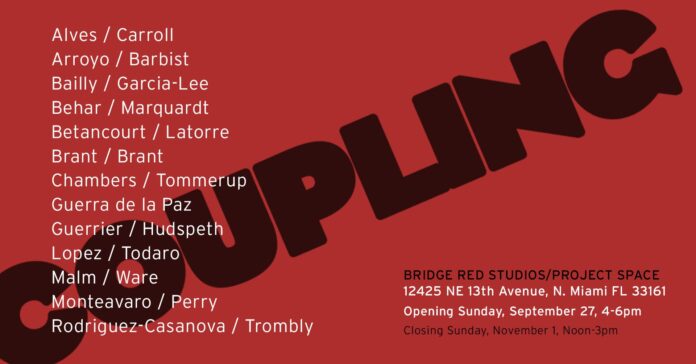
COUPLING began in 2009 as an exhibition at the Buena Vista Building in Miami’s Design District, curated by Kristen Thiele. Held February 14–21, 2009, the exhibition brought together artists who were also couples, exploring the ways intimate partnerships intersect with and inform artistic practice.
Seventeen years later, COUPLING returns at Bridge Red Studios/Project Space, bringing together a new group of artist couples alongside several participants from the original exhibition. The new iteration revisits the premise from the perspective of time, considering how relationships and artistic practices evolve, influence one another, and develop side by side.
The exhibition presents artists whose practices are shaped by both shared lives and distinct artistic voices. Some collaborate directly, creating work through a shared process; others maintain independent practices that unfold alongside one another. In either case, partnership becomes a context for exchange, support, proximity, difference, and mutual influence.
COUPLING considers how living and working alongside another artist can shape ideas, methods, and creative decisions—sometimes visibly within the work itself, and sometimes through the less tangible dynamics of conversation, observation, and shared experience. Rather than suggesting a single model of artistic partnership, the exhibition reveals the many ways intimacy and artistic identity can coexist.
By bringing these artists together across time, COUPLING considers partnership not simply as a private relationship, but as a space in which creative lives intersect. It is a space that can foster dialogue, challenge assumptions, and expand the possibilities of individual practice.
Participating Artists:
COUPLING
Carlos Alves / JC Carroll Eddie Arroyo / Maria Theresa Barbist John William Bailly / Natalia Garcia-Lee Roberto Behar / Rosario Marquardt Carlos Betancourt / Alberto Latorre Duane Brant / Pip Brant Robert Chambers / Mette Tommerup Guerra de la Paz Adler Guerrier / Kathleen Hudspeth J Tomas Lopez / Carol Todaro Mary Malm / Kerry Ware Beatriz Monteavaro / Gavin Perry Leyden Rodriguez-Casanova / Frances Trombly
Exhibition Dates: September 27th – November 1st, 2026 Opening Reception: Sunday September 27th from 4-6 pm Closing Brunch: Sunday, November 1st, noon – 3 pm
Location: Bridge Red Studios / Project Space 12425 NE 13th Ave #3, North Miami, FL 33161
Bridge Red Studios is an artists’ complex in North Miami. Bridge Red consists of 10 working artist studios and an exhibition / project space that is run by sculptor and painter Robert Thiele and his daughter, painter Kristen Thiele. Bridge Red Studios/Project Space was the recipient of a Knight Challenge Grant to further the mission to exhibit, document, and expose the art work of strong and developed artists with ties to South Florida, who do not get the exposure their work merits. Works shown include paintings, drawings, photography, collage, installation, clay art, sound, video, sculpture, and performance. The artists who currently hold studios at Bridge Red are William Cordova, Yanira Collado, Kristen Thiele, Robert Thiele, Stephan Tugrul, Carol K. Brown, Luisa Basnuevo, and Lou Anne Colodny. Colodny, who was the first director of MOCA and it’s former incarnation, the Center of Contemporary Art (COCA), has converted her studio into an exhibition space located below Bridge Red’s Project Space, called Under the Bridge. Both exhibition spaces hold openings on the same Sunday evenings and closing brunches on the same Sunday afternoons. Both are open in between these events by appointment. Bridge Red is located just east of the Museum of Contemporary Art (MOCA NOMI) and west of Biscayne Boulevard, off of 125th street.
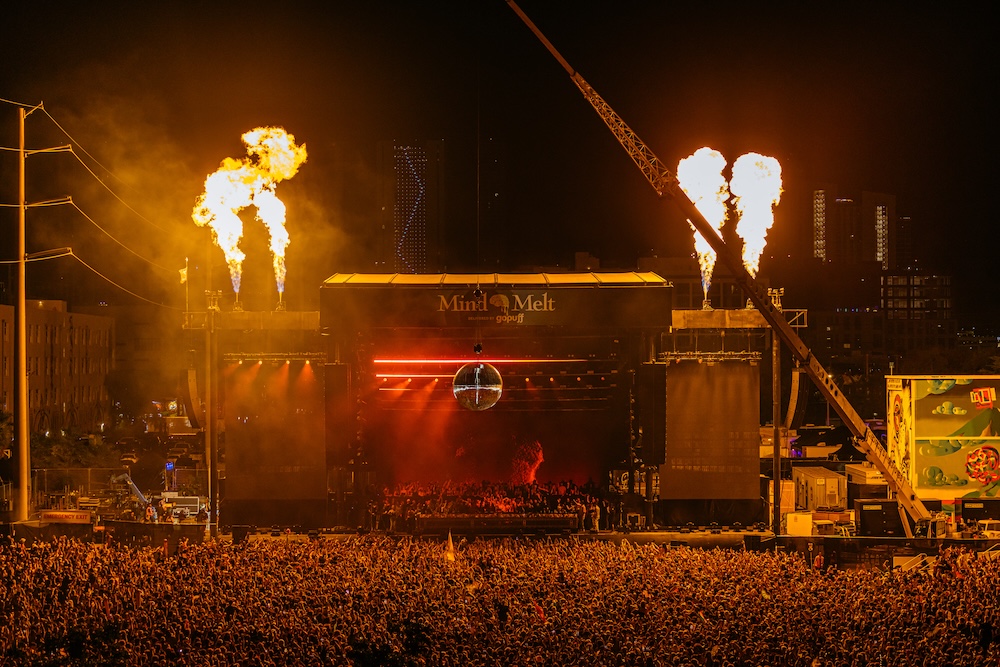
David Sinopoli, founder of III Points and a driving force behind Miami nightlife spaces including Club Space, The Ground, Floyd, Las Rosas, and Jolene. Courtesy of III Points.
Written By Olga Garcia-Mayoral
There are festivals that arrive in a city, use its name, borrow its scenery, and disappear. Then there is III Points—a festival that feels less like an import and more like an organism grown from Miami’s underground nervous system. In a conversation with David Sinopoli, founder of III Points and operator behind beloved nightlife spaces including Club Space, The Ground, Floyd, Las Rosas, and Jolene, it becomes clear that his project has never been only about music. It has been about identity, ecology, and cultural survival.
What stood out most in speaking with Sinopoli was not only the scale of what he has built, but the sincerity behind it. He speaks about Miami with care—less like someone managing nightlife from a distance and more like someone who has lived inside its rhythms, mistakes, late nights, friendships, and fragile creative ecosystems. He describes culture with a groundedness: not as branding, not as spectacle, but as something built through trust, repetition, collaboration, and showing up year after year.
Since its early, chaotic beginnings in 2013, III Points has become one of Miami’s most important annual gatherings for music, art, nightlife, and experimental culture. Yet Sinopoli still speaks about it with the energy of someone building from the inside, not observing from above. He remembers that first year as chaotic, full of mistakes, urgency, and instinct. But the commitment that launched the festival remains intact: to give Miami’s artists, musicians, and creative communities a stage large enough to reflect their actual power.
For Sinopoli, the mission was never simply to create another festival. It was to put Miami on the map honestly. One of the core reasons behind III Points was to give artists identity and help them see themselves as legitimate cultural producers. That idea still drives the festival today. The operations have matured, the scale has expanded, and the reach has grown, but its deepest loyalty remains local. A major portion of the music programming still comes from Miami and South Florida—a point of pride and a statement of intent.
That localism is what separates III Points from many large-scale festival models. Unlike festivals where audiences travel in from everywhere and temporarily consume a place, III Points feels like Miami recognizing itself. You see friends, collaborators, DJs, artists, designers, nightlife regulars, and people from multiple subcultures sharing the same field of experience. It feels like someone’s backyard—if that backyard happened to contain techno, indie, house, hip-hop, experimental sound, visual art, and one of the most recognizable disco balls in the Southeast.
When I asked how he defines the Miami that III Points represents, Sinopoli returned to one word: based. Not branded, not topical, not decorative. Based, as in rooted. Layered. Real. Miami, he suggested, has a sharp instinct for what is fake. That line captures the festival’s deeper intelligence. III Points does not need palm trees, neon clichés, or postcard imagery to announce Miami. Instead, it collaborates with people and collectives who already carry the city’s codes. The result is a festival that feels unmistakably local without needing to perform locality.
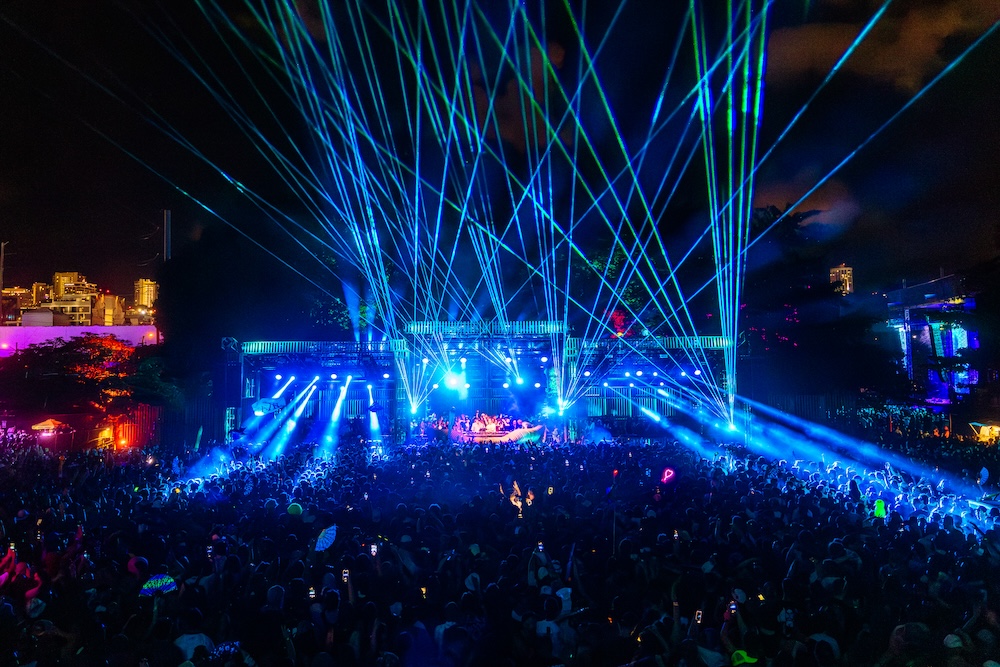
A massive disco ball suspended above the III Points crowd captures the festival’s blend of nightlife, spectacle, and Miami’s ever-shifting urban landscape. Courtesy of III Points.
That same ethos shaped the festival’s visual art program from the start, though Sinopoli admits visual art wasn’t initially his primary focus. Tara Long pushed for it, whom he describes as a creative force and early collaborator. While Sinopoli thought Miami musicians lacked proper representation, Long reminded him that visual artists faced an even more intense version of that problem. From there, III Points developed an art program that was never about placing polite gallery objects around a music festival. It was about atmosphere, interruption, ritual, and encounter.
Long helped shape the early visual direction through projects like TVVIN HAUS, bringing together Miami’s strange, brilliant, underground creative energy to build spaces inside the festival that felt ceremonial, raw, and deeply local. Those early installations established the DNA of III Points: art and music as parallel underground languages, both emerging from an alternative Miami point of view. The goal was not to make the festival feel like a museum. It was to make discovery unavoidable. You might leave a set and suddenly find yourself inside an installation, a box, a truck, a room of lights, sound, bodies, and sensation.
Over time, that approach became central to the festival’s identity. Sinopoli does not describe himself and his team as traditional curators. Instead, he sees them as organizers of possibility. They choose artists and collectives, assign spaces, discuss functionality and budget, then let the artists create. That trust is crucial. It keeps the work alive, current, and risky. Unlike institutions that plan exhibitions years in advance, III Points often operates in real time, with artists developing ideas close to the festival itself. The result is immediacy. The installations feel freshly made because they are.
Among the visual projects Sinopoli remembers most vividly is Mokiworld’s evolution. He recalls Moki’s journey from helping behind the scenes in the festival’s earliest days to creating her first TV installation, which later developed into an annual world of its own. This year, she returns with a “Lucky Number 13” theme, tied to casino and betting imagery—a fitting gesture for a festival now old enough to have its own mythology.
Another unforgettable moment was the Brian Eno-related installation known as The Ship, conceived as an ambient listening environment. In practice, festivalgoers turned it into something more communal and unruly, making the room an unexpected gathering space. The story reveals something essential about III Points: the audience completes the work. The most successful experiences are not always the ones that behave exactly as planned.
Then there is the disco ball—perhaps the festival’s most iconic visual symbol. Born from Miami’s skyline of cranes and constant development, the idea was simple and brilliant: use a crane not only as construction equipment, but as sculpture. Hang the largest disco ball possible above thousands of people and let it become a beacon. For many attendees, seeing it produces that emotional arrival moment: the recognition that you are back inside the III Points universe.
Musically, Sinopoli describes the programming as a curation puzzle. The lineup moves across techno, house, indie, hip-hop, experimental music, and underground sounds, but the goal is not randomness. His team searches for connective tissue between scenes and audiences. A techno listener might discover something heavy and experimental. A Flying Lotus fan might find a pathway toward Blood Orange. A house devotee might encounter an adjacent sound they would not have bought a separate ticket to see. Discovery is not a side effect; it is built into the architecture.
Sinopoli is especially interested in generational listening habits. He speaks openly about having to remain a student as younger audiences embrace faster, stranger, more hybrid sounds—music that pulls from punk, electroclash, internet culture, and underground electronic forms. Rather than resist that shift, he sees it as part of III Points’ responsibility: to keep evolving with the people coming up next.
Still, the conversation inevitably returns to Miami’s future. Sinopoli is both optimistic and concerned. The city’s post-pandemic boom has benefited nightlife and ticketed culture, but it has also made life harder for the artists who give Miami its soul. He speaks plainly about affordability, housing, and the danger of a city growing so quickly that it pushes creative communities out. For someone whose businesses have benefited from Miami’s rise, his honesty matters. He is not romanticizing struggle. He is asking what it would mean to preserve the people who make the city worth celebrating.
Ultimately, what makes Sinopoli’s work meaningful is not only the institutions he has helped build, but the spirit with which he continues to build them. III Points, Club Space, The Ground, Floyd, Las Rosas, and Jolene are not simply venues or events; they are gathering places where Miami’s creative communities recognize themselves. They hold the energy of artists, DJs, designers, dancers, friends, and night creatures who have shaped the city from the inside out.
Speaking with Sinopoli, you sense his vision is less about ownership than stewardship. He understands that Miami culture is delicate because it is alive. It has to be protected, challenged, refreshed, and allowed to stay strange. That sensitivity may be one reason III Points has endured. It does not feel manufactured. It feels inhabited.
For me, the conversation felt like an invitation to think more deeply about the people who build culture before it becomes visible to everyone else. Sinopoli’s work reminds us that Miami’s future will not be shaped only by institutions, towers, collectors, or global attention. It will also be shaped by the people who make space—literally and spiritually—for artists to gather, experiment, fail, return, and begin again.
In a city often accused of surface, III Points insists on depth. It is messy, ambitious, strange, communal, and unmistakably Miami. Under David Sinopoli’s vision, the festival continues to function as both mirror and engine: reflecting the city’s underground while helping push it forward.
What makes III Points powerful is not only who plays, what gets built, or how late the night runs. It is the feeling that Miami’s artists, DJs, makers, and misfits are not being invited into someone else’s cultural structure. They are building their own—and Sinopoli has helped give that movement a home.
TO LAUNCH NEW WORLD SCHOOL OF THE ARTS’ DANCE SEASONWITH DYNAMIC PERFORMANCE AND 40TH ANNIVERSARY VIP RECEPTION
THURSDAY, OCTOBER 10, 2026
NEW WORLD DANCE THEATER
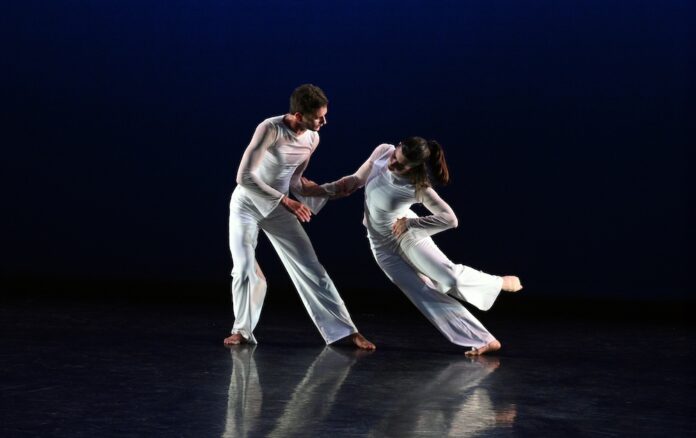
Miami – As the New World School of the Arts marks its 40th Anniversary, the NWSA dance division will present a special evening of dances by Robert Battle and Paul Taylor to inaugurate NWSA’s dance season. Battle will present two works created specifically for NWSA dancers, and the event will showcase an exhilarating performance of Taylor’s signature work, “Airs,” as well as a solo performance featuring distinguished alumnus John Harnage, who will grace the stage courtesy of the Paul Taylor Dance Company to perform an excerpt from the captivating piece “Company B.” After the performance, attendees will have the opportunity to join a VIP Reception, where they can celebrate this important milestone in the school’s history and engage with Mr. Battle, who will be available to meet and interact with guests.
ROBERT BATTLE AND PAUL TAYLOR
With guest dancer John Harnage (Paul Taylor Dance Company)
Saturday, October 10, 2026
7 PM
VIP RECEPTIONImmediately following the performance
New World Dance Theater, 25 NE 2nd Street, downtown Miami
“We look forward to sharing the works of these two remarkable choreographers, whose works thrill audiences around the world, and to showcasing the talent of our current and former students as they bring these works to life onstage,” said Mary Lisa Burns, Dean of Dance at NWSA. “It promises to be an exciting way to start our 40th anniversary celebrations!“
Robert Battle’s works specifically created for the dancers at New World School of the Arts include “Where the Light Lands,” which is accompanied by the uplifting compositions of Mendelssohn and Bach, and “Coming Home,” set to a diverse selection of music from Mahalia Jackson, Wycliffe Gordon, Bill Allred’s Classic Jazz Band, and others.
“I am thrilled that the Paul Taylor Dance Company can join New World School of the Arts in celebrating their 40th Anniversary. We have a close connection to the dance program there, sharing faculty, alumni, and a dear connection with our Resident Choreographer, Robert Battle. I hope everyone can join us on Saturday, October 10th, to experience the brilliance of Robert, Paul, and the students of New World.” – Michael Novak, Artistic Director, Paul Taylor Dance Company.
Robert Battle, distinguished dancer and choreographer, graduated from the NWSA high school dance program in 1990, studying under the direction of Daniel Lewis. He then attended the dance program at the Juilliard School. He danced with Parsons Dance from 1994 to 2001 and choreographed for the company starting in 1998. Mr. Battle then founded Battleworks Dance Company, which made its debut in 2002 in Düsseldorf, Germany, and performed extensively at venues including the Joyce Theater, Dance Theater Workshop, American Dance Festival, and Jacob’s Pillow Dance Festival. In July 2011Robert Battle became artistic director of Alvin Ailey American Dance Theater after being personally selected by Judith Jamison, making him only the third person to head the company. Mr. Battle was honored as one of the “Masters of African American Choreography” by the Kennedy Center for the Performing Arts in 2005 and received the prestigious Statue Award from the Princess Grace Foundation-USA in 2007. Robert Battle was named a 2015 Visiting Fellow for the Art of Change, an initiative by the Ford Foundation, and is a recipient of the 2021Dance Magazine Award. He was appointed Resident Choreographer of the Paul Taylor Dance company in Fall 2024. Mr. Battle holds honorary doctorates from the University of the Arts, Marymount Manhattan College, and Fordham University.
Paul Taylor (1930–2018) was a transformative figure in American modern dance, celebrated for his remarkable physicality and emotionally resonant choreography. His journey began at Syracuse University, where he discovered his love for dance, leading him to further his training at The Juilliard School. Taylor’s career included performances alongside legendary figures such as Martha Graham and Merce Cunningham. In 1954, he founded the Paul Taylor Dance Company, dedicating the next sixty years to the creation of 147 innovative pieces, including notable works like Esplanade and Company B, which artfully combined ordinary movements with deep emotional expression. His significant impact on the arts garnered him extensive international recognition and prestigious accolades, including the National Medal of Arts and a Kennedy Center Honor.
John Harnage, originally from Miami, Florida, pursued his dance education at the Miami City Ballet School and New World School of the Arts graduating from the NWSA high school dance program in 2010. He distinguished himself as a Modern Dance Finalist in the 2010 National Foundation for Advancement in the Arts YoungArts competition. In 2014, he earned his degree from The Juilliard School, where he showcased his talent in works by renowned choreographers such as Pina Bausch, Alexander Ekman, Jose Limón, and Lar Lubovitch. Following his graduation, he began his professional journey with Jessica Lang Dance, officially joining the company in 2015, which allowed him to perform and teach internationally. Additionally, he took on the role of principal dancer in the Washington National Opera’s 2017 production of Aida at the John F. Kennedy Center for the Performing Arts. In the Fall of 2018, Mr. Harnage became a member of the Paul Taylor Dance Company.
The dance training at New World School of the Arts is rooted in a conservatory model, emphasizing classical ballet while also embracing various cultural dance forms and contemporary styles. The curriculum is complemented by studies in choreography, music, dance history, anatomy, kinesiology, movement analysis, and dance production. NWSA enjoys international recognition for the achievements and artistry of its professional alumni, the expertise of its distinguished faculty, and its exceptional dance curriculum. Additionally, the school maintains productive partnerships with numerous national and international ballet and modern dance companies, reflecting the diverse backgrounds of both faculty and students, as well as providing excellent facilities for dance education. For further details regarding the NWSA Dance Division, please contact 305-237-3684 or visit https://nwsa.mdc.edu/dance/
A Florida center of excellence in the visual and performing arts, New World School of the Arts is an educational partnership of Miami-Dade County Public Schools, Miami Dade College, and University of Florida. NWSA provides a comprehensive program of artistic, creative, and academic development through a curriculum that reflects our community and the rich multicultural state of Florida. Through our partners NWSA confers the high school diploma, Associate of Arts degree, and Bachelor of Fine Arts and Bachelor of Music degrees in programs accredited by the National Association of Schools of Dance, Music, Theatre, and Art & Design. NWSA’s rigorous eight-year curriculum and conservatory-style teaching has empowered students in our community and our nation to become leaders in the arts for more three decades. Information about New World School of the Arts at 305-237-3135 or https://nwsa.mdc.edu/
Photo by Juan E. Cabrera.
NWSA college student dancers Ryan Fernandez and Larissa Poscidonio.
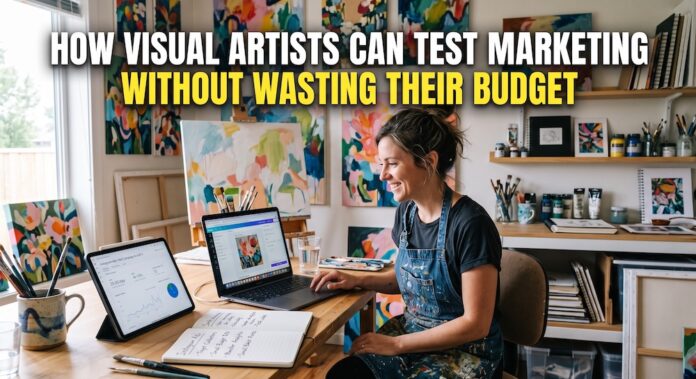
For many visual artists, marketing creates an uncomfortable contradiction. Artists understand that visibility matters, yet they often hesitate to invest in promotion because the results can feel difficult to measure. Posting on Instagram, running an advertisement, appearing in a publication, sending a newsletter, or promoting an exhibition all require time—and sometimes money—but how do you know whether any of it is actually working?
Three questions should guide almost every marketing decision an artist makes:
How do I measure it?
How much should I spend?
Am I simply reaching the same people I already reach elsewhere?
These questions are not signs of uncertainty. They are the foundation of a more intelligent marketing strategy.
Measure What Matters to Your Career
Artists sometimes make the mistake of measuring success only through likes and followers. These numbers can provide useful information, but they rarely tell the whole story.
A marketing campaign should be measured according to its objective.
If your goal is visibility, look at reach, profile visits, website traffic, and the number of new people discovering your work.
If your goal is building professional relationships, pay attention to inquiries from collectors, galleries, curators, journalists, designers, consultants, or institutions.
If your objective is selling work, then inquiries, qualified leads, studio visits, and actual sales become more important than social-media engagement.
The central question is not simply, “How many people saw my work?”
It is:
“Did the right people see my work, and did that visibility lead to something meaningful?”
An artist with 5,000 highly relevant followers may ultimately have a stronger professional network than an artist with 100,000 followers who have little connection to contemporary art.
Do Not Start With a Large Budget
Artists do not need enormous advertising budgets to understand whether a marketing channel works.
Start with a controlled experiment.
Instead of committing significant resources immediately, run a small campaign alongside what you are already doing. Continue using Instagram, your website, exhibitions, email, editorial coverage, or whichever channels currently form part of your strategy.
Then introduce one additional promotional channel and compare the results.
The purpose of the first campaign is not necessarily to sell artwork immediately. Its first purpose is to learn.
Which images attracted attention?
Which audience responded?
Did people visit your website?
Did they spend time looking at several works?
Did they follow your Instagram account?
Did someone contact you afterward?
This information has value because it allows the next campaign to become more precise.
A small test can teach you more than a large campaign executed without a clear strategy.
Think About Audience Overlap
One of the least discussed problems in art marketing is audience duplication.
An artist may promote the same exhibition through Instagram, Facebook, email, and several online platforms and assume that each channel is introducing the work to an entirely new public.
Often, however, many of the same people are seeing the message repeatedly.
Repetition itself is not necessarily negative. Familiarity can strengthen recognition. But artists should distinguish between frequency and incremental reach.
Frequency means the same audience encounters your work several times.
Incremental reach means your campaign introduces your work to people who were not already encountering it elsewhere.
For a developing artist, incremental reach can be particularly valuable.
The objective should therefore not be to abandon existing platforms, but to identify channels capable of expanding the artist’s professional ecosystem.
A contemporary-art publication may reach a different audience from Instagram. An art fair may introduce the artist to people who never subscribed to the artist’s newsletter. A targeted digital campaign may reach architects, collectors, interior designers, or cultural professionals who were previously outside the artist’s immediate network.
Each channel should perform a different function.
Stop Thinking About Marketing as a Single Campaign
Perhaps the most important shift is conceptual.
Artists often approach promotion episodically:
“I have an exhibition, so now I need marketing.”
A stronger approach treats visibility as part of an ongoing professional practice.
An exhibition creates content.
An interview creates credibility.
A magazine feature creates documentation.
Social media distributes that documentation.
A website archives it.
Search engines make it discoverable.
Email maintains the relationship.
One channel reinforces another.
Marketing therefore becomes less about advertising and more about constructing a recognizable professional presence over time.
The Question Is Not Whether Artists Should Market Themselves
Contemporary artists operate inside an extraordinarily crowded visual environment. Thousands of images compete for attention every minute, and artistic quality alone does not guarantee discovery.
This does not mean that artists should become marketers instead of artists.
It means they should understand how visibility works.
A thoughtful marketing strategy does not replace the work. It creates more opportunities for the work to be encountered, studied, remembered, and discussed.
Start small. Measure carefully. Compare audiences. Learn from the results.
Then invest more heavily only in the channels that genuinely expand your reach.
For artists, the most valuable marketing question may ultimately be very simple:
Am I merely being seen more often—or am I being seen by people who did not know my work before?
Referencias principales
Batra, R., & Keller, K. L. (2016). Integrating Marketing Communications: New Findings, New Lessons, and New Ideas. Journal of Marketing, 80(6), 122–145.
Rogers, R. (2021). After Vanity Metrics: Critical Analytics for Social Media Analysis. Oxford University Press, pp. 271–290.
Prasad, A., & Sethi, S. P. (2009). Integrated marketing communications in markets with uncertainty and competition. Automatica, 45(3), 601–610.
Nielsen (2024). Why do we need cross-media measurement?
Nielsen (2019). Understanding Campaign Audiences Across TV + Digital.
Google Ads. Test with confidence with the Experiments page y documentación de Campaign Experiments.
Art Basel & UBS / Arts Economics. Survey of Global Collecting 2025.
Art Basel & UBS / Arts Economics. The Art Market Report 2026.
American Psychological Association. Mere-exposure effect.
NADA (New Art Dealers Alliance) presents over 130 participating galleries and art spaces for the 24th edition of NADA Miami, to take place December 1–5, 2026 at Ice Palace Studios.
The NADA Miami art fair brings together exhibitors from 63 cities and 27 countries, including Lagos, Havana, Tokyo, Buenos Aires, and Kansas City. This year’s fair welcomes 45 first-time exhibitors, including Pietro Alexander (New York), Clauda (Prague), FORGOTTEN LANDS (Christiansted), Real Tinsel (Milwaukee), and Slip House (New York), and features 59 NADA Gallery Members, including Burnaway (Atlanta), Entrance (New York), Gattopardo (Los Angeles), MISAKO & ROSEN (Tokyo), Pangée (Montreal) Proxyco Gallery (New York), and ANDREW RAFACZ (Chicago). Participants are selected through a competitive application and peer review process.
NADA is a market-making nonprofit that has been advancing the conversation around contemporary art since 2002. Its network of more than 500 galleries, art professionals, institutions, and publications, two flagship fairs, and year-round programming make it one of the most consequential organizations in the contemporary art field. The galleries, artists, and ideas that end up defining contemporary art take shape at NADA.
NADA will donate a portion of the proceeds raised from NADA Miami ticket sales to fund the ninth annual NADA Acquisition Gift for PAMM, an acquisition gift which provides funding for Pérez Art Museum Miami curators to acquire artworks from the fair for the museum’s permanent collection. The initiative has led to the acquisition of works by Simon Benjamin, Thomas Bils, Danielle De Jesus, Camila Falquez, Nikita Gale, Sheroanawe Hakihiiwe, Patrick Dean Hubbell, Cassi Namoda, Kenny Rivero, Chemi Rosado-Seijo, and Pallavi Sen.
“NADA’s fairs are the most visible expression of a peer community that runs year-round. Our member mentorship initiative, recently launched dealer residency in Finland, and the PAMM Acquisition Gift, now in its ninth year, are all built on the belief that the field works better when people work together,” said Heather Hubbs, NADA’s Executive Director. “The floor in Miami is an incredible way to experience this community firsthand, through a dynamic selection of presentations from galleries working at the forefront of contemporary art.”
Highlights will include solo presentations from Sheroanawe Hakihiiwe at ABRA, Caracas; Antonio Darden at Burnaway, Atlanta; Antone Könst at CASTLE, Los Angeles; Lisu Vega at Gladwell Projects, New York; Vincent Larouche in a shared presentation by Eli Kerr, Montreal and M. LeBlanc, Chicago; Paul-Sebastian Japaz at Kevin Kramer Gallery, New York; and Jessica Palermo at Tyler Park Presents, Los Angeles. Highlights from NADA Projects include Alli Conrad at Dominique Porter Gallery, Los Angeles; Noelle Africh at Twelve Ten Gallery, Chicago; Kaoru Okubo at TATSURO KISHIMOTO, Tokyo.
Exhibitors: Galleries and NADA Projects
This year’s exhibitor lineup brings together a broad international selection of galleries, artist-run spaces, and independent projects from across the United States, Latin America, Europe, and Asia. From established art centers such as New York, Los Angeles, London, Miami, Tokyo, and Berlin to emerging spaces in cities including Tbilisi, Lima, Lagos, Pittsburgh, and San Juan, the presentation reflects the increasingly global and interconnected character of contemporary art.
NADA 2026 Brings Together an International Roster of Galleries and Independent Projects
Galleries
839 — Los Angeles ABRA — Caracas ABRI MARS — New York Affinity Gallery — Lagos AKIINOUE — Tokyo Pietro Alexander — New York Alice Amati — London Althuis Hofland Fine Arts — Amsterdam Alzueta Gallery — Multiple Locations Amanita — New York & Rome American Art Projects — Berlin, New York & Los Angeles april april — Pittsburgh Bill Arning Exhibitions — Old Chatham Baert Gallery — Los Angeles Baker—Hall — Miami Hannah Barry Gallery — London Blue Velvet — Zurich & Madrid Burnaway — Atlanta Calvaresi — Buenos Aires Cassina Projects — Milan CASTLE — Los Angeles CH64 Gallery — Tbilisi CHART — New York Chilli — London Chozick Family Art Gallery — New York Cob — London Creative Growth — Oakland The Cuban Art Hub — Havana de boer — Los Angeles & Antwerp DIMIN — New York Dio Horia Gallery — Athens Dot Fiftyone Gallery — Miami Tara Downs — New York ELLEPHANT — Montreal EMBAJADA — San Juan Entrance — New York Deanna Evans Projects — New York Feia — Los Angeles Fernberger — Los Angeles Patricia Fleming Gallery — Glasgow FLOHAUS Gallery — New York FORGOTTEN LANDS — Christiansted & New York Fragment — New York Gattopardo — Los Angeles Geary — Salisbury Asya Geisberg Gallery — New York Laurel Gitlen — New York Gladwell Projects — New York Gratin — New York The Green Gallery — Milwaukee Halsey McKay Gallery — East Hampton & New York Timothy Hawkinson Gallery — Los Angeles HESSE FLATOW — New York & Amagansett HeyThereProjects — Joshua Tree The Hole — New York House of Seiko — Los Angeles Jarvis & Werner — New York JDJ — New York KATES-FERRI PROJECTS — New York KDR — Miami Eli Kerr — Montreal Kevin Kramer Gallery — New York GALLERY KTO — Tokyo KodlContemporary — Prauge Kutlesa — New York & Goldau LA BIBI GALLERY — Palma de Mallorca & Mexico City La Loma — Los Angeles LaMontagne Gallery — Boston LAURA — Houston M. LeBlanc — Chicago Galerie Christian Lethert — Cologne Linse Gallery — Buenos Aires The Locker Room — New York Main Projects — Richmond Management — New York Marrow — San Francisco Martha’s — Austin MISAKO & ROSEN — Tokyo Charles Moffett — New York Morgan Lehman Gallery — New York mueve (galería) — Lima Megan Mulrooney — Los Angeles New Discretions — New York New York Life Gallery — New York Oolong Gallery — New York & San Diego Opa Projects — Miami Tyler Park Presents — Los Angeles Patel Brown — Toronto Playlist — San Francisco & Busan Polina Berlin Gallery — New York PRIMARY — Miami Pangée — Montreal Proxyco Gallery — New York ANDREW RAFACZ — Chicago Refusés — London & New York Rivalry Projects — Buffalo Diane Rosenstein Gallery — Los Angeles Roland Ross — Margate Romance — Pittsburgh Scroll — New York Chris Sharp Gallery — Los Angeles Sheet Cake Gallery — Memphis SHRINE — New York SITUATIONS — New York Slip House — New York Sorry We’re Closed — Brussels Tappeto Volante Projects — New York TINNEY — Nashville Twelve Gates Arts — Philadelphia Whaam! — New York The Why Not Gallery — Tbilisi Wolfgang Gallery — Atlanta
NADA Projects
The NADA Projects section expands the fair’s platform through a selection of galleries, nonprofit organizations, independent initiatives, and emerging contemporary art spaces, with a notable presence from Miami alongside participants from New York, Los Angeles, Chicago, Latin America, Europe, and Asia.
ai. gallery — London Bleu Acier — Tampa & Belmont Gallery Bogart — Kansas City Ceibo Gallery — Miami Clauda — Prague Concordia Studio — New York dmincubator — New York EY Projects — Shanghai hipopoety — Buenos Aires TATSURO KISHIMOTO — Tokyo KNELL — Los Angeles The Living Room — Miami Mahara+Co — Miami M-ARCH PROJECTS — Beacon & New York Miriam — New York Oolite Arts — Miami Beach Open Studio — New York & Miami Picture Theory — New York Dominique Porter Gallery — Los Angeles Real Tinsel — Milwaukee Satchel Projects — New York Southside Contemporary — Richmond Twelve Ten Gallery — Chicago VESPER TZU — Lima Voltz Clarke Gallery — New York VSG Contemporary — Chicago
Gallery Members: An International Network of Contemporary Art Spaces
This directory brings together galleries, nonprofit organizations, artist-run spaces, and independent platforms from across the United States and the international contemporary art community. From New York, Los Angeles, Miami, Chicago, and San Francisco to Caracas, Bogotá, London, Paris, Tokyo, Seoul, Warsaw, Tbilisi, and beyond, these members reflect the geographic and cultural diversity of today’s art ecosystem.
0
062 — Chicago
56 Henry — New York
65GRAND — Chicago
A
A.I.R. Gallery — New York
Abattoir — Cleveland
ABRA — Caracas
ABRI MARS — New York
Ackerman Clarke — Chicago
Adams and Ollman — Portland, OR
ALA Projects — Coral Gables & Miami
Pietro Alexander — New York
Alice Folker Gallery — Copenhagen
Anat Ebgi — Los Angeles & New York
april april — Pittsburgh
Bill Arning Exhibitions — Kinderhook
Artadia — New York
Arts of Life – Circle Contemporary — Chicago
as-is.la — Los Angeles
B
Baert Gallery — Los Angeles
Baker—Hall — Miami
Jack Barrett — New York
Nicelle Beauchene Gallery — New York
Berthold Pott — Cologne
Bienvenu Steinberg & C — New York
bitforms gallery — New York
Blade Study — New York
Gallery Bogart — Kansas City
Bradley Ertaskiran — Montreal
BRITTA RETTBERG — Munich
Broadway Gallery — New York
Spencer Brownstone Gallery — New York
Bukia Vakhania — Tbilisi
BUREAU — New York
Burnaway — Atlanta
gallery burster — Berlin
C
Rebecca Camacho Presents — San Francisco
CANADA — New York
Candice Madey — New York
Capsule — Shanghai
CARVALHO — New York
Cassina Projects — Milan
Cevera Yoon — Los Angeles
CH64 Gallery — Tbilisi
Chapter NY — New York
CHART — New York
Cheremoya — Santa Fe
Chozick Family Art Gallery — New York
Cleo the Project Space — Savannah
COOPER COLE — Toronto
Creative Growth — Oakland
Creativity Explored — San Francisco
CUE Art Foundation — New York
D
D. D. D. D. — New York & Singapore
David Peter Francis — New York
de boer — Los Angeles
Luis De Jesus Los Angeles — Los Angeles
Derosia — New York
Galerie Derouillon — Paris
Dimensions Variable — Miami
DIMIN — New York
Dinner Gallery — New York
Dio Horia Gallery — Athens
DOCUMENT — Chicago & Lisbon
Dreamsong — Minneapolis
Duane Thomas Gallery — New York
Dunes — Portland, ME
Dutton — New York
E
EACHEVE — Guayaquil
Ed. Varie — New York
Eighth House Residency — Rochester
El Apartamento Gallery — Havana & Madrid
El Kilometro — San Juan
Derek Eller Gallery — New York
EMBAJADA — San Juan
ENGAGE Projects — Chicago
Entrance — New York
Essex Flowers — New York
Et al. — San Francisco
EUROPA — New York
Deanna Evans Projects — New York
Everybody — Tucson
F
Fabienne Levy — Geneva, Lausanne & Zurich
Feia — Los Angeles
Galería Nora Fisch — Buenos Aires
Foreign & Domestic — New York
Fountain House Gallery — New York
Fragment — New York
Franz Kaka — Toronto
G
G Gallery — Seoul
Gaa — Cologne, New York & Provincetown
Galerie Hugues Charbonneau — Montreal
Garvey|Simon — New York
Gattopardo — Los Angeles
Geary — New York
Asya Geisberg Gallery — New York
Gene’s Dispensary — Los Angeles
Gern en Regalia — New York
Gisela Projects — New York
Laurel Gitlen — New York
Sebastian Gladstone — Los Angeles
Good Mother Gallery — Los Angeles & Oakland
Good Naked Gallery — New York
Good Weather — Chicago & North Little Rock
Gordon Robichaux — New York
Kavi Gupta — Chicago
H
HAIR+NAILS — Minneapolis & New York
Halsey McKay Gallery — East Hampton
Harkawik — Los Angeles & New York
Timothy Hawkinson Gallery — Los Angeles
HESSE FLATOW — New York
I
Independent Curators International (ICI) — New York
Indigo Arts Alliance — Portland, ME
Instituto de Visión — Bogota & New York
IRL Gallery — New York
Ivester Contemporary — Austin
J
JDJ — New York
Jeni Abramson Gallery — Los Angeles
Jennifer Terzian Gallery — Litchfield
JJ Murphy Gallery — New York
Nina Johnson — Miami
K
KATES-FERRI PROJECTS — New York
KDR — Miami
Eli Kerr — Montreal
Ketabi-Bourdet — Paris
KIM? Contemporary Art Centre — Riga
KIPNZ — Walton
Klaus von Nichtssagend Gallery — New York
Richard Koh Fine Art — Singapore
L
la BEAST gallery — Los Angeles
La Loma — Los Angeles
LaMontagne Gallery — Boston
the Landing — Los Angeles
Laney Contemporary — Savannah
Laura (the gallery) — Houston
M. LeBlanc — Chicago
Galerie Christian Lethert — Cologne
LETO — Warsaw
LIC Artists — Long Island City
Long Story Short — Los Angeles, New York & Paris
Kristen Lorello — New York
Louis Buhl & Co. — Detroit
LOYAL — Stockholm
LVL3 — Chicago
M
Magenta Plains — New York
Mahara+Co — Miami
Mama Projects — New York
Management — New York
Marinaro — New York
Kathryn Markel Fine Arts — New York
MARS Gallery — Melbourne
Marta — Los Angeles
Martha’s — Austin
Philip Martin Gallery — Los Angeles
Massey Klein — New York
Kai Matsumiya — New York
M+B — Los Angeles
McLennon Pen Co. — Austin
Medium Tings — New York
Meno Parkas Gallery — Kaunas
MICKEY — Chicago
Microscope Gallery — New York
Midway Contemporary Art — Minneapolis
Miriam — New York
MISAKO & ROSEN — Tokyo
Charles Moffett — New York
Morgan Lehman Gallery — New York
Moskowitz Bayse — Los Angeles
Mrs. — New York
Brigitte Mulholland — Paris
N
N.A.S.A.L. — Guayaquil & Mexico City
Nationale — Portland, OR
Nazarian / Curcio — Los Angeles
New Discretions — New York
New Release — New York
New York Life Gallery — New York
New Image Art — Los Angeles
Night Gallery — Los Angeles
NOON Projects — Los Angeles
O
O Gallery — Tehran
OCHI — Los Angeles & Sun Valley
Ontopo — New York
Oolong Gallery — New York & Rancho Santa Fe
Ortega y Gasset Projects — New York
Outer Space — Concord
P
P.A.D. — New York
Paradigm Gallery + Studio — Philadelphia
Parent Company — New York
Tyler Park Presents — Los Angeles
Patel Brown — Toronto
Gallery Kendra Jayne Patrick GmbH — Bern, Switzerland
Chicago Art Fair Unveils Exhibitor Lineup for Inaugural Edition at THE MART
Nearly 50 local, national, and international galleries will gather in Chicago from October 7–10, 2026, offering a new destination for discovering, experiencing, and collecting modern and contemporary art.
CHICAGO — Chicago Art Fair, the city’s newest contemporary and modern fine art exhibition, has announced the exhibitor lineup for its inaugural edition, taking place October 7–10, 2026, at THE MART.
Bringing together nearly 50 leading local, national, and international galleries, the fair aims to create a new destination for collectors, designers, architects, advisors, and art enthusiasts to discover, experience, and acquire works by both established and emerging artists.
The inaugural edition will feature a diverse selection of contemporary and modern painting, sculpture, photography, mixed media, glass, and other artistic practices. Chicago-based galleries will join exhibitors from across the United States and abroad, giving visitors the opportunity to engage directly with gallerists while exploring a wide range of artists, perspectives, and price points in an intimate and approachable setting.
“Chicago has an incredibly engaged arts community, and we’re excited to bring together a group of galleries that reflects both the strength of the city’s own cultural landscape and the breadth of the larger art world,” said George Billis, Exhibition Manager at Chicago Art Fair. “Our goal is to create an environment that encourages discovery and conversation, where guests can connect directly with galleries, learn more about the artists and works they represent, and ultimately find art that resonates with them.”
Participating Galleries
Chicago-based exhibitors include Carousel Fine Art, F.L. Braswell Fine Art, Glick Sullivan Projects, Hilton Contemporary, Jean Albano Gallery, McCormick Gallery, Richard Norton Gallery, and Stephen Daiter Gallery.
New York-based participants include Camp Z, George Billis Gallery, Haven Gallery, Lawrence Fine Art, Marloe Gallery, Nancy Hoffman Gallery, Raccolta | YMF, Treat Gallery, Vallarino Fine Art, and Walter Wickiser Gallery.
International exhibitors include Cogalerie, Echo Fine Arts, Galleria Barbara Paci, GX Gallery, Jonathan Cooper, TSEKH Gallery, and Yvel.
Additional galleries from across the United States include Artavita, Aspen Art Gallery, Christopher Martin Gallery, Conde Contemporary, Gabriel Da Sylva Gallery, Galeria Azur, Gallery Giuseppe, Gebhardt Gallery, Habatat, J. Ruel Martin Gallery, Jerald Melberg Gallery, Judy Ferrara Gallery, Melissa Morgan Fine Art Gallery, Michael Fine Art, Moberg Gallery, Okay Spark Fine Art, Perseus Gallery, Price Krishnan Gallery, SAB Gallery, Salazar Art Advisory, Sponder Gallery, Tim Lotton Glass Works, Timothy Yarger Fine Art, Trifecta, and Walter Redondo Fine Art Collection.
The fair will also feature special projects by Agnes Beleznay and Graham Hobart.
Beyond the Gallery Booths
In addition to gallery presentations, Chicago Art Fair will offer opportunities to connect directly with working artists, engage with art-focused nonprofit organizations, experience large-scale sculpture installations, and hear from leading voices in the art and design industries.
Designed to complement Chicago’s established cultural landscape, the fair will provide a focused, gallery-driven experience intended to make discovering and collecting fine art accessible to a broad audience.
From seasoned collectors seeking new acquisitions to visitors beginning to explore the art market, the fair will offer opportunities to experience works firsthand, speak directly with galleries, and build meaningful connections within the arts community.
A New Addition to Chicago’s Cultural Calendar
Located in the heart of Chicago at THE MART, Chicago Art Fair seeks to establish itself as a new platform connecting galleries with collectors, advisors, designers, architects, and art enthusiasts throughout Chicago and the Midwest.
The fair will showcase work ranging from emerging talent to established artists, creating a concentrated environment for discovering contemporary and modern art.
Chicago Art Fair 2026
Dates: October 7–10, 2026 Location: THE MART, Chicago Single-Day Tickets: Starting at $25 Information:www.chicagoartfair.com
About Chicago Art Fair
Taking place October 7–10, 2026, the inaugural Chicago Art Fair will bring together a selected roster of galleries presenting contemporary and modern fine art at Chicago’s iconic THE MART.
Designed to connect galleries with collectors, advisors, designers, architects, and enthusiasts throughout Chicago and the Midwest, the fair will draw on the city’s longstanding reputation as a major cultural destination while creating new opportunities for discovery, dialogue, and collecting.
Participating Galleries & Booth Numbers
A diverse group of galleries, art dealers, and contemporary art platforms will come together for the fair, presenting works across painting, sculpture, photography, glass, mixed media, and other contemporary practices. Visitors can use the following exhibitor list and booth numbers to navigate the fair and discover participating galleries.
ARTAVITA / WORLD WIDE ART — Booth 4049 ASPEN ART GALLERY — Booth 2042 CAMP Z — Booth 2034 CAROUSEL FINE ART — Booth 5050 CHRISTOPHER MARTIN GALLERY — Booth 2030 COGALERIE — Booth 1042 CONDE CONTEMPORARY — Booth 3072 ECHO FINE ARTS — Booth 4071 F.L. BRASWELL FINE ART — Booth 2086 GABRIEL DA SYLVA GALLERY — Booth 2025 GALERIA AZUR — Booth 5038 GALLERIA BARBARA PACI — Booth 1052 GEBHARDT GALLERY — Booth 5030 GEORGE BILLIS GALLERY — Booth 1078 GLICK SULLIVAN PROJECTS — Booth 2038 GX GALLERY — Booth 1038 HABATAT — Booth 4077 HAVEN GALLERY — Booth 3078 HILTON CONTEMPORARY.COM — Booth 2062 J. RUEL MARTIN GALLERY OF WOOD SCULPTURES — Booth 4081 JANNA’S GATE GALLERY — Booth 4041 JEAN ALBANO GALLERY — Booth 4037 JERALD MELBERG GALLERY — Booth 3050 JONATHAN COOPER — Booth 5086 JUDY FERRARA GALLERY — Booth 3086 LAWRENCE FINE ART — Booth 3058 MARLOE GALLERY — Booth 4024 MCCORMICK GALLERY — Booth 4061 MELISSA MORGAN FINE ART GALLERY — Booth 5062 MICHAEL FINE ART — Booth 1062 MOBERG GALLERY — Booth 1086 NANCY HOFFMAN GALLERY — Booth 3062 OKAY SPARK FINE ART — Booth 2050 PERSEUS GALLERY — Booth 1030 PRICE KRISHNAN GALLERY — Booth 1066 RACCOLTA | YMF — Booth 5046 RICHARD NORTON GALLERY — Booth 1074 SAB GALLERY — Booth 3053 SALAZAR ART ADVISORY — Booth 3016 SPONDER GALLERY — Booth 3030 STEPHEN DAITER GALLERY — Booth 3024 TIM LOTTON GLASS WORKS — Booth 3025 TIMOTHY YARGER FINE ART — Booth 5024 TREAT GALLERY — Booth 5018 TSEKH GALLERY — Booth 4045 VALLARINO FINE ART — Booth 4067 WALTER REDONDO FINE ART COLLECTION — Booth 1050 WALTER WICKISER GALLERY — Booth 1070 YVEL — Booth 5072