Born in Jamaica and based in South Florida, the self-taught artist and military veteran reflects on how his years in uniform shaped his clean, precise lines, why he refuses to paint anything he does not believe, and what it means to keep personal pain off the canvas.
AMM: In your statement, Jamaica appears as the place you were born; in your biography, the story begins with your upbringing in South Florida, and the island disappears. What part of you is left out when you choose where your story begins, and what do you fear would happen if that absence moved to the center of your work?
Allan Creary: I love my upbringing in Jamaica as well as South Florida. If I left anything out regarding where my story begins it would be that I am grateful that I had a great childhood, mostly free from drama and trauma. Who knows where I would be if that were not the case. Would I even be an artist today? If the absence of a great childhood was absent from my biography I may not even be an artist.
AMM: You come from military life, where obedience, hierarchy, and duty can define a person, and today you speak of pushing boundaries as a self-taught artist, with no teachers to authorize you. Which orders do you still follow when you are alone with the work, and which have you not yet been able to discharge yourself from?
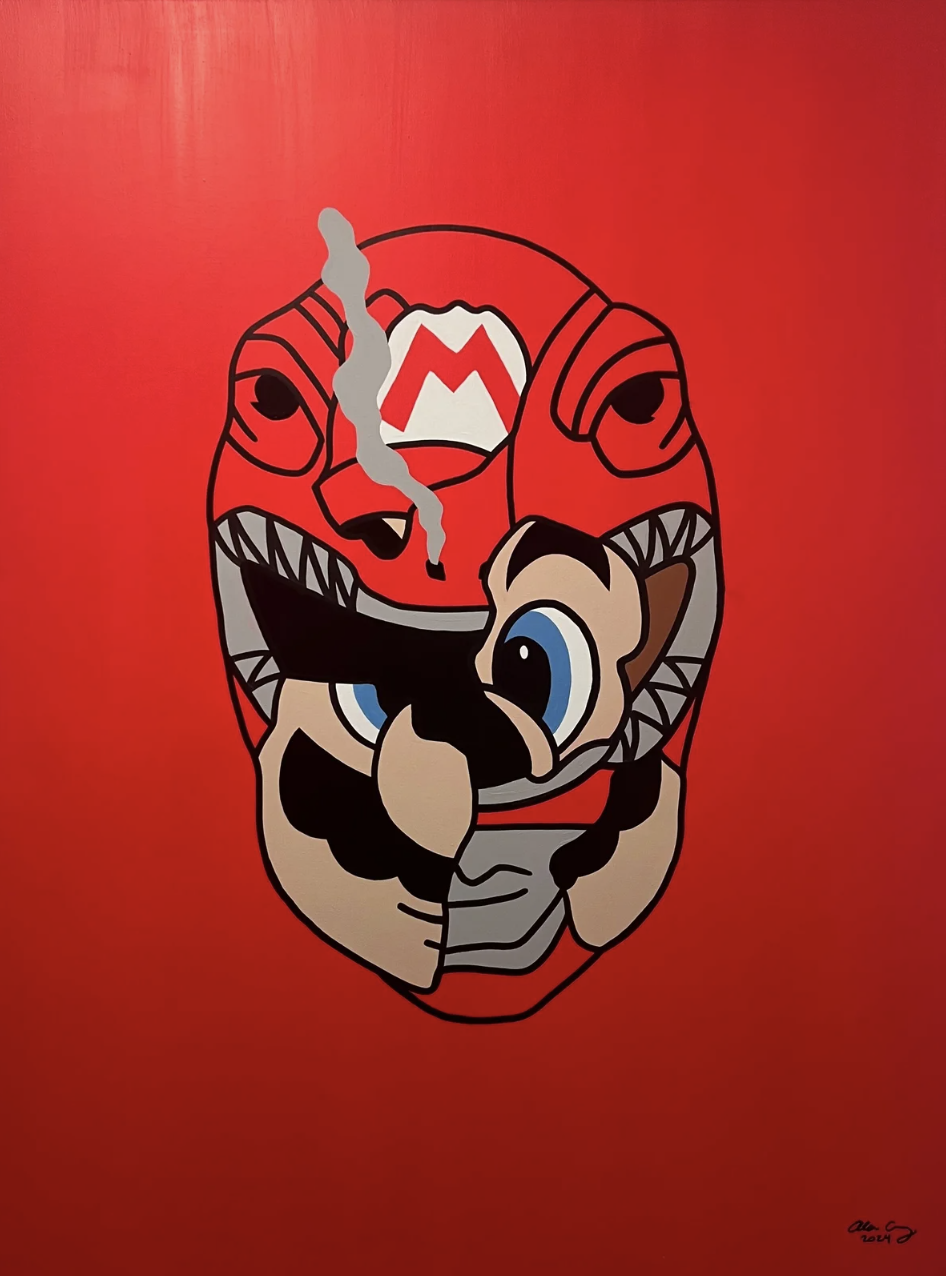
A.C.: I believe my military experience made me see the world from a very sharp view. In the military things are done in a uniform way and everything you see on a warship for example is very sharp and clean. Everyone is in the same pressed uniform, shined boots, good haircuts, and shaven, clean-faced. The lines in my art are always very sharp and clean and I believe that is something that I took with me and something I cannot escape. The images I paint are very clear and smooth. I do not like texture in any of my works.
AMM: You say that each piece reflects an ever-changing world, yet also that you remain true to the core of your vision. If that core were actually a defense against the very transformation you proclaim, what would you have to lose to find out, and would you be willing to stop recognizing yourself in your own work?
A.C.: I have to stay true to my core beliefs as an artist. I am not the type of artist to seek change in order to create something transformative. I will not paint anything I do not believe. Changes happen in the visual arts but I address those contemporary changes head on without changing my art practice. For example my art is ultra contemporary and I may even address AI (artificial intelligence) in my art. But I would never use it as a tool to generate visual art, but I would more so use the term AI as a word that shows up in my art, or in the title of a painting.
AMM: Your work is defined by a futuristic outlook, and yet you invite the viewer into a fusion of past, present, and future. What in your past can you still not look at directly, and to what extent has imagining the future been a form of hope for you, or an elegant way of running away?
A.C.: I can’t think of anything in particular in my past that I cannot look at directly. Everything that happened in my past brought me to where I am today and I am grateful for that. Imagining the future is a form of hope for me because I do wonder where my art career will be in the future. Whether I break out, when I break out and what the catalyst may be. No matter when the breakout is though I will always be a painter, it bring some so much joy to bring something in the world that wasn’t there before.
AMM: Your career is told through exhibitions, collaborations, and selections, and your images have reached the window of a library and a digital billboard in Detroit, while you champion art as a catalyst for change and dialogue. But your pain, your doubt, and your failure barely appear in that story. What truth about yourself is impossible to tell in a work meant to be shared by everyone, and what would happen to your idea of community if one day you made a piece that no one wanted to embrace?
A.C.: I try my best to not let any pain or issues I go through make it to my canvas. People should be able to enjoy my art and if they interpret something as me going through something distressing that may take them out of the experience because they would only be seeing what I bring to the table but I want everyone to bring just as much to the interpretation of my images as I brought to create it. I don’t think I have a truth about myself that is impossible to tell in a work for the public. I lay it all on the canvas with each painting. Even if I tried to hide something about myself, it may come out in a painting. If I ever made a piece that nobody wanted to embrace, I think I would be ok with that, and wouldn’t take it personal from my community. As long as it is not offensive. Some paintings may take time to interpret, some paintings may only ever even work as a part of a very large body of work. So if one painting in a large narrative that is being told is hyper-focused on, I think that would be more interesting to me than anything. I would be wondering, why did this painting stand out in this large major story that is being told?