Between Darkness and Lightness: Manuela Gjoka’s Grief as Living Architecture
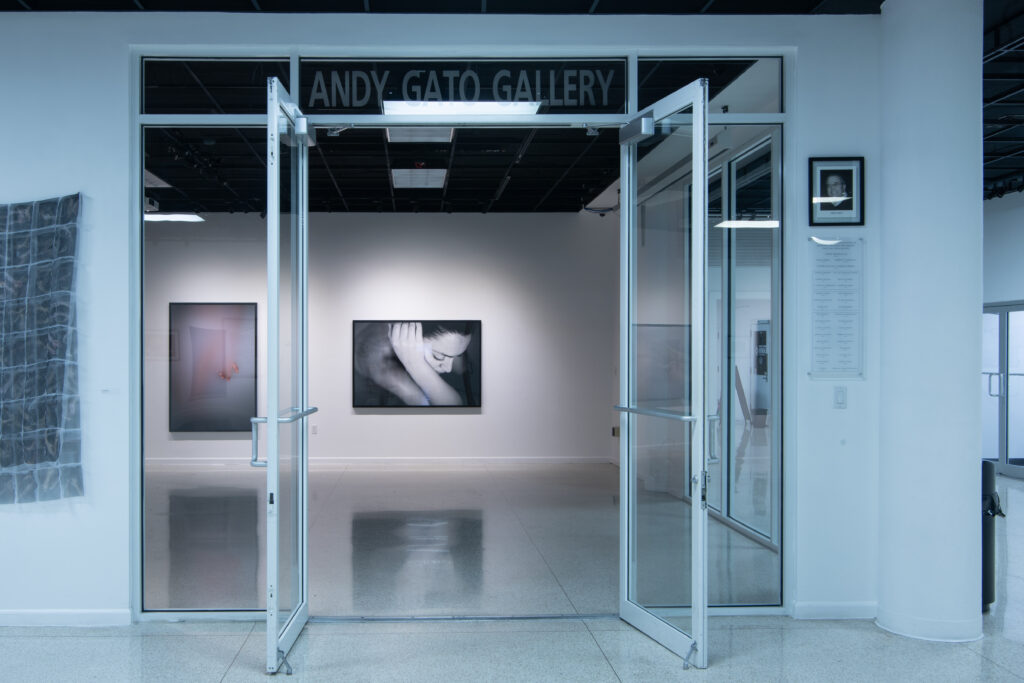
Andy Gato Gallery, Barry University • February 19 – April 24, 2026
Written By Olga Garcia-Mayoral
Grief rarely moves in a straight line. It circles back. It changes temperature. It slips from clarity into heaviness without warning, then returns—sometimes gently, sometimes like a wave you didn’t see coming. In Manuela Gjoka’s Between Darkness and Lightness at Andy Gato Gallery, Barry University (February 19 – April 24, 2026), that truth isn’t simply described—it is built, staged, and embodied. The exhibition is a photographic and performative body of work that traces loss not as a chapter with an ending, but as an ongoing condition of being alive: vulnerable, resilient, and continually transforming.
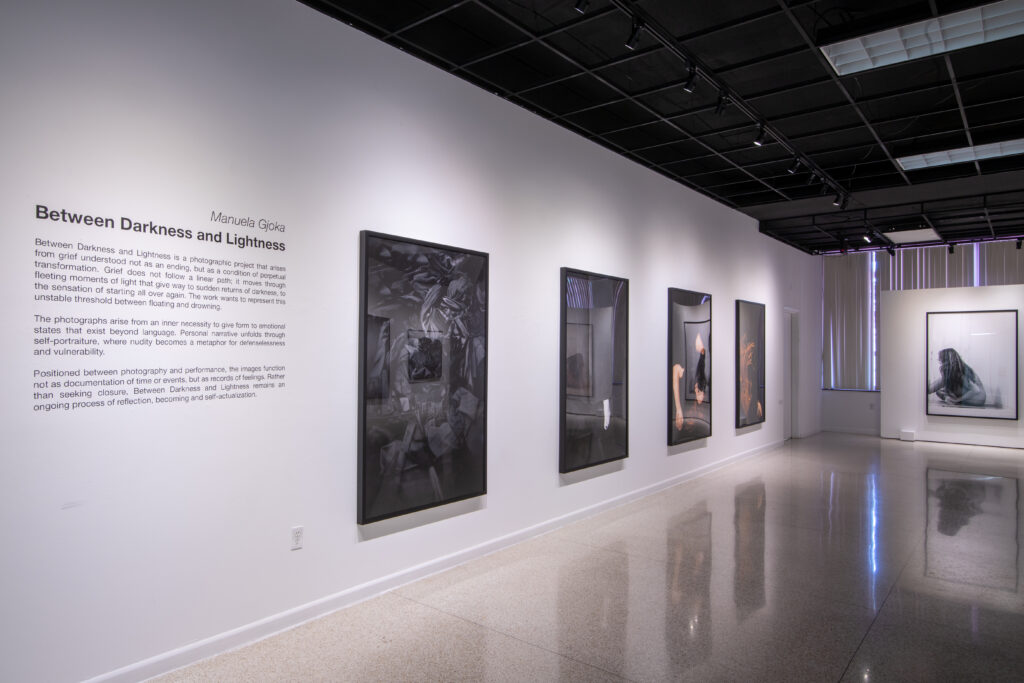
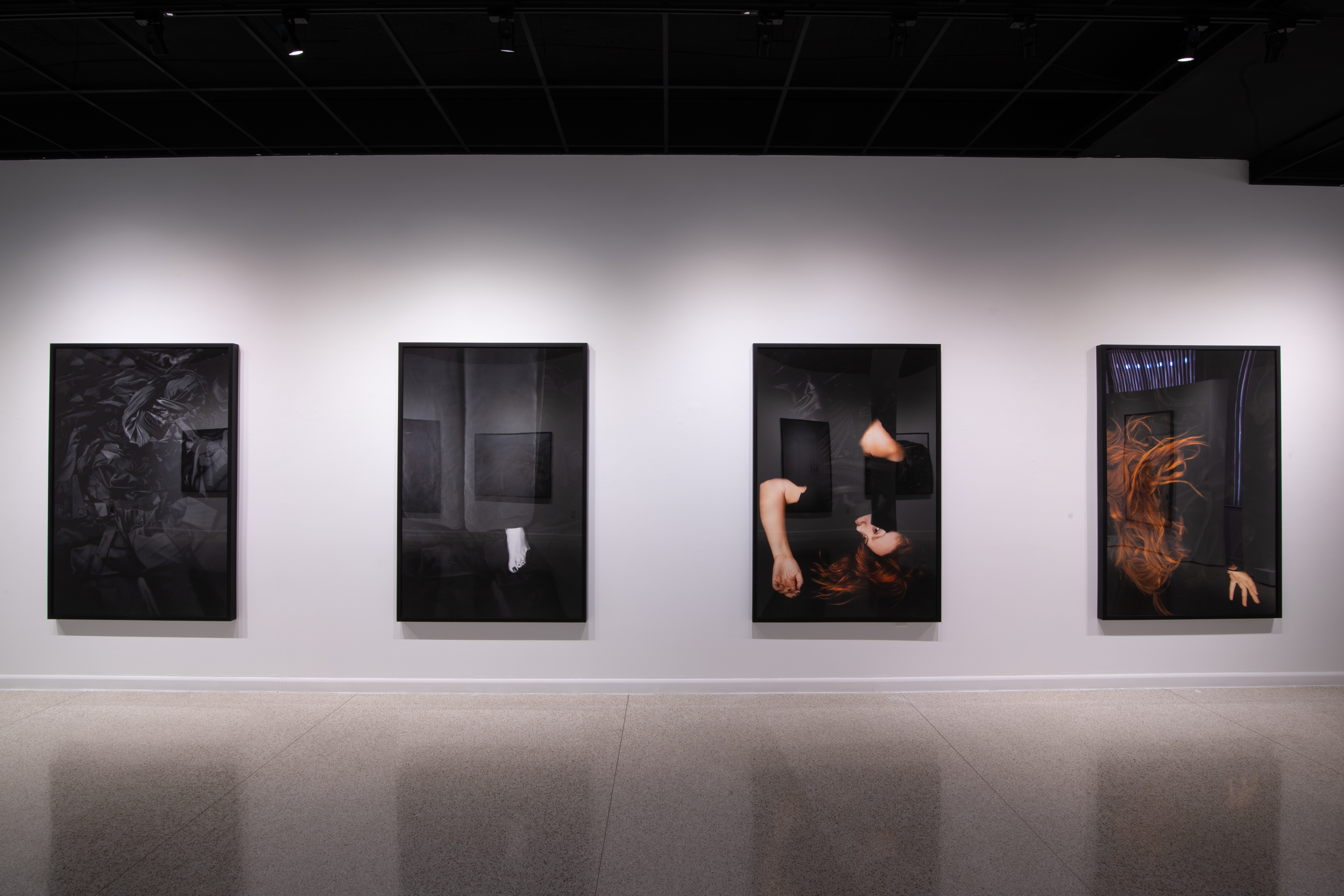
Gjoka’s images feel caught mid-breath—between presence and disappearance, between strength and exposure. Developed over the past three years, the work documents staged performances in which the artist’s own body serves as both subject and medium, collapsing the distance between experience and image. Even when the photographs are silent, they don’t feel still. They feel as if something is happening just outside the frame: a shift in weight, a return of memory, a moment of acceptance interrupted by uncertainty.
When I spoke with Gjoka, she described the show’s title as an intentional wordplay—one that refuses the literal and insists on the emotional. “I decided to name it Between Darkness and Lightness,” she told me. “It’s a play on words, because darkness means the lack of light, but lightness means weightless—the lack of weight. These states of darkness and light are emotional states. They’re not physical, it’s emotional.” That distinction matters. The exhibition does not treat grief as aesthetic darkness, nor healing as an image of brightness. Instead, it treats both as states of the body—felt, carried, and revised over time.
The Body as Archive
What makes Between Darkness and Lightness especially affecting is Gjoka’s decision to turn toward self-portraiture. In the past, she explained, she often told stories through others, but here she removes that protective space. “I don’t want to confine myself to photography,” she said. “I am a multidisciplinary artist… a performance artist. The show is all self-portraiture… It’s what is left after the performance.” That phrase—what is left after the performance—lands like a thesis statement. The photographs are not the performance itself; they are its residue, its evidence, the trace of an emotional event.
Gjoka’s biography adds depth to the work without reducing it to autobiography. Trained in architecture and urban design in Albania and later working in New York in architecture and construction management, she speaks about space the way an architect does: as something that holds history. Photography, for her, began as architectural observation—documenting buildings, surfaces, and sites—but she admits her curiosity always went beyond the structure. She wanted to know the human lives that moved through the spaces: “Who walked the floors,” she said, “the transcendental aspect… beyond the historical focus.” In this exhibition, that curiosity turns inward. The “site” becomes her own body, and the architecture becomes the psychological landscape of mourning.
The show’s central insight is that Healing is not a staircase you climb. It is not progress as a straight ascent. Gjoka said it plainly: “Healing is not linear. It’s not like you climb the steps and then it’s over.” She spoke about being triggered, about returns, and even about relapses—without shame. “That’s what it means to be human,” she said. “Anything goes.”
This is exactly what the exhibition communicates visually. The series moves through emotional environments rather than a fixed narrative, mirroring how grief functions in real life: one step forward, two steps sideways, then a moment of surprising lightness, followed by another return.
Three Environments, One Journey
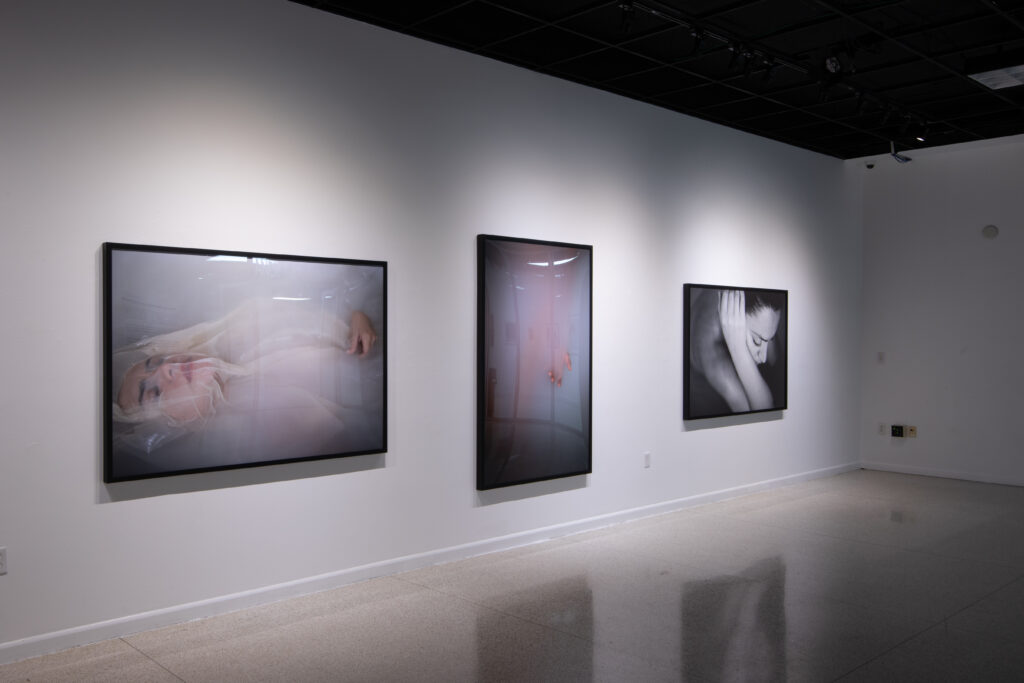
Gjoka described the exhibition as unfolding in three “moments” or environments. The first is surreal: “We don’t understand what’s going on,” she said. “We understand there are humans, but we don’t know—there’s just darkness and hair and limbs.” This is grief as fragmentation, grief as a world that no longer makes sense. Bodies appear in pieces, like memory shattered by an event too large to integrate. These images don’t explain; they confront. They ask the viewer to sit inside the disorientation.
The second environment shifts into a recognizable reality—doors, mirrors, architectural cues that anchor the scene in something more familiar. Here, Gjoka’s use of nudity becomes explicit and metaphorical: “I am using nudity as a metaphor for fragility… and defenselessness,” she told me. “We use clothing as a shield… but in this case I am shieldless… in this reality that is not mine.” She connects that defenselessness to loss: the absence of what once protected her. “Without the strongest figure in my life—my protector, my father… I’m just by myself and defenseless.”
That framing is crucial because it clarifies what the work is not. The nudity is not a provocation; it is a removal of armor. It functions as a stripped-down condition of being, where the body is no longer an object to be consumed but a vessel of truth—exposed to weather, memory, and time.
Gjoka also uses shifts between black-and-white and color to mirror emotional confusion. “I’m going back and forth to make a little bit of confusion,” she said—“just as the confusion that happens when you’re going through moments like that.” Even the palette refuses stability, because grief refuses stability.
“Grieveland” and the Weight of Time
The show consists of 12 artworks, and Gjoka intentionally connects that number to time and mourning. In Albania, she explained, there is a forty-day mourning tradition in which family members wear dark. After her father’s death, she chose to wear black for a year. She speaks about that choice as a kind of durational performance—one she didn’t recognize as art at the time. “I decided to wear black for a year… and in a way, I think that was my first contact with performance art… a durational piece… my way of showing the world how much his loss meant to me.” She links the twelve months to the twelve artworks—a full cycle of time translated into a visual structure.
The first piece, she told me, is titled Grieveland, which she describes as “a barren land after an explosion… after a tragedy.” The metaphor is startling because it removes grief from sentimentality. It becomes terrain: scorched, quiet, emptied, unstable. In her words, “nothing is happening… just a mess of chaos… grief… darkness… and nothingness.” And then comes the second piece, The First Step—the beginning of movement, not toward resolution, but toward survival. “That first step into this land,” she said. “You find yourself in a surreal reality that doesn’t belong to you… but you have to… come alive and understand your surroundings.”
This is the exhibition’s deeper achievement: it does not romanticize Healing. It presents the labor of continuing. It presents the courage of returning.
Why the Work Lands
What makes Gjoka’s work so resonant is her insistence that the more personal she becomes, the more universal the work becomes. “I realized that the more inward I go,” she said, “and the more personal I get, the more relatable the art is.” That’s the paradox of honest art: specificity becomes a doorway.
The images invite viewers into their own internal dialogue—not by demanding interpretation, but by holding emotional space. Gjoka is also comfortable with ambiguity. She acknowledges that viewers often perceive things she didn’t intend—and she welcomes that. In grief, interpretation is never fixed; every viewer arrives with their own history, their own losses, their own thresholds. Between Darkness and Lightness meets them there.
In the end, the exhibition does not offer closure. It doesn’t pretend to resolve grief into triumph. Instead, it offers something more truthful: a space where grief is understood as an ongoing process and Healing as something that continues to unfold, shift, and reveal itself in new ways over time.
Gjoka’s photographs do not ask us to “move on.” They ask us to stay with what is real: the oscillation, the vulnerability, the strength we build without noticing, and the strange lightness that sometimes arrives—not as a cure, but as a momentary gift.
Between Darkness and Lightness is not simply an exhibition. It is a lived architecture of mourning—one that holds both the weight of loss and the possibility of becoming human again and again.