Art Museums: Where Global Art Meets the Americas
South Florida has developed one of the most distinctive museum ecosystems in the United States. Across Miami-Dade, Broward, and Palm Beach counties, museums operate within a region shaped by Latin American and Caribbean migration, tourism, architecture, design, international collecting, and one of the world’s most visible annual art-market gatherings. The result is not a single institutional identity, but a network of museums with remarkably different perspectives on what art can represent.
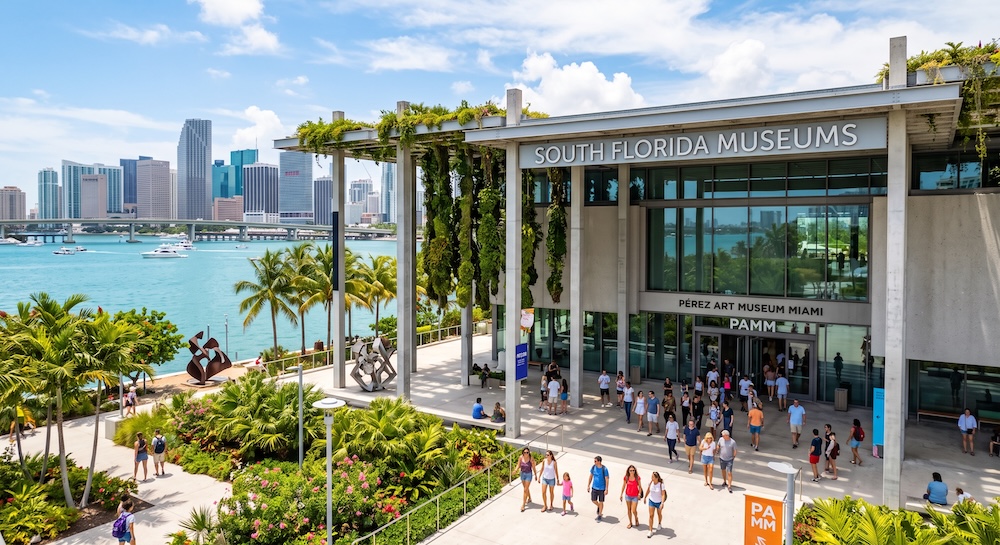
At the center of Miami’s contemporary-art landscape is Pérez Art Museum Miami (PAMM). Dedicated to international modern and contemporary art of the 20th and 21st centuries, PAMM positions Miami as a crossroads of the Americas. Its collection and exhibition program give particular attention to the U.S. Latino experience, the African diaspora, Latin America, and the Caribbean—areas that closely reflect the cultural composition of South Florida itself.
The museum’s architecture has also become inseparable from its identity. Designed by Herzog & de Meuron, PAMM occupies a waterfront building that combines galleries, educational spaces, outdoor environments, and dramatic views of Biscayne Bay. Its exhibition program continues to reinforce its position as one of the region’s principal international cultural institutions.
A different model can be found in the Institute of Contemporary Art, Miami (ICA Miami). Located in the Miami Design District, ICA emphasizes experimental contemporary practices and provides year-round free public admission. Its permanent collection and temporary exhibitions frequently introduce Miami audiences to artists and practices that are still evolving within the international contemporary art conversation.
ICA Miami’s growth also illustrates a broader transformation taking place in South Florida: museums are no longer peripheral attractions within a tourism economy. Increasingly, they are becoming major components of the region’s cultural infrastructure.
On Miami Beach, The Bass occupies another important position. The museum focuses on contemporary art and presents exhibitions by international, mid-career, and established artists whose work reflects the global character of Miami Beach. Its exhibitions, commissions, and educational programs demonstrate how a focused institution can respond directly to contemporary culture while maintaining a strong relationship with its immediate community.
Only a short distance away, The Wolfsonian–Florida International University approaches visual culture from an entirely different direction. It is simultaneously a museum, library, and research center, with an extensive collection of fine art, decorative arts, graphic and industrial design, architectural drawings, books, and ephemera.
The Wolfsonian is especially valuable because it asks visitors to consider how designed objects communicate ideology. Posters, furniture, publications, architecture, advertising, and everyday objects become evidence of how societies construct ideas about progress, nationalism, technology, labor, consumption, and identity. In a city celebrated for contemporary art, The Wolfsonian provides an essential historical framework for understanding how visual culture shapes public life.
Academic museums also play a significant role. The Patricia & Phillip Frost Art Museum at Florida International University is one of South Florida’s important academic art institutions and offers free admission. Its collection includes significant holdings in 20th- and 21st-century art from the United States and Latin America, as well as Haitian and Cuban painting and work by Miami-based and self-taught artists.
That combination of university research, public accessibility, and regional collecting gives the Frost an important role in connecting scholarship with the communities whose histories are represented within the museum.
The Bass
Located in Miami Beach, The Bass is a contemporary art museum focused on international contemporary art and the work of mid-career and established artists. Through exhibitions, commissions, educational initiatives, and public programs, the museum reflects the international character of Miami Beach while creating a direct dialogue between artists and the cultural issues shaping contemporary life.
Coral Gables Museum
The Coral Gables Museum explores the distinctive history, architecture, urban planning, environmental design, and visual culture of Coral Gables. Housed in the city’s historic former Police and Fire Station, the museum examines how architecture and civic design have shaped the identity of the “City Beautiful.” Its exhibitions and educational programs connect local history with broader conversations about preservation, public space, design, and community.
Patricia & Phillip Frost Art Museum FIU
Located at Florida International University, the Patricia & Phillip Frost Art Museum is one of South Florida’s major academic museums. Its exhibitions and collections connect international art with the cultural histories of Miami, Latin America, the Caribbean, and the United States. As part of a public research university, the Frost combines museum exhibitions with scholarship, education, lectures, and community programming, while maintaining free admission for the public.
Haitian Heritage Museum
The Haitian Heritage Museum plays a distinctive role in Miami’s cultural landscape by preserving and presenting Haiti’s art, history, and cultural heritage. Founded in 2004 in connection with Haiti’s bicentennial, the museum brings together Haitian visual art, historical artifacts, music, film, and literature. Its presence in Miami also reflects the profound influence of Haitian culture and the Haitian diaspora on South Florida’s identity.
Miami Children’s Museum
The Miami Children’s Museum expands the definition of a museum through interactive exhibitions centered on learning, imagination, creativity, and play. Designed especially for children and families, its hands-on environments encourage curiosity, collaboration, problem-solving, and artistic exploration. In addition to exhibitions, the institution supports educational programs, early-childhood learning, community outreach, and a museum-based charter school, making it an important educational resource within South Florida.
Museum of Miami
Formerly known as HistoryMiami Museum, the institution is now the Museum of Miami, reflecting an expanded vision of its role as Greater Miami’s civic museum of history, culture, and community. A Smithsonian Affiliate with more than eight decades of history, the museum preserves more than 40,000 artifacts and over two million images documenting the development and extraordinary diversity of Greater Miami. Its evolving mission connects historical memory with contemporary voices through exhibitions, research, city tours, education, photography, and community programs throughout the region.
Beyond Miami
South Florida’s museum culture does not end at the Miami-Dade County line.
In downtown Fort Lauderdale, NSU Art Museum Fort Lauderdale represents a major cultural anchor between Miami and Palm Beach. Founded in 1958, the museum presents modern and contemporary art while maintaining important connections to the artistic histories of South Florida and the Caribbean.
The museum is also closely associated with the history of Christo and Jeanne-Claude’s Surrounded Islands, the monumental 1983 intervention in Biscayne Bay that remains one of the most recognizable works of public art ever realized in Miami. Materials connected with the project preserve an important chapter of the region’s art history.
Farther north, the Norton Museum of Art in West Palm Beach broadens the regional narrative considerably. Its permanent collections encompass American, Asian, Contemporary, and European art, as well as photography. The breadth of the Norton demonstrates how South Florida’s institutional landscape extends beyond contemporary-art specialization into a much longer history of collecting and art scholarship.
The Boca Raton Museum of Art adds another dimension. Located in Mizner Park, its broader creative campus combines the museum with an Art School, linking exhibitions and collections with hands-on artistic education.
Museums as Cultural Infrastructure
What makes South Florida museums particularly interesting is not simply the number of institutions. It is the diversity of their functions.
Some are collecting institutions. Others prioritize experimentation. Some operate within universities. Others connect contemporary art to design, history, architecture, or education. Several provide free access, expanding the museum beyond the traditional model of cultural tourism and transforming it into a public resource.
Together they also document a region whose cultural identity cannot easily be separated into American, Latin American, Caribbean, or European categories. South Florida exists precisely through the intersection of those histories.
That gives its museums an unusual responsibility. They are not merely places where art is displayed. They participate in constructing the cultural memory of a rapidly changing region.
For artists, museums create legitimacy and historical context. For students, they provide direct encounters with objects that cannot be replicated through a screen. For scholars and curators, their archives and collections become research resources. For residents, they provide spaces in which the histories of migration, race, politics, design, ecology, and identity can be examined visually.
And for visitors who know Miami primarily through beaches, nightlife, luxury, or Art Basel Miami Beach, South Florida’s museums reveal a much more complicated cultural landscape.
From PAMM’s dialogue with the Americas and ICA Miami’s experimental contemporary program to The Wolfsonian’s exploration of design, the Frost’s academic mission, NSU Art Museum’s regional history, and the Norton’s broad collections, these institutions demonstrate that South Florida has developed far beyond its former reputation as a seasonal art destination.
Its museums are helping transform the region into a cultural center with its own histories, institutions, collections, and increasingly influential voice in the international art world.