How the Right Canvas Surface Can Transform an Artist’s Work
Explore cotton, linen, primed, unprimed, premade, and custom stretched canvases, including oversized formats, canvas rolls, and floating-frame options.
Artists often devote considerable attention to color, composition, scale, and technique, but the canvas surface is one of the first creative decisions that shapes the final artwork. Long before the first brushstroke is applied, the fabric, weave, tension, preparation, and dimensions of the canvas begin influencing how the painting will look and feel.
A smooth linen surface encourages precision and subtle transitions. A heavier cotton weave can emphasize gesture, texture, and physical movement. An oversized custom canvas can change the relationship between the artist’s body, the artwork, and the viewer.
For this reason, choosing a canvas should not be treated as a purely practical decision. The surface is part of the visual language of the artwork.
Canvas as an Active Artistic Element
Canvas is sometimes described simply as a support for paint. In practice, however, it actively participates in the creative process.
Its texture affects the movement of the brush. Its absorbency influences the brilliance and fluidity of color. Its tension determines how the surface responds to pressure. Its dimensions establish the scale and rhythm of the composition.
Contemporary artists increasingly recognize that the physical structure of a painting can carry conceptual meaning. A panoramic canvas may suggest landscape or cinematic movement. A tall vertical format can reference the human body or architecture. A deep gallery canvas can give the painting an object-like, sculptural presence.
Custom canvas fabrication allows artists to consider these relationships before the work begins.
Premade Stretched Canvases
Premade stretched canvases are practical, accessible, and ready for immediate use. They are especially valuable for artists working in standard dimensions or producing studies, portraits, commissions, workshops, and coordinated series.
The canvas fabric is stretched over a wooden frame and usually coated with a prepared ground. This eliminates several construction steps and allows the artist to focus directly on painting.
Premade canvases are suitable for:
- Acrylic and oil painting
- Studio studies and finished works
- Art classes and workshops
- Portrait and landscape painting
- Small and medium-sized commissions
- Artists who work repeatedly in standard formats
They may be produced with traditional stretcher-bar profiles or deeper gallery-style edges. Gallery-depth canvases offer a contemporary presentation and may be displayed without an additional decorative frame.
For many artists, premade stretched canvases provide the ideal balance of convenience, consistency, and affordability.
Custom Stretched Canvases
Standard canvas dimensions do not always correspond to the needs of an individual artwork. Custom stretched canvases give artists control over the proportions, depth, material, texture, and scale of the painting support.
A custom canvas may be created for a narrow architectural space, a large commercial commission, a panoramic composition, or a multi-panel installation. It can also help artists maintain consistent dimensions across an entire exhibition or body of work.
Custom fabrication options may include:
- Exact nonstandard dimensions
- Oversized and monumental canvases
- Panoramic formats
- Square, vertical, and horizontal proportions
- Custom stretcher-bar depths
- Reinforced frames and cross braces
- Diptychs, triptychs, and modular groups
- Cotton, linen, or blended fabrics
- Primed or unprimed surfaces
- Special surface preparation
Large canvases require more than simply increasing the length of the stretcher bars. Weight, tension, structural reinforcement, transportation, and installation must all be considered during fabrication.
A professionally constructed custom canvas gives the artist a stable and carefully planned foundation for ambitious work.
Canvas by the Yard or Roll
Some artists prefer to stretch, prepare, or display canvas themselves. Canvas sold by the yard, linear meter, or full roll provides maximum freedom for experimentation and production.
Continuous canvas fabric is particularly useful for artists who create numerous works, require unusual dimensions, or want to control each stage of surface preparation.
Canvas rolls may be used for:
- Large-scale paintings
- Custom stretching
- Murals and installations
- Unstretched hanging works
- Textile-based art
- Studio production of multiple canvases
- Experimental painting techniques
- Artist-designed banners and screens
Buying canvas in continuous lengths can also help maintain visual consistency across a series because multiple works can be produced from the same fabric and weave.
Artists can select raw or pre-primed canvas depending on their preferred medium and preparation method.
Cotton Canvas: Versatile and Accessible
Cotton is one of the most widely used canvas materials in contemporary art. It is affordable, adaptable, and available in many weights and textures.
A medium-weight cotton canvas is appropriate for general studio use, while heavier cotton can provide greater physical strength for larger works or more demanding techniques.
Cotton is often selected for:
- Acrylic painting
- Properly prepared oil painting
- Mixed-media works
- Expressive brushwork
- Student and professional practice
- Large-scale production
- Artists working within a defined budget
The natural texture of cotton can become part of the artwork, especially when thin washes, stains, or areas of exposed fabric remain visible.
Linen Canvas: Refined and Professional
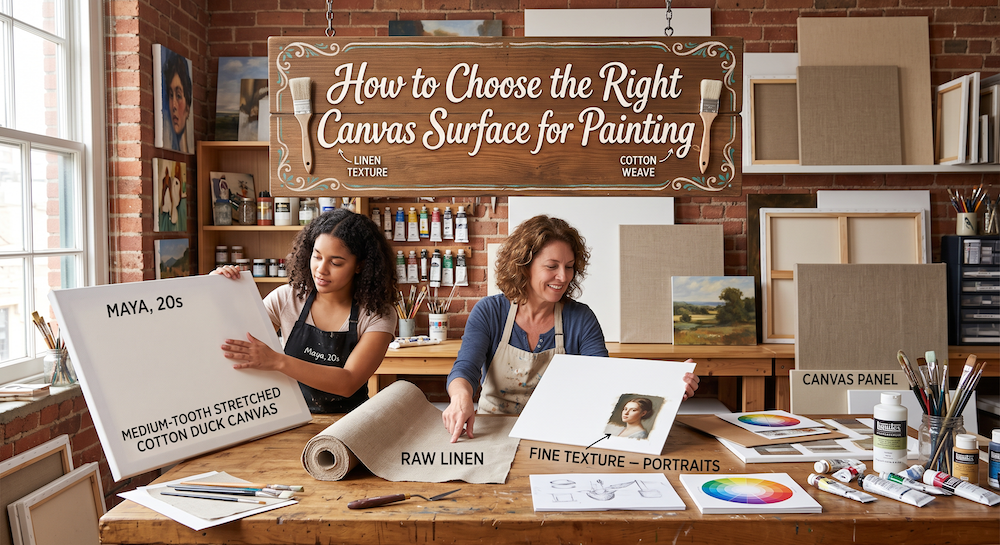
Linen is valued for its strength, fine weave, and elegant surface. Many professional painters choose linen for detailed portraiture, controlled glazing, delicate line work, and carefully layered oil painting.
Fine linen provides less visible texture than many cotton canvases, allowing subtle marks and precise details to remain clear. Heavier linen weaves can also create rich, materially expressive surfaces.
Linen may be ideal for:
- Portrait and figurative painting
- Detailed realism
- Thin glazing techniques
- Controlled brushwork
- Professional commissions
- Exhibition-quality projects
- Artists seeking a premium painting surface
Although linen is often more expensive than cotton, many artists consider its tactile qualities and refined appearance worth the investment.
Synthetic and Blended Canvas
Synthetic and blended fabrics offer another option for contemporary artists. These surfaces may combine natural fibers with polyester or other manufactured materials to create a consistent weave and greater dimensional stability.
Synthetic or blended canvas can be useful for:
- Hyperrealistic painting
- Fine line work
- Airbrushing
- Smooth acrylic applications
- Experimental techniques
- Artists seeking a consistent manufactured surface
The fabric should always be selected in relation to the primer, paint, scale, and intended display environment.
Texture Changes the Painting Experience
The texture of a canvas is often referred to as its “tooth.” This describes the amount of surface resistance created by the weave and preparation.
A coarse canvas catches more paint from the brush and makes the fabric texture visible. It can strengthen the physical character of thick paint and gestural mark-making.
A fine canvas allows the brush to move more smoothly and is better suited to controlled detail.
Rougher canvas surfaces are effective for:
- Impasto
- Expressive abstraction
- Visible brushwork
- Thick paint applications
- Dry-brush techniques
- Paintings that emphasize material texture
Smoother canvas surfaces are effective for:
- Portraiture
- Fine details
- Hyperrealism
- Precise geometry
- Glazing
- Delicate transitions
- Thin and controlled paint layers
There is no universally superior texture. The best surface is the one that complements the artist’s technique and visual intention.
Primed and Unprimed Canvas
Priming creates a prepared layer between the fabric and the paint. It changes the absorbency, color, texture, and response of the surface.
Most ready-made canvases are coated with acrylic-based primer, commonly known as acrylic gesso. This versatile preparation is widely used for acrylic painting and, when properly applied, for many oil-painting techniques.
Oil-primed canvas offers a different working experience. It generally provides a smoother, less absorbent surface that allows oil paint to remain fluid and luminous.
Unprimed canvas gives artists complete control over preparation. They may apply their own sizing, transparent ground, colored primer, absorbent layer, or customized surface texture.
Raw canvas is also used intentionally in contemporary painting, particularly in staining, abstraction, textile-based work, and compositions where the natural fabric becomes visible.
Stretched Canvas with a Floating Frame
A floating frame offers a clean, contemporary way to present a stretched canvas. A small space is left between the canvas and the frame, creating the impression that the artwork is suspended within it.
This style preserves the visibility of the painted edges and gives the work a finished architectural presence without covering any part of the image.
Floating frames are particularly effective for:
- Contemporary and abstract painting
- Geometric compositions
- Gallery-depth canvases
- Paintings with finished edges
- Residential and commercial interiors
- Gallery and exhibition installations
- Artwork requiring a minimalist presentation
Floating frames may be created in natural wood, black, white, stained finishes, metallic surfaces, or custom colors.
When the canvas and floating frame are designed together, the depth, spacing, and proportions can be carefully coordinated with the artwork.
Canvas Solutions Designed Around the Artist
Every artist has a different process. Some need an affordable premade canvas for daily studio practice. Others require fine linen for detailed oil painting, continuous fabric for large installations, or a custom canvas designed for a specific wall or exhibition.
Our canvas services include:
- Premade stretched canvases
- Custom stretched canvases
- Canvas by the yard or roll
- Cotton and linen surfaces
- Primed and unprimed canvas
- Oversized canvas fabrication
- Gallery-depth stretcher frames
- Stretched canvas with floating frames
- Custom dimensions and structural reinforcement
Artists, galleries, interior designers, architects, and creative businesses can request individual canvases or coordinated production for larger projects.
To receive an accurate quote, provide the required dimensions, preferred material, intended painting medium, stretcher depth, quantity, surface preparation, and framing preferences.
The right canvas does not merely support the artwork. It helps define its texture, scale, physical presence, and relationship with the viewer.
For premade canvases, custom stretched canvases, canvas rolls, floating frames, and special fabrication, contact: