Reception, September 26, 6—9 pm
Dimensions Variable (DV) presents a solo project titled Field of Convergence by Karla Kantorovich. The exhibition opens on September 26, 2026, and runs through November 4, 2026.
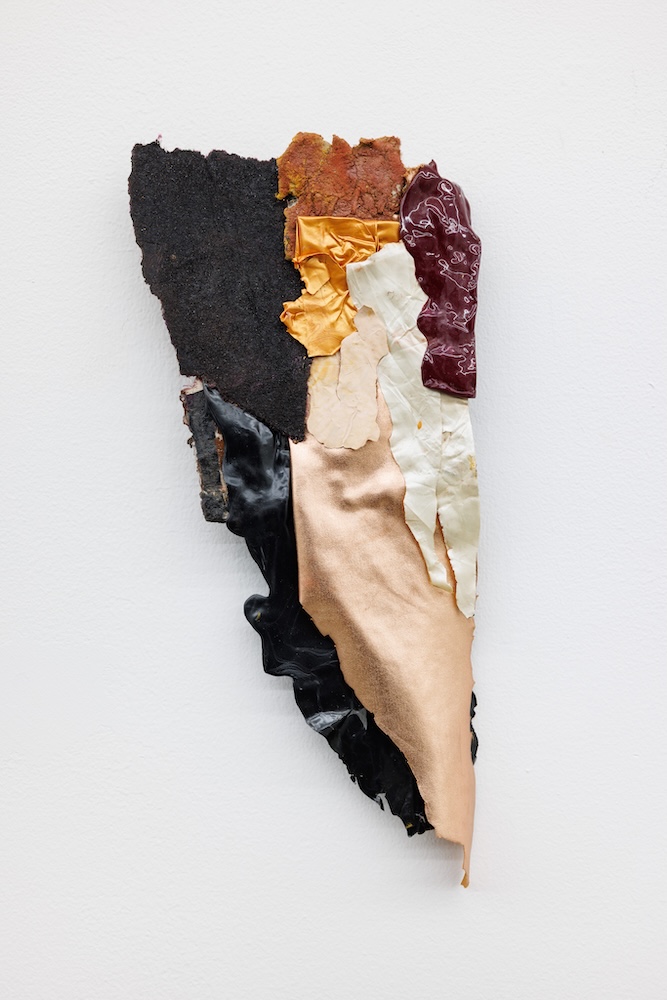
Field of Convergence brings together a body of work made through similar processes and materials—painting, handmade paper, textiles, wood, found objects, and, running throughout, copper and copper-colored pigment. The exhibition extends a practice Kantorovich has pursued for more than a decade, built from materials that arrive already marked by use and time: frayed cloth, tree bark, leaves, old book pages, fragments cut from her own earlier paintings. She has long described an attraction to the moment when objects approach nothingness, the threshold at which matter begins to come apart. For her, these worn surfaces are not depleted but full—each carries the trace of what has altered it, a record of handling, weather, and loss that the work preserves rather than conceals. To assemble them is to treat matter as something that remembers, an active participant in meaning rather than an inert support.¹
Copper gathers these concerns into a single element. Among the most conductive of metals, it has long stood for connection and the passage of energy from one body to another; it is antimicrobial and bound, across many traditions, to healing and regeneration; and, left to the air, it oxidizes into a patina that records the passage of time even as it protects the metal beneath. Those properties give material form to the question at the center of the exhibition, which is a question about mending. In Kantorovich’s hands, repair is never the erasure of rupture but the integration of its history into a new form; the fracture stays present, and something else emerges from it. The impulse finds a precedent in the Japanese tradition of kintsugi, in which broken vessels are rejoined with lacquer and gold so that the seam is not hidden but illuminated, the break understood as one event in an object’s life rather than its end.² The same search for order behind apparent chaos and unity behind duality has long organized her practice. Across weathered surfaces and reflective metals, fragility and strength, darkness and light, permanence and change are held together without canceling one another. The work sustains difference rather than resolving it.
Field of Convergence also marks a deliberate expansion of that project beyond the plane of the wall. The largest work spills from the wall onto the floor and into the surrounding architecture, so that painting becomes an expanded field in which surface gives way to space and material gives way to experience.³ The convergence named in the title is at once formal and conceptual—the meeting of many materials and many histories, and the meeting of painting with the room that holds it. What accumulates is not a resolution but a coexistence: rupture and repair, decay and endurance, the many and the one, sustained together in a single continuous field.
—
Notes
- Jane Bennett, Vibrant Matter: A Political Ecology of Things (Durham: Duke University Press, 2010), 1–19.
- Christy Bartlett, “A Tearoom View of Mended Ceramics,” in Flickwerk: The Aesthetics of Mended Japanese Ceramics (Münster: Museum für Lackkunst; Ithaca, NY: Herbert F. Johnson Museum of Art, Cornell University, 2008).
- Rosalind Krauss, “Sculpture in the Expanded Field,” October 8 (Spring 1979): 30–44.