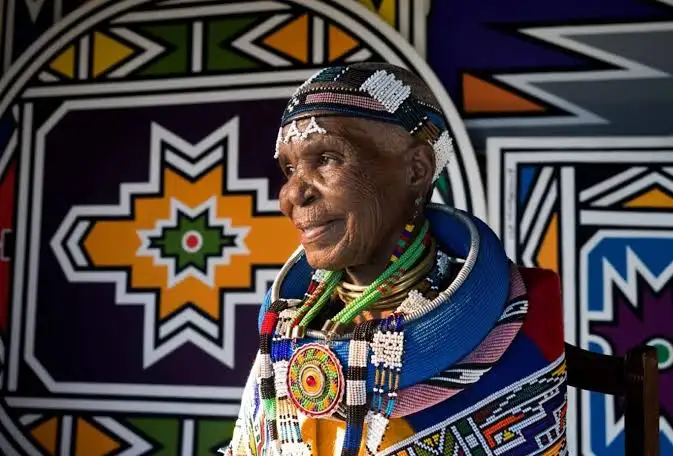
Esther Mahlangu
Geometry as Resistance: The Art and Legacy of Esther Mahlangu
“One of the most important artists of our time — painting is in her heart and in her blood.” Hans Ulrich Obrist, Artistic Director, Serpentine Galleries
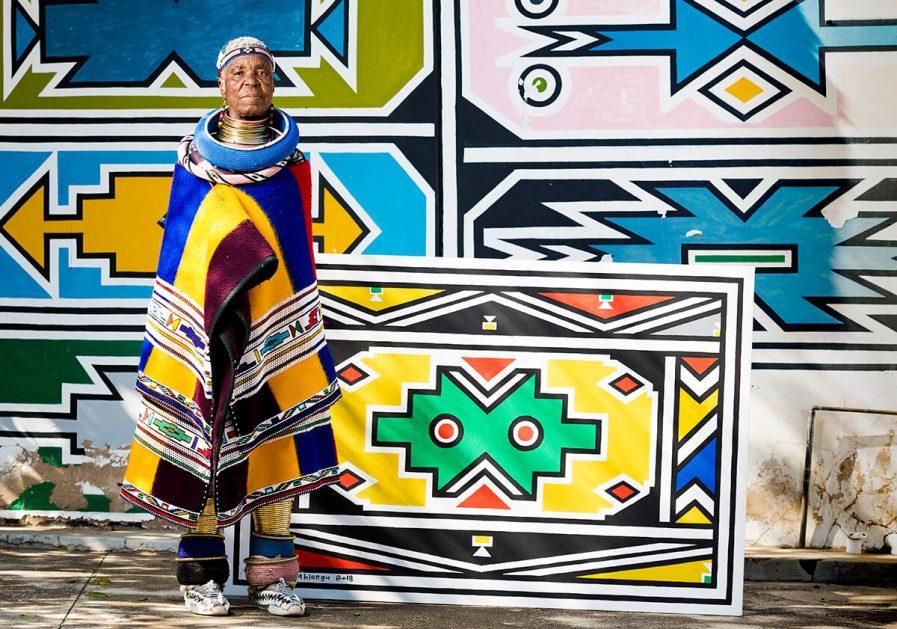
There are artists who paint the world as they find it, and there are artists who paint the world back into existence after it has been stolen. Esther Nikwambi Mahlangu, born on 11 November 1935 on a farm outside Middelburg in South Africa’s Mpumalanga province, belongs firmly in the second category. For nearly nine decades, she has wielded a chicken feather — her instrument of choice — with the precision of a geometer and the authority of a griotte, producing works that are simultaneously ancient and radical, communal and deeply personal. To dismiss her art as “decorative” or merely “traditional” is to commit the most grievous error in criticism: mistaking the surface for the meaning.
Origins of a Visual Language
For hundreds of years, the Ndebele people of South Africa have used architecture, mural painting, and beadwork to express that they belong to a distinctive identity. This material culture became particularly important as they began to become dispersed — beginning in the 1800s with war against the colonial Boers and intensified in the 1940s by the onset of apartheid and white minority rule. The Conversation What this tells us, from an art-historical standpoint, is that Ndebele visual culture was never merely aesthetic. It was a technology of survival.
As the Ndebele lost their land and became dispersed, they held on to their painting, architecture, and beaded dress to preserve their sense of belonging and identity. Their material culture evolved to express cultural resistance and continuity. The Conversation Wall paintings, executed exclusively by women, carried encoded social meaning: the original patterns painted on houses were part of a ritual to announce events like a birth, death, wedding, or when a boy goes off to the initiation school. Artsy In the vocabulary of semiotics, these were not mere signs but full symbolic systems — a grammar of identity legible to insiders and deliberately opaque to colonial authorities who, as one historical account notes, viewed the paintings as harmless, never understanding what was being communicated beneath the geometry.
Mahlangu was born the eldest of nine children and is a member of the Southern Ndebele people. She began painting at the age of ten, taught by her mother and grandmother in accordance with Ndebele tradition, in which adolescent girls learn to paint in preparation for decorating the exterior of their homes after marriage. Wikipedia What is critical here is the pedagogical structure: this was knowledge transmitted matrilineally, outside formal institutions, constituting a parallel academy invisible to the colonial and apartheid state.
The Artist’s Hand: Technique as Statement
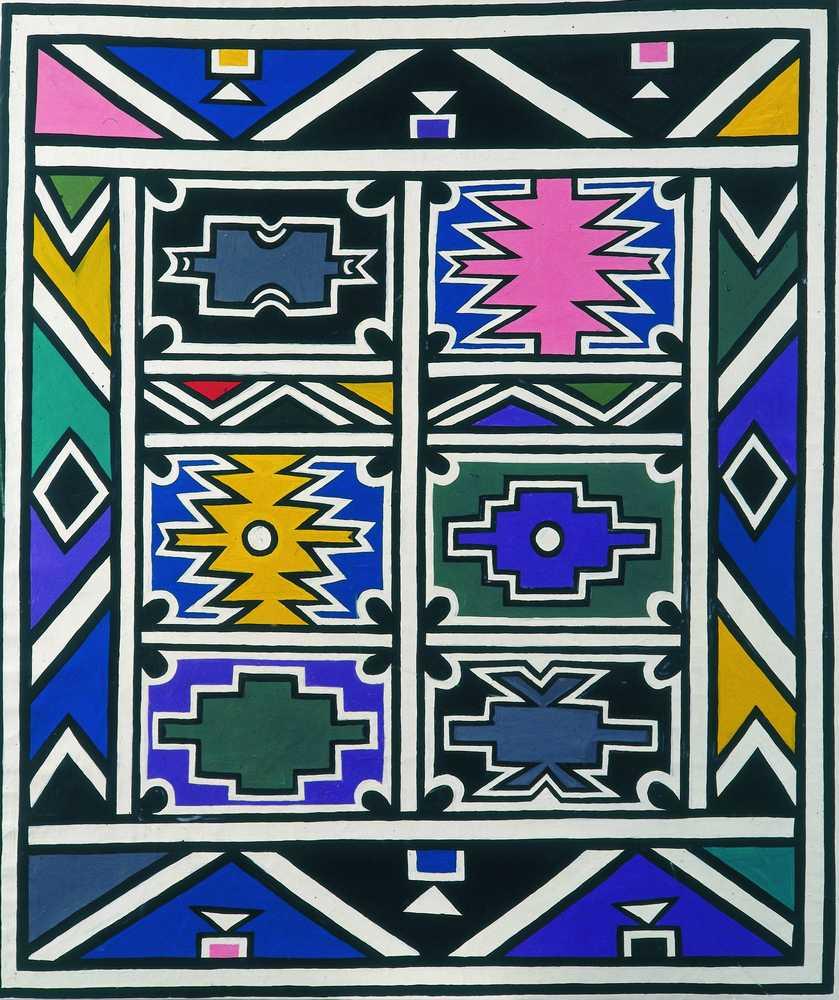
Mahlangu works a visual language that spans disciplines, from pop art to graphic design. She imagines her compositions without the help of preliminary drawings, and, with superhuman precision and using a delicate chicken feather as her brush, she applies thick black lines in patterns that echo Ndebele beadwork but in paint, then adds swathes of rich color. Artsy The refusal of the preliminary sketch is not a limitation — it is a philosophical position. To draw freehand, without measurement, is to declare that this knowledge is embodied, not algorithmic; carried in the hands and the eye, not in instruments of Western technical rationality.
She draws freehand, without first measuring or sketching, using luminous and high-contrast vinyl paints that lend extraordinary vigor to her murals. Google Arts & Culture The shift from natural pigments to industrially manufactured paints — a change that occurred in the mid-twentieth century — is itself a quiet act of adaptation. During the years in which Mahlangu was mastering Ndebele visual semiotics and modernizing Ndebele artistic practice, she began to use industrially manufactured paints, improvising new shapes, working on diverse canvases, and introducing figuration. Artforum Here is where Mahlangu’s genius lies: tradition for her is not a cage but a scaffold — a structure from which she improvises.
The Global Stage: From Mpumalanga to the Centre Pompidou
The turning point came in 1986, when French researchers travelling the world to document traditional arts encountered the paintings on Mahlangu’s house. Between 1980 and 1991 she lived and worked at the Botshabelo Historical Village, an open-air museum of Ndebele culture. In 1986, researchers from Paris who were travelling the world to document traditional arts saw the paintings on Mahlangu’s house and invited her to create murals for an exhibition of international contemporary art, the Magiciens de la Terre (“Magicians of the World”). South African History Online
Mahlangu first received global recognition in 1989 at the Magiciens de la Terre group exhibition, held at the Centre Pompidou and Grand Halle de la Villette in Paris. The exhibition was intended to highlight contemporary art from non-Western countries on an international stage, and her participation brought her wider attention. Wikipedia One must, however, read this moment with critical eyes. Magiciens de la Terre was not without controversy — scholars have debated the extent to which it reproduced the very primitivising gaze it claimed to dismantle, positioning non-Western artists as bearers of timeless tradition rather than as contemporary practitioners making deliberate aesthetic choices. Mahlangu herself navigated this framing with characteristic dignity, demonstrating through the very precision of her freehand line that she was no ethnographic exhibit.
Esther Mahlangu was forced to act in an ethnographic charade, yet she constructed a unique Ndebele grammar that has finally been acknowledged. Artforum That tension — between being instrumentalised by the Western gaze and asserting one’s own artistic sovereignty — runs through the entirety of her career.
The BMW Art Car: Tradition on a Global Canvas
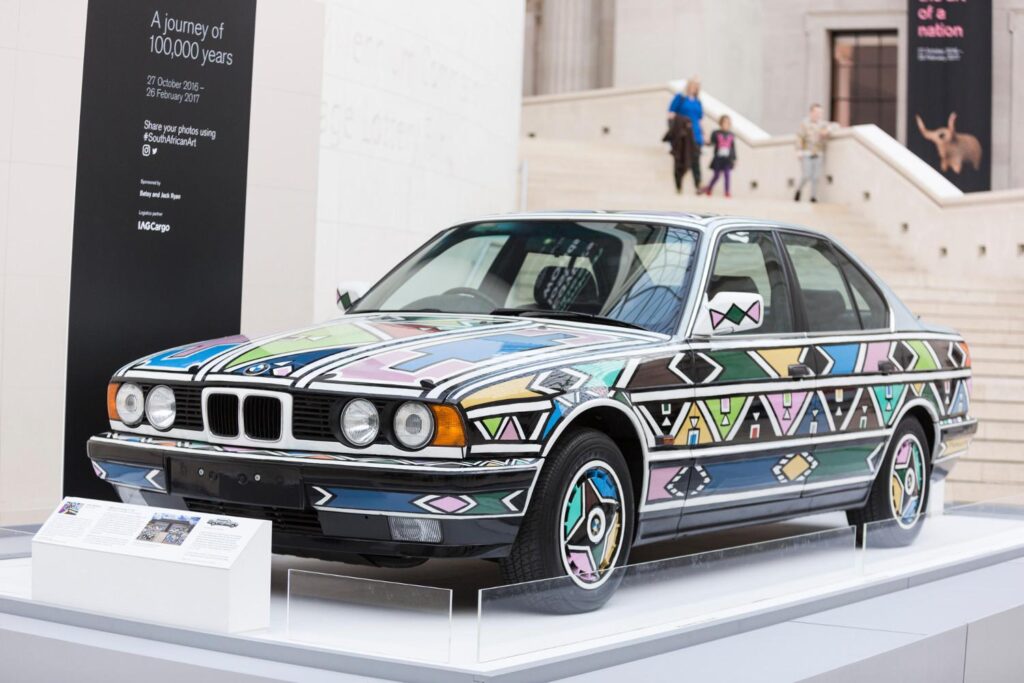
In 1991, Mahlangu was commissioned by BMW to paint a 525i sedan, entering a lineage that included Andy Warhol, David Hockney, Robert Rauschenberg, Frank Stella, and Roy Lichtenstein. Her design featured traditional Ndebele motifs and was the first BMW Art Car created by both a non-Western artist and a woman. Wikipedia The symbolism here is almost too rich for commentary: a Black woman from rural Mpumalanga, who had never driven a car, inserting herself into one of the most prestigious circuits of Western art-world prestige.
Thomas Girst, art historian and Head of Cultural Engagement at BMW, acknowledged the uncomfortable history lurking in this collaboration: “I would think that no art is being created in a vacuum. It’s somewhat problematic when looking at South African art and Western art — with mostly Western art taking and African art giving. The way that African art was appropriated is more of a taker’s attitude.” Artsy This is a rare moment of institutional self-awareness, and it places Mahlangu’s BMW commission in a productive critical light. She was not simply included in the Western canon — she was confronting it from within, on its own metallic surface.
Previously, art cars had been reserved as prestigious “boys’ toys” for the usual suspects: Andy Warhol, Robert Rauschenberg, Roy Lichtenstein, Frank Stella, David Hockney, and, more recently, Jeff Koons. Mahlangu was not only the first woman to be added to that list — she was, and remains, the only African. Wanted Online That singularity, three decades on, should disturb us as much as it impresses us.
Tradition, Commerce, and Cultural Capital
No critical assessment of Mahlangu’s work can avoid the question of commodification. What was once an embedded form of cultural communication has now become a recognised asset in the global art economy. Mahlangu’s work, grounded in communal tradition, is being traded in the same circuits as blue-chip contemporary art. This transition — from a community practice to a commodified object of global desire — raises critical questions about cultural capital, ownership, and the selective inclusion of African traditions in profit-driven systems. MoMAA
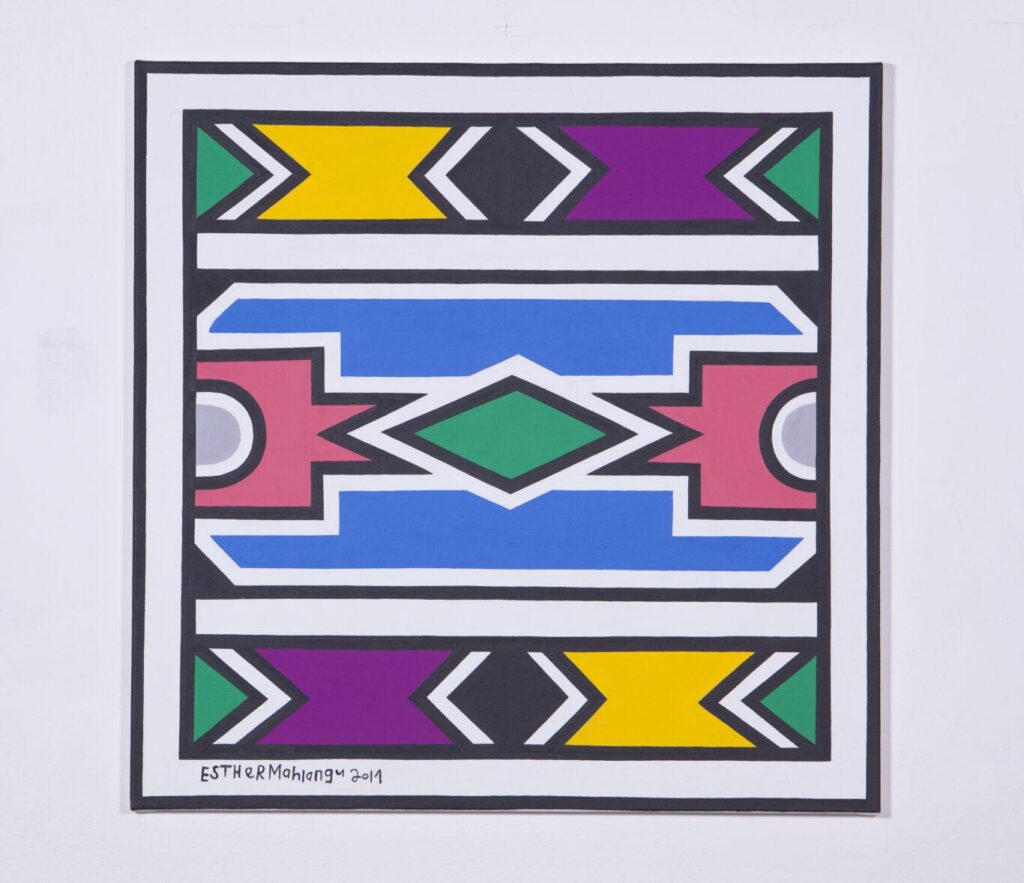
Painting as a modern, commercially determined practice hardly existed in Ndebele culture before the 1990s. Esther Mahlangu pioneered the artistic transference of Ndebele designs, then virtually exclusively reserved for wall paintings, onto canvas. Wanted Online Her adaptation was pragmatic and visionary: “I started painting on canvas and board as I realised not everybody will be able to see the Ndebele painting in Mpumalanga where I live, and I felt I need to take it to them to see. This is how my work started to be exhibited in museums and galleries around the world.” Artsy
Yet Mahlangu’s case is exceptional, not typical. Thousands of African artisans remain excluded from the economic value their traditions generate abroad. Mahlangu’s visibility becomes both proof of possibility and indictment of the larger system. MoMAA The global art market did not discover the value of Ndebele art — it merely began to price it, and that is a distinction with profound ethical implications.
Recognition, Legacy, and the Pedagogical Imperative
The institutional honours Mahlangu has accumulated are considerable. In 2006, the Government of South Africa awarded Mahlangu the Order of Ikhamanga in Silver for “excellent contribution to the development of the indigenous Ndebele arts.” In April 2018, she was awarded an honorary doctorate by the University of Johannesburg. In 2024, she received an honorary Doctor of Philosophy in mathematics from the University of South Africa in recognition of her artistic career and “mathematical prowess.” Wikipedia That last degree — in mathematics — is itself a critical statement: it formally acknowledges what artists and scholars of African visual culture have long argued, that geometric abstraction of this complexity is not instinctive decoration but rigorous spatial and mathematical thinking.
With the goal of preserving her cultural heritage, Mahlangu started an art school in the backyard of her home in Mabhoko (Weltevreden) in the KwaMhlanga district. She funded the school herself, and when not travelling for exhibitions she mentors young artists in the traditional style of Ndebele design. Pupils learn how to mix pigments and paint straight lines, freehanded and without sketches, using their fingers or chicken feathers. South African History Online This act of self-funded pedagogy — an artist establishing an institution outside the state, outside the market — is perhaps her most radical gesture. It insists that the transmission of this knowledge must not depend on the goodwill of institutions that have historically misunderstood or exploited it.
Conclusion: The Geometry Holds
In 2024, Mahlangu presented her first full retrospective, Then I Knew I Was Good at Painting, a fifty-year travelling exhibition that originated at the Iziko South African National Gallery. Wikipedia The title is drawn from a story she tells of her childhood: painting on the back of her family’s house while her mother and grandmother were away, being scolded on their return, and persisting anyway — until the day they finally called her back to the front. It is a story about artistic formation, but it is also a story about refusal. Refusal to be told where to paint, what to paint, and for whom.
That refusal is the spine of her entire career. Esther Mahlangu has spent nine decades insisting, in the most vivid geometries imaginable, that Ndebele visual culture is not a relic to be preserved under glass but a living language capable of adorning anything from a rural mud wall to a BMW, a Rolls-Royce Phantom, a British Airways tail fin, and the walls of the Centre Pompidou. She did not ask permission from the Western art world to be significant. She simply painted — freehand, without a sketch, without a ruler — and waited for the world to catch up.
Sources
- Zvomuya, P. “Esther Mahlangu and Ndebele Art.” Artforum, June 2025. https://www.artforum.com/features/esther-mahlangu-ndebele-art-percy-zvomuya-1234731435/
- Ndlovu, S. “Esther Mahlangu: How the Famous South African Artist Keeps Her Ndebele Culture Alive.” The Conversation / Daily Maverick, November 2024. https://theconversation.com/esther-mahlangu-how-the-famous-south-african-artist-keeps-her-ndebele-culture-alive-225845
- “Esther Mahlangu.” Wikipedia. https://en.wikipedia.org/wiki/Esther_Mahlangu
- “Esther Mahlangu.” South African History Online. https://sahistory.org.za/people/esther-mahlangu
- “Esther Mahlangu Is Keeping Africa’s Ndebele Painting Alive.” Artsy, 2017. https://www.artsy.net/article/artsy-editorial-esther-mahlangu-is-keeping-africa-s-ndebele-painting-alive
- “The Art Woman: Dr Esther Mahlangu’s Ndebele Art Renaissance.” Wanted Online, 2017. https://www.wantedonline.co.za/art-design/2017-02-10-the-art-woman-dr-esther-mahlangus-ndebele-art-renaissance/
- “Esther Mahlangu — Ndebele Painting Ambassador.” Google Arts & Culture. https://artsandculture.google.com/story/esther-mahlangu-ndebele-painting-ambassador/4QIiDMDyXh5QJg
- Adeyemi, A. “Esther Mahlangu’s Ndebele Revolution: When African Tradition Hits the Global Art Market.” MoMAA, 2025. https://momaa.org/esther-mahlangus-ndebele-revolution-when-african-tradition-hits-the-global-art-market/