A Distant Blue
By Sophie Bonet
There is a particular blue that appears at the edge of sight, a color that seems to belong to places slightly out of reach. Rebecca Solnit calls this “the blue of distance.”¹ It is not only about where we are or are not, but about the way distance settles in the body—how longing and perception come together, forming the space between here and elsewhere. There is something about this blue that resists immediate naming. It is sensed before it is fully articulated, registering at a level that precedes language.
A Distant Blue unfolds within this condition. The exhibition does not frame displacement as a fixed narrative. It moves across memory and separation, along the contours of place and perception. In conversation, Marisa Tellería described this as a rupture—“one that begins at the level of the self and then reverberates across everything that follows.” What emerges isn’t a resolved account of exile, but an ongoing process, held between what can be reached and what slips away.
This condition is shaped by sociopolitical realities—borders, the regulation of movement, and the denial of return. As a Nicaraguan artist, it’s impossible to separate the work from this context. Since 2018, Nicaragua has undergone a period of intensified repression, marked by the criminalization of dissent, the persecution of opposition, and the forced exile of citizens, many of whom have been stripped of their nationality. Within this context, displacement is not a matter of choice. It settles in over time, altering the patterns of individual lives and eventually, the fabric of entire communities.
Rather than depicting these conditions directly, Tellería works through material and perceptual strategies. The exhibition is structured around a set of elements—sky, soil, border, map—that register different relationships to territory: what can be seen, claimed, crossed, remembered, and what remains unreachable.
The sky appears first, functioning as both an entry point and framework. Unlike land, it cannot be owned or divided, yet it is not neutral. In Tellería’s work, the sky is shaped by memory, by color, and by the histories it carries. Blue is not simply atmospheric. It recalls Nicaragua’s flag—blue and white—and the meanings those colors have carried in recent years. After the 2018 protests, their use was penalized, transforming a national symbol into a marker of dissent. As Tellería notes, color does not remain only visual. It is felt in the body—held as tension, as risk.
Before the sky begins to move through projection or disperse across material, it appears in a more fixed form in a series of photographic works, including Untitled (skies, various locations), 2003. These seven images are drawn from different places the artist has lived—geographically distinct contexts that nonetheless converge through the act of looking upward. The skies are not anonymous; they carry the specificity of place even as they appear continuous. Each image isolates a portion of sky at a particular moment—variations of light, density, and atmosphere that, at first glance, seem similar, almost interchangeable. Some appear open and diffused, others compressed, clouded, or weighted.
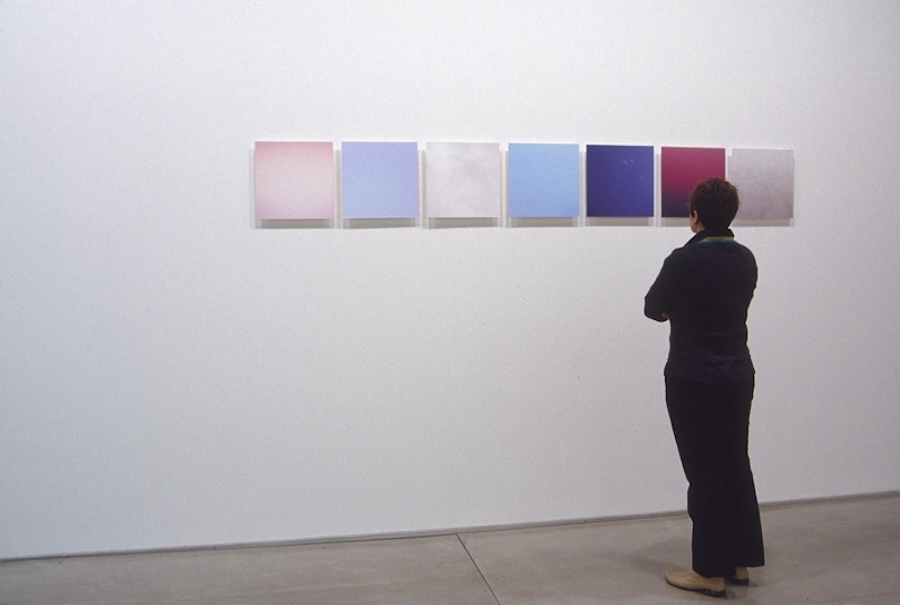
At first glance, a photograph seems to hold a moment still. Yet the sky does not settle. It extends past the edges, refusing to be tamed. Here, what appears is not a single image, but a set of changing conditions—light moving through and places traced only by what passes overhead. The photographs gather both presence and absence: skies from punctual locations, each unique, yet never fully contained by the place where they were taken.
The exhibition holds this tension without resolving it: one sky that remains continuous, and a ground that does not. A space above that stays open, and a territory below that is fractured, restricted, and contested.
This condition comes into focus in the central video installation, One Sky (2026). Participants—both inside and outside Nicaragua—record the sky above them. The images are gathered across distance and time, then brought together through a multi-channel projection. They begin to align into a shared horizon, though not seamlessly; different atmospheres remain visible as the images move across one another. The gesture is simple. But it holds weight. What it makes possible is a form of encounter that can only take place within the work—“a way of doing, symbolically, what cannot happen otherwise.”
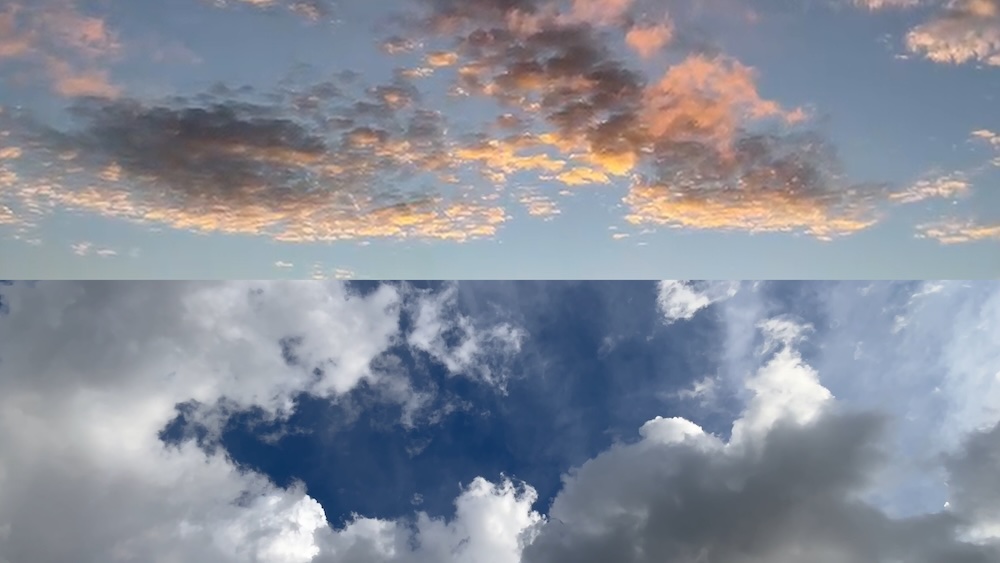
The images are made at different times of day, in different weather conditions, and within different rhythms of daily life. Some remain still, while others move slightly. They don’t fully line up. That misalignment stays visible and eventually becomes an integral part of the work. The images don’t come together into a single, unified view. Instead, they create a sense of proximity—a brief coming together that makes distance even more noticeable. Identity begins to take shape through that process, as the images align and fall out of sync again.
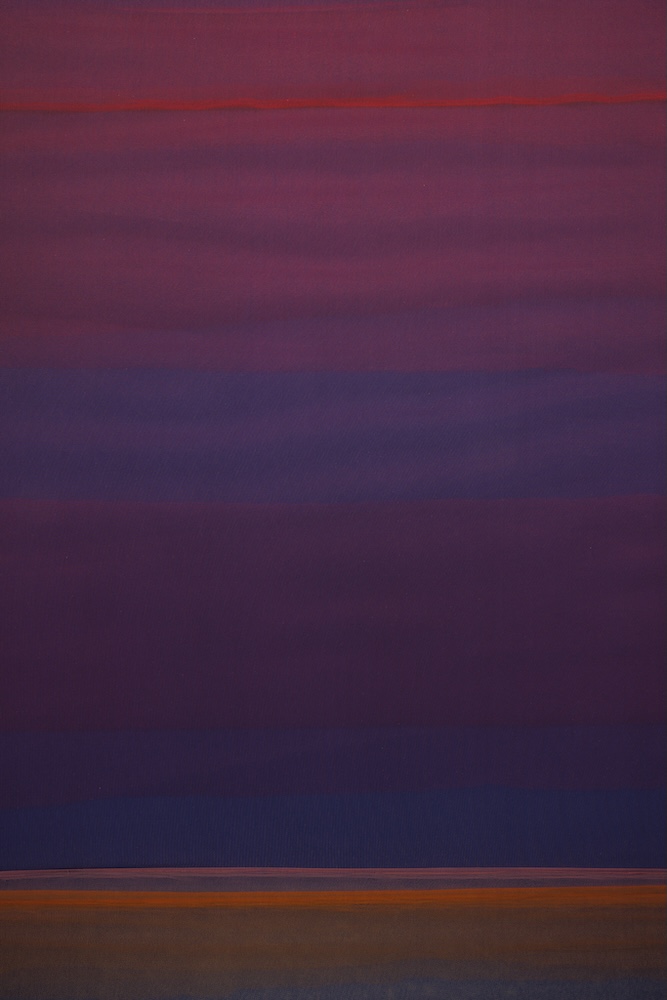
Three large-scale wall pieces—Pink Interval, Gray Interval, and Nocturne (2026)—extend this condition into material form. Built from layered tulle and scrim stretched over wooden support, they rely on the physical qualities of these fabrics—their permeability, tension, and the way they catch and release light.
Color is dispersed across multiple translucent surfaces, so it seems to hover rather than settle. As one moves, opacity gives way to transparency; textures dissolve and then come back into view. Tellería often describes these works as sensorial paintings that emerge through light and color. The key is a slower kind of looking—one that stays with them long enough for these transitions to become visible.
Seeing them in person, the differences between the works become more pronounced. One holds a softer range of pinks and blues–lighter, closer to the atmosphere of a late afternoon. Another feels more compressed and clouded, where the blue is partially obscured. A third deepens into darker, saturated blues, closer to the moment just before night.
They are not literal depictions of time, but they move through it; reading less as images to be decoded and more as changing atmospheric conditions—something you notice gradually, as your eyes adjust.
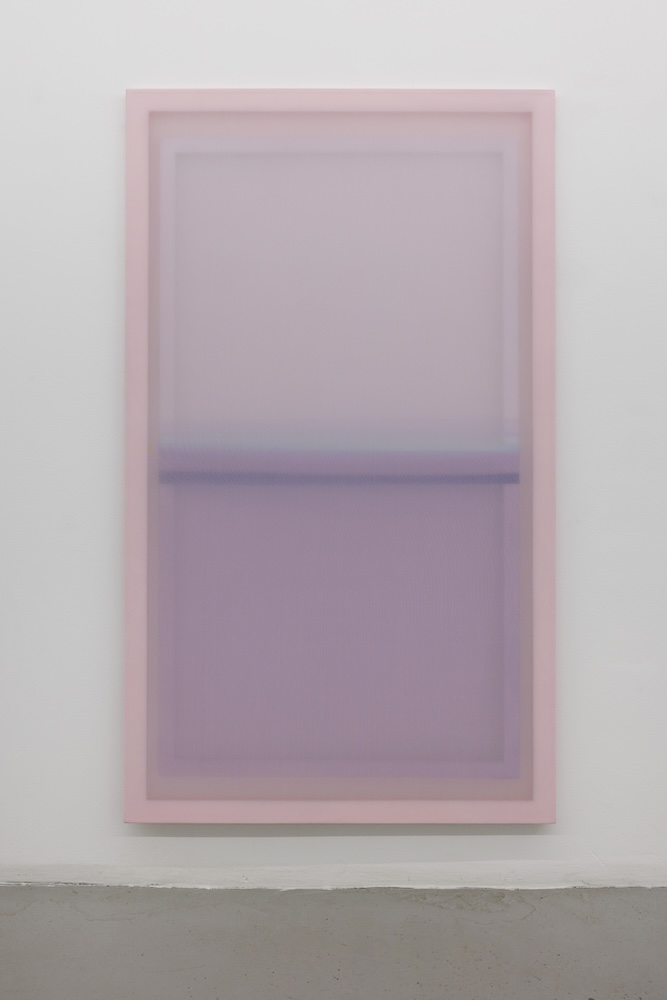
Tellería describes these works as a way of “recreating the sensation of looking,” rather than representing what is seen. The difference becomes clearer in front of the work. The sky is never fully fixed; it’s approached, but not entirely reached.
The layering of soft materials reads as a gradual unfolding—memory settling over what is seen, and perceptual presence over surface itself. What comes forward is less a static view than a field in motion, where presence and absence remain in tension.
This attention to perception moves through the body. The exhibition doesn’t guide so much as place us, viewers, in relation to the work. Spacing invites pause, and proximity becomes part of the experience. Looking slows and becomes physical—it asks for small adjustments.
As Maurice Merleau-Ponty reminds us, the body is not separate from perception; it is how we encounter the world.² Here, that encounter unfolds quietly, without instruction.
If the sky reads as continuous, the maps begin to unsettle it. Des-tierra II (2026) brings together twenty-one silhouettes of Nicaragua, each drawn from memory by Nicaraguans living abroad. These recollections are transferred onto silk and mounted on wooden panels.
The differences show up right away. Some are compressed, others feel uneven. They don’t settle into a single, stable outline. The work moves away from geographic accuracy and focuses instead on how land is remembered. These outlines don’t match the map exactly—they shift through lived experience. Proportions change, edges blur. Some areas stay more defined, while others start to fade.
At stake here is not only how a place is remembered, but how it is defined in the first place. What makes a map valid? Maps are often treated as stable and authoritative, yet they are shaped by decisions—about borders, scale, and what is included or left out. If a map is already an interpretation of territory—an abstraction shaped by power, measurement, and convention—then the distance between it and one drawn from memory begins to narrow.
As Gloria Anzaldúa writes, the border is not only a line but a lived condition—something inscribed in the body as much as it is imposed on the land.³ The work does not resolve these questions, but it makes them visible.
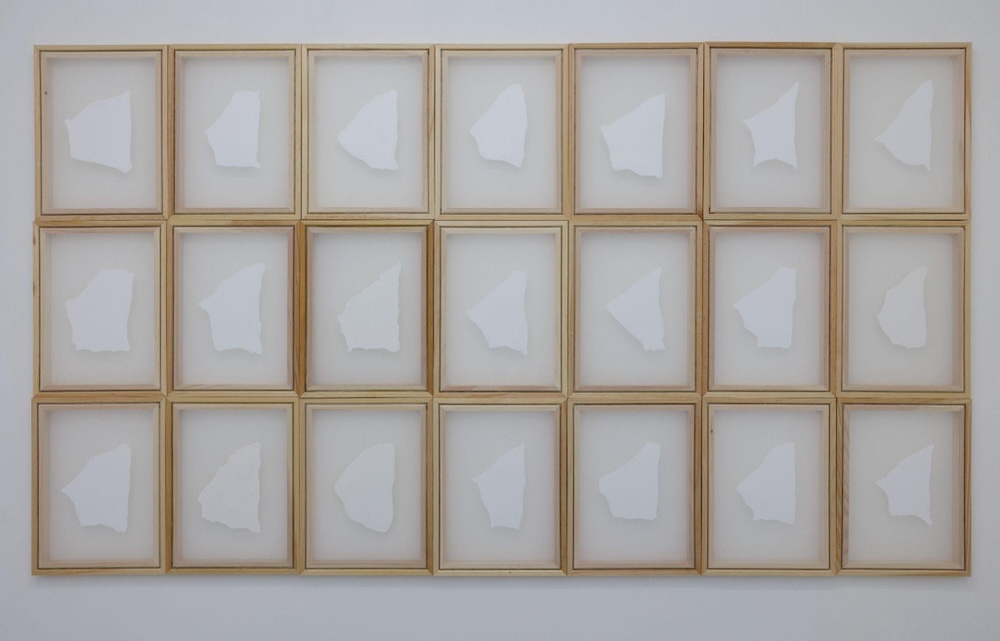
Seen together, the silhouettes operate less as maps and more as traces. They mark how places are carried in memory. The silk holds those variations without correcting them. Together, they suggest a kind of cartography of displacement, reflecting not only where people come from but also how place is remembered and reassembled over time.
The question is less about accuracy and more about what kind of truth these forms hold. These drawings read less like maps and more like recollections—geographies shaped by what is felt or lost. They stay closer to lived experience than to official borders, because homeland here isn’t fixed but carried and adjusted through memory and distance.
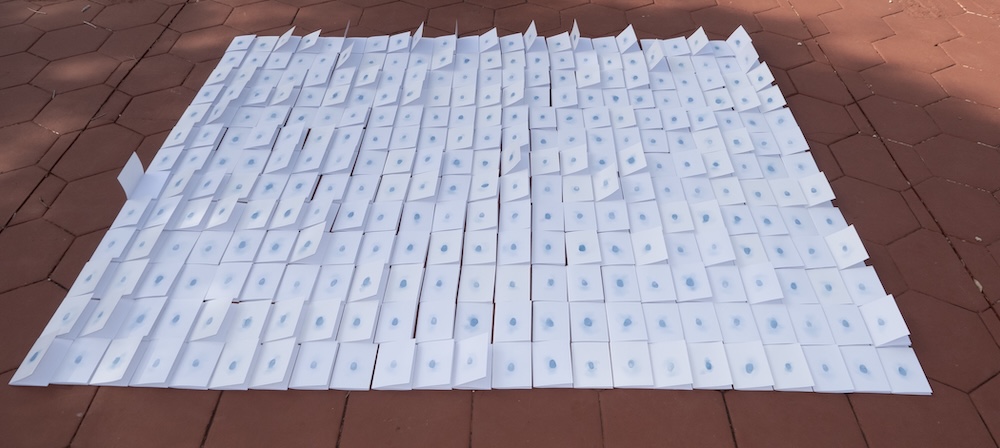
If the maps loosen the authority of geography, the works that follow bring its consequences into focus. Blanco (2023) presents 316 passport-sized notebooks, each marked with a single fingerprint pressed in blue ink onto paper. The repetition is precise, almost methodical. Each notebook corresponds to a Nicaraguan citizen stripped of their nationality and forcibly exiled to the United States. Installed in Rubén Darío Park in Miami, as part of the AIM BIENNIAL 2023–24—a symbolic site for the Nicaraguan diaspora—the work moves beyond the gallery into a shared civic space.
The passport—typically a document tied to identity and mobility—is rendered inert. Its function breaks down here. What is meant to allow movement instead marks its restriction. Identity, in this case, is no longer something self-held or assumed, but something administered, revoked, or withheld. These individuals have been removed from the civil registry. In bureaucratic terms, they no longer exist within the nation.
The openness of the sky gives way to something contained, regulated. The notebooks remain blank, but their silence carries weight. The title, Blanco, points to both absence and erasure, while also recalling the blue and white of Nicaragua’s flag. The work echoes Rubén Darío’s Azul and his line, “If the homeland is small, one dreams it big,” holding that tension between imagination and constraint.
The fingerprint does not restore citizenship, but it resists disappearance. It remains as a trace—biometric, physical, undeniable—anchoring identity in the body when it has been stripped from the state. Across the installation, these marks accumulate into more than a record of loss. They point to the presence and the persistence of identity even when mobility, belonging, and recognition are denied.
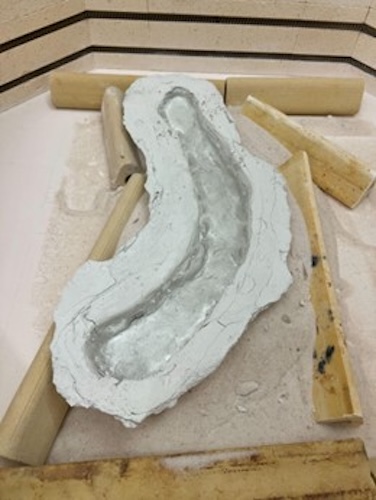
Nearby, Latitud Norte (2026) cuts across the space at an angle. A line of cast glass runs along the floor, its surface absorbing and refracting light as it moves through the gallery. It is easy to miss at first—until it interrupts your path. The line is not neutral. It marks and references the Nicaragua–Honduras border, altering perception and proposing a way of navigating the space.
The work traces back to a moment when Tellería stood close to the border, encountering a division that appeared both arbitrary and absolute—“almost imperceptible, yet impenetrable.” That contradiction stays with the piece. The border can feel almost provisional, and still determine who crosses and who does not.
The piece is made through an elaborate casting process. The line starts as a clay form, then moves through a series of casts before reaching its final refractory shape. That form is filled with pieces of glass and fused in the kiln. The work comes together through these stages, each one shaping the last. It builds gradually, through accumulation rather than a single gesture.
This marks Tellería’s first time working with kiln-cast glass. Known for a more controlled and meticulous approach, here the material introduces a different condition. Glass does not fully submit to intention; it settles on its own terms during firing. The process requires a degree of surrender; an acceptance of outcomes that cannot be entirely predetermined. In this sense, the work also marks a shift in her practice, where her visual language expands through experimentation with materials that resist control.
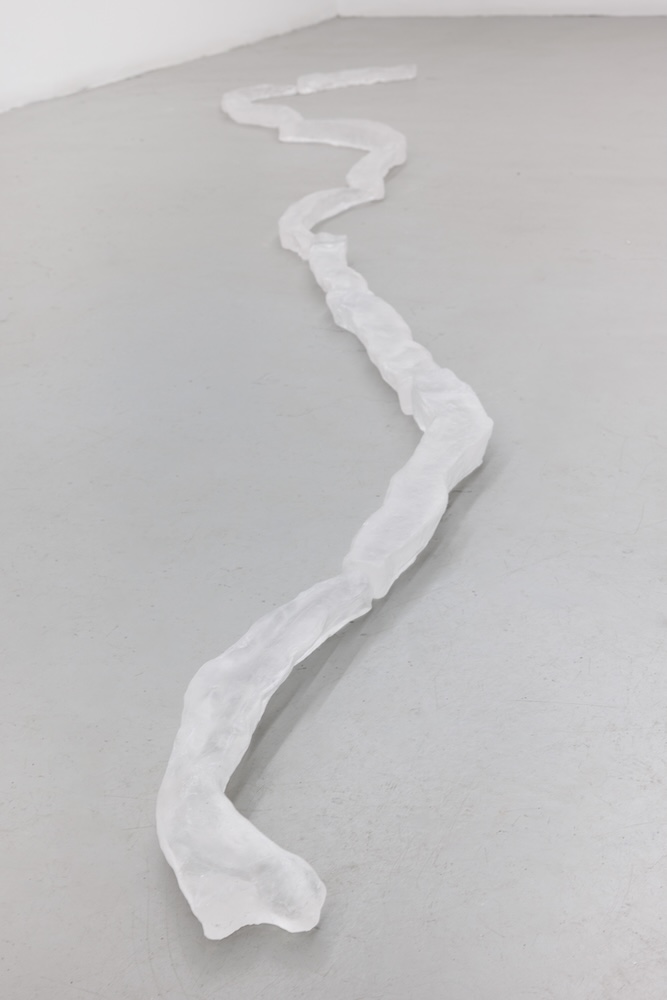
Glass changes how the work is read. It feels fragile, exposing a sense of vulnerability—maybe even our own in relation to it—but it also carries a quiet resilience. It holds a tension between breaking and holding, between what might disappear and what stays. The line is precise, but it doesn’t fully settle. Its presence depends on light, movement, and attention.
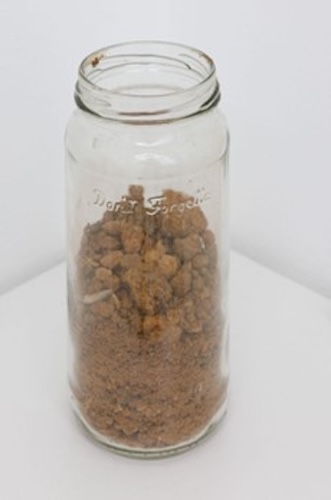
The final gesture, Don’t Forgetta (2026), returns to an intimate scale. A small glass container holds Nicaraguan soil, carried across distance by a friend. The material is raw, dense, and granular, composed of small stones and fragments that still retain the texture of the land.
After the immateriality of sky and projection, the work comes back to something concrete. The soil doesn’t stand in for the land; it points to its absence. It remains a palpable fragment—something that can be held when the rest cannot.
Throughout the exhibition, Tellería’s practice extends beyond the studio. Many of the works develop through exchanges with members of the diaspora—through drawings, documentation, and gestures that build over time. The work doesn’t fix identity. It gathers it gradually, through remembering, translating, and reworking what has been carried and shared across distance.
As Ocean Vuong writes, “What is a country but a life sentence?”⁴ The question stays with the work—not as a declaration, but as something that runs through it. Country reads as something both weighty and carried: in color, in memory, in documents that lose their function, and in gestures that attempt, however partially, to repair.
In A Distant Blue, things don’t settle into a single view. The sky seems to connect, but the ground doesn’t follow. The maps unfold depending on how they are remembered. The border persists. Tellería doesn’t try to resolve this. Instead, she makes it visible, bringing forward the complexity of these conditions, including the contradictions of exile—between places, between images, between what can be held and what cannot.
What the exhibition proposes is not a unified picture or a reconciled position, but a way of experiencing how these conditions are lived and embodied. Distance is not something abstract here. It shows up in fragments, in interruptions, in what doesn’t quite align. Identity, in turn, does not appear as fixed or complete, but as something in constant flux. It takes shape through that process—through what is carried, what shifts, and what continues to be negotiated over time.
Footnotes
This essay was developed through a series of studio visits and conversations with the artist Marisa Tellería between October 2025 and April 2026; all quotations are drawn from these exchanges.
- Rebecca Solnit, A Field Guide to Getting Lost (New York: Penguin Books, 2005).
- Maurice Merleau-Ponty, Phenomenology of Perception, trans. Colin Smith (London: Routledge, 2002).
- Gloria Anzaldúa, Borderlands/La Frontera: The New Mestiza, 4th ed. (San Francisco: Aunt Lute Books, 2012).
- Ocean Vuong, On Earth We’re Briefly Gorgeous (New York: Penguin Press, 2019).
Fig. 5
Installation view, Des-tierra, 2023