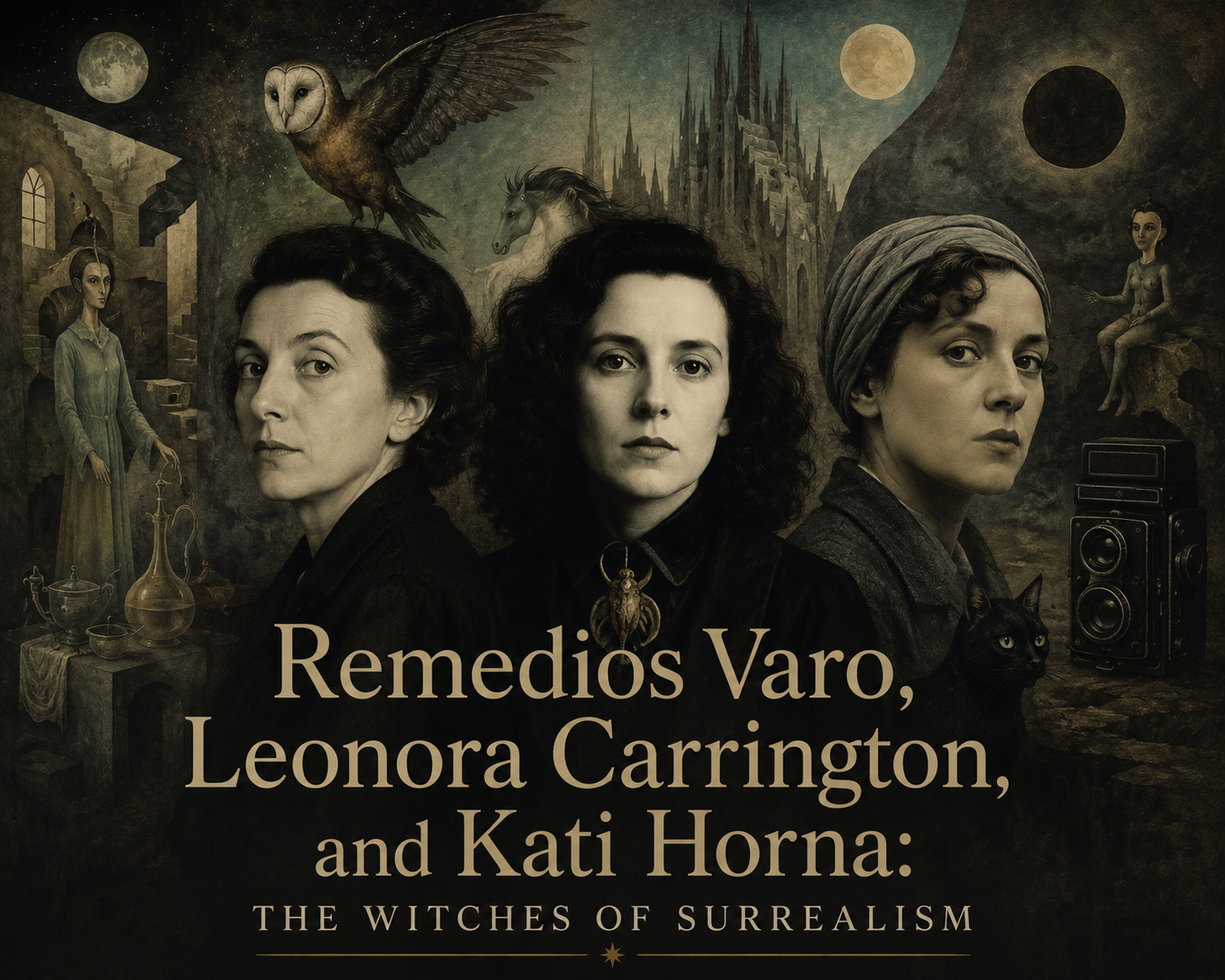
Remedios Varo, Leonora Carrington, and Kati Horna: The Witches of Surrealism
In the cultural landscape of twentieth-century Mexico, few artistic friendships possess the symbolic, intellectual, and mythological power of the relationship between Remedios Varo, Leonora Carrington, and Kati Horna. Exiled from a Europe devastated by fascism and war, these three women found in Mexico not only refuge, but also the possibility of reinventing themselves artistically, spiritually, and emotionally. Their alliance became much more than a friendship: it evolved into a creative constellation where surrealism, mysticism, esotericism, feminism, exile, and imagination converged into one of the most extraordinary chapters in modern art history.
They would later become known as “the witches of surrealism” — not because they practiced literal witchcraft, but because their artistic universes invoked transformation, ritual, alchemy, intuition, and the invisible dimensions of reality. In a surrealist movement historically dominated by male figures such as André Breton, Max Ernst, Salvador Dalí, and Yves Tanguy, Varo, Carrington, and Horna constructed an alternative surrealism rooted not in the objectification of women, but in female consciousness itself.
Their meeting in Mexico City during the 1940s represented a profound cultural and symbolic encounter. Within a house in the Roma neighborhood, these artists shared conversations, meals, dreams, occult studies, artistic collaborations, and emotional support during years marked by exile and displacement. Mexico became fertile ground for their imaginations precisely because it existed outside the rigid intellectual structures of wartime Europe. There, they found the freedom to explore magical thinking, mythology, science, mysticism, and psychic transformation without fear of persecution or ridicule.
Remedios Varo: Alchemy, Science, and the Architecture of the Invisible
Remedios Varo’s paintings operate as metaphysical laboratories where science and mysticism coexist harmoniously. Born in Spain in 1908, Varo developed an extraordinarily refined visual language in which elongated figures, mysterious machines, astronomical systems, and symbolic architectures form intricate narratives of spiritual transformation.
Unlike traditional surrealism, which often emphasized automatism and irrationality, Varo approached imagination with almost scientific precision. Her compositions reveal an obsession with geometry, mechanics, cosmology, and alchemical processes. The female figure in her work frequently appears not as passive muse, but as magician, inventor, traveler, or creator of worlds.
Mexico profoundly transformed her artistic vision. Surrounded by pre-Hispanic cosmologies, colonial architecture, popular mysticism, and indigenous symbolism, Varo developed paintings that feel suspended between dream, ritual, and philosophical inquiry. Her work suggests that reality itself contains hidden structures accessible only through intuition and imagination.
Leonora Carrington: Myth, Rebellion, and Feminine Transformation
Leonora Carrington brought to surrealism an untamed mythology shaped by rebellion, trauma, and spiritual liberation. Born into an upper-class English family in 1917, Carrington rejected conventional social expectations early in life, pursuing painting and literature while gravitating toward the surrealist circles of Europe.
Her relationship with Max Ernst and the rise of fascism would radically alter her life. Ernst’s imprisonment during World War II triggered a psychological crisis that led to Carrington’s institutionalization in Spain. Yet this traumatic rupture became transformative rather than destructive. Her eventual escape to Mexico in 1942 marked the beginning of her most important artistic period.
In Mexico, Carrington found a space where female imagination could exist outside patriarchal constraints. Her paintings are populated by hybrid creatures, shape-shifting beings, mystical animals, occult ceremonies, and symbolic transformations. Rather than depicting women as objects of desire — a common trope in male surrealism — Carrington presented female consciousness as a source of cosmic knowledge and spiritual power.
Her artistic universe exists somewhere between Celtic mythology, Jungian psychology, medieval alchemy, and Mexican magical traditions. Carrington’s work proposes that identity itself is fluid, transformative, and deeply connected to invisible forces operating beneath rational consciousness.
Kati Horna: Photography, Exile, and the Surreal Everyday
If Varo and Carrington constructed dream worlds through painting, Kati Horna approached surrealism through the lens of photography. Born in Hungary in 1912, Horna documented the violence of the Spanish Civil War alongside photographers such as Robert Capa and Gerda Taro before eventually fleeing to Mexico after the Nazi occupation of Europe.
Her photography occupies a unique space between documentary realism and poetic surrealism. Horna understood that the uncanny already existed within ordinary life. Through shadows, fragmented spaces, masks, symbolic objects, and theatrical compositions, she transformed photography into a psychological and philosophical medium.
Unlike the heroic narratives often associated with war photography, Horna focused on vulnerability, displacement, domesticity, and emotional tension. In Mexico, her camera captured not only social realities, but also the magical atmosphere embedded within everyday existence.
Her collaborations and friendships with Varo and Carrington helped preserve the memory of this extraordinary creative circle. Through Horna’s photographs, the mythology surrounding these women continues to survive visually and historically.
The Feminine Counter-Surrealism
What makes these three artists historically radical is that they transformed surrealism from within. Male surrealists frequently positioned women as symbols of irrationality, erotic mystery, or unconscious desire. Varo, Carrington, and Horna rejected this passive role entirely.
Instead, they became creators of symbolic systems themselves.
Their works explored:
- occult knowledge,
- transformation,
- female autonomy,
- exile,
- spiritual rebirth,
- mythology,
- and the hidden structures of reality.
The “witch” metaphor surrounding them reflects this symbolic power. The witch historically represents forbidden knowledge, intuition, resistance, and female independence — qualities deeply embedded within their artistic practices.
Mexico as Sacred Territory
Mexico was not merely a backdrop to their work; it became an active force within their artistic evolution. The country’s relationship to death, ritual, spirituality, indigenous cosmologies, and magical realism offered these women an alternative intellectual framework to Western rationalism.
Within Mexico, they discovered a society where mythology and daily life often coexist naturally. This cultural atmosphere allowed their surrealism to evolve beyond European psychoanalysis into something more mystical, symbolic, and spiritually expansive.
Legacy
Today, Remedios Varo, Leonora Carrington, and Kati Horna are recognized not simply as women within surrealism, but as artists who fundamentally transformed the movement itself. Their works continue to resonate because they speak to contemporary questions surrounding identity, displacement, feminism, spirituality, ecology, and imagination.
Together, they created a visual language where art becomes ritual, transformation, and metaphysical inquiry. Their friendship demonstrates that artistic communities are capable of generating not only creative innovation, but also emotional survival during periods of historical catastrophe.
They were not witches in the literal sense.
Yet through painting, photography, symbolism, and imagination, they practiced a different kind of magic — one capable of transforming exile into myth and suffering into visionary creation.