Written By Olga Garcia-Mayoral
Exhibition: November 5, 2025 – March 16, 2026 • Site visit: November 26, 2025 • Interview: Curatorial Assistant Kimari Jackson
MOCA North Miami’s galleries have been reshaped into a living concept: the jannat, or “Paradise Garden.” The exhibition—Hiba Schahbaz: The Garden, the artist’s first major museum solo—opens with a verse by the great Urdu poet Mirza Ghalib, whose lyric compression primes you to read pictures the way you read couplets: slowly, by metaphor and return. The show’s curatorial armature borrows from the char-bagh, the four-part garden associated with Persian and Mughal design; not as a rigid checklist, the museum stresses, but as a lens for wayfinding through 15+ years of work in which self-portraiture, mythology, and the elements course together.
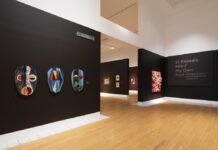
Curatorial Assistant Kimari Jackson—who stewarded the installation with guest curator Jasmine Wahi—described the design as a network of “portals,” a spatial answer to the garden idea. “We decided to do basically portals, trying to mimic an Islamic garden,” she told me on our walkthrough. “You see the show from different angles… broken up into five different courtyards.” The choice, she said, was a risk: “The triangles were new for us—precise, expensive, and our most intricate layout yet—but once it came together, people were happy.”
A grid of water, a city of light
In classical char-bagh planning, water orders the garden as canals divide space and converge at a fountain. Here, the grid is conceptual: channels become sightlines; crossings become thresholds between architecture and the elements—water, fire, Earth (air is implied in the open sightlines and figure’s breath). The museum’s wall text explicitly states that the works were not made to fit this scheme; the char-bagh is a poetic framework that maps Hiba’s recurring metamorphoses. That framework also courts local resonance, echoing South Florida’s lush gardening culture and the ways immigrant and diasporic communities cultivate place.
The fit is uncanny: in North Miami’s multicultural context, a garden is not just an Edenic dream, it’s a civic practice. Curatorially, it’s smart to anchor the show there and to begin with Ghalib—a nod to Sufi-inflected intimacies that thread the artist’s imagery.
A practice grown from miniature to life-size.
Born in Karachi and trained in Indo-Persian miniature painting at Lahore’s National College of Arts, Hiba Schahbaz arrived at the idiom that still undergirds her work: exacting line, handmade papers, tea-tinged washes, and a devotional attention to the figure (usually her own). The show tracks the expansion of that craft into large-scale oils, painted paper cut-out installations, and—new here—works on wood. The continuity is less about the medium than about ethics: a ritual meticulousness repurposed for a contemporary, feminist gaze. (mocanomi.org)
Kimari walked me into the Architecture room, the only section not assigned to an element. “This is where you’ll see art-historical and mythical references flipped through the feminine eye,” she said. A tower that nods toward Babylon is repopulated by women guardians; poetry appears across the lintels; a constellation of cut-out mermaids swims across one wall. “She installed all of these herself,” Kimari noted. “Two weeks on site—each mermaid placed by hand.”
Water, then fire, then Earth
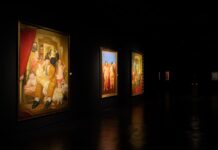
In Water, Schahbaz turns the myth of Leda and the Swan into tenderness. “It’s her perspective,” Kimari said, “a softer way of telling the story, not the objectifying male vantage.” The room’s palette feels like a shallow tide: thalo blue, milk-white surf, skin tones that refuse spectacle. The Fire court burns cooler than the name suggests—smoked corals, dragon greens. Here, Schahbaz’s women co-exist with creatures of power (dragons, lions), but the figures keep the emotional center. New life-size wood pieces—echoes of a commissioned work at the exhibition’s start—read like bodies that have stepped off the panel into the room.
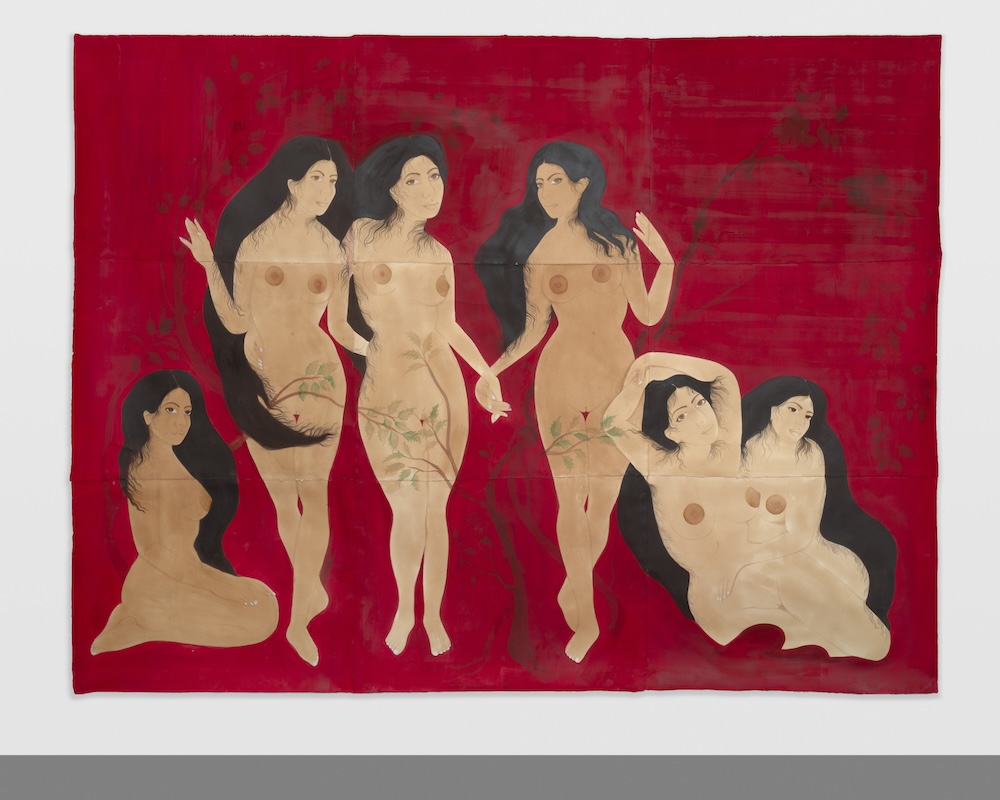
Across Earth, the show’s argument comes into most explicit focus. A monumental self-portrait, spanning multiple sheets of handmade paper, hangs on the wall with unforced authority. Nearby, Schahbaz’s reply to Picasso’s Les Demoiselles d’Avignon recasts the earlier work’s angular masks and colonial exoticism with a softened gaze and a reparative poise. “She focuses on how white male artists portrayed women—and flips it,” Kimari said. It’s emblematic of Schahbaz’s project writ large: to re-script canonical images within a cosmology where female bodies are subjects, not symbols.
The show’s miniatures—often self-portraits born from looking in a mirror—hold an intimate charge. “She began by painting herself,” Jackson said. “Those small works feel like true images—the discipline stripped of performance.” That intimacy scales up without losing pitch: the larger pieces keep the hush of a notebook even as they command a room.
A feminist Eden that remembers history
Schahbaz’s paradise is not naïve. The MOCA text puts gardens in a global frame—spaces of refuge and transcendence across cultures—but the installation also recognizes the garden’s historical entanglements with enclosure and power. The solution isn’t didactic labels; it’s the sequencing. Mythological retellings (Eve, mermaids, dragons) sit in conversation with architectural allegories and with South Asian literary references. The result is a garden with history, a space where transcendence is earned in the open, not hidden behind a hedge.
If the Ghalib epigraph plants the exhibition in language, the galleries let that poetry breathe. The curatorial team resisted over-translation. “We didn’t translate the poems on the walls,” Kimari explained, “out of respect for the original tongue.” Elsewhere, MOCA’s longstanding commitment to multilingual access carries: English, Spanish, and Haitian Creole interpretation recognizes the museum’s audiences and the neighborhood’s Caribbean presence. “We double-check everything with translators—down to the accents,” Kimari said. “And if someone flags a line that doesn’t read right, we fix it.”
Collaboration and trust
Kimari was candid about the choreography behind the scenes. “It’s interesting working with an artist and a curator who aren’t local,” she said of Schahbaz (Brooklyn-based) and Wahi (New York). “There’s a lot of trust in us that it’s going to look the way we’ve been talking about for almost a year.” That trust extended to exhibition designer Matt Roza, whose triangular portals literally frame the show’s argument. “We wanted things broken into important sections… since it’s not chronological, it’s about where the elemental themes land,” Kimari added.
The decision not to organize by year but by element and architecture gives the retrospective bite without nostalgia. It allows the viewer to watch the palette shift and the scale expand across time, while keeping the through-lines (self-portraiture, allegory, feminist address) legible. It also foregrounds what the museum identifies as multiplicity and transformation in Schahbaz’s vocabulary—figures as selves and symbols, bodies as conduits for narrative charge.
Education, community, thresholds
MOCA is mindful of the intergenerational public walking into The Garden. “We have after-school programs and Sunday Stories,” Kimari said, “and we’re looking at mythical books—mermaids, dragons—as a way to tie in.” Nudity is handled with care: a polite warning at the entrance, then pictures that “are not graphic… done in a subtle, feminine way.” In a city where family visits often begin with very young viewers, this is a notable line to walk—and a reminder that a Paradise Garden welcomes many ages.
The museum’s Miami Art Week materials have leaned into the show’s mix of Sufi mysticism, global myth, and feminist gaze, pairing Schahbaz with a concurrent exhibition by Diana Eusebio—another artist using craft, narrative, and the vegetal world to rethink home. It’s a brilliant institutional duet, one that uses Miami’s seasonal attention to underline MOCA’s longer-term commitments.
Why now, why here
What makes The Garden land in North Miami isn’t only the content; it’s the institutional frame. MOCA’s current exhibitions page makes the case with clarity: over this winter season, the museum positions transnational practices—South Asian, Caribbean, Miami-made—in productive adjacency. It’s a curatorial stance that treats diaspora as the rule rather than the exception and designs the building accordingly.
This matters for Schahbaz. Her first museum solo arrives as a summation—more than 70 works across formats, a vocabulary of mermaids, dragons, lilies, and self-portraits braided to art history—but also as a new start, especially in the wood pieces and the architectural ambitions of the cut-outs. It confirms that the miniature discipline wasn’t left behind; it was scaled, its ritual intact.
A retrospective that feels like a beginning
Before we left the Earth courtyard, Kimari pointed to a favorite: the Picasso reply. “I remember seeing Demoiselles at MoMA, and before Hiba spoke about it, that’s what I thought of,” she said. What she loves is how artists write back—not to score a point but to recompose a gaze. That, ultimately, is what The Garden does room by room: recompose ways of looking at myths, at women’s bodies, at the inherited forms we live inside.
And if a garden is a place you want to return to, MOCA has built one with paths and views. Visitors move through portals that do what reasonable thresholds do: mark the passage from one state to another. As you leave, the Ghalib couplet lingers like an after-scent. In Miami’s humidity, the idea of paradise can feel cheapened by overuse. Schahbaz and MOCA restore it to a practice: patient, precise, and open to the next rain.