Digital Detox for Visual Artists: Reclaiming Attention, Restoring Meaning
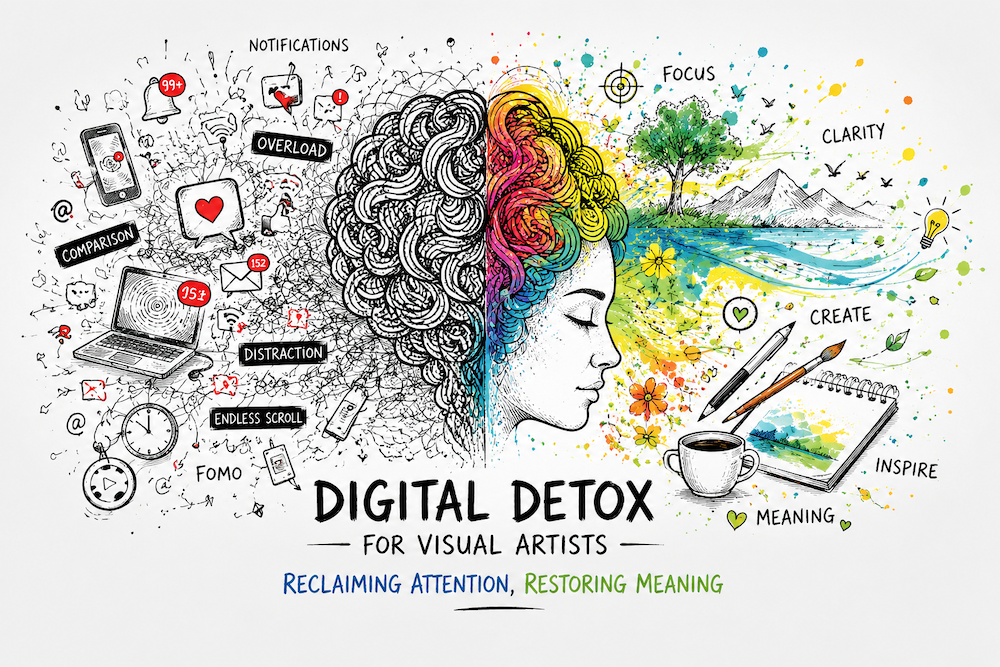
In an era where artistic production is increasingly entangled with digital visibility, the notion of a digital detox emerges not as a lifestyle trend, but as a critical artistic strategy. For visual artists, whose practice depends on perception, attention, and depth of thought, the constant exposure to screens—particularly social media—can fragment cognition and dilute creative intentionality.
A growing body of academic research supports this concern. Studies show that digital overuse is linked to reduced attention span, increased stress, and diminished well-being, while structured digital detox interventions can improve sleep, focus, and overall mental health . Even short-term disengagement—such as a one-week or two-week break—has been associated with measurable reductions in anxiety and improvements in life satisfaction . At a neurological level, social media platforms operate through reward mechanisms that trigger dopamine release, reinforcing compulsive engagement patterns that compete directly with sustained creative work .
However, the concept of a “dopamine detox” is often misunderstood. As researchers and clinicians emphasize, one cannot literally “detox” from dopamine; rather, the practice involves reducing overstimulation and rebalancing behavioral habits . In this sense, digital detox is less about abstinence and more about recalibration—a return to intentional use of attention.
This aligns closely with the philosophical framework proposed by Arthur Brooks, who argues that meaningful life is built not on passive consumption but on active engagement. His emphasis on reducing what he calls “dumb nonsense”—mindless scrolling and low-value digital input—resonates profoundly with artistic practice. For Brooks, reclaiming time and attention allows individuals to reconnect with the four pillars of happiness: faith, family, friendship, and meaningful work. For artists, this translates into a return to studio presence, material engagement, and the slow unfolding of ideas.
For the contemporary visual artist, the digital environment presents a paradox. It offers unprecedented visibility and connectivity, yet simultaneously erodes the very conditions required for meaningful creation. The studio—once a site of solitude and concentration—now competes with the algorithmic logic of constant stimulation. The act of making is interrupted by the compulsion to document, share, and compare.
A digital detox, therefore, is not a rejection of technology, but a reassertion of artistic autonomy. It is the deliberate act of choosing depth over distraction, process over performance, and presence over immediacy. It is, ultimately, a return to the essential question of art: not how it is seen, but how it is made.
In this light, the digital detox becomes a contemporary form of resistance—an aesthetic and ethical gesture that restores the artist’s most valuable resource: attention.