The Mathematics of Creativity: Wisdom for the Stuck Visual Artist
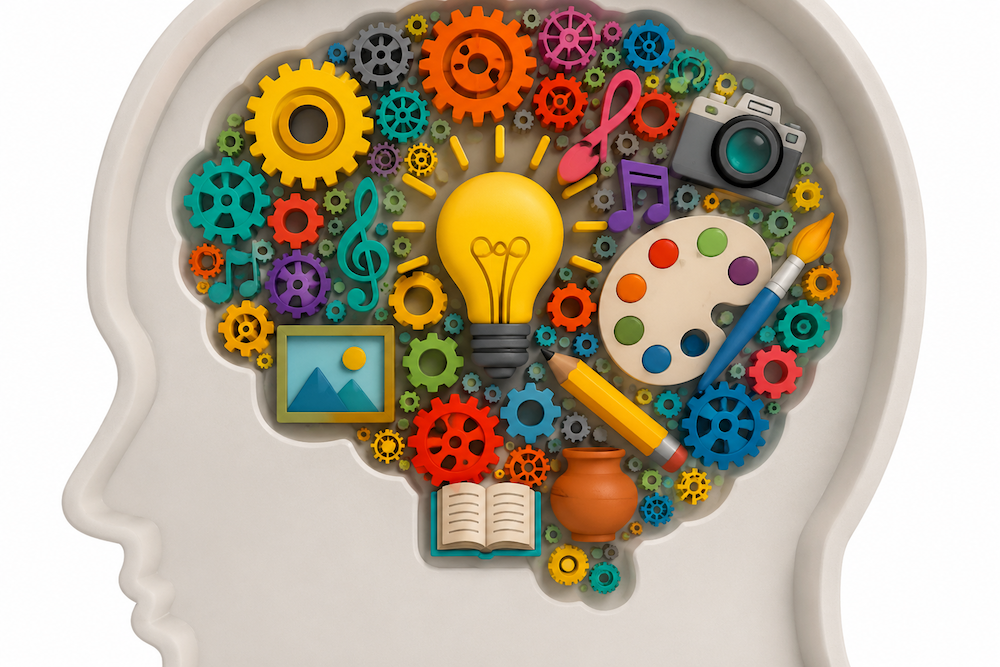
One of the most damaging myths in contemporary art is the belief that creativity is a mysterious gift possessed only by a select few. The romantic image of the artist as a visionary suddenly struck by inspiration continues to dominate cultural imagination. Yet psychology, cognitive science, mathematics, and art history suggest something radically different: creativity is not chaos alone. It follows patterns, structures, probabilities, and accumulations. In many ways, creativity behaves less like magic and more like mathematics.
For the stuck visual artist, this realization can be liberating.
Creative paralysis often emerges from a misunderstanding of how artistic breakthroughs actually occur. Many artists believe every idea must immediately possess originality, coherence, and significance. As a result, they become trapped in perfectionism, producing less and judging more. But research into creativity repeatedly demonstrates that masterpieces are statistical outliers generated through sustained production. Psychologist Dean Keith Simonton described this phenomenon through what resembles a “law of large numbers”: the more work an artist produces, the greater the probability of producing exceptional work.
The history of art confirms this principle. Picasso created over 20,000 works. Louise Bourgeois filled decades of notebooks, sketches, and experiments. Gerhard Richter generated endless variations before arriving at resolution. Most works were not masterpieces. Yet without the quantity, the breakthroughs could not emerge.
For the visual artist, this changes the role of failure entirely. Failed paintings, unfinished installations, abandoned sketches, experimental photographs, awkward sculptures, and fragmented concepts are not evidence of inadequacy. They are mathematical necessities within the ecology of creation.
Another important principle appears in what mathematicians call Zipf’s Law: within large systems, most outcomes are average while only a small number become extraordinary. Applied to artistic practice, this means most ideas will inevitably be ordinary. A few will possess potential. Very few will become transformative.
This is not pessimistic; it is profoundly freeing.
The artist no longer needs every work to justify existence. The role of the studio becomes generative rather than performative. Creativity depends on volume, experimentation, and movement.
Margaret Boden’s theory of combinational creativity expands this further. According to Boden, innovation rarely emerges from absolute originality; it emerges from recombination. Existing images, memories, forms, symbols, materials, and references are reorganized into new relationships.
This principle has shaped the history of visual culture itself:
- Cubism recombined African sculpture and European painting.
- Pop Art recombined advertising and fine art.
- Contemporary installation art merges architecture, sound, performance, and sculpture.
- Digital culture continuously remixes visual language.
The stuck artist often waits for an entirely “new” idea when creativity itself is fundamentally relational. The breakthrough frequently emerges not from invention, but from unexpected combinations.
Equally important is the mathematics of time. Malcolm Gladwell popularized the idea that mastery develops through accumulated practice rather than sudden talent. While the “10,000-hour rule” remains debated, the underlying principle reflects a deeper truth: artistic growth behaves exponentially. Early progress appears slow, almost invisible. Then, over time, accumulated experience compounds.
This explains why many artists abandon themselves too early. They mistake the invisible stages of development for stagnation.
Complexity theory offers perhaps the most poetic insight of all. Scientists describe creativity as emerging at the “edge of chaos” — the unstable threshold between rigid order and complete randomness. Too much control suffocates invention. Too much chaos dissolves meaning. Creativity flourishes precisely in the unstable middle ground where structure and unpredictability coexist.
This is where great visual art lives:
between intuition and discipline,
between accident and intention,
between fragmentation and coherence.
The wisdom for the stuck artist, then, is not to wait for inspiration. It is to enter the flow of production without demanding immediate perfection. Creativity is cumulative motion. Every drawing, failed experiment, collage, color study, or unfinished sculpture participates in a larger invisible equation.
The artist’s task is not to control every outcome.
It is to remain in movement long enough for emergence to occur.
Perhaps the true formula for artistic creation is remarkably simple:
Creativity = Attempts × Time × Combinations × Risk.
And within that equation, the most important variable is persistence.