Philippe Vergne and the Future of The Bass: A Defining Moment for Miami’s Contemporary Art Landscape
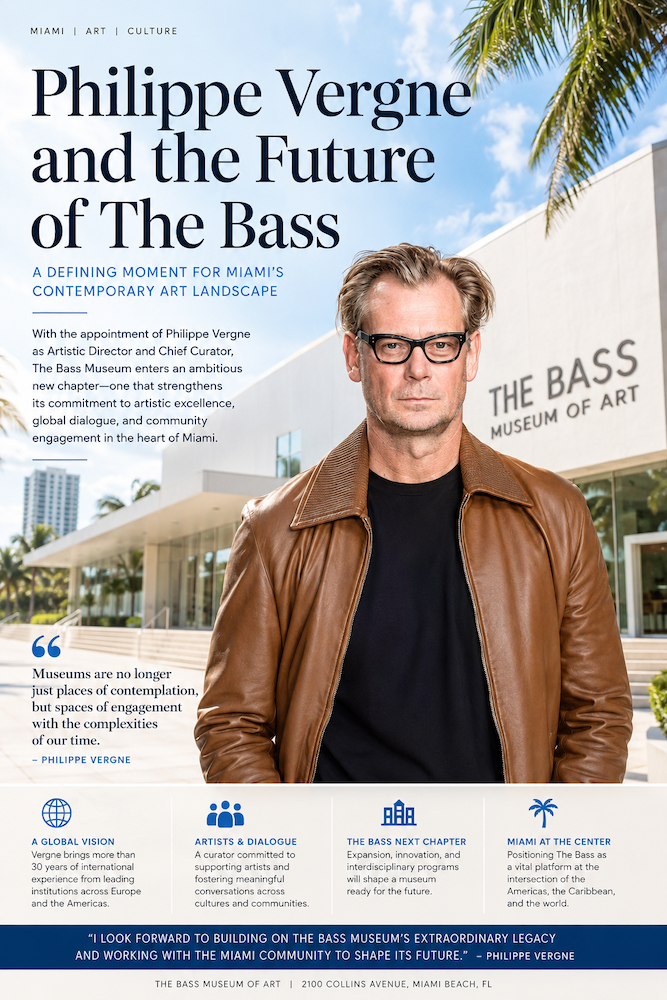
The appointment of Philippe Vergne as Artistic Director and Chief Curator of The Bass marks one of the most significant institutional developments in Miami’s contemporary art ecosystem in recent years. More than a leadership transition, this decision signals the museum’s ambition to position itself as a major international platform for contemporary artistic discourse at a moment when Miami continues to redefine its cultural identity on the global stage.
Vergne arrives with one of the most distinguished curatorial and museum leadership careers of his generation. Over the past three decades, he has held key positions at some of the world’s most influential contemporary art institutions, including the Musée d’Art Contemporain in Marseille, the Walker Art Center in Minneapolis, the Dia Art Foundation in New York, MOCA Los Angeles, and most recently the Serralves Museum of Contemporary Art in Porto. His trajectory reflects a rare combination of intellectual rigor, curatorial experimentation, and institutional vision.
What makes this appointment particularly compelling is its timing. The Bass is entering a new phase of expansion, supported by a major capital investment and an ambitious architectural development project. At the same time, the museum has increasingly distinguished itself through exhibitions that bridge global contemporary practices with Miami’s unique cultural geography. Vergne’s appointment suggests a desire not simply to grow physically, but to deepen the museum’s intellectual and artistic impact.
Throughout his career, Vergne has championed artists whose work challenges conventional narratives and expands the social role of contemporary art. His curatorial philosophy has consistently emphasized dialogue, critical inquiry, and the museum as a site of civic engagement rather than mere cultural consumption. In recent statements, he has argued that museums have evolved from spaces of contemplation into spaces of active engagement with the complexities of contemporary society.
For Miami, this perspective could prove transformative. The city occupies a unique position between North America, Latin America, the Caribbean, and Europe. Yet despite its prominence as an art market destination, it continues to search for a deeper institutional identity capable of reflecting its multicultural realities. Vergne’s international experience and commitment to artist-centered dialogue may offer a framework through which The Bass can strengthen its role as a museum that not only presents contemporary art but also actively participates in shaping cultural conversations.
Equally important is the collaborative structure of the new position. Working alongside Executive Director Silvia Cubiñá, Vergne will contribute not only to exhibitions but also to educational initiatives, collection development, and the museum’s expansion strategy. Such an integrated role acknowledges that contemporary museums are no longer defined solely by exhibitions but by their capacity to connect artistic production, public engagement, and institutional responsibility.
The question now is not whether Philippe Vergne can elevate The Bass—his record suggests he can—but how his vision will interact with Miami itself. The most successful museum leaders do not impose models from elsewhere; they listen, adapt, and build upon the particularities of place. Vergne has already emphasized the importance of conversation before defining a curatorial agenda, a promising indication that his approach will emerge from engagement rather than prescription.
As Miami’s cultural institutions continue to mature, the arrival of Philippe Vergne may be remembered as a pivotal moment in the evolution of The Bass. His appointment represents more than a change in leadership; it reflects an aspiration to position the museum as a site where contemporary art, critical thought, and public life intersect with renewed relevance and international significance.