Alma Allen: Representing US at Venice Biennale 2026
Matter, Silence, and the Politics of Form
The selection of Alma Allen as the United States representative at the Venice Biennale 2026 marks one of the most unexpected—and revealing—moments in recent American art. At once understated and controversial, Allen’s appointment exposes a fracture within contemporary discourse: between spectacle and stillness, between ideological urgency and material introspection.
A Sculptor Outside the System
Born in Utah and based in Tepoztlán, Mexico, Allen has long cultivated a practice that exists at the margins of institutional visibility. A self-taught artist, his work developed “independently of any recognized art movement,” grounded instead in an intuitive dialogue with materials such as stone, wood, and bronze.
This distance from the art world’s conventional circuits is precisely what makes his selection so charged. Unlike predecessors such as Simone Leigh or Jenny Holzer—whose practices engage explicitly with identity, politics, and language—Allen’s sculptures operate in a quieter register. They resist narrative. They resist declaration.
And yet, in that resistance lies their potency.
“Call Me the Breeze”: Elevation as Method
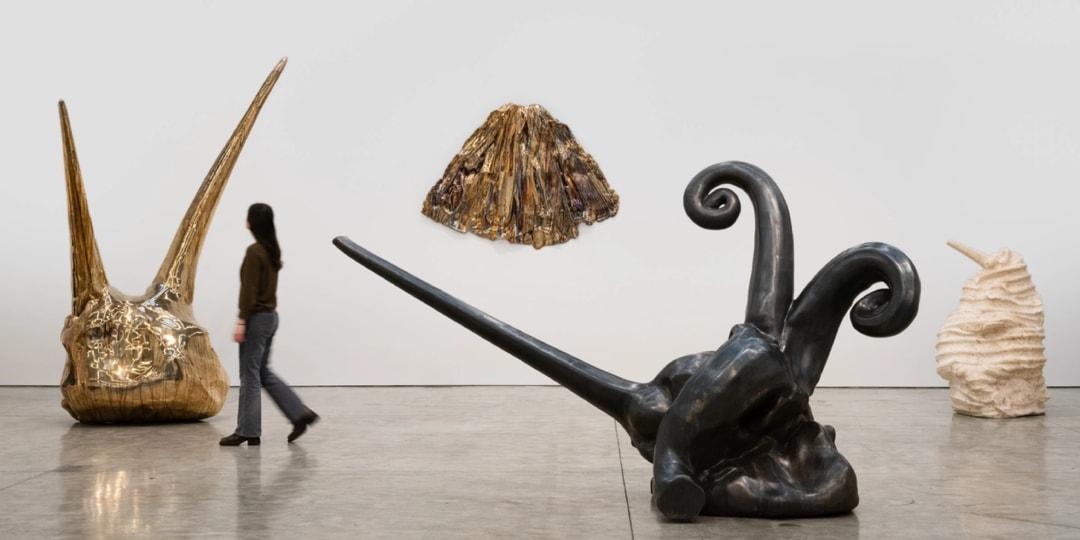
Allen’s pavilion, titled “Call Me the Breeze,” will present approximately 30 sculptures that explore what has been described as an “alchemical transformation of matter” and the concept of elevation.
But elevation here should not be misread as transcendence in the romantic sense. Rather, Allen’s forms—biomorphic, polished, often pierced or hollowed—suggest a continuous negotiation between weight and lightness, density and void. His sculptures do not ascend; they hover, as if caught in a moment of geological hesitation.
There is a profound temporality embedded in his work. Stone appears softened, almost eroded by an invisible time. Wood becomes a vessel rather than a surface. Bronze, traditionally monumental, is rendered intimate. Allen does not impose form onto matter; he coaxes form out of it.
A Controversial Appointment
The context of Allen’s selection is inseparable from its reception. The 2026 U.S. Pavilion emerged from an unusually opaque process, bypassing traditional institutional channels and instead involving the U.S. State Department and the newly formed American Arts Conservancy.
This departure from precedent—combined with Allen’s relatively low public profile—sparked skepticism across the art world. Critics questioned both the selection mechanism and the perceived “apolitical” nature of his work in a moment defined by global instability and cultural polarization.
Yet this critique may misunderstand the deeper stakes of Allen’s practice.
The Politics of Non-Declaration
To call Allen’s work apolitical is to overlook a more subtle proposition: that form itself can be a site of resistance. In an era saturated with images, language, and ideological positioning, Allen’s sculptures insist on something radically different—attention, slowness, and physical presence.
They do not tell us what to think. They ask us to feel how matter thinks.
In this sense, Allen’s work aligns with a lineage that includes Isamu Noguchi and Donald Judd, yet it diverges through its almost mystical sensibility. His objects seem less designed than discovered, as if unearthed from a future archaeology.
A Pavilion of Silence
What might it mean for the United States—at a moment of political intensity and global scrutiny—to present a pavilion grounded in silence, tactility, and ambiguity?
The answer may lie in the very discomfort Allen’s selection has produced. His work refuses to perform identity, refuses to illustrate ideology, refuses even to explain itself. In doing so, it challenges the expectation that national representation must be legible, declarative, or didactic.
Instead, Allen offers something rarer: an encounter.
Conclusion: Between Weight and Meaning
The Venice Biennale has often been described as the Olympics of the art world—a stage for spectacle, competition, and national branding.
Alma Allen’s pavilion may do something else entirely. It may slow the viewer down. It may redirect attention from message to material, from discourse to perception. And in that shift, it may reveal a different kind of American art—one not defined by proclamation, but by presence.
In an age of noise, Allen’s sculptures propose a radical idea: that meaning does not always need to be spoken.