Islamic Art: From the Ilkhanids to the Mughals — A Journey Through Empire, Beauty, and Knowledge
Islamic art is not a style. It is a civilization.
Ilkhanid Period (1256–1353)
Timurid Period (c.1370–1507)
Ottoman Period (before 1600)
Süleyman the Magnificent Period (1520–1566)
Mughal Period (after 1600)
Ottoman Period (after 1600)
Safavid Period (before 1600)
Safavid and Qajar Periods (after 1600)
Spanning more than fourteen centuries and extending across three continents, Islamic art represents one of humanity’s most sophisticated visual traditions. From the courts of Persia and Central Asia to the palaces of Istanbul and the gardens of Mughal India, Islamic artists developed a visual language that fused spirituality, mathematics, poetry, architecture, science, and craftsmanship into a unified artistic vision.
Unlike many Western artistic traditions that centered on individual genius, Islamic art often emphasized collective knowledge, workshop practices, and the transmission of visual ideas across generations. Yet this does not mean individuality was absent. Recent scholarship has increasingly revealed the presence of artists, architects, calligraphers, and manuscript painters whose creative identities shaped the visual culture of entire empires.
The history of Islamic art can be understood through a series of remarkable dynasties whose artistic achievements transformed the visual culture of the world.
The Ilkhanid Period (1256–1353): The Persian Renaissance After the Mongols
The Ilkhanid dynasty emerged following the Mongol conquest of Persia under the descendants of Genghis Khan.
At first glance, one might expect such a conquest to have destroyed Persian culture. Instead, the opposite occurred.
The Mongol rulers gradually adopted Islam and became patrons of Persian art, literature, and architecture. Under their rule, Persian manuscript painting experienced an extraordinary revival.
The Ilkhanids sponsored ambitious illustrated manuscripts, particularly copies of the Shahnameh (Book of Kings), the great Persian epic by Ferdowsi. Artists combined Chinese influences introduced through Mongol connections with established Persian traditions, creating a new visual language characterized by dynamic compositions, atmospheric landscapes, and refined figural representation.
This fusion of East Asian and Persian aesthetics became one of the defining features of later Islamic painting.
The Timurid Period (c. 1370–1507): The Golden Age of Persian Painting
If the Ilkhanids laid the foundations, the Timurids perfected them.
Founded by the conqueror Timur (Tamerlane), the Timurid Empire transformed cities such as Samarkand and Herat into major centers of artistic production.
Timurid workshops produced some of the most celebrated manuscripts in Islamic history. Miniature painting reached extraordinary levels of sophistication, characterized by brilliant color palettes, intricate architectural settings, and unparalleled attention to detail.
Timurid patronage also fostered advances in calligraphy, book design, and architecture. Scholars increasingly view the Timurid period as one of the great intellectual and artistic renaissances of the Islamic world. Many visual conventions later adopted by Ottoman, Safavid, and Mughal artists originated in Timurid ateliers.
The Timurid legacy would become the artistic foundation upon which three major Islamic empires built their visual identities.
The Ottoman Empire Before 1600: Building an Imperial Vision
The Ottoman Empire emerged as one of the most powerful political and cultural forces in world history.
Centered in Istanbul after the conquest of Constantinople in 1453, Ottoman art synthesized Byzantine, Persian, Islamic, and Central Asian traditions into a distinctly Ottoman aesthetic.
Court workshops developed a unified visual language visible across manuscripts, ceramics, textiles, metalwork, architecture, and decorative arts.
The Ottomans excelled in the arts of ornamentation. Floral motifs, arabesques, geometric systems, and elegant calligraphy became hallmarks of Ottoman design. Royal patronage played a crucial role in establishing this visual coherence across the empire.
The Age of Süleyman the Magnificent (1520–1566)
The reign of Süleyman the Magnificent marked the apex of Ottoman artistic achievement.
Under his patronage, architecture, manuscript production, ceramics, textiles, and calligraphy flourished. The architect Mimar Sinan transformed Ottoman architecture through monumental mosques and urban complexes that continue to define the skyline of Istanbul today.
The visual arts also underwent significant refinement. Imperial workshops developed highly sophisticated decorative vocabularies featuring tulips, carnations, roses, saz leaves, and intricate geometric structures.
This period established many of the visual symbols that continue to be associated with Ottoman culture.
The Safavid Empire Before 1600: Persia Reimagined
Founded in 1501, the Safavid dynasty revived Persian cultural identity and established Shi’a Islam as the state religion of Iran.
Safavid rulers became among the greatest patrons of art in Islamic history.
The court of Shah Tahmasp commissioned magnificent manuscripts, including one of the most celebrated illustrated copies of the Shahnameh ever produced. Persian painting reached new levels of elegance and refinement, characterized by lyrical compositions, subtle emotional expression, and extraordinary technical mastery.
Safavid artists also excelled in carpet design, ceramics, metalwork, and textile production. Persian carpets from this period remain among the most admired works of decorative art ever created.
The Mughal Empire After 1600: Observation and Naturalism
The Mughal Empire emerged in India through the descendants of Timur and inherited much of the Timurid artistic tradition.
Yet Mughal art evolved in a unique direction.
Unlike many earlier Persian traditions, Mughal artists developed a remarkable interest in observation and naturalism. Court painters produced detailed studies of animals, plants, birds, landscapes, and historical events with astonishing precision.
Under rulers such as Akbar, Jahangir, and Shah Jahan, artistic workshops became centers of innovation where Persian, Indian, and European influences converged.
The Mughal fascination with the natural world resulted in some of the most scientifically observant artworks produced before modern photography.
Ottoman and Safavid Art After 1600: New Identities, Shared Heritage
By the seventeenth century, the Ottoman and Safavid empires had developed distinct visual identities.
The Ottomans increasingly emphasized decorative abstraction, floral ornament, and architectural grandeur, while the Safavids continued to cultivate figurative painting, luxury textiles, and manuscript production.
Despite political rivalries, both empires shared a common artistic ancestry rooted in Timurid traditions. Modern scholarship increasingly highlights the interconnected nature of Ottoman, Safavid, and Mughal artistic production, revealing extensive exchanges of artists, motifs, techniques, and ideas.
The Qajar Period: Tradition Meets Modernity
The Qajar dynasty (1789–1925) introduced a new chapter in Iranian art.
Qajar painters embraced large-scale portraiture, royal imagery, and increasingly naturalistic representation. European artistic influences became more visible, yet traditional Persian aesthetics remained central.
The period reflects the complex dialogue between tradition and modernity that characterized much of the nineteenth century across the Islamic world.
Geometry, Calligraphy, and the Search for Infinity
Across all these dynasties, certain artistic principles remained remarkably consistent.
Geometry
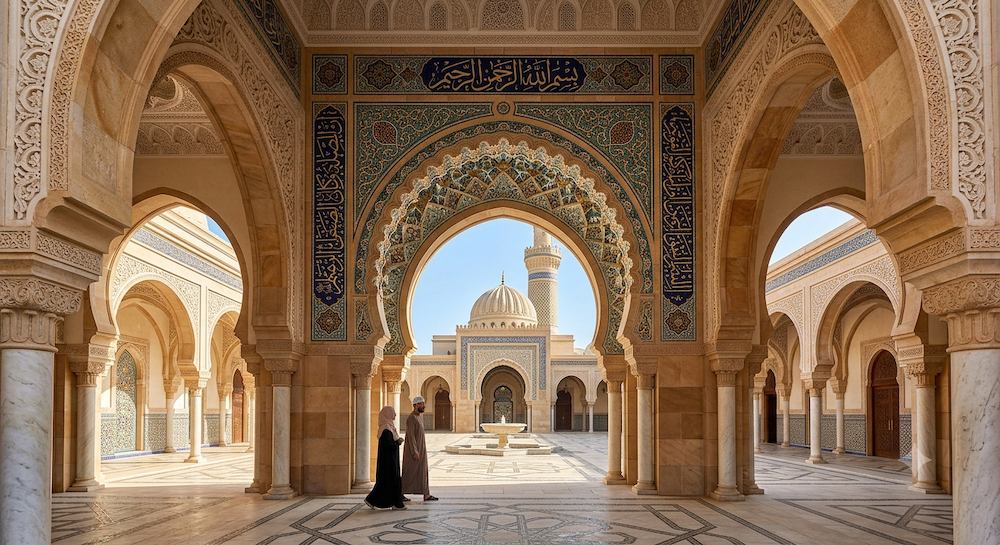
Islamic artists developed some of the most sophisticated geometric systems in human history. Through symmetry, repetition, and mathematical precision, geometry became a visual expression of cosmic order.
Calligraphy
The written word occupied a privileged position within Islamic culture. Calligraphy transformed language into visual art, elevating writing to a sacred practice.
Ornament
Arabesques and vegetal forms symbolized growth, continuity, and the infinite nature of creation.
Architecture
Mosques, palaces, gardens, and madrasas became spaces where mathematics, engineering, spirituality, and aesthetics converged.
Conclusion
Islamic art is often described through its visual beauty, but its deeper significance lies in its intellectual ambition.
The Ilkhanids, Timurids, Ottomans, Safavids, Mughals, and Qajars created artistic traditions that were simultaneously spiritual, scientific, poetic, and political.
Their artists were not merely decorators of empire. They were architects of knowledge.
Through manuscripts, textiles, ceramics, carpets, architecture, calligraphy, and painting, they constructed visual systems capable of expressing profound ideas about order, faith, memory, power, and the nature of the universe itself.
Today, Islamic art remains one of humanity’s greatest artistic achievements—not simply because of its beauty, but because it demonstrates how art can serve as a bridge between mathematics and spirituality, between history and imagination, and between the earthly and the infinite.