Latin American Artists: Reimagining Contemporary Art in the Twenty-First Century
Miami Cultural Guide
Latin American artists are no longer emerging voices seeking recognition from traditional cultural centers. In the twenty-first century, they have become some of the most influential contributors to contemporary art, shaping global conversations around identity, memory, migration, ecology, technology, and social transformation.
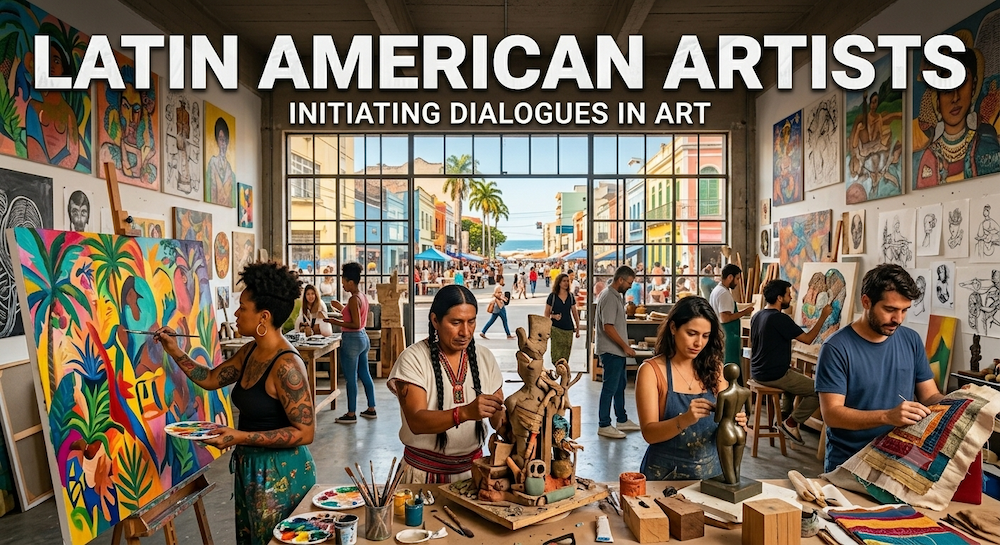
From Mexico City to Buenos Aires, from Bogotá to São Paulo, from Havana to Miami, Latin American artists are redefining what contemporary art can be. Their work challenges conventional narratives while offering alternative ways of understanding history, community, and the human experience.
Today, the international art world increasingly looks toward Latin America not as a peripheral region, but as a source of intellectual innovation and cultural leadership.
Beyond Geography
The term “Latin American artist” refers to much more than nationality.
It encompasses a vast cultural territory shaped by Indigenous civilizations, European colonization, African diasporas, migration, political upheavals, economic transformations, and centuries of cultural exchange. The result is an artistic landscape characterized by extraordinary diversity.
There is no singular Latin American aesthetic.
Some artists engage with geometric abstraction and conceptual practices. Others explore social realities through photography, installation, performance, painting, sculpture, textiles, or digital media. Many move fluidly between disciplines, rejecting traditional categories altogether.
What unites many contemporary Latin American artists is a willingness to question dominant narratives and explore complex relationships between history, identity, and power.
The Legacy of Modernism
The global recognition of Latin American contemporary art did not emerge overnight. It is rooted in a rich history of artistic innovation.
Visionary figures such as Diego Rivera, Frida Kahlo, Joaquín Torres-García, Wifredo Lam, Lygia Clark, Hélio Oiticica, and Jesús Rafael Soto fundamentally transformed twentieth-century art.
Their contributions extended beyond regional influence. They challenged Eurocentric perspectives and introduced new approaches to participation, abstraction, symbolism, and social engagement that continue to influence artists worldwide.
Contemporary generations build upon these foundations while addressing the realities of a rapidly changing world.
Identity in Motion
Migration has become one of the defining themes of contemporary Latin American art.
Many artists live between countries, cultures, and languages. Their work reflects experiences of displacement, adaptation, belonging, and cultural hybridity.
For artists working across borders, identity is not fixed. It is fluid, evolving, and negotiated through lived experience.
This perspective has become particularly relevant in cities such as Miami, Los Angeles, New York, Madrid, and Berlin, where Latin American artists contribute to increasingly global cultural dialogues while maintaining strong connections to their origins.
Their work reminds us that identity is not a destination but a continuous process of transformation.
Memory as Resistance
Latin America carries a complex history marked by colonialism, dictatorship, social inequality, political violence, and cultural resilience.
Many contemporary artists engage directly with these histories, using art as a form of remembrance and critical inquiry.
Archives, family photographs, oral histories, Indigenous knowledge systems, and forgotten narratives frequently become raw material for artistic investigation.
Rather than presenting history as a closed chapter, these artists reveal how the past continues to shape the present.
Art becomes a space where memory resists erasure.
The Rise of Textile Practices
One of the most significant developments in recent years has been the growing prominence of textile-based art.
Across Latin America, artists are revisiting weaving, embroidery, fiber construction, and handcrafted processes as contemporary artistic languages.
Textiles carry cultural memory. They preserve stories, traditions, and relationships that often exist outside official historical records.
For many artists, working with textiles is both a political and poetic act. It challenges longstanding hierarchies that separated craft from fine art while honoring knowledge passed through generations.
The increasing visibility of textile practices demonstrates how contemporary art can simultaneously embrace innovation and tradition.
Conceptual Thinking and New Technologies
Latin American artists have long embraced conceptual strategies.
Today, that tradition continues through works that investigate language, systems, social structures, artificial intelligence, and digital culture.
Rather than viewing technology as separate from human experience, many artists use it to explore questions of perception, surveillance, memory, authorship, and collective consciousness.
Artificial intelligence, data visualization, virtual environments, and algorithmic systems are becoming part of the contemporary artistic toolkit.
Yet even as technologies evolve, the central questions remain deeply human.
Who are we?
How do we construct meaning?
What stories do we inherit?
What futures are we creating?
The Global Market and Cultural Visibility
The international art market has increasingly recognized the significance of Latin American artists.
Major museums, biennials, galleries, and private collections are expanding their representation of artists from the region. Institutions are reassessing historical omissions while collectors seek works that offer perspectives beyond traditional Western narratives.
However, visibility also brings challenges.
As market demand grows, artists must navigate tensions between authenticity and commercialization, local relevance and international expectations.
The most compelling artists often resist simplification. They remain rooted in their experiences while speaking to universal concerns.
Latin America and the Future of Contemporary Art
Perhaps the greatest contribution of Latin American artists lies in their ability to operate between worlds.
They move between tradition and innovation, local histories and global conversations, material practices and conceptual investigations.
Their work reflects a profound understanding that culture is never static. It evolves through exchange, adaptation, and imagination.
In an era defined by uncertainty and transformation, Latin American artists offer something increasingly valuable: the ability to embrace complexity without reducing it to easy answers.
Their art invites us to think more deeply, remember more honestly, and imagine more generously.
The future of contemporary art will not be defined by a single geography, movement, or medium. It will be shaped by diverse voices capable of navigating multiple realities at once.
Latin American artists are already leading that conversation.
And the world is paying attention.