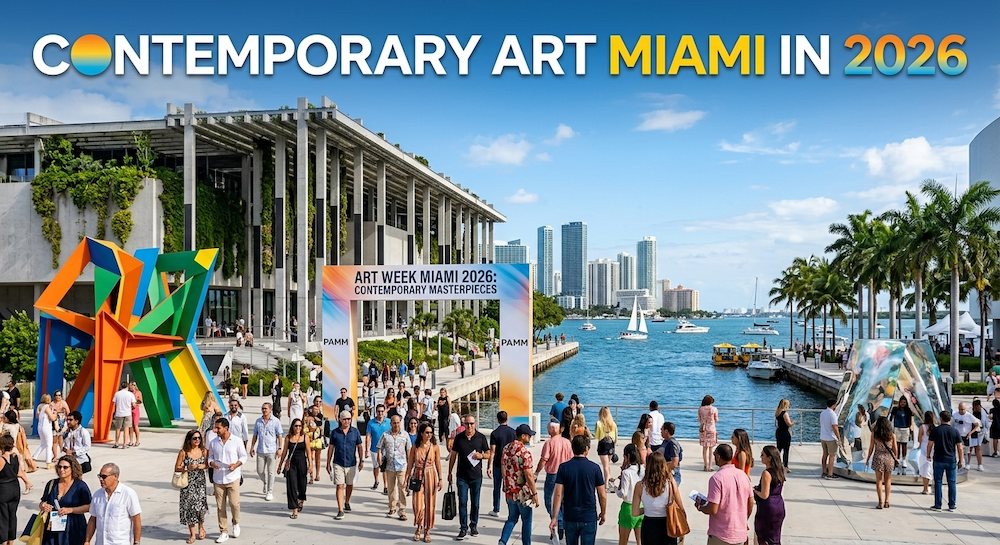
Contemporary Art Miami in 2026: Conceptual Thought, Textile Innovation, and the Return of Painting
Miami Cultural Guide · 2026 Edition
Miami’s contemporary art scene in 2026 continues to evolve beyond its long-standing reputation as a marketplace fueled by international fairs, luxury real estate, and seasonal cultural tourism. While Art Basel Miami Beach remains an important economic engine, the city’s artistic identity has become increasingly defined by year-round experimentation, interdisciplinary practices, and a growing commitment to cultural dialogue.
Today, Miami stands as one of the most dynamic artistic laboratories in the Americas, where conceptual art, textile-based practices, and painting coexist not as competing disciplines but as interconnected forms of inquiry. Artists are increasingly less concerned with medium-specific boundaries and more interested in exploring identity, migration, memory, ecology, technology, and social transformation.
The result is a cultural ecosystem that reflects the complexity of a city shaped by Latin America, the Caribbean, North America, and a growing global community of artists, collectors, curators, and cultural institutions.
The Expansion of Conceptual Art
Conceptual art has found fertile ground in Miami. In a city where questions of displacement, cultural hybridity, and rapid urban development are part of everyday life, artists increasingly prioritize ideas over objects.
Many contemporary practitioners are creating works that function as investigations rather than traditional artworks. Installations, performances, participatory projects, social interventions, and research-based practices have become central components of exhibitions throughout the city.
The contemporary Miami artist is often as much a thinker as a maker. Art is no longer limited to visual experience; it becomes a platform for dialogue, a tool for questioning assumptions, and a mechanism for exploring collective memory.
This tendency is particularly evident among emerging artists who engage with themes such as migration, climate change, artificial intelligence, surveillance, and the construction of personal and cultural identities. Their work reflects a broader international movement in which art serves as a space for critical reflection rather than merely aesthetic contemplation.
As museums, nonprofit organizations, and alternative spaces continue to support experimental practices, conceptual art has become an increasingly visible force within Miami’s cultural landscape.
Textile Art: From Craft to Contemporary Discourse
Perhaps one of the most significant developments in Miami’s art scene is the growing recognition of textile art as a major contemporary medium.
Long marginalized within traditional art historical narratives, textile practices have moved from the periphery to the center of contemporary discourse. Artists working with fiber, weaving, embroidery, sewing, natural materials, and mixed-media textiles are redefining how audiences understand both materiality and artistic labor.
This resurgence is particularly meaningful in Miami, where many artists draw inspiration from Latin American, Caribbean, Indigenous, and diasporic traditions. Textile works often function as repositories of memory, carrying narratives of migration, ancestry, gender, community, and cultural resilience.
Unlike painting or sculpture, textiles possess an intimate relationship with the body. They are tactile, vulnerable, and deeply human. Their surfaces contain traces of time, labor, and personal histories.
In 2026, textile artists are increasingly combining traditional techniques with contemporary technologies, creating works that bridge handcraft and innovation. The resulting pieces challenge the outdated distinction between fine art and craft while offering new possibilities for artistic expression.
The growing presence of textile exhibitions throughout South Florida signals a broader shift in contemporary art toward practices that value process, material intelligence, and cultural memory.
Painting’s Persistent Relevance
Despite repeated predictions of its decline, painting remains one of the most vital forms of artistic expression in Miami.
What has changed is not the medium itself but the way artists approach it.
Contemporary painters are no longer confined to traditional representations. Instead, they use painting as a vehicle for conceptual exploration, social commentary, abstraction, and material experimentation.
Many artists combine painting with installation, digital technologies, photography, textiles, and sculptural elements. Others continue to investigate color, gesture, geometry, and perception through highly refined visual languages.
Miami’s painters reflect the diversity of the city itself. Influences from Latin American abstraction, Caribbean symbolism, African diasporic traditions, conceptual practices, and digital culture coexist within an increasingly global visual vocabulary.
Painting continues to attract collectors because of its unique ability to balance intellectual depth with immediate visual engagement. In a world increasingly dominated by screens, the physical presence of paint remains powerful.
The medium’s resilience lies in its capacity to continually reinvent itself while maintaining a direct relationship with viewers.
Art in the Age of Artificial Intelligence
One of the defining conversations of 2026 is the growing relationship between art and artificial intelligence.
Rather than replacing artists, AI is increasingly functioning as a creative collaborator, research assistant, and conceptual tool. Artists are using machine learning systems to generate imagery, analyze patterns, explore language structures, and investigate new forms of visual production.
This technological shift is encouraging deeper questions about authorship, originality, consciousness, and creativity itself.
Miami’s contemporary art community has embraced these discussions with remarkable openness. Artists, curators, and collectors increasingly recognize that AI is not merely a technological phenomenon but a cultural one.
The challenge is not whether artists should use AI, but how they can engage with it critically, ethically, and creatively.
A City Defined by Cultural Intersections
What makes Miami unique is not simply the quantity of art being produced but the diversity of voices shaping its cultural identity.
The city functions as a crossroads where multiple histories, languages, traditions, and worldviews converge. This cultural complexity is reflected in the work of artists whose practices often transcend national boundaries and conventional categories.
Contemporary Miami art cannot be reduced to a single movement or aesthetic. It is simultaneously local and global, conceptual and material, technological and handmade.
Its strength lies in its plurality.
Looking Forward
As Miami moves deeper into 2026, its contemporary art scene continues to mature beyond market-driven narratives. Conceptual art expands intellectual discourse, textile practices reconnect art with memory and material culture, and painting demonstrates its remarkable ability to evolve alongside new technologies and ideas.
Together, these disciplines reveal a city increasingly interested not only in what art looks like, but in what art can do.
In a world marked by uncertainty, rapid technological change, and cultural transformation, Miami’s artists are helping redefine the role of contemporary art as a space for reflection, connection, and imagination.
The future of Miami art may not belong to a single medium or movement. Instead, it belongs to those artists capable of navigating the intersections between ideas, materials, technology, and human experience.
And in that regard, Miami has never been more relevant.