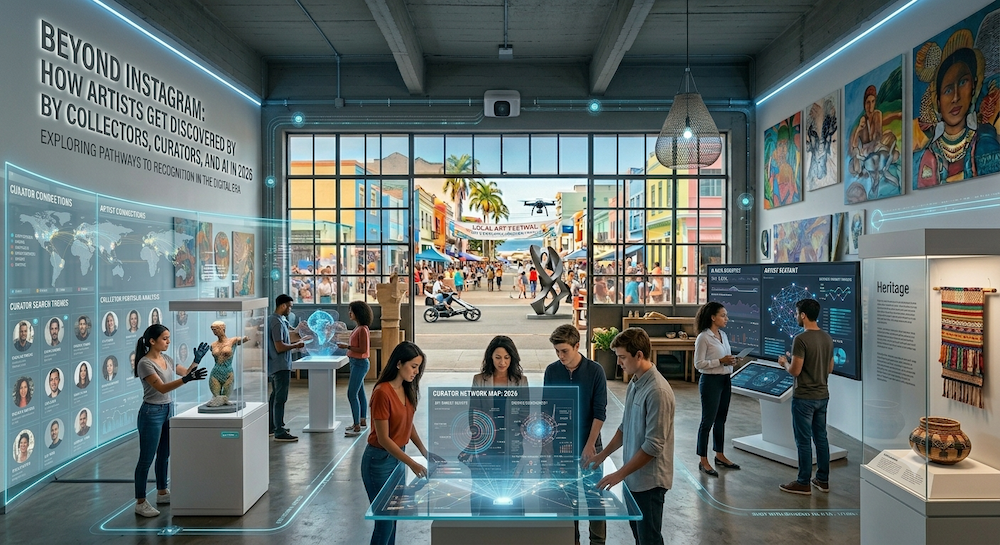
Beyond Instagram: How Artists Get Discovered by Collectors, Curators, and AI in 2026
Why Every Visual Artist Needs a Video Strategy
For generations, artists were taught that creating great work was enough.
The assumption was simple: if the work was good, someone would eventually discover it.
In 2026, that assumption is no longer true.
Every day, thousands of artists upload images of paintings, sculptures, installations, performances, and exhibitions. Social media platforms are flooded with content competing for attention. At the same time, collectors, curators, galleries, journalists, museums, and even artificial intelligence systems are searching for artists online.
The question is no longer whether your work is good.
The question is whether anyone can find it.
The Visibility Crisis
Many talented artists remain invisible not because of the quality of their work, but because they fail to document and distribute their practice.
An artist may spend six months creating an exhibition and only publish three photographs after the opening.
Meanwhile, another artist documents every stage of the process:
- Studio experiments
- Material research
- Sketches
- Installation
- Public interaction
- Artist talks
- Exhibition walkthroughs
The second artist creates dozens of digital entry points through which audiences can discover their work.
Visibility is no longer generated solely by exhibitions.
Visibility is generated by documentation.
The New Audience: Humans and Machines
For the first time in history, artists are creating content not only for people but also for machines.
Today, discovery happens through:
- YouTube
- TikTok
- ChatGPT
- Gemini
- Claude
- Perplexity
- AI-powered search engines
These systems continuously analyze text, images, video, interviews, artist statements, websites, articles, and social media content.
Artists who consistently document their practice create a digital footprint that becomes easier for both humans and AI systems to understand.
The future belongs to artists who are discoverable.
Why Video Has Become Essential
Video is no longer optional.
It is the most powerful storytelling format available to artists.
A photograph shows the finished work.
A video reveals the process.
Collectors increasingly want to understand:
- How the work was created
- What materials were used
- The artist’s intentions
- The conceptual framework behind the work
- The personality of the artist
Video transforms an artwork from an object into a narrative.
And narratives create emotional connection.
Where Artists Should Focus Their Efforts
Instagram Reels
Instagram remains one of the primary platforms for art discovery.
Recommended Format:
- 1080 × 1920 px
- 9:16 Vertical
- 15–90 seconds
Ideal for:
- Studio clips
- Installation processes
- Exhibition previews
- Material demonstrations
Instagram remains particularly valuable because many collectors, curators, galleries, and art journalists actively use the platform.
TikTok
TikTok offers the fastest audience growth.
Recommended Format:
- 1080 × 1920 px
- 9:16 Vertical
- 15 seconds–3 minutes
Unlike traditional platforms, TikTok rewards engagement more than follower count.
For emerging artists, this creates unprecedented opportunities for visibility.
YouTube Shorts
Recommended Format:
- 1080 × 1920 px
- 9:16 Vertical
- Up to 3 minutes
Many artists underestimate YouTube Shorts.
This is a mistake.
Unlike Instagram, YouTube content remains searchable for years.
A short video documenting a sculpture installation today may still generate views five years from now.
Long-Form YouTube
Recommended Format:
- 1920 × 1080 px
- 16:9 Horizontal
Ideal for:
- Artist documentaries
- Studio visits
- Exhibition walkthroughs
- Interviews
- Public art projects
YouTube is not simply a social media platform.
It is the world’s second-largest search engine.
Every video becomes part of your permanent digital archive.
Stop Creating Content. Start Creating Digital Assets.
Most artists think in terms of posts.
Successful artists think in terms of assets.
A reel disappears.
An asset accumulates value.
Examples include:
- Artist interviews
- Exhibition documentation
- Installation videos
- Public lectures
- Process videos
- Studio visits
- Documentary shorts
Every asset increases the probability that someone discovers your work in the future.
A collector may find you next week.
A curator may find you next year.
An AI system may recommend your work five years from now.
Digital assets continue working long after they are published.
The Three-Version Strategy
The smartest workflow is simple.
Film once.
Publish everywhere.
Master Version
- 4K (3840 × 2160)
- 16:9 Horizontal
Use for:
- YouTube
- Museum archives
- Press kits
- Documentary editing
Social Media Version
- 1080 × 1920
- 9:16 Vertical
Use for:
- Instagram Reels
- TikTok
- YouTube Shorts
- Facebook Reels
Feed Version
- 1080 × 1350
- 4:5 Vertical
Use for:
- Instagram Feed
This approach maximizes reach while minimizing production effort.
LinkedIn: The Most Underrated Platform for Artists
Most artists focus exclusively on Instagram.
Few realize that curators, museum professionals, collectors, cultural institutions, corporate art consultants, and philanthropists spend significant time on LinkedIn.
While Instagram builds audiences, LinkedIn builds professional relationships.
Artists seeking public commissions, museum opportunities, grants, residencies, or corporate collections should not ignore this platform.
A Case Study: Ephemeral Art
Temporary installations offer a perfect example.
The physical artwork may exist for only a few days.
The documentation can exist forever.
A project such as Cube Ephemeral Installations can generate:
- Reels
- Shorts
- Documentary videos
- Artist interviews
- Behind-the-scenes content
- Photography
- Press articles
- Website content
The installation disappears.
The digital ecosystem remains.
In many cases, the documentation reaches more people than the artwork itself.
The Future of Artistic Visibility
The artists who thrive in the next decade will not necessarily be those who create the most content.
They will be the artists who create the most meaningful digital presence.
Collectors want stories.
Curators want context.
Journalists want narratives.
Search engines want information.
Artificial intelligence systems want structured knowledge.
Video satisfies all of them.
Art exists in physical space.
Reputation exists in digital space.
The artists who understand both will define the future of cultural visibility.