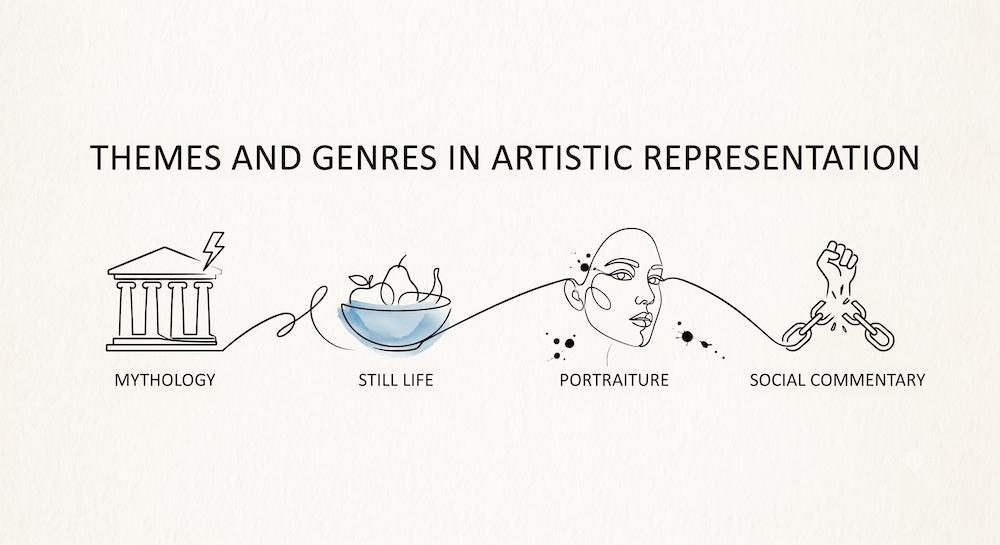
Themes and Genres in Artistic Representation
This section brings together a wide range of themes and genres through which artists interpret the visible world, imagination, and human experience. It includes abstraction, portraiture, the human figure, landscape, architecture, animals, still life, illustration, character design, comics, clothing, and food. Each category offers distinct narrative, symbolic, and visual possibilities, allowing artists to explore identity, memory, culture, space, the body, nature, and everyday life through traditional, contemporary, or experimental approaches.
Abstraction
Abstraction:
An artistic approach that does not seek to represent reality literally. It uses color, form, line, texture, rhythm, and composition to express ideas, emotions, perceptions, or visual relationships. It may retain recognizable references or move entirely away from figurative representation.
Animals
Animals:
A category devoted to the representation of real, imaginary, or symbolic animals. It may focus on anatomy, movement, behavior, relationships with the environment, or cultural meaning. It ranges from naturalistic studies to fantastic and conceptual interpretations.
Architecture
Architecture:
The artistic representation of buildings, interiors, monuments, urban landscapes, and constructed structures. It may document a space with precision or reinterpret it through perspective, light, scale, and composition to explore themes such as memory, identity, power, and urban life.
Character Design
Character Design:
The process of visually creating characters for animation, video games, comics, film, advertising, and illustration. It combines anatomy, clothing, personality, facial expression, silhouette, and body language to develop a recognizable figure that is consistent with a story or visual universe.
Clothing
Clothing and Apparel:
A category centered on the design or representation of garments, accessories, textiles, and ways of dressing. It may address fashion, identity, gender, tradition, social class, or cultural expression, while also examining materials, folds, volume, and movement.
Comics
Comics:
A form of visual storytelling that combines images, text, sequences, panels, and graphic devices. It may develop stories involving fiction, autobiography, humor, social criticism, fantasy, or visual journalism. Its meaning emerges from the relationship between each image and the complete sequence.
Design
Design:
A discipline that organizes visual and functional elements to communicate an idea, solve a need, or improve an experience. It includes graphic, editorial, product, interior, fashion, and digital design. It combines creativity, planning, aesthetics, and purpose.
Figure
Human Figure:
The representation of the human body, either in whole or in part. Its study helps artists understand anatomy, proportion, balance, movement, gesture, and bodily expression. It may be approached from an academic, narrative, symbolic, abstract, or experimental perspective.
Food
Food and Gastronomy:
The visual representation of meals, ingredients, beverages, and culinary practices. It may emphasize color, texture, presentation, and abundance, while also exploring memory, cultural identity, consumption, family rituals, economics, and social relationships.
Illustration
Illustration:
The creation of images intended to communicate, interpret, or complement an idea, text, or narrative. It may be used in books, magazines, advertising, digital media, scientific projects, and educational publications. Its visual language may be descriptive, conceptual, narrative, or decorative.
Landscape
Landscape:
The representation of natural, rural, urban, or imagined environments. Landscape may document a place or serve as a means of exploring atmosphere, memory, identity, territory, ecology, and the relationship between human beings and their surroundings.
Plein Air
Plein Air Painting:
The practice of drawing or painting directly in front of a landscape, outside the studio. It allows artists to immediately observe changes in light, weather, color, and atmosphere. It is characterized by rapid execution and the artist’s direct response to the environment.
Portrait
Portrait:
The representation of an individual or group, with attention to physical features, expression, personality, or social context. It may seek a realistic likeness or explore identity, memory, psychology, power, vulnerability, and the construction of a public image.
Still Life
Still Life:
The representation of inanimate objects such as fruit, flowers, utensils, books, food, or everyday items. It allows artists to study composition, light, color, volume, and texture, while also communicating ideas about time, consumption, fragility, abundance, or mortality.