Devora Perez: In the Space Between—Where Light Becomes Structure
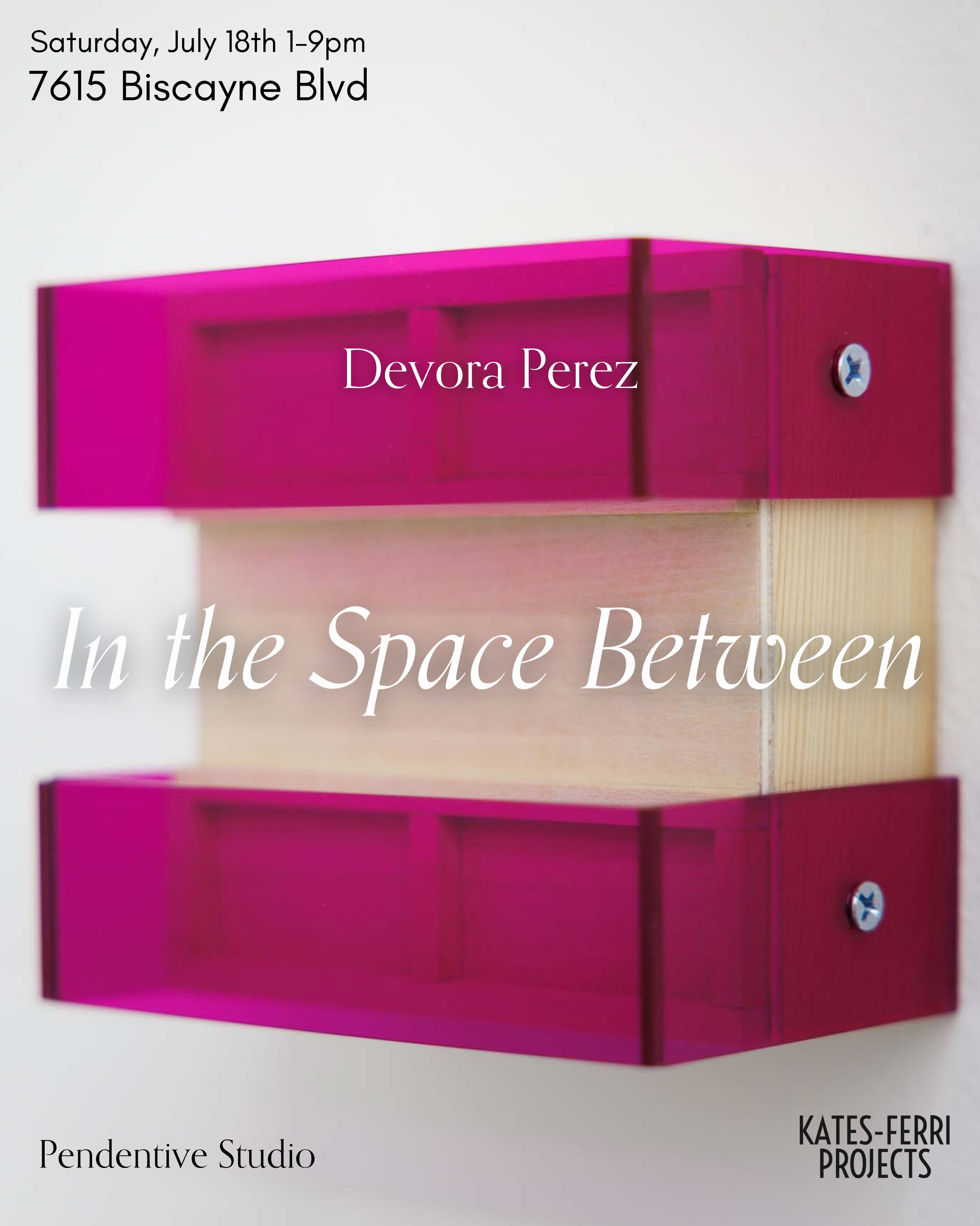
Devora Perez: In the Space Between
Opening: Saturday, July 18, 2026
Public hours: 1:00–9:00 p.m.
Opening reception: 6:00–9:00 p.m.
Venue: Pendentive Studio
Address: 7615 Biscayne Boulevard, Miami, FL 33138
Presented with: Kates-Ferri Projects
Miami-born artist Devora Perez transforms light from an instrument of visibility into a material presence in In the Space Between, a solo exhibition opening July 18, 2026, at Pendentive Studio in Miami. Presented in collaboration with New York–based Kates-Ferri Projects, the exhibition brings together luminous constructions that move fluidly among painting, sculpture, architecture, and installation.
At first encounter, Perez’s works appear restrained: maple structures, translucent sheets of colored acrylic, carefully measured angles, and geometries reduced to their essential components. Yet this apparent simplicity is deceptive. Once natural light enters the acrylic planes, the objects begin to exceed their physical limits. Color escapes the artwork, spreading across walls, floors, adjacent objects, and the bodies of passing viewers.
The work is no longer confined to what Perez has constructed. It also includes what cannot be permanently held: reflections, shadows, chromatic projections, atmospheric changes, and the viewer’s continuously shifting perception.
Between Painting and Sculpture
The title In the Space Between identifies the conceptual territory Perez has occupied throughout her practice. Her works are neither conventional paintings nor autonomous sculptures. They borrow from the language of painting through color, surface, composition, and geometric abstraction, while asserting the physical projection and spatial presence commonly associated with sculpture.
Perez’s official artist statement describes her practice as an exploration of abstraction, materiality, and perception that deliberately blurs the distinctions among painting, sculpture, and installation. Her two- and three-dimensional works challenge stable definitions of structure and utility by activating relationships among material, light, and space.
The colored acrylic can initially be read as a painted plane. Unlike pigment applied to canvas, however, its color is not completely attached to a solid surface. It is transmitted through light. The hue that appears inside the acrylic is only one part of the composition; another emerges as a projection outside it.
Painting therefore becomes environmental. Color is liberated from the wall and allowed to occupy the room.
Perez’s maple constructions reinforce this ambiguity. They can resemble frames, supports, fragments of architecture, or incomplete functional objects. Rather than merely holding the colored material, the wood establishes boundaries through which light can pass. It creates a disciplined structure for something inherently unstable.
Color Beyond the Object
One of the exhibition’s central propositions is that an artwork does not necessarily end at its visible edge.
The translucent acrylic planes absorb, filter, redirect, and release light into the surrounding environment. These projections are not incidental effects produced by the sculptures; they form an essential part of the work. Pendentive Studio describes Perez’s color-cast shadows as extensions of the objects themselves, allowing each construction to change as daylight shifts and viewers move around it.
This expanded understanding of color distinguishes Perez’s work from forms of abstraction in which the painted surface remains materially stable. Her color is conditional. It depends upon the hour, the architecture, the intensity and direction of illumination, and the position of the observer.
A red or yellow plane may appear visually concentrated within the acrylic at one moment and then disperse across the wall at another. Two colors may overlap in space and produce a third, temporary field. A shadow may soften, sharpen, lengthen, or disappear.
Perez does not entirely determine these transformations. She creates the conditions through which they can occur.
Authorship is consequently shared among artist, material, light, architecture, and viewer. The completed object becomes the beginning of an experience rather than its final form.
The Viewer as an Active Participant
Perez’s work requires movement. It cannot be fully understood from a single frontal position because each change in perspective reorganizes the relationship among transparency, opacity, reflection, color, and depth.
From one angle, an acrylic plane may appear intensely saturated. From another, it becomes almost transparent. A wooden structure that initially reads as flat may reveal its volume when approached from the side. The viewer’s body may interrupt a projection, temporarily entering the composition as a silhouette.
This does not make the work interactive in a technological sense. Its interaction is perceptual and embodied. The viewer completes the artwork by walking, pausing, looking again, and becoming conscious of how vision is constructed.
Perez shifts attention away from the idea of perception as passive reception. Seeing becomes an event shaped by location and duration. The work reveals that an object does not possess one immutable appearance; it continually emerges through its relationship with changing conditions.
Minimal Form, Complex Experience
The apparent minimalism of Perez’s sculptures intensifies rather than reduces their complexity. By limiting her materials and formal vocabulary, she directs attention toward subtle phenomena that might otherwise remain unnoticed.
The precision of the maple structures contrasts with the instability of projected light. Wood appears solid, warm, and architectonic. Acrylic is manufactured and sharply defined, yet visually permeable. The shadow is immaterial but occupies measurable space.
These oppositions—solid and transparent, permanent and temporary, constructed and atmospheric—give the works their conceptual tension.
Minimal form also slows the act of looking. Because the works do not depend on figurative narration or spectacular imagery, viewers must become attentive to gradual changes: a slight alteration in hue, the overlap of translucent surfaces, a shadow extending beyond the object, or daylight reshaping the entire composition.
What initially appears quiet gradually becomes expansive.
Architecture, Interior Space, and Miami Light
The presentation at Pendentive Studio is especially relevant to Perez’s investigation. Located in Miami’s MiMo District, Pendentive functions simultaneously as a contemporary art gallery and the working offices of Phoebe O’Neill Interiors. Its exhibitions are installed among furnishings and design elements, encouraging visitors to consider how artworks operate within inhabited environments rather than isolated white-cube conditions.
Within this setting, Perez’s sculptures engage directly with interior architecture. The walls become receiving surfaces for projected color. Windows and changing daylight influence the exhibition. Furniture and architectural details enter into temporary relationships with the works.
This encounter also challenges the assumption that art and interior design occupy separate cultural categories. Perez’s objects may respond elegantly to an architectural space, but they resist becoming merely decorative. They alter the room while simultaneously exposing how the room structures our experience of them.
Miami itself is deeply relevant to this visual language. Perez has spoken about the influence of South Florida’s natural and artificial light, urban architecture, and landscape on her practice. In a city where sunlight can be intense, reflective, and constantly altered by water, glass, concrete, vegetation, and atmospheric conditions, light is not an abstract subject. It is part of the region’s daily material reality.
A Practice of Resistance
Perez describes her work as a form of resistance against singular definitions and limitations. This resistance does not appear through overt declaration. It is embedded in the inability of the works to remain inside one category.
They resist being only paintings because they occupy physical space. They resist being only sculptures because their visual identities depend upon projected color. They resist complete material containment because their boundaries are continually extended by light. They also resist a single fixed interpretation because every viewing position produces a different encounter.
In this sense, the “space between” is not an empty interval separating established forms. It is a productive territory in which distinctions can be questioned and reorganized.
From Object to Event
Perez earned her BFA from New World School of the Arts in 2016 and her MFA from Florida International University in 2020. Her work has appeared in exhibitions at institutions and organizations including the Corcoran Museum, the Patricia & Phillip Frost Art Museum, Coral Springs Museum of Art, Oolite Arts, and the Cisneros Fontanals Art Foundation. She received the Frost Art Museum’s Betty Laird Perry Award in 2020.
In the Space Between builds upon this sustained investigation of abstraction and perception while giving particular emphasis to the temporal life of the artwork. Perez does not present sculpture as an inert object completed in the studio. Instead, she creates a structure that waits to be activated by its surroundings.
The exhibition asks viewers to consider whether color belongs to the object that filters it, the light that carries it, the wall that receives it, or the eye that perceives it. The answer remains intentionally unresolved.
What Perez ultimately constructs is not simply a collection of maple-and-acrylic forms. She constructs encounters: temporary alignments among body, architecture, atmosphere, and time.
Her works occupy the space between painting and sculpture, but also the space between what is physically present and what can only be experienced. In that interval, light becomes structure, color becomes environment, and perception becomes the true medium of the exhibition.