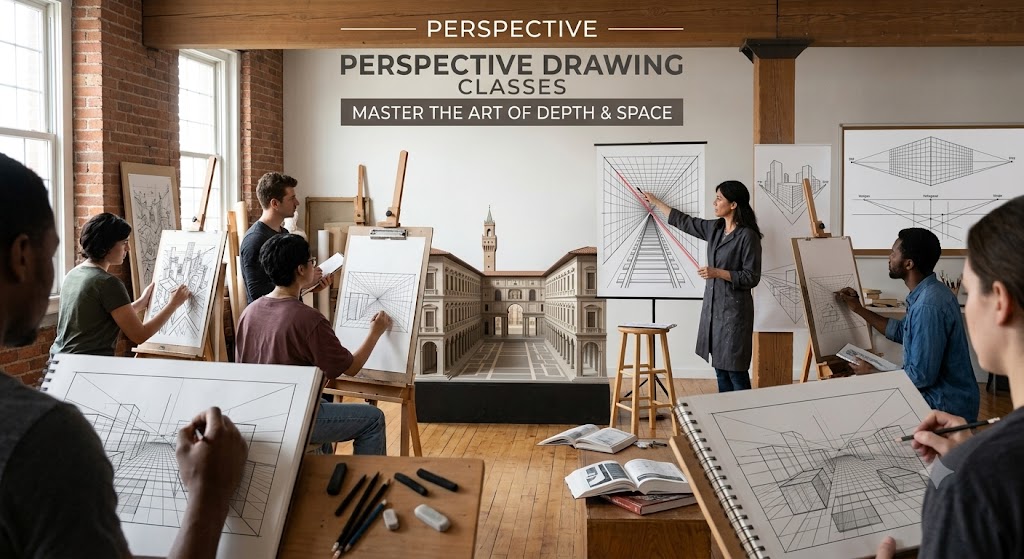
Perspective Drawing: Private and Group Classes Taught by Professional Artists
Perspective drawing is one of the most important skills for anyone who wants to create convincing images of buildings, interiors, streets, landscapes, objects, or imagined environments. It helps artists understand how space, distance, proportion, and depth can be represented on a flat surface.
Private and group perspective drawing classes taught by professional artists provide students with practical instruction and guided exercises. These classes can be adapted for beginners, teenagers, adults, art students, architects, designers, illustrators, and practicing artists who want to strengthen their drawing skills.
What Is Perspective Drawing Classes?
Perspective is a system used to represent three-dimensional space on a two-dimensional surface. It explains why objects appear smaller as they move farther away and why parallel lines seem to meet in the distance.
Artists use perspective to create a believable sense of:
- Depth
- Distance
- Scale
- Proportion
- Spatial relationships
- Volume
- Architectural structure
Perspective is not limited to highly realistic art. It is also useful in illustration, animation, comics, abstract art, set design, sculpture, and conceptual drawing.
Why Learn Perspective?
Many students can draw individual objects but struggle when placing them inside a room, landscape, or architectural setting. Perspective helps organize those objects within a consistent space.
By studying perspective, students learn how to:
- Draw rooms and interiors accurately
- Create believable streets and cityscapes
- Position objects at different distances
- Understand the relationship between the viewer and the subject
- Draw buildings from different angles
- Create depth in landscapes
- Construct imagined environments
- Improve proportion and spatial awareness
Perspective also helps students understand how visual space is organized in paintings, photographs, films, and architectural images.
Private Perspective Drawing Classes
Private lessons provide individualized instruction based on the student’s experience, interests, and professional goals.
A beginner may need to understand the horizon line and vanishing points, while a more advanced student may want to study complex interiors, curved forms, aerial perspective, or architectural drawing.
Private classes are especially useful for:
- Beginners who prefer personal guidance
- Art students preparing portfolios
- Architects and interior designers
- Illustrators and comic artists
- Students interested in urban sketching
- Artists working with landscapes or interiors
- Adults returning to drawing
- Students who need flexible scheduling
The instructor can identify specific problems and develop exercises focused on those areas. Because the lesson is personalized, students can progress at a pace that feels comfortable and productive.
Group Perspective Drawing Classes
Group classes offer a collaborative environment where students can learn through demonstrations, shared exercises, and constructive discussion.
The instructor may introduce a perspective system and then guide the class through drawing a room, street, building, still life, or imaginary scene. Students can compare different solutions and learn from the way others interpret the same assignment.
Group classes are ideal for:
- Friends or family members learning together
- Teenagers interested in art and design
- Community art groups
- Beginners seeking an affordable introduction
- Students who enjoy social learning
- Artists interested in regular practice
- Schools and cultural organizations
Although everyone may work from the same lesson, professional instructors can provide individual feedback and adapt exercises for different skill levels.
One-Point Perspective
One-point perspective is often the first system students learn. It is used when the front of an object faces the viewer directly and lines moving into the distance converge toward a single vanishing point.
Common examples include:
- A hallway
- A road viewed from the center
- A room seen from the front
- Railroad tracks
- A row of buildings
- A table positioned directly in front of the viewer
Students usually begin by identifying the horizon line and placing one vanishing point. They then learn how to construct boxes, furniture, doors, windows, and architectural elements within the same space.
One-point perspective provides a strong introduction to depth and spatial organization.
Two-Point Perspective
Two-point perspective is used when the viewer sees the corner of an object rather than its front surface.
The horizontal edges of the object move toward two separate vanishing points. This system is commonly used to draw:
- Buildings seen from a corner
- Furniture at an angle
- City blocks
- Boxes and geometric objects
- Interior spaces
- Architectural exteriors
Two-point perspective creates a more dynamic view and helps students understand how forms rotate in space.
Three-Point Perspective
Three-point perspective adds a third vanishing point above or below the horizon line. It is often used when looking dramatically upward or downward.
Examples include:
- Looking up at a skyscraper
- Viewing a city from a high building
- Dramatic architectural illustrations
- Comic-book environments
- Fantasy cities
- Aerial views
This system can create a powerful sense of height, scale, and movement. It is generally introduced after students understand one- and two-point perspective.
The Horizon Line and Eye Level
The horizon line represents the viewer’s eye level. Its placement affects how objects are seen.
When an object is below the horizon line, the viewer can usually see its top. When it is above the horizon line, the viewer may see its underside.
Understanding eye level helps students control the visual experience of a scene. A low horizon line can make buildings appear monumental, while a high horizon line can create the impression of looking down over a space.
Vanishing Points
A vanishing point is the location where parallel lines appear to meet as they recede into the distance.
Vanishing points help artists maintain consistency. Without them, buildings, furniture, and other objects may appear distorted or disconnected from the surrounding space.
Students learn how to identify vanishing points in photographs and real environments. They also learn how to create their own spatial systems when drawing from imagination.
Drawing Basic Forms in Perspective
Before attempting complicated buildings or interiors, students often practice drawing simple geometric forms, including:
- Cubes
- Rectangular boxes
- Cylinders
- Spheres
- Pyramids
- Cones
These forms become the foundation for more complex subjects. A building can begin as a box, a column as a cylinder, and a roof as a triangular form.
Professional artists teach students how to simplify complicated structures before adding windows, textures, decorations, or other details.
Circles, Cylinders, and Curved Forms
Drawing circles in perspective can be challenging because a circle often appears as an ellipse when viewed at an angle.
Students may practice drawing:
- Wheels
- Cups
- Columns
- Arches
- Domes
- Tables
- Bottles
- Round buildings
Understanding ellipses is especially important for industrial design, product drawing, architecture, and still-life art.
Measuring Proportion and Scale
Perspective drawing also involves comparing the size and position of objects.
Students learn how to:
- Repeat objects at equal distances
- Draw windows of consistent size
- Place people correctly within architectural scenes
- Create floor tiles
- Measure building levels
- Establish believable scale relationships
- Reduce objects gradually as they recede
These skills help prevent figures, furniture, and architectural elements from appearing too large or too small.
Drawing Interiors
Interior perspective is useful for artists, architects, interior designers, and students interested in spatial design.
Classes may include exercises involving:
- Bedrooms
- Living rooms
- Galleries
- Restaurants
- Studios
- Offices
- Museums
- Theaters
Students learn how to place walls, doors, windows, furniture, artwork, and lighting within a coherent space.
They may also study how composition and viewpoint influence the mood of an interior.
Architectural and Urban Drawing
Perspective is essential for drawing buildings and city environments.
Students may work from:
- Photographs
- Architectural references
- Direct observation
- Outdoor urban-sketching sessions
- Historical buildings
- Modern architecture
- Imagined cities
They learn how to simplify complex structures, establish major angles, and add details without losing the overall spatial organization.
Urban drawing can also teach students how people, vehicles, signs, trees, and street furniture interact within public space.
Perspective in Landscape Drawing
Perspective is not limited to architecture. It also helps create depth in natural environments.
Students learn how distant objects change in:
- Size
- Detail
- Contrast
- Color
- Sharpness
- Texture
A tree in the foreground may appear large and detailed, while distant trees become smaller and less defined.
This gradual change creates the illusion of space and distance.
Aerial or Atmospheric Perspective
Aerial perspective describes how the atmosphere affects the appearance of distant objects.
As objects move farther away, they often appear:
- Lighter
- Less detailed
- Lower in contrast
- Softer around the edges
- Closer in color to the sky or atmosphere
Artists use atmospheric perspective to create depth in landscapes, cityscapes, and large interior spaces.
It can be combined with linear perspective to produce a more convincing image.
Perspective from Observation
Students may practice drawing directly from real environments rather than relying only on diagrams.
Possible locations include:
- A classroom
- A studio
- A hallway
- A park
- A street
- A museum
- A public plaza
- A café
Drawing from observation helps students recognize perspective systems in everyday life. It also teaches them how to simplify what they see and make decisions about composition.
Perspective from Imagination
Once students understand the basic rules, they can use perspective to invent spaces that do not exist.
This is especially useful for:
- Concept art
- Animation
- Video-game design
- Comics
- Film storyboards
- Fantasy illustration
- Science-fiction environments
- Set design
Students learn how to create a believable world by maintaining consistent scale, viewpoint, lighting, and spatial relationships.
Materials Used in Perspective Drawing Classes
Students may use:
- Graphite pencils
- Mechanical pencils
- Charcoal
- Ink
- Rulers
- T-squares
- Set squares
- Perspective grids
- Erasers
- Sketchbooks
- Drawing paper
- Digital tablets
Beginners can start with simple pencils, paper, and a ruler. More advanced students may work freehand or use digital drawing programs.
The instructor can recommend materials according to the student’s goals and budget.
Freehand Perspective
Although rulers are helpful for learning the basic system, artists also benefit from practicing freehand perspective.
Freehand drawing allows students to work more quickly and naturally. It is especially valuable for urban sketching, travel drawing, and conceptual studies.
The goal is not always mathematical perfection. A drawing can remain expressive while still communicating believable space.
Professional artists help students find a balance between accuracy and spontaneity.
Why Study with a Professional Artist?
A practicing artist can explain perspective as both a technical system and a creative tool.
Professional artists understand that a perfectly constructed drawing is not necessarily an interesting artwork. They can teach students how to use viewpoint, scale, distortion, and composition to create atmosphere and meaning.
An artist-instructor can also demonstrate how perspective is used differently in:
- Fine art
- Architecture
- Illustration
- Animation
- Painting
- Comics
- Sculpture
- Installation art
- Film and theater design
This broader perspective helps students understand how technical knowledge supports personal expression.
Perspective and Personal Style
Learning the rules of perspective does not require artists to create only realistic drawings.
Many artists intentionally alter or reject traditional perspective to create emotional, symbolic, or abstract spaces. However, understanding the system allows them to make those choices deliberately.
Students can use perspective to create:
- Realistic environments
- Distorted interiors
- Dreamlike spaces
- Surreal architecture
- Abstract geometric compositions
- Multiple viewpoints
- Symbolic landscapes
Technical knowledge gives artists more freedom because they can decide when to follow the rules and when to transform them.
Benefits Beyond Art
Perspective drawing also develops useful cognitive and practical abilities, including:
- Spatial reasoning
- Problem-solving
- Observation
- Patience
- Concentration
- Visual organization
- Hand-eye coordination
- Design awareness
- Planning skills
These abilities can be valuable in architecture, engineering, interior design, fashion, product design, animation, and many other fields.
Choosing the Right Class
Before enrolling, students should consider their goals and preferred learning environment.
Private classes are often best for students who need individualized instruction, flexible scheduling, portfolio preparation, or help with a specific problem.
Group classes may be better for students who enjoy collaboration, shared assignments, demonstrations, and creative community.
Useful questions to ask include:
- Is the class suitable for beginners?
- Does it cover one-, two-, and three-point perspective?
- Is the focus architectural, artistic, or both?
- Are outdoor drawing sessions included?
- Does the instructor teach freehand perspective?
- Are materials provided?
- Is individual feedback included?
- Can lessons be adapted for portfolio development?
- Are online classes available?
- Does the instructor have experience as a professional artist?
A strong course should combine clear technical instruction with creativity, experimentation, and personal support.
Conclusion
Private and group perspective drawing classes provide students with the knowledge needed to create convincing spaces, structures, and environments.
Through the study of horizon lines, vanishing points, proportion, scale, geometric forms, and atmospheric depth, students gain greater control over their drawings. Under the guidance of professional artists, perspective becomes more than a set of rules. It becomes a creative language for organizing space and directing the viewer’s experience.
Whether the goal is to draw architecture, improve a portfolio, explore urban sketching, design imaginary worlds, or simply gain confidence, perspective classes offer a practical and rewarding foundation for artistic growth.