Frances Trombly: What Holds—Weaving Tension, Labor, and the Material Memory of Painting
Frances Trombly’s Los Angeles exhibition What Holds explores weaving, labor, tension, textile history, and the material structures underlying painting.
Frances Trombly: What Holds
Shoshana Wayne Gallery
5247 W. Adams Boulevard, Los Angeles, California
May 30–July 18, 2026
At Shoshana Wayne Gallery in Los Angeles, Frances Trombly’s What Holds asks a deceptively simple question: What allows an artwork, an institution, a body, or a social structure to remain intact under pressure? Presented from May 30 through July 18, 2026, the exhibition marks the Miami-based artist’s return to the gallery following her 2016 solo presentation. It continues her sustained investigation of weaving, material labor, and the often-unseen systems that make visual experience possible.
Trombly’s work has long occupied an unstable territory among painting, sculpture, installation, and textile art. In a 2016 Los Angeles Times review, Leah Ollman called her works “confident trespassers”—an apt description of objects that cross disciplinary borders without seeking permission from the categories they disturb. In What Holds, however, this trespassing has become more structural and philosophically precise. Trombly is not merely combining artistic genres; she is exposing the physical and cultural assumptions that separate them.
Before the Image, There Is a Structure
Western painting is frequently discussed through images, gestures, colors, symbols, and narratives. Trombly redirects attention toward what usually remains beneath or behind those visible elements: the woven support, the frame, the tension of the fibers, and the labor necessary to construct a surface.
At the conceptual center of What Holds is the warp—the longitudinal system of threads held under tension during weaving. Without the warp, cloth cannot take form. It is both infrastructure and possibility: a system that determines alignment while remaining open to alteration.
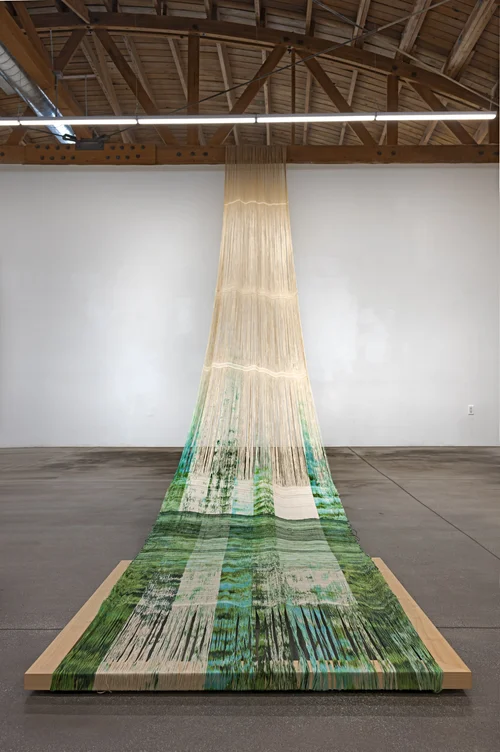
Trombly brings this concealed framework forward. Threads hang openly rather than disappearing beneath a completed surface. Woven sections slip away from their frames. Fiber accumulates through layers, folds, knots, interruptions, and suspended lengths. Nothing appears entirely resolved or permanently secured.
By leaving these material conditions visible, Trombly interrupts the expectation that artistic labor should disappear into a polished object. The work refuses the illusion of effortless completion. Instead, it preserves duration, repetition, correction, physical strain, and decision-making as part of its meaning.
Process is not evidence left behind after the artwork has been completed. Process becomes the artwork’s primary language.
Painting Without the Stability of the Canvas
Many of Trombly’s structures evoke looms, stretcher bars, scaffolding, warping boards, and architectural frameworks. They point toward painting while withdrawing the conventional stability that painting traditionally promises.
A stretched canvas is normally expected to present a unified plane: tight, flat, contained, and ready to receive an image. Trombly dismantles this expectation. Her woven surfaces sag, extend, overlap, detach, or remain incomplete. Frames no longer function as neutral boundaries. They become active structures that carry, divide, suspend, and expose.
This approach returns painting to its material origins. Canvas is not simply a blank field; it is cloth held under tension. The apparently passive support is the product of fiber, pressure, preparation, physical knowledge, and time.
Trombly’s work therefore proposes that every image depends upon an infrastructure. Visibility is never autonomous. Something must hold the surface in place, just as unseen systems hold institutions, economies, communities, and cultural narratives together.
The title What Holds can consequently be understood as both a question and a condition. What structures endure? What becomes visible because something else remains concealed? What labor supports the appearance of coherence?
The Grid as Discipline and Accumulated Time
The grid has often been associated with modernist order, rationality, autonomy, and formal control. In Trombly’s practice, however, it is neither purely optical nor entirely abstract. The textile grid is produced bodily, thread by thread.
Every crossing registers an action. Every repeated movement accumulates time. The grid becomes a record of discipline rather than a symbol detached from human effort.
This distinction is essential. Trombly’s woven geometry may initially resemble the visual vocabulary of abstract painting, but its structure emerges from repetitive physical labor. What appears minimal is not necessarily effortless. Restraint may conceal exhaustion; precision may be the result of countless gestures.
The works thus challenge conventional hierarchies that historically elevated painting and sculpture while positioning weaving, embroidery, and other textile practices as decorative, domestic, functional, or secondary. Trombly does not simply demand that fiber be admitted into the category of fine art. She demonstrates that the supposedly autonomous history of painting has always depended upon textile knowledge.
Color as Material Event
Color in What Holds does not behave as an independent layer placed upon a neutral support. It travels through the support itself.
Dyed and painted threads form washes, bands, interruptions, and gradual transitions. Color appears to move across the works, but it also penetrates their physical construction. Rather than creating illusionistic depth, Trombly produces depth through accumulation: one textile plane before another, one thread crossing another, one duration remaining visible beside the next.
The results can recall Color Field painting, geometric abstraction, or modernist experiments with the picture plane. Yet Trombly refuses the fiction that color floats freely. Her color remains attached to fiber, gravity, weight, touch, and resistance.
A painted area can be interrupted by an exposed warp. A smooth chromatic passage can end in knots or hanging threads. A seemingly unified composition can reveal the instability of the structure supporting it.
These interruptions are not failures to complete the image. They are reminders that unity is constructed and provisional.
Labor Without Spectacle
Trombly’s work is visually quiet, but its quietness should not be mistaken for passivity. The exhibition resists spectacle because spectacle would conceal the forms of attention it seeks to recover.
Her materials demand slow observation. The viewer must notice slight differences in density, tension, spacing, weight, and surface. The works do not reveal themselves through a single dramatic encounter. They unfold through prolonged looking.
This temporal demand mirrors the time required to produce them. Hand weaving is accumulative: a structure grows through repetition rather than sudden transformation. Trombly translates that duration into an encounter between artwork and audience. Looking becomes another form of sustained labor.
The exhibition therefore offers an alternative to the accelerated circulation of contemporary images. It does not ask merely to be photographed, consumed, and replaced. It asks the viewer to remain with the work long enough to perceive how it has been built.
Structures Under Pressure
In What Holds, tension is both a technical necessity and a social metaphor. Textile production depends upon calibrated pressure. Too little tension and the structure loses coherence; too much and the threads risk distortion or rupture.
Trombly does not resolve this tension. She allows it to remain visible.
Her works suggest that endurance is not the same as stability. A system can continue functioning while showing strain. A structure can support weight while approaching its limits. Something may appear complete even as its underlying framework begins to separate.
This insight gives the exhibition a broader emotional and political resonance. The exposed warp becomes an image of vulnerability, but also of persistence. The hanging thread may suggest incompletion, yet it also represents continued possibility. A partially woven field contains both what has been accomplished and what remains open.
Frances Trombly and Miami’s Artistic Infrastructure
Trombly lives and works in Miami and earned a BFA from the Maryland Institute College of Art. Alongside her studio practice, she is a co-founder and co-director of Dimensions Variable, the nonprofit contemporary art organization established in Miami with artist Leyden Rodriguez-Casanova.
This institutional role provides an important context for What Holds. Trombly not only examines structures of support through fiber and wood; she has participated directly in building cultural structures that support artists, exhibitions, dialogue, and experimentation.
Her artistic and organizational practices are therefore connected by a shared concern: the creation of conditions under which something else can exist. A loom holds threads so cloth can emerge. A stretcher supports a painted surface. An artist-run organization creates space for practices that may not receive sufficient institutional attention.
Support, in Trombly’s work, is never passive. It is a form of authorship.
What Remains Visible
What Holds does not offer a final image of equilibrium. Its power emerges from the refusal to hide strain, dependency, and incompletion.
Trombly reveals that every surface contains a history of contact. Every woven structure records pressure. Every frame distributes force. Every completed object depends upon repeated acts that are easily overlooked once the work enters public view.
By bringing those acts forward, she transforms the support into the subject and labor into a visible form of knowledge.
The exhibition’s most compelling proposition may be that what holds us together is not permanence, perfection, or absolute stability. It is the continuous work of maintaining relationships among separate elements—threads, bodies, materials, histories, and institutions.
Nothing in What Holds is simply held. Everything is being held, continually, through time.