
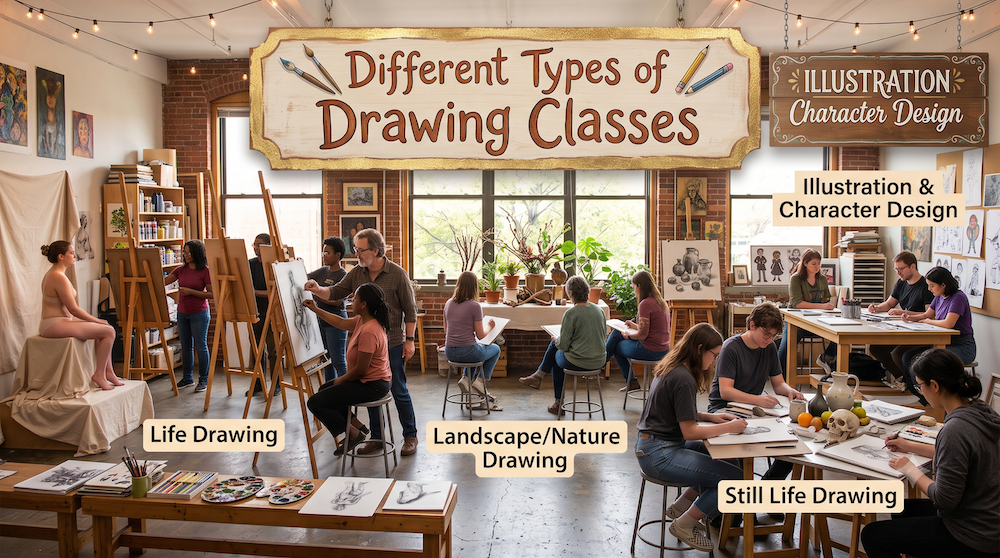
Different Types of Drawing Classes: Artistic, Technical, Digital, and Specialized Instruction
Drawing is not a single skill. It includes many approaches, methods, and professional applications. Some students want to learn how to sketch people and landscapes, while others are interested in architecture, product design, digital illustration, fashion, animation, or botanical studies.
Private and group drawing classes taught by professional artists can help students understand these different paths and choose the type of instruction that best supports their goals. These classes may be designed for beginners, teenagers, adults, art students, designers, illustrators, and experienced artists who want to strengthen specific skills.
Why Take Drawing Classes?
Drawing develops observation, coordination, concentration, imagination, and visual communication. It helps students understand form, proportion, space, light, movement, and composition.
A strong drawing course can teach students how to:
- Observe more carefully
- Build forms from simple shapes
- Improve hand-eye coordination
- Understand light and shadow
- Create depth and perspective
- Represent the human figure
- Organize a composition
- Develop a personal style
- Communicate ideas visually
- Build a professional or academic portfolio
The most appropriate class depends on the student’s interests, current level, and long-term goals.
Artistic Drawing Classes
Artistic drawing focuses on observation, expression, composition, and personal interpretation. It is ideal for students interested in fine art, illustration, painting, sculpture, or creative self-development.
These classes often include:
- Still-life drawing
- Portrait drawing
- Figure drawing
- Landscape drawing
- Gesture drawing
- Anatomy
- Composition
- Light and shadow
- Texture
- Experimental mark-making
Students may work with graphite, charcoal, ink, colored pencils, pastels, or mixed media.
Observational Drawing
Observational drawing teaches students to draw directly from real objects, people, plants, interiors, or landscapes.
The goal is not simply to copy what is visible. Students learn how to analyze proportion, shape, negative space, angles, values, and relationships between forms.
This type of drawing provides a strong foundation for nearly every visual-art discipline.
Expressive Drawing
Expressive drawing emphasizes emotion, movement, rhythm, and personal interpretation.
Students may explore:
- Loose line work
- Gesture
- Distortion
- Repetition
- Automatic drawing
- Emotional use of value
- Unconventional materials
This approach is especially useful for students who want to move beyond strict realism and develop an individual visual language.
Portrait and Figure Drawing
Portrait and figure classes focus on the human face and body. Students study proportion, anatomy, posture, gesture, expression, and the effects of light.
These classes may use:
- Photographic references
- Mirrors
- Anatomical models
- Clothed models
- Live models
- Master artworks
Portrait and figure drawing are useful for fine artists, illustrators, animators, fashion designers, and sculptors.
Technical Drawing Classes
Technical drawing is more structured and precise. It is used to communicate dimensions, construction, function, and spatial relationships.
These classes are especially relevant for students interested in:
- Architecture
- Engineering
- Interior design
- Industrial design
- Furniture design
- Product development
- Set design
- Construction
- Drafting
Technical drawing often requires accuracy, measurement, and standardized visual systems.
Perspective Drawing
Perspective helps students represent three-dimensional space on a flat surface.
Courses may cover:
- One-point perspective
- Two-point perspective
- Three-point perspective
- Interior spaces
- Architectural exteriors
- Streets and cityscapes
- Circles and ellipses
- Scale and proportion
- Atmospheric perspective
Perspective is valuable for both artistic and technical drawing.
Architectural Drawing
Architectural drawing focuses on buildings, interiors, plans, sections, elevations, and spatial presentation.
Students may learn how to:
- Draw rooms and structures
- Use scale
- Represent materials
- Create floor plans
- Develop elevations
- Draw perspective views
- Organize presentation sheets
An artist who also understands architecture and design can help students balance precision with visual clarity.
Product and Industrial Drawing
Product drawing teaches students how to represent objects clearly and convincingly.
Exercises may include:
- Geometric construction
- Ellipses
- Rotating forms
- Exploded views
- Surface materials
- Shading for volume
- Design variations
- Presentation sketches
This type of instruction is useful for students interested in product design, transportation design, furniture, fashion accessories, or invention.
Digital Drawing Classes
Digital drawing combines traditional artistic knowledge with digital tools. The basic principles of proportion, composition, anatomy, value, and perspective still apply, but students work on tablets, computers, or touchscreen devices.
Digital classes may include:
- Digital sketching
- Illustration
- Concept art
- Character design
- Environmental design
- Digital painting
- Comics
- Storyboarding
- Animation preparation
- Graphic composition
Students may use drawing tablets, styluses, and software designed for illustration or painting.
Digital Illustration
Digital illustration classes teach students how to create polished images for books, magazines, advertising, websites, games, and social media.
Students may study:
- Layers
- Brushes
- Color selection
- Line control
- Masking
- Texture
- Lighting
- Composition
- File preparation
A professional artist can help students use software as a tool rather than allowing technical effects to replace drawing knowledge.
Character Design
Character-design classes focus on creating believable and visually distinctive figures.
Students may learn:
- Shape language
- Silhouette
- Proportion
- Facial expressions
- Costume
- Gesture
- Turnarounds
- Color schemes
- Personality development
These skills are useful in animation, games, comics, children’s books, and entertainment design.
Concept Art and Environment Design
Concept-art classes teach students how to visualize characters, locations, objects, and worlds before they are produced in final form.
Students may create:
- Interior environments
- Landscapes
- Fantasy worlds
- Science-fiction cities
- Props
- Vehicles
- Mood studies
- Visual development boards
Strong perspective and composition skills are essential in this field.
Specialized Drawing Classes
Specialized classes focus on a particular subject, technique, profession, or creative goal.
These may include:
- Botanical drawing
- Fashion illustration
- Medical illustration
- Scientific illustration
- Comics and graphic novels
- Urban sketching
- Children’s book illustration
- Animal drawing
- Jewelry design
- Textile design
- Calligraphy and line art
- Portfolio preparation
Botanical Drawing
Botanical drawing teaches students to study plants, flowers, leaves, stems, and natural structures.
Classes may focus on:
- Accurate observation
- Contour
- Texture
- Symmetry
- Organic structure
- Graphite shading
- Colored pencil
- Ink
- Watercolor combinations
This type of drawing can be scientific, decorative, expressive, or meditative.
Fashion Illustration
Fashion illustration combines figure drawing with clothing, textiles, proportion, gesture, and design.
Students may learn:
- Fashion proportions
- Dynamic poses
- Fabric movement
- Garment construction
- Accessories
- Color
- Presentation boards
- Personal style
Fashion classes are useful for aspiring designers, stylists, and illustrators.
Medical and Scientific Illustration
Medical and scientific drawing requires precision, clarity, and accurate representation.
Students may study:
- Anatomy
- Biological structures
- Plants and animals
- Cross-sections
- Diagrams
- Labels
- Informational composition
This field often combines artistic skill with scientific knowledge.
Comics and Graphic Novels
Comic drawing involves visual storytelling, character development, action, sequence, and page design.
Students may learn:
- Panel composition
- Storyboarding
- Character consistency
- Facial expression
- Perspective
- Inking
- Lettering
- Visual pacing
These classes can be taught traditionally, digitally, or through a combination of both.
Urban Sketching
Urban sketching teaches students how to draw quickly from real environments.
Subjects may include:
- Streets
- Buildings
- Cafés
- Parks
- Public transportation
- People
- Architectural details
Students often work in sketchbooks using pencil, ink, watercolor, or markers.
Private Drawing Classes
Private classes provide individualized instruction. The teacher can adapt each lesson to the student’s ability, interests, pace, and objectives.
Private instruction is especially helpful for:
- Complete beginners
- Students who need extra support
- Adults returning to art
- Portfolio preparation
- Students with specific professional goals
- Artists working through technical problems
- Learners who prefer flexible scheduling
- Students who feel uncomfortable in large groups
A private teacher can observe the student’s process closely and provide immediate corrections.
Lessons may be organized as a personalized program covering several types of drawing or focused on one specialized subject.
Group Drawing Classes
Group classes create a social and collaborative learning experience.
Students benefit from:
- Instructor demonstrations
- Shared exercises
- Group critiques
- Peer motivation
- Different interpretations of the same subject
- Creative community
- More affordable instruction
Group classes may be organized by age, skill level, subject, or medium.
They are suitable for:
- Beginners
- Teenagers
- Adults
- Friends and family members
- Community groups
- Schools
- Cultural organizations
- Professional teams seeking creative development
A skilled artist-teacher can provide a common lesson while still offering individual guidance.
In-Person and Online Drawing Classes
Drawing classes can be offered in person or online.
In-Person Classes
In-person instruction allows the teacher to observe posture, hand movement, pressure, materials, and scale directly.
It is especially useful for:
- Charcoal
- Large-format drawing
- Live-model sessions
- Still life
- Outdoor sketching
- Material experimentation
Online Classes
Online classes offer flexibility and access to teachers who may not live nearby.
Students can participate from home and receive demonstrations, assignments, critiques, and personalized feedback.
Online classes work well for:
- Digital drawing
- Portfolio reviews
- Perspective
- Anatomy
- Illustration
- Individual coaching
- Structured drawing programs
The best format depends on the student’s goals and learning preferences.
Why Study with a Professional Artist?
Professional artists bring practical experience from their own studio practice. They understand that learning to draw involves more than memorizing rules.
An artist-teacher can help students:
- Simplify complex subjects
- Develop visual judgment
- Understand materials
- Learn from mistakes
- Revise effectively
- Build confidence
- Discover personal interests
- Connect technique with expression
- Prepare professional work
Artists can also introduce students to art history, contemporary practice, exhibitions, portfolios, and creative careers.
Materials Used in Different Drawing Classes
Materials vary according to the type of class.
Traditional artistic drawing may use:
- Graphite
- Charcoal
- Ink
- Colored pencils
- Pastels
- Conté
- Toned paper
- Sketchbooks
Technical drawing may require:
- Rulers
- T-squares
- Compasses
- Set squares
- Mechanical pencils
- Grids
- Drafting paper
Digital classes may require:
- Tablet
- Stylus
- Computer
- Drawing software
- Cloud storage
- Digital portfolio tools
The instructor should provide a clear materials list before the course begins.
How to Choose the Right Drawing Class
Before enrolling, students should identify what they want to achieve.
Useful questions include:
- Do I want to learn realistic drawing or creative expression?
- Am I interested in fine art, design, illustration, or a profession?
- Do I prefer traditional or digital tools?
- Do I need private attention or enjoy group learning?
- Am I preparing a portfolio?
- Do I want short workshops or a long-term course?
- Is the instructor a practicing artist?
- Does the teacher have experience with my area of interest?
- Will I receive individual feedback?
- Are the classes appropriate for my age and level?
A good instructor should be able to explain the course structure and adapt the lessons when necessary.
Drawing Classes for Beginners
Beginners do not need previous experience.
A well-designed introductory course may begin with:
- Line
- Shape
- Basic forms
- Proportion
- Negative space
- Light and shadow
- Simple perspective
- Composition
- Basic materials
Students should not feel pressured to create perfect drawings. The purpose of beginner classes is to build understanding, confidence, and regular practice.
Drawing Classes for Advanced Students
Advanced classes may focus on:
- Complex anatomy
- Master studies
- Personal style
- Professional portfolios
- Large-scale drawing
- Experimental media
- Advanced perspective
- Concept development
- Exhibition preparation
- Career goals
An experienced artist-teacher can provide critical feedback and help students move beyond technical competence toward a more individual body of work.
Benefits of Learning Different Types of Drawing
Studying more than one approach can make students more versatile.
For example:
- Artistic drawing improves observation and expression.
- Technical drawing strengthens precision and spatial thinking.
- Digital drawing expands professional tools and production methods.
- Specialized drawing connects skills to a subject or career.
Together, these approaches can develop both creative freedom and technical control.
Conclusion
Artistic, technical, digital, and specialized drawing classes offer different ways to understand and communicate the world visually.
Private classes provide personalized instruction and focused development, while group classes offer collaboration, shared learning, and creative community. When taught by professional artists, these courses combine technical knowledge with real studio experience, helping students develop stronger skills and a more confident artistic voice.
Whether a student wants to explore drawing as a hobby, prepare for art school, improve a professional portfolio, learn digital illustration, study architecture, or develop a specialized practice, the right class can provide a clear and rewarding path forward.