
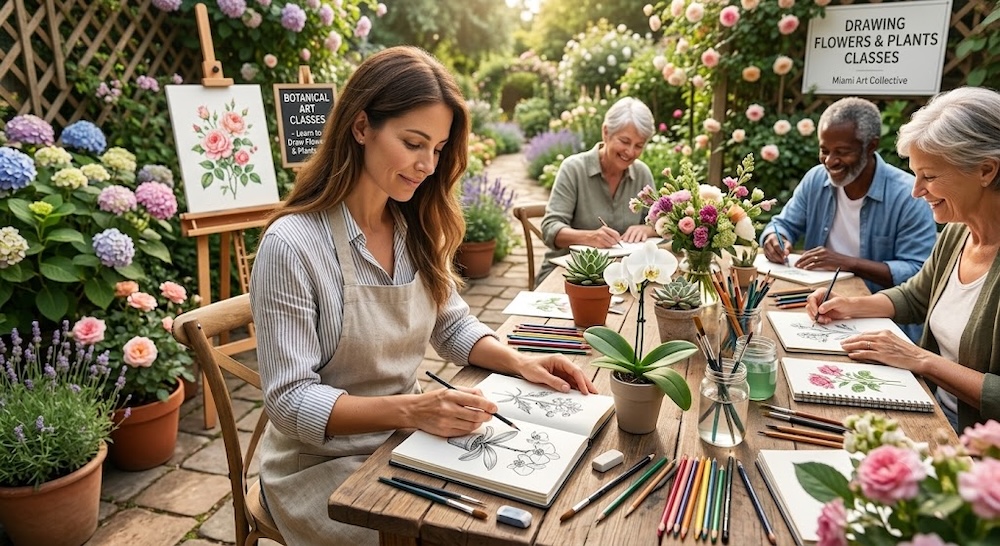
Learning to draw plants and flowers is an excellent way to develop observation, patience, technical skill, and creative confidence. Botanical subjects may appear simple at first, but they offer endless opportunities to study line, shape, proportion, texture, light, shadow, and composition.
Private and group drawing classes taught by professional artists provide students with direct guidance while allowing them to explore the natural world through art. These classes are suitable for beginners, experienced students, adults, teenagers, and anyone looking for personalized drawing instruction.
Why Learn to Draw Plants and Flowers?
Plants and flowers are ideal subjects for drawing because they combine structure and freedom. A leaf has a recognizable form, but no two leaves are exactly alike. A flower may have a symmetrical pattern, yet its petals naturally bend, overlap, and respond to light.
By drawing botanical subjects, students learn how to observe carefully rather than simply draw what they assume they see. They begin to notice small but important details, including:
- The direction of veins in a leaf
- The way petals overlap
- Differences in texture between stems, flowers, and foliage
- Changes in value caused by light and shadow
- Organic movement and natural asymmetry
- The relationship between individual forms and the overall composition
These observational skills can later be applied to portraiture, landscape, still life, illustration, and other forms of visual art.
Private Drawing Classes
Private classes offer individualized instruction based on the student’s interests, experience, pace, and artistic goals.
A professional artist can evaluate the student’s current abilities and design lessons that address specific areas for improvement. Some students may want to learn basic pencil control, while others may be interested in botanical illustration, realistic shading, composition, or developing a personal style.
During a private class, the instructor can provide immediate feedback on proportion, line quality, perspective, tonal values, and technique. This concentrated attention often helps students progress more efficiently and gain confidence.
Private lessons are especially helpful for:
- Complete beginners who prefer personalized guidance
- Students preparing art portfolios
- Adults returning to drawing after many years
- Artists seeking to improve botanical drawing
- Students who need a flexible schedule
- Individuals who feel uncomfortable in large classes
- People interested in a specific medium or technique
The pace of the lesson can be adjusted according to the student’s needs, making private instruction both focused and supportive.
Group Drawing Classes
Group classes create a social and collaborative learning environment. Students can observe how others interpret the same plant or flower and discover that there are many valid ways to approach a subject.
These classes may include guided demonstrations, drawing exercises, group discussions, and constructive critiques. Learning alongside others can encourage motivation and help students feel connected to a creative community.
Group classes are often ideal for:
- Friends or family members who want to learn together
- Beginners looking for an introduction to drawing
- Community groups and cultural organizations
- Teenagers interested in creative activities
- Adults seeking a relaxing and educational experience
- Students who benefit from peer interaction
Although the class follows a shared lesson, experienced instructors can still offer individual feedback and adapt exercises to different skill levels.
What Students May Learn
A drawing course focused on plants and flowers can include both foundational and advanced techniques.
Students may study:
Contour and Line Drawing
Contour drawing teaches students to observe the edges and internal structures of leaves, petals, stems, and branches. It improves hand-eye coordination and encourages careful attention.
Proportion and Structure
Before adding detail, students learn how to identify the basic shapes that form a plant or flower. Understanding structure helps create more accurate and balanced drawings.
Light and Shadow
Shading gives botanical drawings volume and depth. Students learn how to recognize highlights, middle values, reflected light, and cast shadows.
Texture
Different marks can suggest smooth petals, rough bark, delicate veins, dry leaves, or thick succulent surfaces. Texture allows a drawing to become more visually convincing.
Composition
Students learn how to arrange flowers, leaves, and negative spaces within the page. A strong composition guides the viewer’s eye and creates harmony.
Botanical Accuracy and Creative Interpretation
Some students may prefer precise botanical illustration, while others may want a more expressive or abstract approach. Professional artists can help students understand both observation and interpretation.
Materials Used in Class
Drawing plants and flowers can be explored through several traditional materials, including:
- Graphite pencils
- Charcoal
- Colored pencils
- Ink
- Pastels
- Watercolor pencils
- Sketchbooks and fine-art papers
Beginners often begin with graphite because it is easy to control and allows students to study line, value, and form. As they progress, they may experiment with color and mixed media.
The instructor can recommend materials based on the student’s goals and budget. Expensive supplies are usually unnecessary for the first lessons.
Why Study with an Artist?
A class taught by a practicing artist offers more than technical instruction. Professional artists understand the creative process, including experimentation, mistakes, revision, and the development of an individual visual language.
They can demonstrate not only how to draw a flower, but also how to make artistic decisions. Students learn when to simplify, where to place emphasis, how to create movement, and how to transform direct observation into a personal artwork.
Artists also bring knowledge of art history, composition, materials, and studio practice. Their experience can help students understand drawing as both a skill and a form of personal expression.
The Benefits of Drawing from Nature
Drawing plants and flowers can also support concentration and emotional well-being. The process requires students to slow down, focus on small details, and remain present with the subject.
Many people find botanical drawing calming because it provides a break from screens, notifications, and daily distractions. The activity can encourage mindfulness while still offering intellectual and artistic challenges.
Students often develop greater appreciation for the natural world as they begin to notice forms, colors, and patterns that previously went unnoticed.
Choosing the Right Class
Before selecting a private or group class, students should consider their goals.
Someone looking for intensive technical development may prefer private instruction. A person seeking community, relaxation, or a shared creative activity may enjoy a group class.
It is also helpful to ask:
- Is the class suitable for beginners?
- Are materials included?
- Does the instructor teach realism, illustration, or expressive drawing?
- How long is each session?
- Are lessons held in person or online?
- Can the course be adapted to personal interests?
- Does the instructor provide individual feedback?
The most effective class is one that combines clear instruction, encouragement, and enough freedom for personal exploration.
Conclusion
Private and group classes in drawing plants and flowers offer an accessible introduction to visual art and a valuable opportunity for continued artistic development. Through direct observation and professional guidance, students can improve their technical skills, strengthen their creativity, and develop a deeper connection with nature.
Whether the goal is to create realistic botanical drawings, build a portfolio, explore a new hobby, or enjoy a meaningful creative experience, learning from an artist can make the process more engaging, structured, and rewarding.
Drawing Plants and Flowers: Private and Group Classes Taught by Professional Artists
Learning to draw plants and flowers is an excellent way to develop observation, patience, technical skill, and creative confidence. Botanical subjects may appear simple at first, but they offer endless opportunities to study line, shape, proportion, texture, light, shadow, and composition.
Private and group drawing classes taught by professional artists provide students with direct guidance while allowing them to explore the natural world through art. These classes are suitable for beginners, experienced students, adults, teenagers, and anyone looking for personalized drawing instruction.
Why Learn to Draw Plants and Flowers?
Plants and flowers are ideal subjects for drawing because they combine structure and freedom. A leaf has a recognizable form, but no two leaves are exactly alike. A flower may have a symmetrical pattern, yet its petals naturally bend, overlap, and respond to light.
By drawing botanical subjects, students learn how to observe carefully rather than simply draw what they assume they see. They begin to notice small but important details, including:
- The direction of veins in a leaf
- The way petals overlap
- Differences in texture between stems, flowers, and foliage
- Changes in value caused by light and shadow
- Organic movement and natural asymmetry
- The relationship between individual forms and the overall composition
These observational skills can later be applied to portraiture, landscape, still life, illustration, and other forms of visual art.
Private Drawing Classes
Private classes offer individualized instruction based on the student’s interests, experience, pace, and artistic goals.
A professional artist can evaluate the student’s current abilities and design lessons that address specific areas for improvement. Some students may want to learn basic pencil control, while others may be interested in botanical illustration, realistic shading, composition, or developing a personal style.
During a private class, the instructor can provide immediate feedback on proportion, line quality, perspective, tonal values, and technique. This concentrated attention often helps students progress more efficiently and gain confidence.
Private lessons are especially helpful for:
- Complete beginners who prefer personalized guidance
- Students preparing art portfolios
- Adults returning to drawing after many years
- Artists seeking to improve botanical drawing
- Students who need a flexible schedule
- Individuals who feel uncomfortable in large classes
- People interested in a specific medium or technique
The pace of the lesson can be adjusted according to the student’s needs, making private instruction both focused and supportive.
Group Drawing Classes
Group classes create a social and collaborative learning environment. Students can observe how others interpret the same plant or flower and discover that there are many valid ways to approach a subject.
These classes may include guided demonstrations, drawing exercises, group discussions, and constructive critiques. Learning alongside others can encourage motivation and help students feel connected to a creative community.
Group classes are often ideal for:
- Friends or family members who want to learn together
- Beginners looking for an introduction to drawing
- Community groups and cultural organizations
- Teenagers interested in creative activities
- Adults seeking a relaxing and educational experience
- Students who benefit from peer interaction
Although the class follows a shared lesson, experienced instructors can still offer individual feedback and adapt exercises to different skill levels.
What Students May Learn
A drawing course focused on plants and flowers can include both foundational and advanced techniques.
Students may study:
Contour and Line Drawing
Contour drawing teaches students to observe the edges and internal structures of leaves, petals, stems, and branches. It improves hand-eye coordination and encourages careful attention.
Proportion and Structure
Before adding detail, students learn how to identify the basic shapes that form a plant or flower. Understanding structure helps create more accurate and balanced drawings.
Light and Shadow
Shading gives botanical drawings volume and depth. Students learn how to recognize highlights, middle values, reflected light, and cast shadows.
Texture
Different marks can suggest smooth petals, rough bark, delicate veins, dry leaves, or thick succulent surfaces. Texture allows a drawing to become more visually convincing.
Composition
Students learn how to arrange flowers, leaves, and negative spaces within the page. A strong composition guides the viewer’s eye and creates harmony.
Botanical Accuracy and Creative Interpretation
Some students may prefer precise botanical illustration, while others may want a more expressive or abstract approach. Professional artists can help students understand both observation and interpretation.
Materials Used in Class
Drawing plants and flowers can be explored through several traditional materials, including:
- Graphite pencils
- Charcoal
- Colored pencils
- Ink
- Pastels
- Watercolor pencils
- Sketchbooks and fine-art papers
Beginners often begin with graphite because it is easy to control and allows students to study line, value, and form. As they progress, they may experiment with color and mixed media.
The instructor can recommend materials based on the student’s goals and budget. Expensive supplies are usually unnecessary for the first lessons.
Why Study with an Artist?
A class taught by a practicing artist offers more than technical instruction. Professional artists understand the creative process, including experimentation, mistakes, revision, and the development of an individual visual language.
They can demonstrate not only how to draw a flower, but also how to make artistic decisions. Students learn when to simplify, where to place emphasis, how to create movement, and how to transform direct observation into a personal artwork.
Artists also bring knowledge of art history, composition, materials, and studio practice. Their experience can help students understand drawing as both a skill and a form of personal expression.
The Benefits of Drawing from Nature
Drawing plants and flowers can also support concentration and emotional well-being. The process requires students to slow down, focus on small details, and remain present with the subject.
Many people find botanical drawing calming because it provides a break from screens, notifications, and daily distractions. The activity can encourage mindfulness while still offering intellectual and artistic challenges.
Students often develop greater appreciation for the natural world as they begin to notice forms, colors, and patterns that previously went unnoticed.
Choosing the Right Class
Before selecting a private or group class, students should consider their goals.
Someone looking for intensive technical development may prefer private instruction. A person seeking community, relaxation, or a shared creative activity may enjoy a group class.
It is also helpful to ask:
- Is the class suitable for beginners?
- Are materials included?
- Does the instructor teach realism, illustration, or expressive drawing?
- How long is each session?
- Are lessons held in person or online?
- Can the course be adapted to personal interests?
- Does the instructor provide individual feedback?
The most effective class is one that combines clear instruction, encouragement, and enough freedom for personal exploration.
Conclusion
Private and group classes in drawing plants and flowers offer an accessible introduction to visual art and a valuable opportunity for continued artistic development. Through direct observation and professional guidance, students can improve their technical skills, strengthen their creativity, and develop a deeper connection with nature.
Whether the goal is to create realistic botanical drawings, build a portfolio, explore a new hobby, or enjoy a meaningful creative experience, learning from an artist can make the process more engaging, structured, and rewarding.