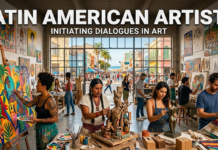
Indigenous Voices, Contemporary Visions: The Rise of Latin American Indigenous Artists in Global Contemporary Art
Miami Cultural Guide
For centuries, Indigenous cultures have shaped the visual, spiritual, and intellectual foundations of the Americas. Yet within the dominant narratives of art history, Indigenous creators were often excluded from the category of “contemporary artist,” their contributions relegated to anthropology, folklore, craft, or ethnography rather than recognized as active participants in contemporary cultural discourse.
Today, that narrative is changing.
Across Latin America, a growing generation of Indigenous artists is transforming the global art landscape. Their work challenges historical exclusions while offering new perspectives on identity, territory, memory, ecology, spirituality, language, and collective knowledge. These artists are not simply preserving ancestral traditions; they are expanding them, creating contemporary visual languages that connect ancient wisdom with the urgent realities of the twenty-first century.
The result is one of the most significant developments in contemporary art today.
Beyond Representation
One of the greatest misconceptions surrounding Indigenous art is the assumption that Indigenous artists are primarily concerned with representing tradition.
In reality, many contemporary Indigenous artists work at the intersection of multiple worlds. Their practices engage with installation, performance, photography, video, painting, sculpture, textiles, sound, artificial intelligence, and conceptual art while remaining deeply connected to ancestral knowledge systems.
Their work is not about nostalgia.
It is about continuity.
Rather than looking backward, these artists demonstrate that Indigenous cultures are living, evolving systems of knowledge capable of addressing contemporary issues such as environmental destruction, migration, extractive economies, cultural erasure, and technological transformation.
Knowledge Systems, Not Aesthetic Styles
Western art history has often categorized artistic movements according to visual characteristics. Indigenous artistic practices invite us to consider a different framework.
For many Indigenous cultures, art is inseparable from relationships—with the land, with community, with ancestors, with language, and with the spiritual dimensions of existence.
The artwork is not merely an object.
It is part of a larger system of knowledge.
This perspective challenges one of the central assumptions of modern Western culture: the separation between human beings and nature.
Across Latin America, Indigenous artists frequently present alternative visions of reality in which rivers, forests, mountains, animals, and ecosystems are understood as living participants rather than passive resources.
Their work expands the conversation beyond aesthetics into questions of responsibility, reciprocity, and coexistence.
Territory as Memory
Land occupies a central position in the work of many Indigenous artists.
Territory is not simply geography; it is memory, identity, language, history, and belonging. It is the physical archive through which generations transmit knowledge.
As Indigenous communities confront deforestation, mining projects, climate change, forced displacement, and urban expansion, contemporary artists increasingly use their practices to document, protect, and reinterpret these relationships.
Photography, video installations, performance interventions, and site-specific works become acts of cultural preservation and political resistance.
Through art, territory becomes visible not only as landscape but as living history.
The Power of Language
Many Indigenous artists are also engaged in the preservation and revitalization of ancestral languages.
Language carries worldviews.
When a language disappears, unique ways of understanding reality disappear with it.
Contemporary Indigenous artists often incorporate spoken word, oral histories, sound installations, poetry, and linguistic research into their work. By doing so, they challenge dominant narratives while reaffirming the value of cultural knowledge that has survived despite centuries of colonization and assimilation.
Their artistic practices reveal that language itself can function as a material.
A word can become an image.
A story can become an installation.
A memory can become an act of resistance.
Textiles, Materiality, and Ancestral Knowledge
Textile traditions occupy a particularly important role in Indigenous contemporary art throughout Latin America.
For centuries, weaving, embroidery, natural dyeing, and fiber construction have functioned as systems of communication, storytelling, and cultural continuity.
Today, many Indigenous artists are reinterpreting these traditions through contemporary frameworks.
Textiles become archives.
Patterns become maps.
Threads become narratives connecting generations across time.
Rather than existing outside contemporary art, these practices reveal how traditional knowledge can generate some of the most innovative artistic responses to contemporary challenges.
The growing recognition of textile-based practices within museums and international biennials reflects a broader shift toward valuing diverse forms of knowledge production.
Ecology and the Future
Few artistic communities have addressed ecological issues with greater urgency than Indigenous artists.
Long before climate change became a central topic within contemporary art, Indigenous knowledge systems emphasized the interconnectedness of all living beings.
Today, artists throughout the Amazon, the Andes, Mesoamerica, and other regions are creating works that examine environmental degradation, biodiversity loss, water rights, and sustainable futures.
Their perspectives challenge extractive models of development and invite audiences to reconsider humanity’s relationship with the natural world.
In many ways, Indigenous contemporary art has become one of the most powerful voices in global ecological discourse.
Indigenous Artists and the International Art World
The increasing visibility of Indigenous artists in museums, biennials, and major international exhibitions marks an important cultural shift.
Institutions are beginning to recognize that Indigenous artists are not peripheral figures within contemporary art. They are central contributors to some of its most urgent conversations.
Their work has appeared in major exhibitions across the Americas and Europe, prompting curators, collectors, and scholars to reconsider longstanding assumptions about art history and cultural production.
Yet this visibility also raises important questions.
How can institutions support Indigenous artists without appropriating their narratives?
How can global recognition coexist with local cultural responsibilities?
How can the art world engage Indigenous knowledge respectfully rather than treating it as a temporary trend?
These questions will continue to shape the future of contemporary art.
Reimagining Contemporary Art
Perhaps the most significant contribution of Indigenous contemporary artists is not a particular aesthetic or medium.
It is a different way of understanding reality.
Their work challenges the idea that progress requires separation from nature. It questions the notion that knowledge belongs exclusively to institutions. It reminds us that memory, community, and spirituality remain vital components of contemporary life.
In an era defined by environmental crisis, technological acceleration, and cultural fragmentation, Indigenous artists offer perspectives grounded in relationship, reciprocity, and long-term thinking.
They invite us to imagine futures informed not only by innovation but also by wisdom.
Conclusion
The rise of Indigenous contemporary artists in Latin America represents one of the most transformative developments in global contemporary art.
Their practices dissolve the false boundaries between tradition and innovation, local knowledge and global discourse, material culture and conceptual inquiry.
More importantly, they remind us that contemporary art is not merely a reflection of the present moment.
It is also a conversation with the past and a proposal for the future.
As museums, collectors, curators, and audiences continue to engage with Indigenous artistic practices, one thing becomes increasingly clear: these artists are not entering contemporary art.
They have been expanding its possibilities all along.