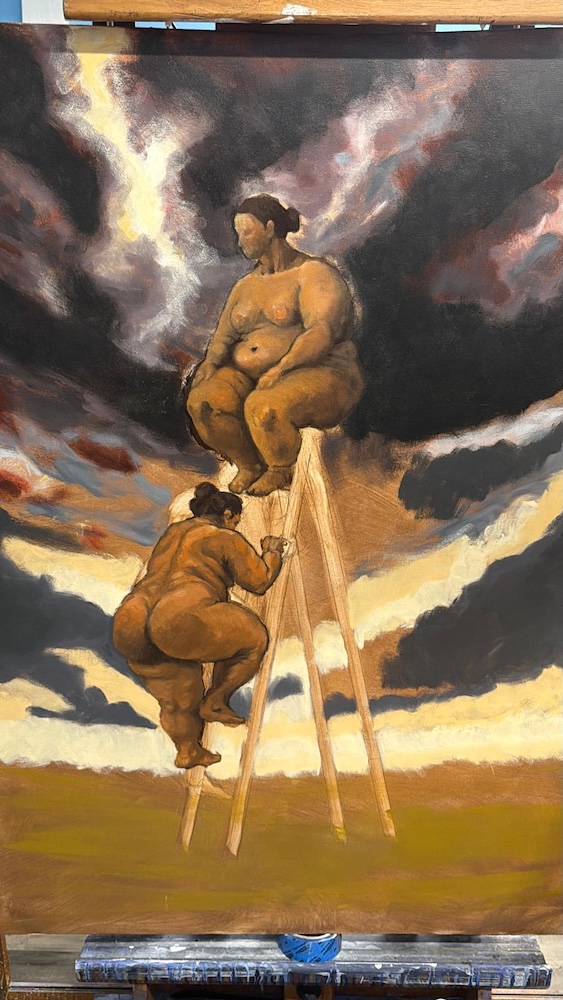
In The Art of Deception, Roger Mari examines ambition, hierarchy, authority, excess, and the unstable relationship between power and identity. His paintings are populated by exaggerated figures, symbolic ladders, and sparse, desolate environments that create a visual tension between accumulation and scarcity, ascent and isolation, control and vulnerability.
Rooted in personal experience and shaped in part by his Venezuelan background, Mari’s work initially emerged from a direct engagement with political and social realities. Over time, however, his visual language has moved toward a more universal form. By reducing specific political references and removing recognizable identities, he opens the work to broader questions about human behavior: What happens when ambition succeeds? How does authority transform the person who holds it? And can the desire for more ever truly be satisfied?
His use of a restricted Zorn palette reinforces these concerns. Limitation becomes both a formal strategy and a conceptual counterpoint to the excess embodied by his figures. The result is a body of work that does not offer simple judgments, but instead functions as a psychological mirror—one that implicates not only those who possess power, but also those who desire it.
In this conversation with Art Miami Magazine, Roger Mari reflects on the origins of The Art of Deception, the influence of Venezuela on his thinking, the tension between ambition and empathy, and the uncomfortable possibility that the structures we criticize in others may also exist within ourselves.
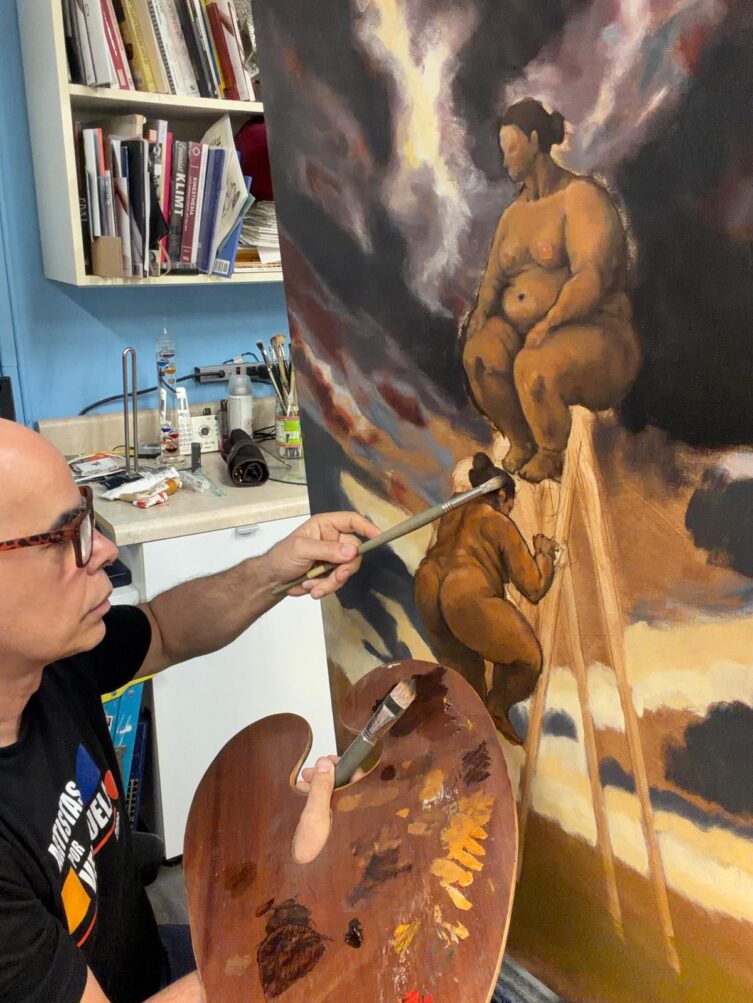
AMM: In The Art of Deception, the ladder represents ambition and social hierarchy, while the figures above it occupy positions of power over desolate landscapes. When you look at this symbol from your own life experience, especially through your Venezuelan background, do you see the desire to ascend as a necessary human impulse, or as the beginning of a separation from others?
Roger Mari: I believe ambition is part of being human. We all want to grow, achieve something, and improve our lives. I don’t think there is anything wrong with wanting to reach the top.
For me, the problem begins when someone reaches that position and starts feeling superior to others, using their authority for personal benefit without considering the consequences.
Growing up in Venezuela, I saw how authority could be used in ways that affected ordinary people. Those experiences stayed with me and eventually became part of my work.
The ladder represents our desire to succeed, but it also raises a question about what happens after we get there. Do we continue to see others as equals, or do we begin to believe that being above them makes us more important?
I don’t question the desire to climb. I question what we become when we reach the top.
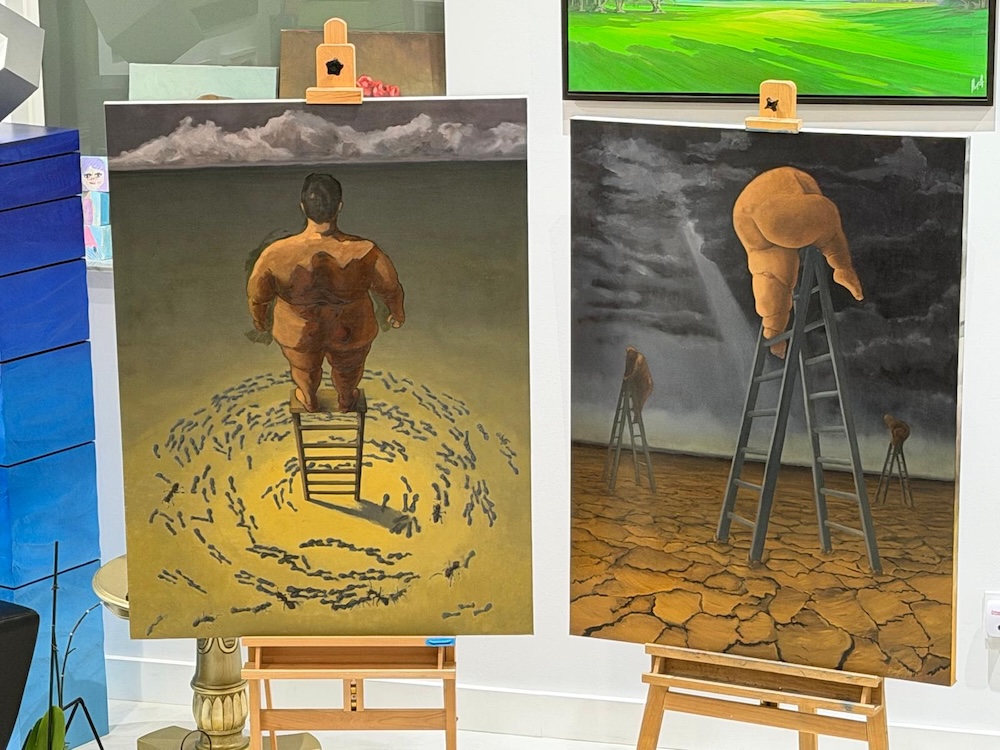
AMM: You describe your figures as physically excessive while the world around them is marked by scarcity. Is that contrast primarily a critique of social inequality, or does it also reflect something psychological—the possibility that accumulation, authority, and domination may emerge from an inner sense of emptiness or insecurity?
RM: When I first started painting these voluptuous figures, I was thinking about the accumulation of wealth and power without concern for the consequences. I wanted their exaggerated bodies to contrast with the desolate world surrounding them.
But as I continued working, another question came to mind: How much is enough?
We spend so much of our lives wanting more. More money, more success, more recognition, more power. But where does that desire end? At what point do we finally feel satisfied?
That made me look at the figures differently. Maybe they are not simply accumulating wealth or power. Maybe they are searching for a satisfaction they can never quite reach.
I didn’t begin the painting with that psychological interpretation in mind. It developed as I worked, and it became one of the questions I now want to explore further.
How much can we accumulate before we realize that having more may never be enough?
AMM: Your earlier work addressed specific political and social circumstances, while your current practice moves toward a more universal language by removing recognizable identities. What have you gained through that process, and what have you risked losing by distancing the work from the specific history and identity that originally shaped it?
RM: My earlier work came from a need to express my frustration with the political situation in Venezuela. I used recognizable images and symbols because I wanted people to understand exactly what I was addressing.
But I have spent much of my life living outside Venezuela, and I am also the son of immigrants who made Venezuela their home. That background made me realize that many of the questions I was asking were not limited to one country.
I wanted my work to speak to people who might know nothing about Venezuela but could still recognize something familiar in the images.
By removing specific political identities, I feel I have given viewers more freedom to interpret the work through their own experiences.
Of course, I risk losing some of the historical context that originally inspired me. But that history is still there. It is part of who I am and why I began asking these questions.
I haven’t abandoned my origins. I have simply changed the way I tell the story.
AMM: You use a restricted Zorn palette to intensify the tension between excess and scarcity. Limitation is therefore not only technical but conceptual. How does imposing restriction on yourself as an artist relate to the very human desire for freedom, control, and power that your work investigates?
RM: For me, working with a limited palette is actually liberating.
Using the Zorn palette allows me to spend less time deciding which colors to use and more time thinking about the painting itself. I can concentrate on the composition, the structure, the light, and how I want the viewer to experience the work.
What should catch your attention first? What should remain in the background? What can I remove without losing what I want to communicate?
Those decisions become much more important to me than having an unlimited selection of colors.
Later, I began to notice something interesting. My paintings were exploring excess and scarcity, and here I was deliberately limiting my own resources.
I hadn’t necessarily planned that connection from the beginning. Maybe it was there without my realizing it.
What I find fascinating is that by giving myself fewer choices, I actually feel more freedom to create.
AMM: You want viewers to recognize something of themselves in your images rather than receive definitive answers. If The Art of Deception functions as a mirror, what aspect of your own relationship with ambition, authority, contradiction, or self-deception have you had to confront while creating the series?
RM: This is probably the most uncomfortable question for me because it touches on some of my personal fears.
Of course, I want to succeed as an artist. I want my work to be recognized internationally, and I hope to leave something meaningful behind.
But while creating this series, I began asking myself a question that honestly frightens me: What if I reach that level of recognition and become one of the very people I am criticizing?
What if success changes the way I treat others? What if I lose my empathy? And what if, after achieving everything I wanted, I still don’t feel satisfied?
I think that is where the idea of deception becomes much more personal.
It is easy to look at someone in power and question their behavior. It is much harder to look at yourself and wonder whether you might behave the same way if you were in their position.
I don’t have an answer, and I’m not sure I ever will.
Perhaps that is what keeps me working on The Art of Deception. The more I question the figures in my paintings, the more I find myself questioning my own ambitions.
Works in Progress
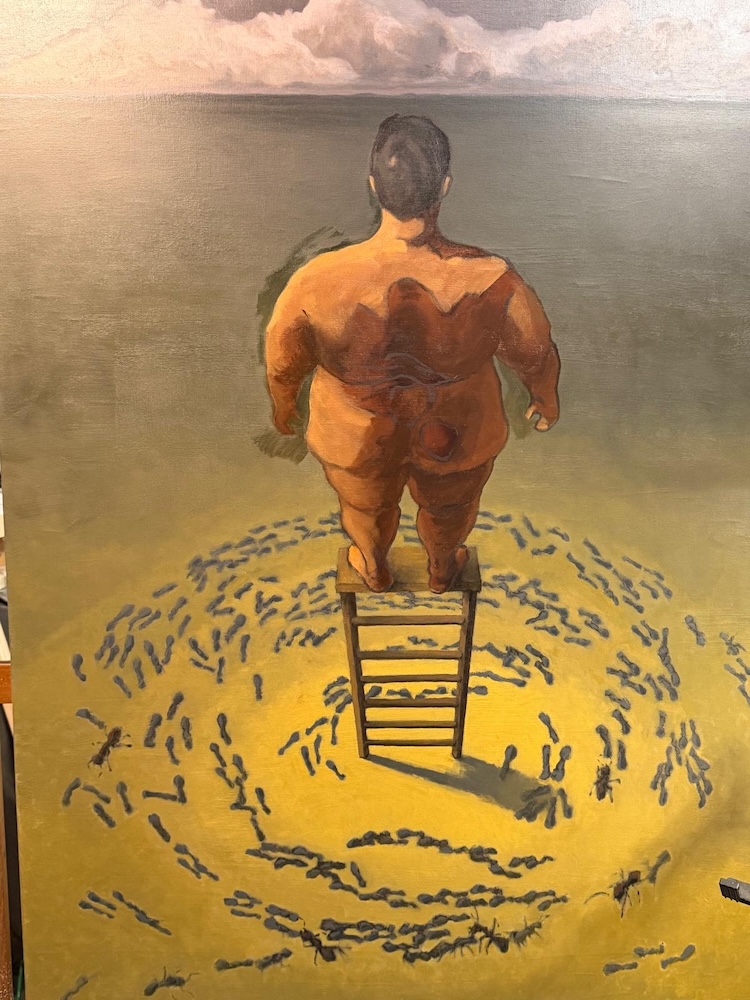
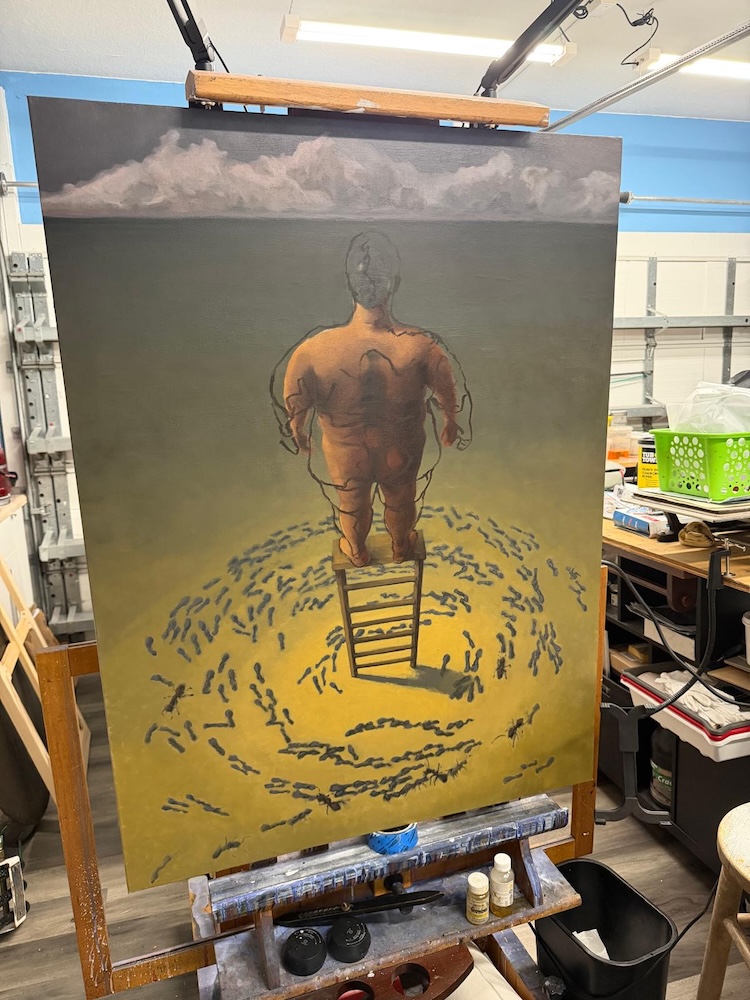
Mari has also shared images of two works currently in progress, The Omnipotent and The Obsession of Ascent, which offer a glimpse into the continuing evolution of The Art of Deception.
These works extend the series’ investigation of power by focusing on different dimensions of authority, ambition, and the struggle to obtain—and maintain—a position of dominance.
Both works should be identified as works in progress when reproduced.