
By Milagros Bello
Confluences. European Cultural Center, during the 61st Venice Biennale 2026
“Return to the Origins emerges from a
return to what is essential: to the earth, to
matter, and to an ancestral memory that
remains within us and, in my case,
reappears transformed through art.” —
Mircza Seiler
Mircza Seiler — Return to the Origins
This interview focuses on the work of Mircza Seiler, presented from May 10 through November 24, 2026, in Confluences, an exhibition organized by the European Cultural Centre as part of Americas. Rewriting the Center, curated by Dr. Milagros Bello.
Seiler participates with Return to the Origins, a work comprising two pieces housed in acrylic boxes and incorporating poinciana pods attached to canvas. The work’s materiality connects territory and belonging, engaging nature and Latin American ancestral legacies.
Milagros Bello:
What was the conceptual point of departure for Return to the Origins? What artistic impulse gave rise to this series?
Mircza Seiler:
My training as an agronomist and my longstanding relationship with nature have been fundamental to the way I see and create. My profession kept me close to the earth, attentive to its elements, cycles, transformations, and mysteries. It taught me to pause before what often goes unnoticed: a seed, a pod, a texture, a form altered by time.
At a certain point, I realized that I no longer wanted to separate that experience from my artistic practice. On the contrary, I felt the need to bring them together—to allow my knowledge of and connection to nature to find another form of expression through art. Return to the Origins grew out of that search.
The works in this series are not simply compositions made from natural elements. When I work with pods, fruits, leaves, seeds, and roots—joining them, repeating them, and constructing new structures—I find in their forms, textures, and imperfections a particular beauty that activates my imagination and often opens the way into the work. Through them, I discover relationships between fragility and resilience, order and transformation. I am interested in how something so elemental can become a threshold for new meanings.
MB: What does the idea of “origin” mean to you, and how does it manifest itself in this work?
MS: To create is to return to the root, to the primordial rhythm of existence, to the origin of things; it is to return to that essential place where our relationship with life begins.
For me, origin means returning to what is elemental, but also recognizing what remains within us: memory, the earth, our bonds, and the experiences that have shaped us.
In Return to the Origins, I work with poinciana pods—irregular and imperfect forms shaped by biological processes and transformed over time. I take these elements as I find them, attentive to their marks and singular mutations. I assemble and interweave them into geometric configurations in which order and dislocation, structure and chaos coexist.
This interrelationship reflects the spirit of nature, while also evoking the connections between our individual lives and our relationships with others. It speaks of the unpredictability of the rhythms that bind us, as well as those that govern the natural environment.
In this sense, the work proposes a journey toward origin, not as an act of nostalgia, but as a way of recognizing ourselves as symbolic territory.
MB: Your practice brings together seemingly distinct registers, from the organic materiality of Return to the Origins to the abstract and semi-figurative configurations of your collages. Yet both seem to share a logic of transformation and recomposing. What role do paper and collage play in the construction of your artistic language?
MS: I am interested in working with materials that already carry a history and in exploring their capacity for transformation. Recovering and intervening in them does not simply mean reusing them; it means altering their condition and bringing them into a new visual logic.
In my collages, paper ceases to function merely as a support and becomes an active material. I paint, tear, cut, layer, and assemble fragments, working at the threshold between rupture and recomposing, where a form loses its original integrity to acquire another presence.
The process unfolds through intuition. Relationships between color, texture, and form continually redirect my decisions, opening possibilities that were not anticipated at the outset. The work emerges through this interaction between intention and discovery.
Abstraction arises precisely there: memory, experience, and affect appear as traces, without needing to resolve themselves into recognizable images. I want the fragment to retain something of what it once was while simultaneously opening itself to another possibility of existence.
For me, collage is a way of thinking through matter’s continual transformation.
MB: Your process does not seem oriented toward achieving absolute control over the work, but rather toward preserving a certain degree of indeterminacy. How important is this to you?
MS: I want to ensure the work does not become merely the execution of a preconceived idea under controlled circumstances. I make certain decisions and establish particular directions, but I leave open the possibility that the process itself may question or reposition them.
That margin of indeterminacy is essential to me because it introduces possibilities I could not have anticipated. The work therefore stops confirming an initial intention and becomes a space of discovery.
MB: What did it mean to you to present Return to the Origins at the European Cultural Centre during the Venice Biennale?
MS: It meant many things. First, an enormous emotional rush: being in Venice with my work was a dream I never imagined I would actually experience. It also meant knowing that a curator had seen my work, believed in it, and chosen to bring it into a context of this significance.
Arriving in Venice, surrounded by so much history and, at the same time, by such a vast range of contemporary artistic practices—by established artists as well as others I encountered for the first time—was an extraordinarily intense experience. At first, it was almost impossible to absorb everything that was happening.
MB: What was it like to see your work enter into dialogue with an international audience and with artists from different cultural contexts? What aspects of the work seemed to acquire a different or unexpected resonance?
MS: I understood that it was no longer simply a matter of “exhibiting in Venice.” My work had entered an international space of exchange, encountering other ways of seeing, other artistic languages, and other ways of thinking about the present. That changed the experience for me. It meant recognizing that my work could move beyond my immediate context, engage diverse audiences, and become part of a broader conversation about art and the world we inhabit.
I discovered that the work could exceed the references from which it had been created and generate readings I had never anticipated. People from different cultural contexts approached it through their own experiences, finding associations, sensations, and meanings different from my own. That changed the way I saw the work myself.
I understood that the gaze of the other not only expands the interpretation of a work; it can also activate meanings and possibilities that had remained latent.
Once a work leaves the studio, it no longer belongs entirely to you. That capacity to move across contexts and generate different interpretations was one of the most enriching and unexpected aspects of my experience at the European Cultural Centre.
MB: Which artists, works, or exhibitions at the Venice Biennale particularly captured your attention?
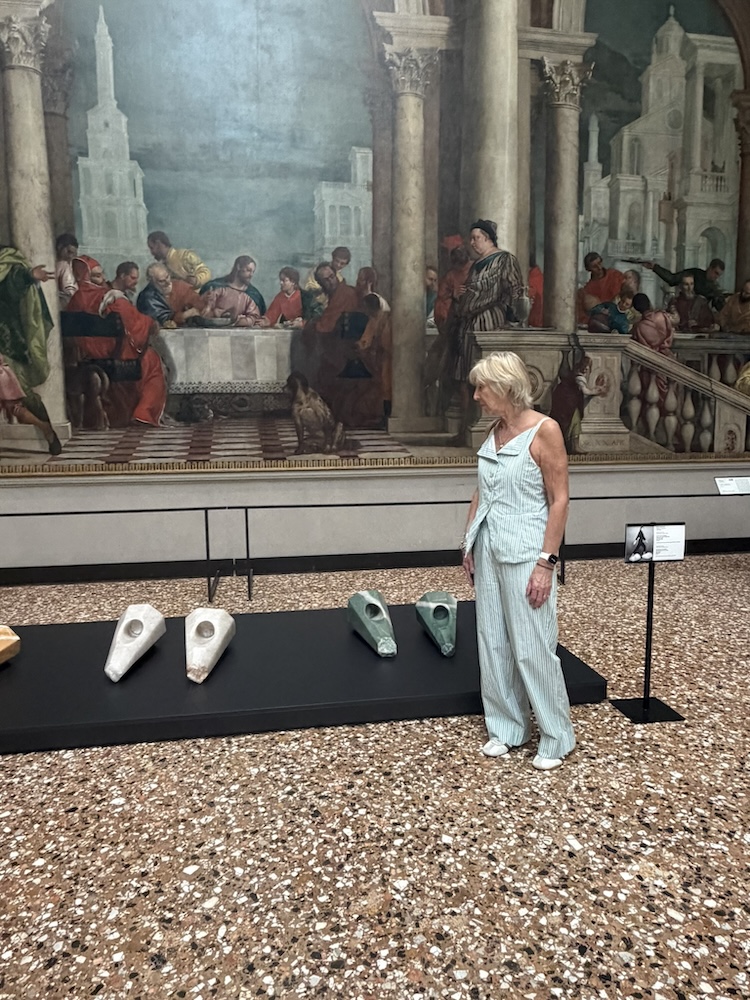
MS: I was particularly drawn to the Argentine Pavilion, with Matías Duville’s Monitoring Yin Yang; the Israeli Pavilion, with Belu-Simion Fainaru’s The Rose of Nothingness; and Marina Abramović’s Transforming Energy at the Gallerie dell’Accademia in Venice.
Despite their very different approaches, I found something vital connecting these works: their capacity to work with elemental, everyday materials and bring them into another symbolic dimension—salt and charcoal in Duville, water in Fainaru, and stone in Abramović.
These materials ceased to be matter and became presences that elicited silence, attention, and contemplation. What struck me was discovering how the elemental can generate such an intense experience.
MB: What reflections on the direction of contemporary art emerged from your experience of the Biennale? And what did you discover about your own work within that context?
MS: This Biennale proposes a different way of approaching art. In the vision of Koyo Kouoh, the late curator of this edition, there is space for introspection, emotion, memory, intimacy, nature, and human relationships. Although questions of identity, politics, war, protest, and the crises of our time remain present, many works speak from quieter, more personal places.
I came to understand In Minor Keys as precisely this opening toward the sensitive and the intimate. That was one of the most valuable things I encountered at the Biennale.
In relation to my own work, I discovered that it has a more defined identity than I had realized. Moving through the Biennale and encountering so many different ways of making and thinking about art allowed me to recognize more clearly what truly belongs to my own practice.
I was also struck by the natural affinity I felt with certain ideas present throughout the Biennale: an attentiveness to the earth, its transformations, the memory it holds, and our relationship with it. These concerns have been present in my work for a long time—not because they respond to a trend, but because they are intrinsic to the way I see and create.
MB: Beyond the significance of participating in the European Cultural Centre, what new directions for your artistic research have emerged from this experience?
MS: I want to continue creating without responding to formulas or trends—to keep exploring, taking risks, questioning, and transforming. Venice allowed me to recognize what I have already built, but it also made visible everything that remains open to further development.
Every work raises new questions.