
In Physis, ice assumes an architectural authority that its own morphology unsettles. Fractures, cavities, and eroded planes give these bodies their structural singularity. Subtraction becomes constructive: what has been removed determines the force of what remains. Their monumentality emerges from this conflict between the assertion of mass and the instability of its limits.
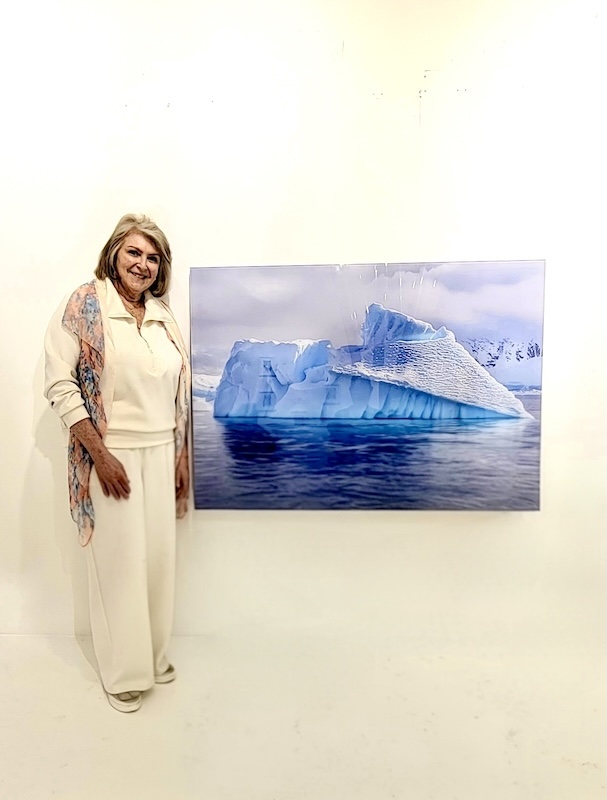
Photography intensifies that conflict. The framing grants each formation the coherence of an autonomous body, extracting it from a material continuum in which no such autonomy is secure. Across the series, the recurrence of these monumental presences establishes a visual order without suppressing their differences. Each body proposes another configuration of the same problem: how matter acquires form through the forces that alter it.

The beauty of these images demands scrutiny. Susan Sontag’s On Photography places aesthetic appropriation at the center of the photographic act. Physis works within that tension. Color, spatial organization, and the isolation of the icebergs confer visual authority. Yet the surfaces complicate the compositional order: every cavity interrupts the apparent sufficiency of the whole. The image makes the body available to contemplation while exposing the precariousness of the integrity it confers.

Barthes’s Camera Lucida introduces a further division. Photography attests to an existence whose present it cannot restore. Here, morphological precision acquires a particular force: the more insistently the image preserves a contour, the more sharply it separates that contour from the material processes that continue beyond the exposure. The iceberg remains intact within the photograph. Its persistence belongs to the image, not to reality.

The postcard’s scenic beauty promises a landscape complete, available to recognition and desire. In Physis, that completeness is placed under pressure. The framing gives each iceberg the coherence of a monument, while its morphology exposes a body shaped by erosion. What appears intact veils what has been lost. The scene becomes a meditation on impermanence and disappearance.