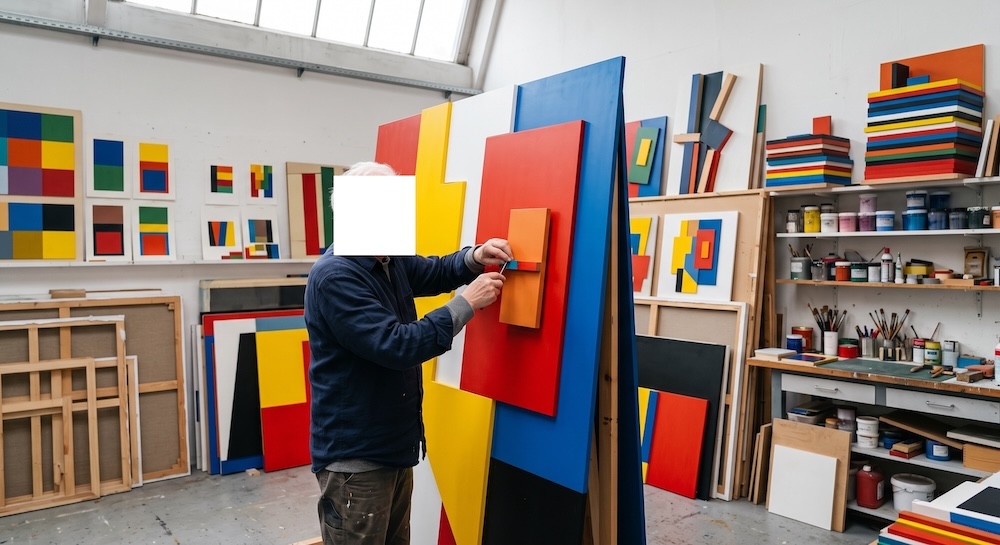
Minimalist Abstract Art
Update 08/2026
Imi Knoebel: Radical Abstraction, Color, and the Architecture of Pure Perception
From Raum 19 and the radical reduction of the 1960s to his new Poem, Ligatur, and Zeichen works, Imi Knoebel continues to redefine the boundaries between painting, sculpture, material, and space.
“If you want to do something, to stay alive, you have to think of something radical.”
— Imi Knoebel
Few artists have pursued the fundamental possibilities of abstraction with the persistence, rigor, and freedom of Imi Knoebel. For more than six decades, the German artist has investigated some of art’s most elemental questions: What constitutes a painting? Where does painting end and sculpture begin? What happens when color becomes an object, when a wall becomes part of a composition, or when a painted surface enters the physical space of the viewer?
Born Klaus Wolf Knoebel in Dessau, Germany, in 1940, Knoebel emerged from the transformative artistic environment of postwar Düsseldorf and became one of the most important figures in European abstraction. Although his work is frequently associated with Minimalism, it cannot be comfortably contained within that category. His practice incorporates elements of Minimal Art, Suprematism, Constructivism and the legacy of the Bauhaus while remaining intensely individual. Painting, sculpture, drawing, photography, projection and installation coexist in an oeuvre devoted not to representation but to the physical and perceptual realities of color, form, surface, material and space.
From the Bauhaus Legacy to Joseph Beuys
From 1962 to 1964, Knoebel attended the Werkkunstschule Darmstadt, where his training in structural and constructive design drew upon pedagogical principles associated with the Bauhaus preliminary courses of Johannes Itten and László Moholy-Nagy. There he met fellow student Rainer Giese. The two eventually adopted the name “Imi & Imi” and transferred to the Kunstakademie Düsseldorf.
At Düsseldorf, Knoebel entered the celebrated class of Joseph Beuys, studying at the academy from the mid-1960s until 1971. Yet Knoebel’s relationship to Beuys was as much one of difference as inheritance. Where Beuys developed an art rich in mythology, symbolism, politics, ritual and social theory, Knoebel increasingly moved toward reduction. His concern was not storytelling but the conditions that allow an artwork to exist in the first place.
That distinction became foundational.
Together with Rainer Giese, and in proximity to fellow Beuys student Blinky Palermo, Knoebel occupied Room 19 at the academy, adjacent to Beuys’s legendary Room 20. The space would give its name to one of Knoebel’s defining early works.
Raum 19: When Painting Becomes Space
Created in 1968 while Knoebel was still a student, Raum 19 (Room 19) has become a landmark of his career.
The installation consists of basic elements fabricated from wood and fiberboard: frames, stretchers, rectangular surfaces and simple volumes. Instead of presenting them as finished paintings or sculptures, Knoebel reduced artistic production to its physical components. These elements could be stacked, separated, rearranged or expanded through the exhibition space.
The work therefore refuses a single permanent composition.
At each installation, relationships among object, wall, floor, architecture and viewer can change. Painting is no longer only an image hanging on a wall; it becomes something spatial and conditional. Dia describes Raum 19 as an investigation into the fundamentals of painting and sculpture in which ordinary artistic components are stripped back to form, material, support and surface. The work remains associated with Dia Beacon, where Knoebel occupies an important place in the institution’s presentation of postwar abstraction.
This principle of reconfiguration would remain central to Knoebel’s practice: an artwork can be rigorous without becoming fixed.
Malevich and the Possibility of Beginning Again
If Beuys was Knoebel’s teacher, Kazimir Malevich was arguably his great conceptual catalyst.
Malevich’s Black Square offered Knoebel the possibility of reaching what might be described as a zero point—a space in which painting no longer needed to describe the external world.
That encounter helps explain Knoebel’s famous reflection on the challenge faced by an artist after Modernism. Yves Klein had already transformed monochrome color into an artistic proposition; Lucio Fontana had physically cut open the canvas. For Knoebel, the problem became how to proceed when radical gestures seemed already exhausted.
His answer was not to abandon painting but to dismantle and reconstruct its vocabulary repeatedly.
During the 1960s, Knoebel produced his Linienbilder, or Line Paintings, based upon simple vertical lines placed at varying intervals. He simultaneously investigated light projections and monochrome black-and-white surfaces. By reducing images almost to nothing, he made the act of seeing more conspicuous.
Knoebel’s art was asking viewers not simply what does this represent? but rather what is actually happening between this form, this color, this wall and my perception?
The Arrival of Color
Beginning around 1974, color assumed a dramatically expanded role in Knoebel’s work. What had initially been an austere language of lines, black, white and industrial materials gradually evolved into saturated fields of red, yellow, blue, pink, orange and numerous unexpected chromatic relationships.
Color, however, was never merely decorative.
For Knoebel, it became structural.
A color could establish weight. Another could generate distance. Adjacent colors could produce tension or equilibrium. A painted aluminum form could behave simultaneously as surface, object and architecture.
His friendship with Blinky Palermo, who died in 1977 at only 33, was particularly significant during this development. Knoebel responded to Palermo’s death with 24 Farben – für Blinky (24 Colors for Blinky), completed in 1977. The work transformed color into both a formal investigation and a memorial while extending Knoebel’s increasingly expansive chromatic vocabulary.
Paintings That Refuse to Remain Paintings
By the 1980s and 1990s, Knoebel had increasingly dissolved the conventional separation between painting and sculpture.
Fiberboard, plywood, wooden stretchers and, later, aluminum became active components rather than neutral supports. Panels were cut into irregular configurations, layered, detached from the rectangle and projected outward from the wall.
The result is neither conventional painting nor autonomous sculpture.
Knoebel’s works inhabit the threshold between the two.
This is particularly evident in Die Lateiner (The Latinists), a group of works associated with 1987. Their elementary geometries and industrial materials share something with American Minimalism, yet Knoebel’s compositions resist Minimalism’s reputation for impersonal systems and predetermined logic. His arrangements retain intuition, instability and aesthetic judgment.
The Broad, which holds significant examples from this body of work, describes the series as five sculptures whose titles derive from Latin conjugations of the verb “to live.” Their plywood, fiberboard and stretcher components appear capable of endless rearrangement—a characteristic that connects them back to Raum 19 and Knoebel’s long fascination with open structures.
Color as Architecture
From the 1990s onward, shaped aluminum became increasingly prominent in Knoebel’s practice.
Its rigid, industrial surface allowed him to transform color into an architectural presence. Rather than painting an illusion of form onto a rectangular canvas, Knoebel could determine the physical contour of the painting itself.
Color acquired an edge.
It acquired thickness.
It cast a shadow.
A work might therefore function simultaneously as a chromatic field, an object and an interruption of architectural space. Knoebel’s paintings do not simply occupy walls; they activate them.
This helps distinguish Knoebel from a purely reductionist understanding of Minimalism. His works may begin with elementary geometry, but they frequently produce sensuous, playful and even unpredictable visual encounters.
Reims Cathedral: Abstraction and Sacred Architecture
One of the most extraordinary chapters in Knoebel’s career came not in a contemporary museum but inside one of Europe’s great Gothic monuments.
In 2011, new monumental stained-glass windows designed by Knoebel were installed in Notre-Dame de Reims Cathedral in France, created in conjunction with the cathedral’s 800th anniversary. Additional windows followed, extending the project through 2015.
Knoebel’s luminous fields of color entered into dialogue with centuries of architecture and with the cathedral’s famous modern stained glass, including windows created by Marc Chagall.
The project demonstrated an essential quality of Knoebel’s abstraction: although his vocabulary can be radically reduced, color itself can generate an almost architectural experience of light.
An International Museum Presence
Knoebel’s work has been exhibited extensively throughout Europe, Asia and the United States. He participated in several editions of documenta in Kassel, and major presentations of his work have taken place at institutions including Haus der Kunst in Munich, Neue Nationalgalerie in Berlin, Kunstmuseum Wolfsburg, Museum Haus Konstruktiv in Zurich, Sammlung Goetz in Munich and Dia Beacon in New York.
His work is represented in major museum collections internationally. The Museum of Modern Art in New York holds multiple works by Knoebel; the Museo Nacional Centro de Arte Reina Sofía in Madrid holds works including Honigmilch and Lina-Liza-Strasse 2; the Kunstsammlung Nordrhein-Westfalen holds important examples of his spatial practice; and the Bavarian State Painting Collections include a substantial group of his works.
His market has likewise remained internationally established. Major paintings have achieved six-figure results at auction; Phillips, for example, records the 2016 aluminum painting ma donna I selling for $114,300.
Imi Knoebel in 2025–2026: Abstraction Is Still Moving
Far from being a historical figure whose importance belongs solely to the twentieth century, Knoebel continues to develop new work from his Düsseldorf studio.
In summer 2025, Galerie Thaddaeus Ropac in Paris presented etcetera, a solo exhibition that demonstrated the continuing evolution of his abstract language. Rather than treating his previous series as closed historical chapters, Knoebel repeatedly returns to forms, methods and ideas from earlier decades, transforming them into new configurations.
That principle became even clearer during 2026.
At Dep Art Gallery in Milan, A Song Sleeps in All Things, curated by Gianluca Ranzi and presented from March through May 2026, brought together works stretching from the early 1980s through 2025. The exhibition connected older series with recent bodies of work including Zeichen, Ligatur and Etcetera, demonstrating the continuity rather than rupture within Knoebel’s practice.
Galerie Jochen Hempel in Leipzig followed with another Knoebel exhibition from April through June 2026.
Then, at Galerie Christian Lethert in Cologne in May and June 2026, Knoebel presented particularly revealing new works from his latest series: individual Zeichen works; multipart compositions titled Poem and Ligatur; and a monumental painting constructed from welded aluminum. Several of the Poem and Ligatur works employ Corten steel, introducing a material whose weathered physicality dramatically contrasts with the immaculate colored aluminum associated with much of his mature oeuvre.
The Poem works are especially intriguing. Individual Corten-steel forms extend across the wall almost like letters assembling themselves into sentences. They suggest language without becoming legible language. There is no code to decipher and no written message hidden inside them.
They remain images.
Yet the suggestion of typography, signs and communication introduces another dimension into Knoebel’s long investigation of abstraction: can a form resemble language while refusing to say anything?
More than sixty years into his career, Knoebel is therefore not repeating Minimalism. He continues testing its boundaries.
Knoebel in the Museum Today
Knoebel’s historical importance is also being reconsidered within contemporary museum narratives.
As of 2026, his work is included in Between & Beyond: Interspaces and Transitions in Art since 1960 at the Pinakothek der Moderne in Munich, on view from July 2026 through August 2027.
The exhibition examines how artists since the 1960s have transformed the relationship between artwork, surrounding architecture and viewer. Knoebel appears alongside figures including Josef Albers, Joseph Beuys, Dan Flavin, Lucio Fontana, Donald Judd, Fred Sandback, Sean Scully and Richard Serra. The museum specifically positions Knoebel’s work within the history of artists who challenged the dimensional limitations of painting and transformed the supposedly empty space around an artwork into an active element of perception.
It is difficult to imagine a more appropriate context for understanding his achievement.
The Radical Possibility of Pure Perception
Knoebel’s importance ultimately lies not simply in geometric abstraction or Minimalism but in his refusal to accept the conventional boundaries of artistic categories.
A painting may become sculpture.
A sculpture may behave like a painting.
A wall may become the ground of an image.
Color may become architecture.
A sequence of Corten-steel shapes may resemble written language while remaining resolutely unreadable.
From Raum 19 in 1968 to Poem and Ligatur in 2026, Knoebel has continually returned to a remarkably small set of fundamental elements—line, color, shape, material, surface and space—without exhausting their possibilities.
This is where his radicalism persists.
For Knoebel, abstraction is not an escape from reality. It is an insistence on encountering what is immediately present: a color beside another color, an edge against a wall, a surface casting a shadow, an object occupying space and a viewer standing before it.
More than six decades after he began stripping painting down to its basic components, Imi Knoebel remains committed to the proposition that the simplest elements of art can still produce something unexpected—and that beginning again remains possible.
Biography
Knoebel has exhibited widely throughout his career, including solo shows at Haus Der Kunst in Munich (1996), Stedelijk Museum in Amsterdam (1996) and Neue Nationalgalerie in Berlin (2009). In 2011, the historic Reims Cathedral inaugurated a series of six monumental stained glass panes created by Knoebel on the occasion of its 800th anniversary. His work can also be found in the public collections of the Museum of Modern Art in New York, Dia:Beacon in Beacon, New York, the Museum of Contemporary Art, Los Angeles, Museo Reina Sofia, Madrid, Hamburger Bahnhof, Berlin, and the Musée National d’Art Moderne, Paris. Knoebel currently lives and works in Düsseldorf, Germany.
Education
- 1964 – 1971 Academy of Arts, Düsseldorf, Germany
Awards
- 2016 Officier des Arts et des Lettres, Haus der Stiftungen, Düsseldorf, Germany
- 2011 Kythera-Prize, Düsseldorf, Germany
- 2008 Glass Windows, Cathedral Reims, France
- 2006 Honorary doctor of the Friedrich Schiller Universität, Jena, Germany
Solo Exhibitions
2022
- Galerie Jochen Hempel, Leipzig, Germany
2021
Dia:Beacon, New York, NY, USA
Galerie Bärbel Grässlin, Frankfurt am Main, Germany
2020
Galerie Bärbel Grässlin, Frankfurt am Main, GermanyWhite Cube, London, UK
2019
Galerie Heinrich Ehrhardt, Madrid, Spain
Jahn und Jahn, Munich, Germany
Patrick De Brock Gallery, Knokke, Belgium
Galerie Fahneman, Berlin, Germany
Galerie Thaddaeus Ropac, Paris, France
Kewenig, Berlin, Germany
2018
Museum Haus Konstruktiv, Zurich, Switzerland
Galerie Christian Lethert, Cologne, Germany
2017
New Works, Galerie Thaddaeus Ropac, Salzburg, Austria
Bilder, Skulpturenpark Waldfrieden, Wuppertal, Germany
Drachenlinien, Galerie nächst St. Stephan, Vienna, Austria
Tisch des Monats, Hetjens Deutsches Keramikmuseum, Düsseldorf, Germany
Zeichnungen, Jahn und Jahn, Munich, Germany
Galerie von Bartha, Basel, Switzerland
VEB Kontor, Galerie Bärbel Grässlin, Frankfurt am Main, Germany
Galerie Filomena Soares, Lisbon, Portugal
2016
Multiples, Galerie Stepahnaie Jaax, Brussels, Belgium
Liaison Astéroïde, Galerie Thaddaeus Ropac, Paris, France
Red Yellow Blue, Museum der Bildenden Künste, Leipzig, Germany
Imi Knoebel – Fernand Léger: une rencontre, Musée National Fernand Léger, Biot, France
2015
Linienbilder 1966-68, Villa Griesebach, Berlin, Germany
Triller, Galerie Heinrich Ehrhardt, Madrid, Spain Anima Mundi, Galerie Thomas Modern, Munich, Germany Malewitsch zu Ehren, K21 Ständehaus, Düsseldorf, GermanyKernstücke, Museum Haus Esters, Krefeld, Germany Linienbilder 1966-68, Villa Grisebach, Düsseldorf, Germany Inside the White Cube, White Cube (Bermondsey), London, UK Recent Works, Patrick De Brock Gallery, Knokke, Belgium Galerie Bärbel Grässlin, Frankfurt am Main, GermanyWeiß – Schwarz, Galerie Fahnemann, Berlin, Germany
Inauguration of Imi Knoebel’s glass windows for the Notre-Dame Cathedral in Reims (May 11, 2015), Reims, France
2014
Rosa Ort, Galerie Kewenig, Berlin, Germany
Position, Galerie Bernard Jordan, Zürich, Switzerland Arbeiten aus den Jahren 1970-2014, Galerie Fahnemann, Berlin, Germany
Imi Knoebel, Works 1966 – 2014, Kunstmuseum Wolfsburg, Wolfsburg, Germany Raum 19 IV, Galerie Christian Lethert, Cologne, Germany
Position, Catherine Putman Galerie, Paris, France
Mahlzeit, Galerie Bärbel Grässlin, Frankfurt am Main, Germany
2013 Das und Das, Galerie Thaddaeus Ropac, Salzburg, Austria
Galerie von Bartha, S-chanf, Switzerland
LUEB, Barbel Grasslin, Frankfurt am Main, Germany
Position, Jordan/Seydoux, Berlin, Germany
Eine Ausstellung, Parkhaus, Düsseldorf, Germany
Akira Ikeda Gallery, Tokyo, Japan
Galerie Hans Strelow, Düsseldorf
2012
Hirschfaktor, Zentrum für Kunst und Medientechnologie, Karlsruhe, Germany
The Third Room, Kunsthalle Düsseldorf, Düsseldorf, Germany
Vera Munro Gallery, Hamburg, Germany
Galerie Clemens Fahnemann, Berlin, Germany
Galerie Hans Strelow, Düsseldorf, Germany
24 Colors – For Blinky, Dia:Beacon, Dia Art Foundation, NY, USA
2011
Werke aus der Sammlung Schaufler, Schauwerk Sindelfingen, Sindelfingen, Germany
Rosenkranz Kubus X, Museum der bildenden Künste, Leipzig, Germany
Kartoffelbilder, Galerie nächst St. Stephan, Vienna, Austria
Design of the gothic windows for the Cathedral of Reims, Reims, France
Weiss Schwarz, Galerie Bärbel Grässlin, Frankfurt
2010
Weiss – Schwarz, Galerie Thaddaeus Ropac, Salzburg, Austria
Mary Boone Gallery, New York, NY, USA
Der Deutsche, Giacomo Guidi Arte Contemporanea, Rome, Italy
Just love me, MUDAM – Musée d’art moderne grand-duc Jean, Luxembourg
2009
Ich Nicht und Enduros, Deutsche Guggenheim, Berlin, Germany
Zu Hilfe, Zu Hilfe…, Neue Nationalgalerie, Berlin, Germany
Werke aus der Sammlung Siegfried und Jutta Weishaupt, Kunsthalle Weishaupt, Ulm, Germany
Joseph Beuys and His Students – SSM – Sakip Sabanci Müzesi, Istanbul, Turkey
Galerie Fahnemann, Berlin
7 x 14 – Jubiläumsausstellung, Staatliche Kunsthalle Baden-Baden, Germany
2008 Concept Space, Gunma, Japan
24 Colors – for Blinky, Dia:Beacon, Beacon, New York
Knife Cuts, Dia Art Foundation, The Dan Flavin Art Institute, Bridgehampton, New York
2007
Imi Knoebel – Werke 1966-2006, Wilhelm Hack Museum, Ludwigshafen, Germany
Anthony McCall and Imi Knoebel, San Francisco Museum of Modern Art, San Francisco, CA, USA
Galerie St. Johann, Saarbrücken, Germany
Amor intellectualis, Galerie Hans Strelow, Düsseldorf, Germany
Mennigebilder, Galerie Fahnemann, Berlin, Germany Galeria Helga de Alvear, Madrid, Spain
Editions, Galeria La Caja Negra, Madrid, Spain
2006
abstrakt/abstract, Museum Moderner Kunst Kärnten, Klagenfurt, Austria
Concept Space, Gunma, Japan
Werke von 1966 bis 2006, Friedrich Schiller Universität, Jena, Germany
IMI für Deutschland, Fahnemann Projects, Berlin
An Meine Grüne Seite, Galeria Jule Kewenig, Palma de Mallorca, Spain
Primary Structures 1966/2006, Henry Moore Institute, Leeds, UK Galeria Filomena Soares, Lissabon, Portugal
2005
Blinky Palermo – Imi Knoebel, KunstHaus Potsdam, Potsdam, Germany
New Works, Galerie Thaddaeus Ropac Paris, France
Galerie Vera Munro, Hamburg, Germany
9 von 24 Farben – für Blinky, Kunsthalle Harry Graf Kessler, Weimar, Germany
2004
Imi Knoebel, Hamburger Kunsthalle, Hamburg, Germany
Galerie Wilma Lock, St. Gallen
Fotografie 1968-1974, Kunstraum 21, Cologne Galerie Lelong, Zürich, Switzerland
2003
Pure Freude, Akira Ikeda Gallery, Berlin, Germany
Galeria Helga de Alvear, Madrid, Spain
Fahnemann Projekte, Berlin, Germany
Akira Ikeda Gallery, New York, NY, USA
2002
Kunstverein Braunschweig, Braunschweig, Germany
Jensen Gallery, Auckland, New Zealand
Galleria Salvatore + Caroline Ala, Milan, Italy
Kestner Gesellschaft, Hannover, Germany
Künstlerverein Malkasten, Düsseldorf, Germany
Kunstraum 21, Cologne, Germany
Galerie Nächst St. Stephan, Wien, Austria
Kunstverein Braunschweig, Braunschweig, Germany
2001
KUCKUCKE, Galerie Thaddaeus Ropac, Paris, France
Viele Grüße, Galerie Bärbel Grässlin, Frankfurt am Main, Germany
1999
Ajun Musa, Galerie Bärbel Grässlin, Frankfurt am Main, Germany
Mennige-Serie, ifa-Galerie, Bonn, Germany
Galerie Lea Gredt, Luxembourg
Coming Out, Galerie Vera Munro, Hamburg, Germany
New Works, Akira Ikeda Gallery, Nagoya, Japan
1998
Galerie am Lindenplatz, Schaan, Lichtenstein
Galerie Fahnemann, Berlin, GermanyInstitut, Düsseldorf, Germany
Art & Public, Geneva, Switzerland
Galerie Thaddaeus Ropac, Salzburg, Switzerland
1997
Retrospectiva 1968-1996, IVAM Centre del Carme, Valencia, Spain
Jablonka Galerie, Cologne, Germany
Galerie Bärbel Grässlin, Frankfurt, Germany
Eine Ausstellung, Kunsthalle Düsseldorf, Germany
Tag und Nacht & Bunt, Kunstmuseum Luzern, Luzern, Germany
Oeuvres 1968-1996, Musée de Grenoble, Grenoble, France
Galeria Helga de Alvear, Madrid, Spain
Projektionen 1968-1974, Galerie Walcheturm, Zürich, Switzerland
Galerie Erhard Klein, Bad Münstereifel, Germany
1996
Works 1968-1996, Stedelijk Museum Amsterdam, Amsterdam, The Netherlands
Retrospektive 1968 – 1996, IVAM – Institut Valencià d’Art Modern, Valencia, Spain
Kunstverein Braunschweig, Braunschweig, Germany
Zeichnungen, Galerie Fahnemann, Berlin, Germany,
Rot Gelb Weiss Blau, Ludwigforum, Aachen, Germany
Jena Bilder, Kunsthistorisches Seminar, Kustodie und Institut für Philosophie, Jena, Germany
Linienbilder 1966-68, Kunstverein St. Gallen Kunstmuseum, St. Gallen, Switzerland
Zeichnungen 1972-74, Galerie Wilma Lock, St. Gallen, Switzerland
Rot-Weiss, Deutsche Bank, Luxembourg
Grace Kelly, Gallery Hyundai, Seoul, South Korea
Imi Knoebel, Deutsche Bank, Travelling Exhibition
Akira Ikeda Gallery, Tokyo, Japan
Imi Knoebel Retrospektive 1968-1996, Haus der Kunst, München, Germany
1995
Rot Gelb Weiss Blau, Galerie Wilma Lock, St. Gallen, Switzerland
Works on paper, Goethe Institut Gallery, London, UK
Rot Gelb Weiss Blau, Stadtgalerie Kulturring Sundern, Germany
Rot Gelb Weiss Blau, Galerie Six Friedrich, München, Germany
Rot Gelb Weiss Blau, Moderna Galeria, Ljublijana, Slovenia
1994
Galerie Six Friedrich, München, Germany
Achenbach Kunsthandel, Düsseldorf, Germany
Odyshape, Galerie Hans Strelow, Düsseldorf, Germany
Tochigi Prefectural Museum of Fine Art, Japan Phosphorsandwiches, Museum Friedericianum, Kassel, Germany
Rot Gelb Weiss Blau, Galerie Grässlin, Frankfurt, Germany
Rot Gelb Weiss Blau, Galerie Nächst St. Stephan, Vienna, Austria
Rot Gelb Weiss Blau, Städtische Kunstsammlungen, Chemnitz, Germany
8 Bilder, Galerie Fahnemann, Berlin, Germany
1993
Portraits, Kanransha, Tokyo, Japan
Sittin’ in the morning sun, Galerie Vera Munro, Hamburg, Germany
Galerie Six Friedrich, München, Germany
Akira Ikeda Gallery, Taura, Japan
Zeichnungen, Städtische Galerie, Quakenbrück, Germany
1992
Rot-Weiss, Kunsthaus Lempertz, Brussels, Belgium
Mennigebilder, Deichtorhallen, Hamburg, Germany
Raum 19-II, Hessisches Landesmuseum Darmstadt, Germany
Projekt: Mennigebilder, Galerie Fahnemann, Berlin, Germany
Eigentum Himmelreich, Bonnefantenmuseum, Maastricht, The Netherlands
Portraits et les Autres, Gilbert Brownstone & Cie., Paris, France
Portraits, Deweer Art Gallery, Otegem, Belgium
Patrick De Brock Gallery, Antwerp, Belgium
1991
Galerie Hans Strelow, Düsseldorf, Germany
Galerie Grässlin-Ehrhard, Frankfurt, Germany
Grace Kelly, Akira Ikeda Gallery, Taura, Japan
Betoni & Cementi, Kanransha, Tokyo, Japan
Galerie Nächst St. Stephan, Vienna, Austria
Grace Kelly, Achim Kubinski, Cologne, Germany
Portraits, Galerie Fahnemann, Berlin, Germany
Rot-Weiss, Maximilian-Verlag Sabine Knust, München, Germany
Galerie Six Friedrich, Munich, Germany
Mennigebilder & Oktoberstück, le consortium & l’usine, Dijon, France
Battle Paintings, Barbara Gladstone Gallery, New York, NY, USA
1990
Canapé Monochrome, Galerie Hans Strelow, Düsseldorf, Germany
Betoni, Galerie Jahn und Fusban, München, Germany
Betoni, Primo Piano, Rome, Italy
Betoni, Galerie Vera Munro, Hamburg, Germany
1989
Imi Knoebel, Bonnefantenmuseum, Maastricht, The Netherlands
Torsi, Fred Hoffman Gallery, Los Angeles, CA, USA
daß die Geschichte zusammenbleibt, Barbara Gladstone Gallery, New York, NY, USA
daß die Geschichte zusammenbleibt, Achim Kubinski, Cologne, Germany
Frauenstücke, Kanransha, Tokyo, Japan
Frauenstücke, Galerie Vera Munro, Hamburg, Germany
1988
Bilder, Galerie Rudolf Zwirner, Cologne, Germany
Galerie Annette Gmeiner, Stuttgart, Germany
Galerie Erhard Klein, Bonn, Germany
Sammlung Ingrid und Hugo Jung, Museum van Hedendaagse Kunst, Antwerp, Belgium
1987
Die Lateiner, Galerie Bruno Bischofberger, Zürich, Switzerland
Galerie Hock, Krefeld, Germany
Die Holzfällerin, Achim Kubinski, Stuttgart, Germany
Imi Knoebel, Dia Art Foundation, New York, NY, US A
Galerie im Taxispalais, Innsbruck, Asutria
1986
Figuren, Galerie Hans Strelow, Düsseldorf, Germany
Staatliche Kunsthalle Baden-Baden, Germany
115 Siebenecke, Galerie Erhard Klein, Bonn, Germany
Nuovi Gelati, Galerie Grässlin-Ehrhard, Frankfurt, Germany
1985
Eigentum Himmelreich, Museé Municipal, La Roche Sur Yon, France
Das Geriede, Rijksmuseum Kröller-Müller, Otterlo, The Netherlands
Galerie Heike Curtze, Düsseldorf, Germany
Achim Kubinski, Stuttgart, Germany
Galerie Wilma Lock, St. Gallen, Switzerland
van Krimpen tekeningen, Amsterdam, The Netherlands
Habe und Ehre, Galerie Nächst St. Stephan, Vienna, Austria
1984
Galerie Annette Gmeiner, Kirchzarten, Germany
Städtisches Museum Abteiberg, Mönchengladbach, Germany
Heerstraße 16, Lehmbruck Museum, Duisburg, Germany
Schmitz & Becker, Duisburg, Germant
Galerie Liesbeth Lips, Delft, The Netherlands
Meditation, Kanransha, Tokyo, Japan
Galerie Heinrich Ehrhardt, Frankfurt, Germany
Galerie Erhard Klein, Bonn, Germany
Im Sommer 84, Galerie Six Friedrich, München, Germany
Maximilian-Verlag Sabine Knust, München, Germany
Eigentum Himmelreich, le consortium, Dijon, France
1983
Radio Beirut, Dia Art Foundation, Cologne, Germany
Kunstmuseum Winterthur, Winterthur, Switzerland
Kunstmuseum Bonn, Bonn, Germany
Galerie Ascan Crone, Hamburg, Germany
Maximilian-Verlag Sabine Knust, München, Germany Bismarckstraße 50, Dia Art Foundation, Cologne, Germany
Eigentum Himmelreich, Galerie Schoof, Frankfurt, Germany
1982
Stedelijk Van-Abbe-Museum, Eindhoven, The Netherlands
Radio Beirut, Galerie Six Friedrich, München, Germany
Galerie Heike Curtze, Düsseldorf, Germany
Galerie Wilma Lock, St. Gallen, Switzerland
1981
Mennigebilder, Dia Art Foundation, Cologne, Germany Galerie Heinrich Ehrhardt, Madrid, Spain Galerie Erhard Klein, Bonn, Germany
1980
Drachenzeichnungen, Galerie Heike Curtze, Düsseldorf, Germany
1979
R ot Gelb Blau – 54 Messerschnitte, Galerie Heiner Friedrich, Munich, Germany
1978
Galerie Heiner Friedrich, Cologne, Germany
1977
24 Farben (für Blinky Palermo), Galerie Heiner Friedrich, Cologne, Germany Messerschnitte, Galerie Heiner Friedrich, Munich, Germany
1976
Galerie Heiner Friedrich, Cologne, GermanyGalerie Heiner Friedrich, Munich, Germany
1975
Städtische Kunsthalle Düsseldorf, Düsseldorf, Germany Galerie Heiner Friedrich, Cologne, Germany
1974
Galerie Heiner Friedrich, Cologne, Germany
1973
Galerie Erhard Klein, Bonn, Germany Galerie Heiner Friedrich, Munich, Germany
1972
Projektion 4/1-11, 5/1-11, Stedelijk Museum Amsterdam, The Netherlands
Galerie Heiner Friedrich, Cologne, Germany
Bilder und Zeichnungen, Galerie Heiner Friedrich, Munich, Germany
Projektion X, Video-Galerie Gerry Schum, Düsseldorf, Germany
Kabinett für aktuelle Kunst, Bremerhaven, Germany
Documenta 5, Kassel, Germany
1971
Drachen, Galerie Heiner Friedrich, Munich, Germany Galerie Paul Maenz, Cologne, Germany
1970
De Utrechtse Kring, Utrecht, The Netherlands
Projektionen, art intermedia – Helmut Rywelski, Cologne, Germany
Kabinett für aktuelle Kunst, Bremerhaven, Germany art & projekt, Amsterdam, The Netherlands
1969
art & projekt, Amsterdam, The Netherlands
Galerie René Block, Berlin, Germany
Kabinett für aktuelle Kunst, Bremerhaven, Germany
1968
IMI + IMI, Charlottenburg, Copenhagen, DenmarkImi Art etc., Galerie René Block, Berlin, Germany
Public and Private Collections
Austria
Essl Museum – Kunst der Gegenwart, Klosterneuburg Museum der Moderne, Salzburg Albertina, Vienna
France
Carré d’Art, Nîmes Espace de l’art concret, Mouans-Sartoux FRAC – Bretagne, Rennes FRAC – Bourgogne, Dijon FRAC – Nord-Pas de Calais, Dunkerque Musée d’Art Contemporain Lyon, Lyon Musée de Grenoble, Grenoble Musée d’Art Moderne et Contemporain de Strasbourg, Strasbourg
Germany
Daimler Contemporary, Berlin
Deutsche Bank Collection, Frankfurt
Galerie für Zeitgenössische Kunst, Leipzig
Hamburger Bahnhof – Museum für Gegenwart, Berlin
H2 – Zentrum für Gegenwartskunst im Glaspalast, Augsburg
Julia Stoschek Collection, Dusseldorf
Kunstammlungen Chemnitz, Chemnitz
Kunsthalle Weishaupt, Ulm
Kunsthalle zu Kiel, Kiel
Kunstsammlungen der Ruhr-Universität Bochum, Bochum Kunstmuseum Bonn, Bonn Kunstpalais Erlangen, Erlangen
K21, Dusseldorf
Museum Frieder Burda, Baden-Baden
Museum für Moderne Kunst, Frankfurt am Main
Museum Ritter, Waldenbuch
Sammlung Falckenberg, Hamburg
Sammlung Goetz, Munich
Sammlung Reinking, Hamburg
Sammlung Schroth, Soest
Sammlung Wemhöner, Berlin
SCHAUWERK Sindelfingen, Sindelfingen
Städtisches Museum Abteiberg, Mönchengladbach
Zentrum für Kunst und Medientechnologie Karlsruhe, Karlsruhe
Japan
Toyota Municipal Museum of Art, Toyota Aichi
Liechtenstein
Kunstmuseum Liechtenstein, Vaduz
Luxembourg
Musée d’Art Moderne Grand-Duc Jean, Luxembourg
Musée national d’histoire et d’art Luxembourg, Luxembourg
The Netherlands Bonnefanten museum, Maastricht Gemeente museum Den Haag, The Hague Rijksmuseum Twenthe, Enschede
Portugal
Berardo Museum, Lisbon Serralves Foundation Museum of Contemporary Art, Porto
South Korea
National Museum of Contemporary Art Korea, Gwacheon
Spain
Centro de Artes Visuales Helga de Alvear, Cáceres
Centro Galego de Arte Contemporánea, Santiago de Compostela
Fundación Barrié, Coruña
Museo Nacional Centro de Arte Reina Sofía, Madrid
Es Baluard Museu d’Art Modern, Palma de Mallorca
Tenerife Espacio de las Artes, Santa Cruz de Tenerife
Sweden
Malmö Konsthall, Malmö
Switzerland
Fotomuseum Winterthur, Winterthur
Kunstmuseum St Gallen, St Gallen
US
Art Institute of Chicago, Chicago, IL
Broad Contemporary Art Museum, Santa Monica, CA
Dia: Beacon, Beacon, NY
Museum of Contemporary Art, Los Angeles, CA
Museum of Modern Art, New York City, NY
Norton Museum of Art, West Palm Beach, FL