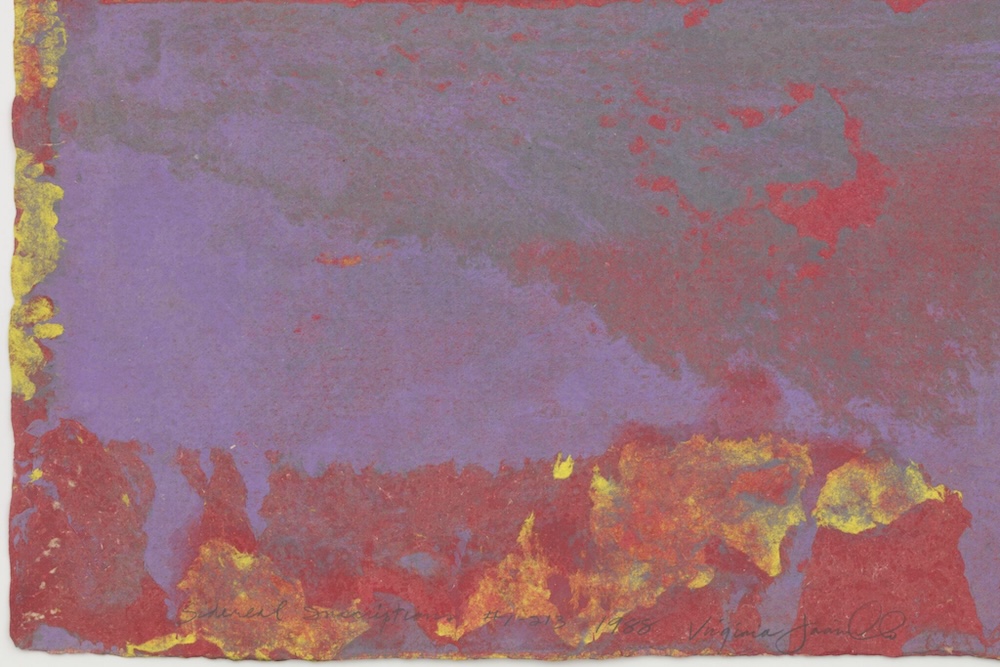
At a moment when the United States marks 250 years since the signing of the Declaration of Independence, Abstraction as Legacy turns to painting as a way of reconsidering how American history has also been shaped through visual experimentation.
Presented by the Museum of Art and Design (MOAD) at Miami Dade College, the exhibition brings together several generations of artists whose work demonstrates that abstraction is not a single movement or aesthetic language, but a continually evolving field of cultural, formal, and personal inquiry.
While figurative painting has long played a central role in documenting historical figures and events, abstraction offers another way of recording experience. Through color, geometry, gesture, material, rhythm, and spatial tension, artists have addressed subjects ranging from the body and landscape to architecture, memory, emotion, and identity.
The exhibition traces some of the many directions abstraction has taken in the United States since the mid-twentieth century, a period when American art increasingly became central to international debates surrounding modernism and experimentation. Rather than presenting a singular history, Abstraction as Legacy emphasizes the plurality of those developments.
The exhibition also expands the conventional geography of American abstraction. Alongside artistic experimentation emerging from centers such as New York and Los Angeles, it acknowledges ideas and visual languages that traveled through migration, exile, and cultural exchange, including practices connected to Cuba, Latin America, Indigenous experience, and diasporic histories.
Featured artists include Young-Il Ahn, Sam Gilliam, Carmen Herrera, Hans Hofmann, Virginia Jaramillo, Lloyd Kiva New, Willem de Kooning, George Morrison, Noemí Ruiz, Zilia Sánchez, and Vaughn Spann.
Seen together, their works reveal abstraction as both inheritance and reinvention. Hard-edged geometry exists beside expressive gesture; disciplined structures coexist with intuitive marks; color can function as atmosphere, architecture, psychological space, or cultural memory.
The exhibition’s title therefore carries a dual meaning. “Legacy” refers not only to the history of abstraction already established in the United States, but also to the possibility that artistic languages are continuously transmitted, questioned, transformed, and redefined by subsequent generations.
Within the context of the nation’s 250th anniversary, Abstraction as Legacy offers an alternative way to think about American history. Rather than focusing solely on political events or recognizable historical imagery, the exhibition considers artistic innovation itself as part of the country’s cultural record.
Abstraction becomes, in this sense, a form of historical evidence: not a literal document of events, but a record of changing perceptions, identities, migrations, materials, and ways of seeing.
Abstraction as Legacy
Museum of Art and Design (MOAD) at Miami Dade College
Freedom Tower
600 Biscayne Blvd, Miami, Florida
September 30 | 10:00 a.m.–6:00 p.m.
Image: Virginia Jaramillo, Sidereal Inscriptions #1-213, 1988. Linen fiber with hand-ground earth pigments on paper. Courtesy of the artist and Hales Gallery.