Fharid LaTorre: Fracture, Containment, and the Anatomy of Transformation
Fharid LaTorre’s sculptural practice begins at a point of instability. Bodies fracture, structures restrain, materials imitate anatomy, and objects appear caught between function and obsolescence. Rather than treating rupture as an endpoint, LaTorre approaches it as a condition through which transformation can occur—a space where injury, healing, regeneration, control, and vulnerability coexist.
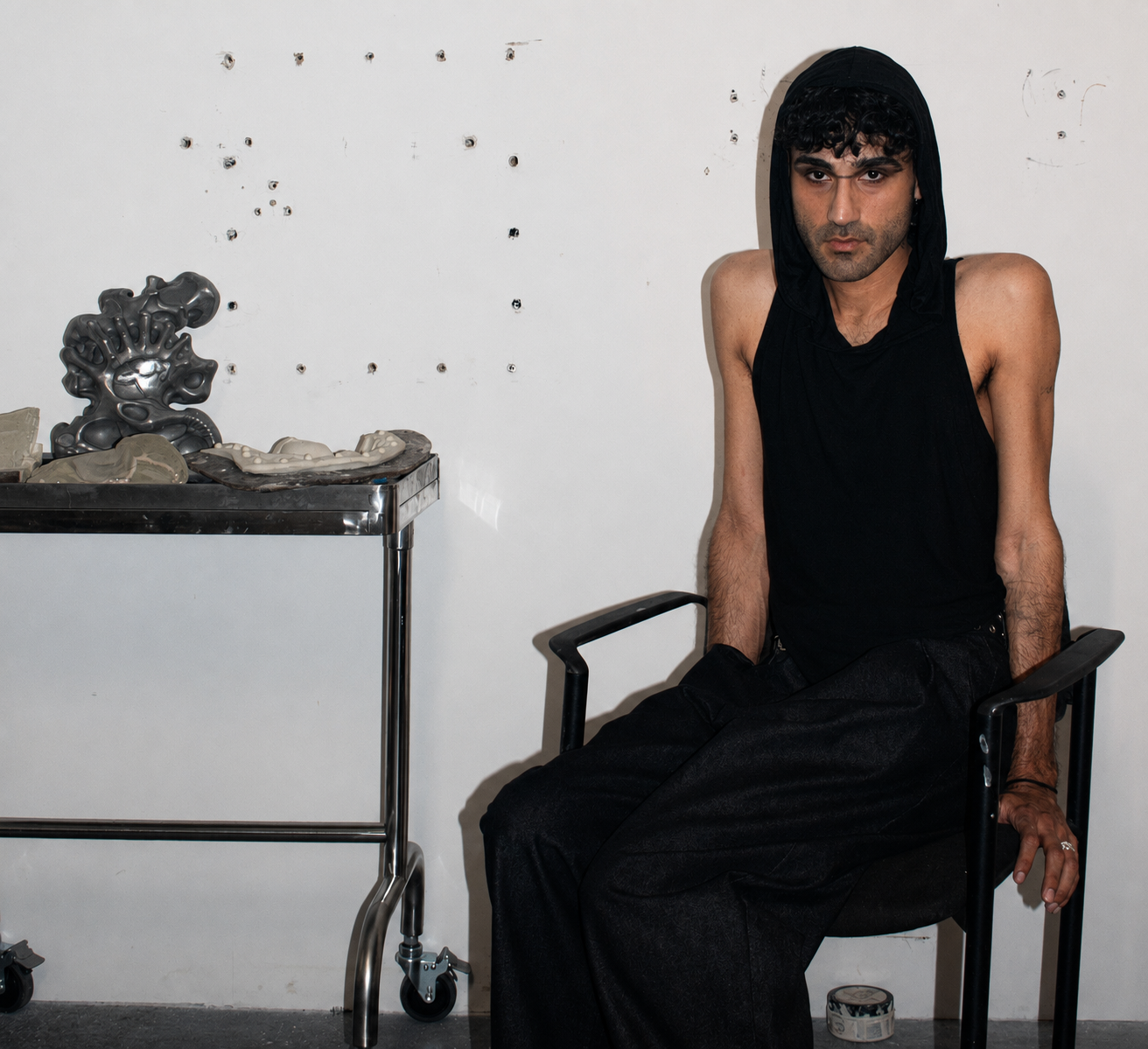
Born in Miami in 1999 and raised in Weston, South Florida, LaTorre pursued art from an early stage of his education. He attended American Heritage School before transferring to DASH in Miami for his final two years of high school. He later received a Presidential Scholarship to The Cooper Union, where he earned his BFA in 2022. He was also recognized as a 2018 YoungArts Winner in Visual Arts. Today, he is based in Miami and works primarily in sculpture.
What distinguishes LaTorre’s work is not simply its material vocabulary, but the psychological tension embedded within it. His sculptures frequently resemble fragments of skeletal systems, prosthetic devices, restraints, tools, medical equipment, or industrial mechanisms whose original purposes are impossible to determine. They appear familiar without becoming fully identifiable.
That uncertainty is essential.
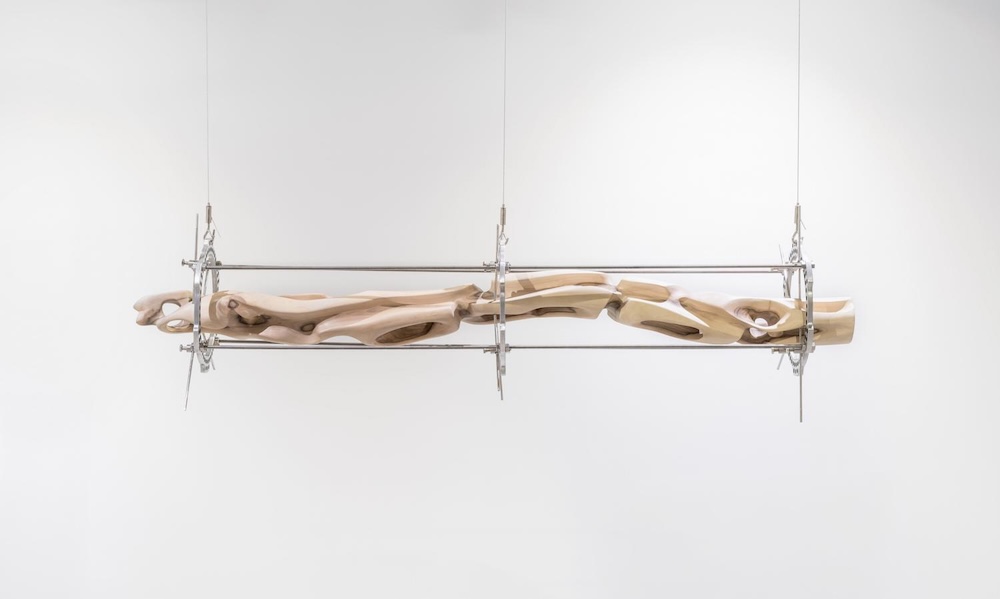
Between the Body and the Machine
LaTorre’s sculptures occupy an unstable territory between the anatomical and the engineered. Bone-like structures coexist with cold-cast metals, hand-carved wood, resin, and industrial hardware. The resulting objects can appear simultaneously excavated and fabricated—as though they belonged equally to a biological organism, a medical archive, and an unknown technological system.
The body is therefore present even when a recognizable human figure is absent.
A curved structure can suggest bone. A fastening mechanism may resemble a brace. A suspended element may evoke restraint. Connections between separate components can recall joints, prostheses, or systems designed to stabilize damaged anatomy.
Yet LaTorre does not simply reproduce medical objects. Instead, he borrows their visual and structural logic to investigate a more complicated relationship between care and control.
A device designed to heal can also restrain.
A structure that stabilizes can immobilize.
A mechanism intended to protect may simultaneously exert pressure on the thing it protects.
This ambiguity allows the sculptures to move beyond literal anatomy and toward psychological questions about dependency, vulnerability, authority, and bodily autonomy.
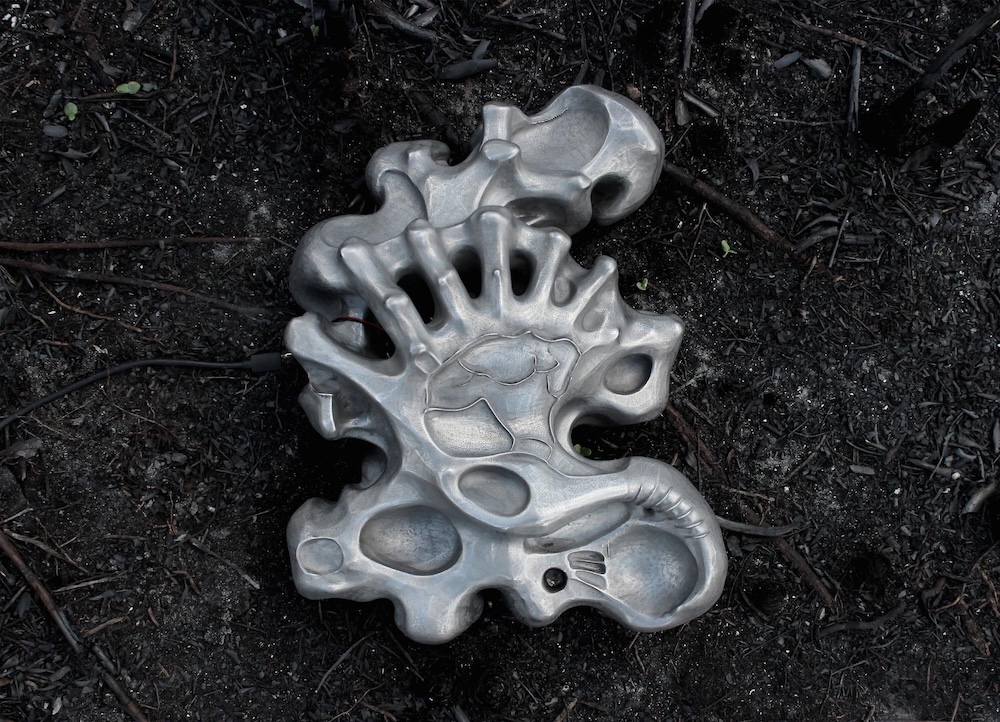
Bramble bees somewhat PARASITIC
twisted ovipositor
very
velvety
Feeble clothing which HUMBLE Fig stings, 2026
Cast stainless steel, Formic acid trace (ant defense compound), Mangrove bark hydrosol (steam-distilled), Saliva, Ultrasound
10 x 12 x 6 in
The Moment of Fracture
LaTorre describes his practice in relation to the beginning point of fracturing—a condition in which rupture, healing, and regeneration exist simultaneously. His work also examines moments of capture and what he characterizes as “(non)consensual illusions” that stabilize them. Material structures informed by medical and industrial systems suggest altered anatomical responses and transformations that may occur beyond individual control.
This makes fracture more than physical damage.
Within LaTorre’s practice, fracture can be understood as a threshold.
Something has ceased to exist in its previous state, but its next form has not yet been determined.
His sculptures inhabit precisely this interval.
They rarely communicate complete destruction, but neither do they offer complete restoration. Instead, they remain suspended within states of repair, adaptation, breakdown, restraint, and possible regeneration.
The absence of resolution becomes part of their meaning.
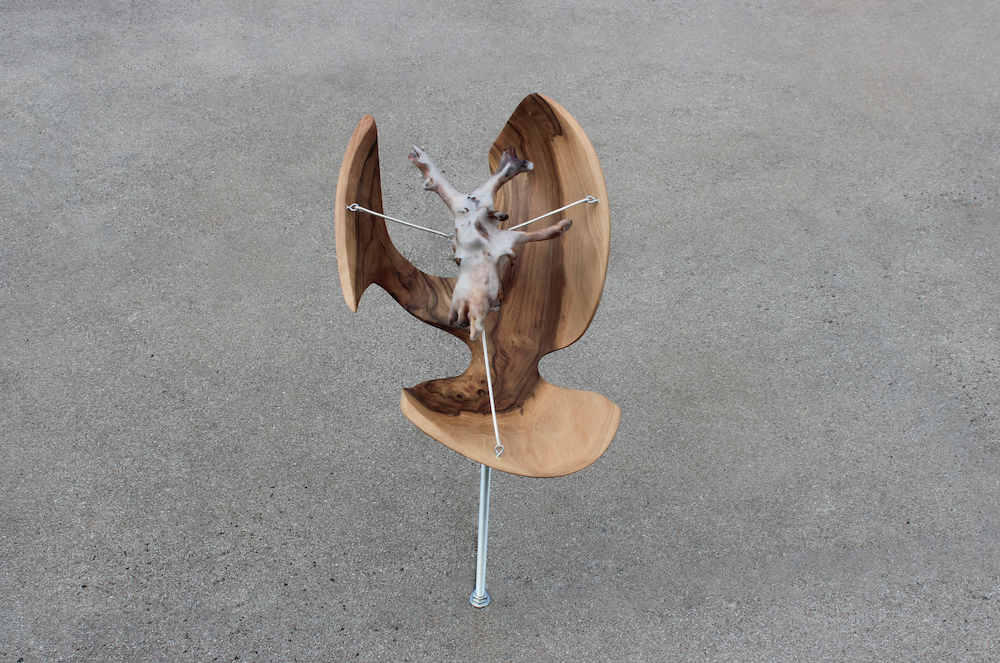
petrified wood, wax, oak, silver
10 x 6 x 22 in
Pressure as Material and Psychological Condition
Another recurring idea in LaTorre’s practice is pressure.
His fragmented structures often resemble restraints, prosthetics, or industrial remnants, allowing pressure to function simultaneously as a physical sculptural force and as a metaphor for embodiment. Failure may become visible through traces, tension, deformation, or structural breakdown.
This relationship between physical and psychological pressure is particularly compelling.
Material can bend.
A structure can collapse.
A joint can fail.
A body can adapt.
Psychological experience can produce analogous conditions: containment, endurance, resistance, breakdown, recovery.
LaTorre does not need to illustrate these states directly. Instead, the physical behavior of his materials provides their vocabulary.
The sculpture becomes a site where material strain and human vulnerability can be considered together.
Evidence of Evolution
These concerns are central to Evidence of Evolution, an exhibition presented by QUEUE Gallery featuring LaTorre’s work.
The exhibition brings together questions of nostalgia and progression, body modification and customization, contradiction and ambiguity, fragmentation and dismemberment. Significantly, its conceptual framework also considers the artist as occupying the position of both perpetrator and victim—someone capable of imposing precision and control upon materials while simultaneously investigating systems in which bodies and individuals are themselves subjected to external forces.
That duality is important.
The sculptor cuts, binds, suspends, reshapes, contains, and assembles.
These gestures give LaTorre enormous authority over the object.
Yet many of the resulting forms evoke bodies subjected to exactly those operations.
The artist therefore occupies an unstable ethical position within the work: simultaneously the one who constructs the system and the one imagining what it means to exist inside it.
This tension complicates any easy division between violence and healing.
A surgical intervention damages the body in order to repair it.
A brace restricts movement in order to facilitate recovery.
A structure may constrain something precisely because it is attempting to preserve it.
LaTorre’s sculptures inhabit these contradictions rather than resolving them.
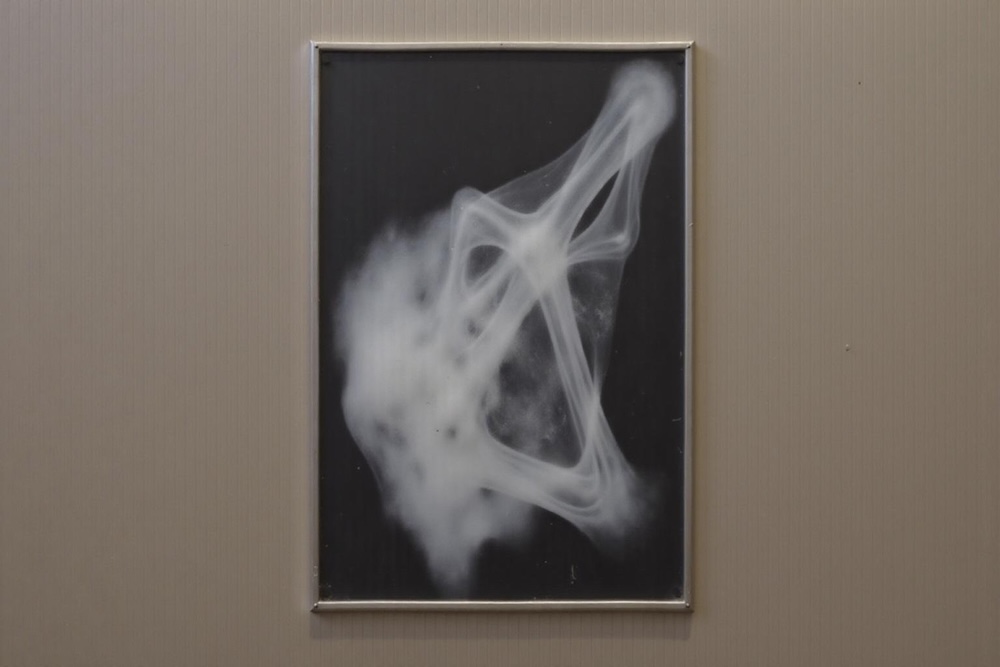
altered photogram
16 x 9 in
Care, Restraint, and Institutional Authority
The way LaTorre presents objects also contributes to their meaning.
His display strategies draw upon clinical and archival aesthetics. Sculptures may appear preserved, stabilized, suspended, or examined, creating associations with laboratories, medical collections, museums, and institutional systems of classification.
This introduces another question: What happens to an object when an institution determines how it should be seen?
The pedestal becomes particularly significant.
Traditionally, the pedestal elevates and protects an artwork. It separates the valued object from ordinary space and identifies it as something worthy of contemplation.
But LaTorre’s work allows another interpretation.
Can preservation become containment?
Can protection become objectification?
Can the structure that grants an object visibility simultaneously control how that object is understood?
The source material surrounding his practice explicitly raises this ambiguity, asking whether the pedestal functions as protection or objectification. His sculptures resist providing a final answer, maintaining transformation, vulnerability, and control as simultaneous conditions.
Bodies Within Larger Systems
Although LaTorre’s forms frequently evoke individual anatomy, his concerns extend beyond the isolated body.
His statement connects bodily mutation with larger infrastructures of extraction and circulation that enter human existence at both massive and molecular scales.
The implication is significant: the body is never entirely autonomous.
It exists within medical systems, technological systems, industrial systems, economic systems, and infrastructures whose operations may be difficult for an individual to perceive or control.
LaTorre’s sculptures can therefore be read as hybrid bodies shaped by environments larger than themselves.
Their industrial components are not simply aesthetic choices. They allow biological and mechanical vocabularies to intersect, suggesting a contemporary condition in which distinctions between organism, device, infrastructure, repair, modification, and technology increasingly overlap.
Residual Function
Many of LaTorre’s sculptures resemble tools whose functions have disappeared.
They look as though they should do something.
Yet what they might once have done—or what they could possibly do now—remains uncertain.
This idea of residual function is central to his practice.
An obsolete object does not necessarily become meaningless when it loses its usefulness.
Instead, function can survive as a kind of memory.
A handle still suggests holding.
A clamp suggests pressure.
A brace suggests support.
A mechanism suggests operation.
Even when the actual purpose disappears, the visual memory of purpose remains.
LaTorre exploits this recognition. The viewer senses usefulness without being able to identify use, producing a psychological tension between familiarity and uncertainty.
The sculptures consequently seem to come from both past and future: remnants of something abandoned and prototypes for something that has not yet been invented.
Transformation Without Resolution
Contemporary culture is marked by an extraordinary circulation of images, information, products, technologies, and models of identity. The curatorial framework of Evidence of Evolution places LaTorre’s work within this environment, where artistic production occurs amid an almost inexhaustible availability of preexisting images and consumable information. Against this condition, his sculptures create a space for considering how transformation itself occurs.
That may ultimately be one of the strongest aspects of Fharid LaTorre’s emerging practice.
He does not present transformation as improvement.
Nor does he treat destruction simply as loss.
Instead, transformation remains ambiguous.
Something breaks and something else becomes possible.
Something is repaired, but the evidence of damage remains.
Something is protected, but protection requires restraint.
Something is preserved, but preservation may transform it into an object of examination.
His sculptures hold these opposing conditions together.
They exist between bone and scaffold, organism and machine, healing and injury, containment and collapse, care and control, past function and future possibility.
LaTorre’s work therefore asks us to consider a difficult question: when a body, object, or system changes under pressure, where does destruction end and evolution begin?
His sculptures offer no definitive answer.
Instead, they remain in that unresolved space—the precise point at which fracture becomes transformation.