Eunice Napanangka Jack — Painting Country, Memory, and Tjukurrpa
Aboriginal Artist
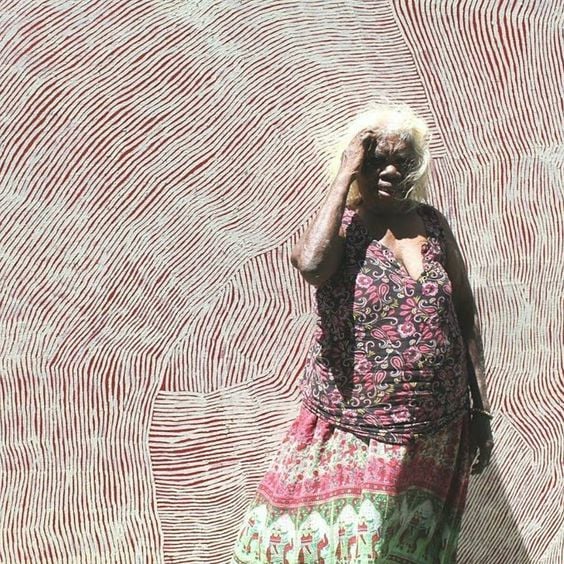
Eunice Napanangka Jack stands as a vital figure within the history and ongoing evolution of Central Australian Aboriginal art. Born in 1940 at Lupul, near Tjukurla in Western Australia, her life and work are inseparable from the profound cultural, environmental, and historical transformations that shaped the Western Desert during the mid-20th century.
From Movement Across Country to Settlement
Eunice’s early life reflects a pivotal moment in Aboriginal history. During a period of severe drought, her family undertook a long journey eastward across the desert toward ration stations established by colonial authorities. This movement culminated in their settlement at Haasts Bluff, where Eunice grew up.
This displacement—both physical and cultural—remains central to her work. Her paintings are not nostalgic reconstructions, but active re-inscriptions of memory and belonging, grounded in places she continues to hold in thought and story, even when physically distant. As she recalls, her birthplace at Kuruyultu remains a site she “thinks about every day,” revealing the enduring relationship between identity and land.
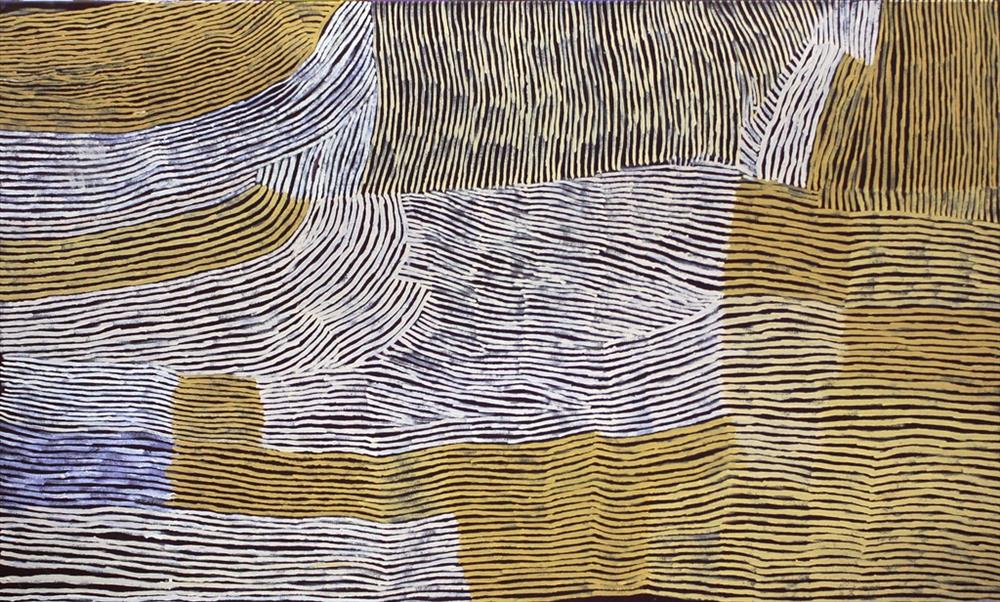
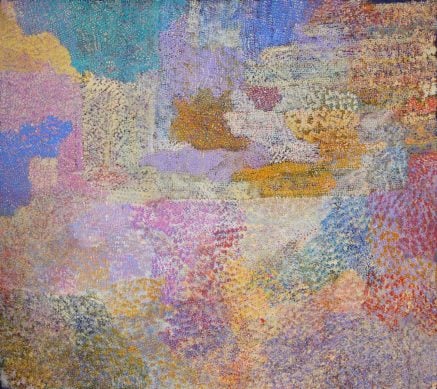
92 x 151cm Acrylic on Linen.
The Central Desert Art Movement
Eunice’s artistic trajectory is deeply embedded in the development of the Central Desert art movement that emerged in the early 1970s. Her father, Tutuma Tjapangarti, was among the first generation of artists painting at Papunya—participants in what would become one of the most significant artistic movements of the 20th century.
Her connection to this movement was initially indirect yet formative. She assisted her husband, Gideon Tjupurrula Jack, with his paintings for Papunya Tula Artists during the 1970s. This period of collaboration situates her within the foundational structures of Western Desert painting, even before she began her own independent practice.
It was not until 1992, with the establishment of the Ikuntji Women’s Centre at Haasts Bluff, that Eunice, alongside other women, began producing her own paintings. This moment marks a critical shift—not only in her career but in the broader recognition of women’s voices within Aboriginal art, expanding the narrative beyond the earlier male-dominated Papunya movement.
Painting Tjukurrpa and Country
At the core of Eunice Napanangka Jack’s work lies the concept of Tjukurrpa—often translated as Dreaming, but more accurately understood as a complex system of law, knowledge, and cosmology that connects people to land, ancestry, and time.
Her paintings draw from both her maternal and paternal heritage:
- From her mother’s Warlpiri country near Lake MacKay, she interprets desert sandhills, bush foods, and plant life
- From her father’s side, she carries stories of places such as Lupul, Tjukurla, Kurulto, and Tjila
These works are not representations in a Western sense. They are topographical, spiritual, and mnemonic mappings—visual systems that encode knowledge of land, survival, and cultural continuity.
The recurring motifs—sandhills, vegetation, pathways—function as both abstraction and narrative. They are at once formal compositions and embodied knowledge systems, where pattern becomes a vehicle for transmitting cultural memory.
Abstraction Beyond the Western Canon
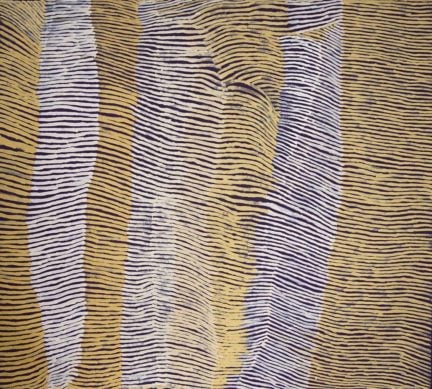
From a critical perspective, Eunice’s work challenges the conventional boundaries of abstraction. While her paintings may appear formally aligned with geometric or gestural abstraction, their meaning is not derived from formal experimentation alone.
Instead, they operate within a different epistemological framework:
- abstraction as cultural encoding
- pattern as knowledge transmission
- repetition as ritual and continuity
This positions her work outside the lineage of Western modernism, even as it intersects visually with it. Her paintings do not reduce the world; they hold it together.
92 x 151cm Acrylic on Linen.
Community, Knowledge, and Continuity
Beyond her artistic production, Eunice remains an important cultural figure within her community. Her role extends into the transmission of knowledge—sharing traditional bush skills, stories, and cultural practices with younger generations.
In this sense, her practice is not confined to the canvas. It exists as part of a broader system of cultural continuity, where art, life, and knowledge are inseparable.
Conclusion: Painting as Presence
Eunice Napanangka Jack’s work is not about representation—it is about presence. It affirms a relationship to Country that persists despite displacement, change, and time.
Her paintings are acts of remembering, mapping, and sustaining. They do not simply depict land; they activate it, holding within their surfaces the stories, movements, and knowledge of generations.
In the context of contemporary art, her work reminds us that abstraction is not a universal language—it is a plural condition, shaped by culture, history, and lived experience.
Through her practice, painting becomes not only an image, but a continuing connection to Country, to memory, and to the enduring structure of Tjukurrpa.
Eunice Napanangka Jack is a senior Ngaanyatjarra artist working at Haasts Bluff in Central Australia. Eunice was born in 1940 at Lupul near Tjukurla in Western Australia near the border with Northern Territory. Her family walked across the desert towards the east where ration stations had been set up during a period of serious drought in the Central Desert. They stayed at the community at Haasts Bluff and Eunice grew up there.
Eunice Napanangka Jack has had a long association with the art movement that began in the Central Desert in the early 1970s. Her father Tutuma Tjapangarti, was one of the early artists painting in the Men’s group at Papunya. Then Eunice helped her husband Gideon Tjupurrula Jack with his paintings for Papunya Tula during the 1970s. Eunice began creating her own paintings in 1992 when the the Ikuntji Women’s Centre opened and many of the women started their own careers as major artists there.
Eunice’s mother was from the Warlpiri country east of Lake MacKay at Winparrku, and many of the stories that Eunice paints come from her mother’s side of the country. Often these are interpretations of the desert sandhills and the bush flowers and plants that were part of the native food resources of the land. Eunice shares these stories along with stories of the Country she inherits on her father’s side, including Lupul, Tjukurla, Kurulto and Tjila.
Eunice describes her early life in this way: “I was born at Kuruyultu, near the rockhole there… We left that place, Kuruyultu. My father, my mother, my big sister and my father’s brother, we all left together and went to Haasts Bluff. I grew up in Haasts Bluff. I have been back to Kuruyultu for visits but I never lived there again in my country. I think about it every day.”
Eunice continues to record the Tjukurrpa, the Country and the memories of her traditional lands. Her artworks are held in major collections in Australia and internationally. Eunice Jack remains an important figure in her community, sharing cultural knowledge and traditional bush skills, as well as her painting and story-telling.
COLLECTIONS
- National Gallery of Victoria, Melbourne
- Museum and Art Gallery of Northern Territory, Darwin
- Flinders University, Adelaide
- Supreme Court of the Northern Territory, Darwin
- Department of Prime Minister and Cabinet Art Collection, Canberra, ACT
- Bailleau Myer, de Young Museum, San Francisco, USA
- Thomas Vroom-Sammlung, Amsterdam, NL
- Ganter Myer Collection, Fine Arts Museum, San Francisco, USA
- Campbelltown Regional Gallery, Campbelltown, NSW
- University of Tasmania, Hobart
- Moreton Bay Region Art Collection, Caboolture, QLD
- Gabrielle Pizzi Collection, Melbourne