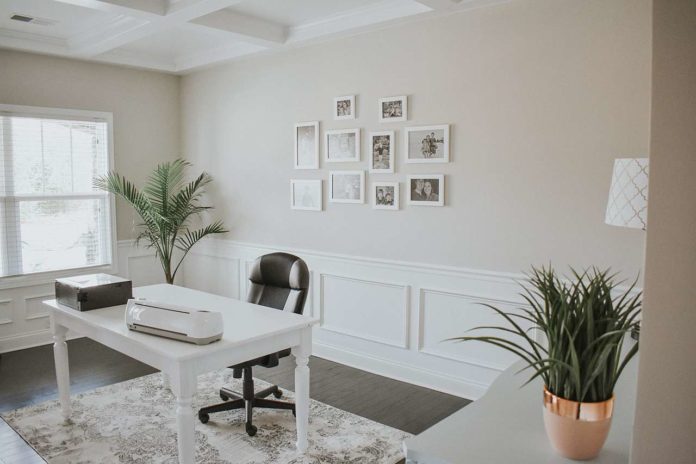
What’s your style? Most people have distinct preferences when it comes to their home surroundings. Paint color, furnishings, art and decor all work together to create various ambiences that we gravitate toward. Of course our choices can change over time, or we can blend in other “flavors” to mix things up. As creative people, that’s to be expected!
Let’s take a peek at four popular interior designs, along with frames that work well with each. After all, the artwork and photography on our walls and shelves should fit seamlessly into the atmosphere we’re going for.
Mid-Century Modern
If we looked around your living room and saw sofas with tapers legs, wingback chairs and an art deco lamp, we might get the impression you’re into Mid-Century Modern design. This style became popular in the 1940s and we’re still enamored with the high-function minimalism, organic shapes and retro vibe. You’re free to come on strong with bold colors and quirky accessories with this style.
Frame the look.If you’re looking to frame 1960s pop art, a colorful vintage travel poster or geometric shapes like starbursts, consider the brightly saturated Nielsen Profile 117V Metal Frames in a variety of colors, or a “Stainless Steel” Wood Frame for a softer complement to vibrant art.
Coastal
Peaceful and pretty, Coastal design transports us to the beach via chic seaside touches. Not to be confused with nautical interior design—which can quickly drift into kitschy with anchor, shell and fish visuals—Coastal design is more subtle. Think turquoise glass, seagrass rugs, earth-toned pottery or statement driftwood or rope pieces. Calming neutral colors are often balanced with one or two vivid hues, and don’t feel limited to blue and aqua. Palm-tree greens, coral pinks and sunset orange can fit in nicely to your Coastal decor.
Frame the look. Lighter wood frames like a White Wood Frame or a natural wood-grain Wood Frame Profile 547 to help complete your seaside retreat. Frame Destination makes it easy to either customize or narrow down your options for a standard-size frame.
Contemporary
If you appreciate simplicity, uncluttered spaces, clean lines (straight or flowy), you probably lean toward contemporary design. This approach places emphasis on open space rather than objects for a streamlined look. Black, white and neutrals are often the stars in a contemporary palette—although the long-favored neutral gray is said to be going out of style with the new decade. Some experts report that navy is the new gray, with other bold, dark colors replacing neutrals. (This makes sense considering Pantone’s Color of the Year is Classic Blue.)
Frame the look. When it comes to framing your artwork, Black Wood Frames, Wood Frame Profile 311 (burled wood with bright color options and a satin or glossy finish), and Nielsen Profile 117V Metal Frames in assorted bright colors all really pop in a contemporary-style home.
Modern Farmhouse
Fans of the HGTV show “Fixer Upper” can spot the Modern Farmhouse look from a mile away. The program’s star couple, Chip and Joanna Gaines, have earned their fame and fortune creating rustic-yet-modern feel to home spaces. Here you see design elements like distressed woods, vintage treasures, apron sinks, and a whitewashed palette. What takes an interior from comfortable Farmhouse to the more sophisticated Modern Farmhouse are elements like metal accents and rich hues that stand out against a creamy backdrop.
Frame the look. Wood frames do a great job of securing the warm feel of a Modern Farmhouse style home. Especially wood frames in lighter colors like the Wood Frame Profile 547 in a range of neutrals, or drustic-meets-modern Wood Frame Profile 703 . The sheen of this White Metal Frame P117 can also work to balance the prevalence of wood.
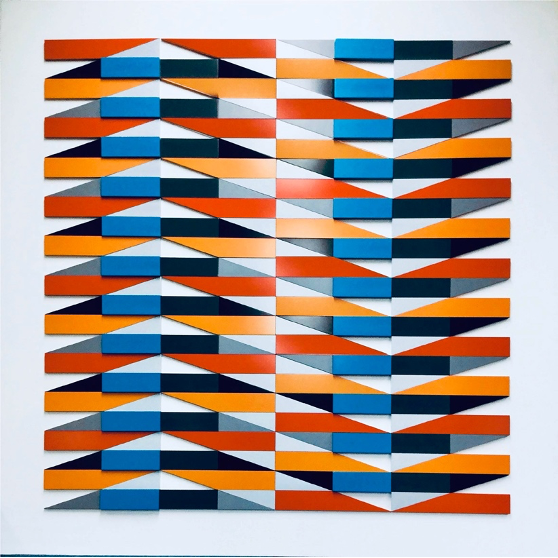
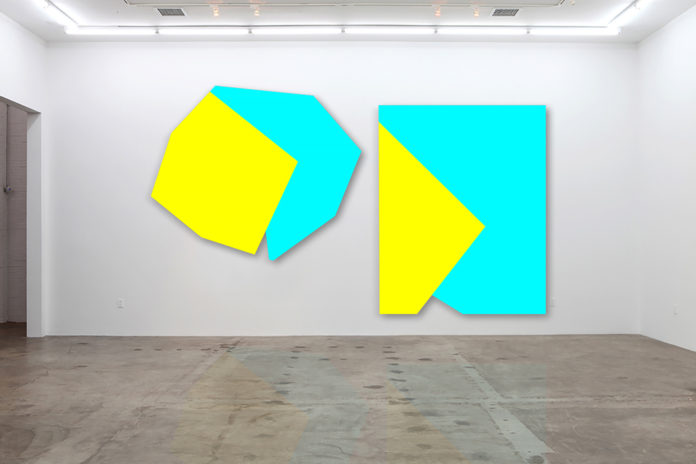
Wuilfredo Soto Opticolor No.4, 2014 Acrilyc on PVC
Wuilfredo Soto and the Interrelation in Series of Lines
By Lieska Husband Sosa February 15 th , 2020
Movement, perception, and optical illusion, are the three concepts connected in Wuilfredo Sotos’s artwork. Rhythmic variations of a Latin America geometric tradition that has always endured in the collective memory but with the imprint of new times. Born in the context where abstract language becomes omnipresent, his references to Jesus Soto and Carlos Cruz-Diez mark the imprint of his work under the reinterpretation of line, shape and color. The theme is not new but the way of interpreting is. The artist, a studious and tireless researcher, tells me about his tastes for Russian Constructivism of the early 20 TH century, the exalted colorful of Gauguin and much closer in time the interaction of color according to Josef Albers; the Kinetic Art of the 50’s with the versatility of Jesus Soto, the vibrancy of Cruz-Diez, the optical illusion of Le Parc and Vasarely or the industrial design of Neal Small in the 70’s. All those sources nourish a work that retakes, reinterprets and makes concepts and legacies of its own. Wuilfredo Soto’s artwork runs with equal skill between the two or three-dimensionality where the apparent simplicity of lines in some cases, joins a formal minimalism with impeccable assembly. His series rhythmic compositions sometimes accentuated by a polychrome charged with light, are an ode to movement.
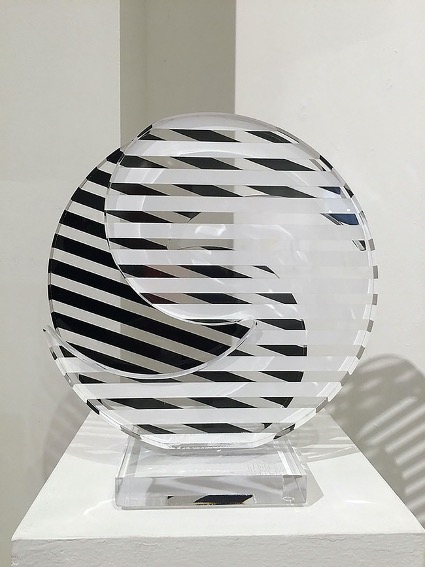
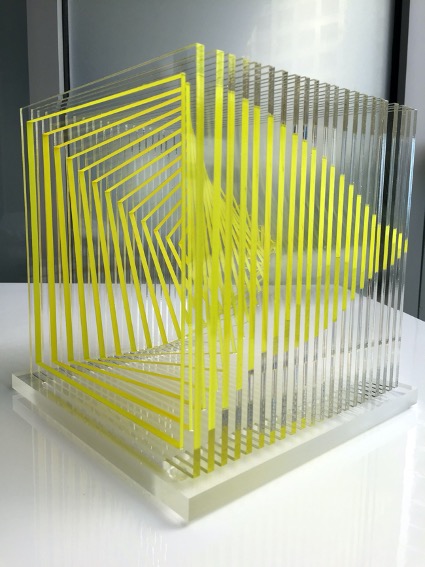
Wuilfredo Soto Infinity in Yellow, 2015 Laser cut painted acrylic
Soto is an artist of his time and the use of materials combined with technology, are sources that when used it an ingenious way, result in a coherent body of work based on the premise of study and research. The use of laser and CNC router as cutting tools in soft and rigid materials, allows him to model parts in two and three dimensions with the help of the computer as a working instrument. It is a process of creation with millimeter precision in which the cuts and cavities in wood, MDF, acrylic or expanded PVC, as well as in aluminum or stainless steel, gives shape to the piece that will later be lacquered ‒if necessary‒ and assembled by hand. It is almost a magical way of sculpting the material. Geometry and mathematics play predominant role In Wuilfredo Soto’s serial structures. His work lies beneath the aesthetic of the scientific and the rationally structured. Both, chromatic interaction with mathematical precision, stimulate the contemplative game of the
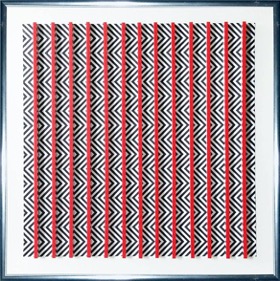
Wuilfredo Soto Lineal Distorsion in Red 2015 Mixed Media
spectator, who perceives movements, vibrations or deviations in a static body of art. Infinite creative possibilities are born from the interrelation of these lines arranged on the material’s surface. In some of these pieces, the translucency of the material (Plexiglas or acrylic) adds another way of interpreting or visualizing the experience. For instance, in three- dimensional artworks the artist superimposes acrylic sheets in which he draws with laser, geometrical structures arranged in a specific order and embedded in calibrated acrylic base, creating volumes with voids toward the interior of the piece that can be observed through of the different layers of the material. Wuilfredo Soto has been able to look into the vast field of the abstraction with a visual proposal that runs between research and creative process calculated to the millimeter. Noting is left to chance. He is a studious of the movement of each of the elements that make up his work and from the dimension of color, adds chromatic harmony. The viewer then, enjoys picking up the artistic fact from his own interpretation, immersing himself in a playful, colorful and dynamic adventure. Note: Images at www.wuilfredosoto.com
Wuilfredo Soto Infinity in Yellow, 2015 Laser cut painted acrylic
Wuilfredo Soto Opticolor No.4, 2014 Acrilyc on PVC
Wuilfredo Soto. La Interrelación en Serialidad de Líneas
Por Lieska Husband Sosa February 15 th , 2020
Movimiento, percepción e ilusión óptica, tres conceptos que se conectan en la obra de Wuilfredo Soto (Caracas, 1961). Variaciones rítmicas de una tradición geométrica latinoamericana que perdura desde siempre en la memoria colectiva, pero con la impronta de nuevos tiempos. Habiendo nacido en el contexto donde el lenguaje abstracto se hace omnipresente, sus referencias a Jesús Soto y Carlos Cruz-Diez marcan la impronta de su trabajo bajo la reinterpretación de línea, forma y color. Lo novedoso no es el tema, sino la manera de interpretarlo. El artista, estudioso e investigador incansable, me comenta sus gustos por el constructivismo ruso de principios del s. XX, el colorido exaltado de Gauguin y mucho más cercano en el tiempo, la interacción del color según Josef Albers; el cinetismo de los 50’s con la versatilidad de Jesús Soto, la vibración de Cruz Diez, la ilusión óptica de LeParc y Vasarely, o el diseño de Neal Small, en los 70’s. Todas, fuentes que nutren una obra que retoma, reinterpreta y hace suyos conceptos y legados.
La obra de Wuilfredo Soto discurre con igual destreza entre lo bidimensional y la tridimensionalidad, donde la aparente simplicidad de líneas en algunos casos, se une a un minimalismo formal con impecable ensamblaje. Sus composiciones rítmicas seriadas, acentuadas a veces por una policromía cargada de luz, son una oda al movimiento. Soto es un artista de su tiempo y el empleo de materiales aunado a la tecnología, son recursos que aprovechados de manera ingeniosa dan como resultado un cuerpo de trabajo coherente, sobre la premisa del estudio y la investigación. El uso del láser y el CNC router como herramientas de corte en materiales blandos y rígidos, le permite modelar piezas en 2 y 3 dimensiones con la ayuda de la computadora como instrumento de trabajo. Es un proceso de creación con precisión milimétrica en el que los cortes y oquedades en maderas, mdf, acrílicos o pvc expandido, así como en aluminio o acero inoxidable, van dando forma a la pieza que luego será laqueada —si fuese el caso— y ensamblada a mano. Una manera casi mágica de esculpir el material. En las estructuras seriadas de Wuilfredo Soto, la geometría y las matemáticas juegan un papel predominante. Su trabajo subyace en la estética de lo científico, lo racionalmente estructurado. La interacción cromática unida a la precisión matemática estimula el juego contemplativo del espectador, que percibe movimientos, vibraciones o desviaciones en un cuerpo estático. Infinitas posibilidades creativas nacen de la interrelación de estas líneas dispuestas sobre la superficie del material. En algunas de estas piezas lo translucido del material (Plexiglas o acrílico) añade otra manera de interpretar y visualizar el hecho artístico. En el caso de obras tridimensionales, el artista superpone láminas acrílicas sobre las que dibuja estructuras geométricas con láser, dispuestas en un orden específico e incrustadas en una base acrílica calibrada, creando volúmenes con vacíos hacia el interior de la pieza que pueden ser observados a través de las diferentes capas del material.
Wuilfredo Soto Lineal Distorsion in Red 2015 Mixed Media
Wuilfredo Soto ha sabido profundizar en el vasto campo de lo abstracto con una propuesta plástica que discurre entre la investigación y un proceso creativo calculado milimétricamente. Nada queda al azar. Es un estudioso del movimiento de cada uno de los elementos que conforman su obra y desde la dimensión del color añade armonía cromática. El espectador disfruta entonces aprehender el hecho artístico desde su propia interpretación, sumergiéndose en una aventura lúdica, colorida y dinámica.
YouTube’s mission is to “give everyone a voice and show them the world.” If you’re looking for ways to make your content more inclusive and appeal to a broader audience, then you’re watching the right video! We’re going to cover tips on how your YouTube channel can help foster greater inclusion, and show you how your channel can be a force for good.
Hi, I’m Dr. Knatokie Ford, Founder and CEO of Fly Sci Enterprise — an education and media consulting firm focused on leveraging the power of storytelling to promote social change. I’ve partnered with YouTube to develop tools that build awareness about the importance of diverse representation, and help empower creators to produce more inclusive videos.
What I’ll dive into today comes from research from leading institutions as well as feedback we collected from quite a few top YouTube creators and partner organizations.
Before we jump in, it’s important to talk about the difference between diversity and inclusion. Diversity means different voices can be represented, but inclusion means all those different voices are actually being heard. It’s presence vs. power. Another way to think about the distinction is that diversity is inviting different people to a party, while inclusion is actually asking everyone to dance.
So let’s talk about The Opportunity here
On-screen representation in media is improving, but is not fully reflecting the diversity of the world. Ready for some stats!? In the U.S., women are 51% of the population, but only 36% of television broadcast leads. Multicultural people comprise 39% of the population, but just 22% of broadcast leads. Here’s another one, 20% percent of Americans between the ages of 18-34 identify as LGBTQ+, while they only represent 9% of primetime regulars. And one more, 13% of Americans have a disability, but only 2% are seen as primetime regulars on TV.
YouTube is different. Unlike traditional media, YouTube provides a forum for user generated videos. Therefore you as a creator have an opportunity to help address representation gaps.
Why should you care?
YouTube videos are highly consumed and tremendously powerful. It’s actually the most widely used online platform for U.S. adults and teens, and 41% of YouTube users are multicultural. Like other media, YouTube videos reflect and shape culture, and can influence the public’s perceptions of certain subjects, careers, and marginalized people. All media can either reinforce biases and stereotypes, or it can be a tool to help counter stereotypes and reduce biases.
Increasing diversity in media is not only good for society– it’s also good for business! In film, a more diverse cast can boost gross revenue. At every budget level, a film that has at least a 30% non-white cast outperforms less-diverse films in the opening weekend at the box office. It’s also worth noting that many of the most successful movies have appealed to diverse audiences.
So how can your YouTube channel(s) help foster greater inclusion?
It’s important to remember we all have unconscious bias, which can influence the people we choose to work with, the topics we cover and which perspectives we decide to include.
If you’re ready to explore how you can make your videos more inclusive and help level the playing field on YouTube, here are some questions you can ask yourself to get started:
Who’s on my team?
Diversity is a driver of innovation. Teams that have diverse perspectives are more creative and more innovative.
What topics are covered & what perspectives are included in my videos?
Start by looking at the type of videos that you’re making. Consider the topics that you discuss and the viewpoints that you include, especially those that may differ from your own.
What do people see when they visit my channel?
When thinking about what appears in a video– like talent, voiceovers and animations– is there diversity among the voices represented? We tend to default to what feels easiest, so decision making can be largely driven by convenience. Consider going beyond your usual circles and sources.
How do I engage & support other creators?
Think about how you can engage creators who have diverse perspectives and consider how your channel can support creators from underrepresented communities. Maybe do a collab!
How do I think about audiences when making my content?
Consider who’s tuning into your channel, and if your videos are truly welcoming a diverse audience.
Ok, I know I just gave you a lot. A lot of questions and stats. But this is a great opportunity to use your own channel to increase inclusion.
We’ll cover more in the Creator Academy lesson linked in the description. Questions? Let us know in the comments.
Las obras de arte son un producto de las llamadas Bellas Artes.
¿Qué es una obra de arte?
Por una obra de arte u obra artística se entiende un objeto elaborado empleando técnicas artísticas y con un propósito estético o social. Es decir, se trata tradicionalmente del producto de las llamadas Bellas Artes: pintura, escultura, literatura, música, danza, teatro, cine, fotografía e historieta.
Sin embargo, no es sencillo definir una obra de arte, ni restringir el uso de esta expresión, que puede emplearse también para aludir metafóricamente a algo muy bien hecho, alguien muy hermoso o simplemente algo que nos gusta en demasía. Y esta dificultad se debe a que es también difícil definir el arte en sí.
De hecho, lo arbitrario del criterio respecto a lo que es o no es arte, hoy en día, es materia de debate y no existe un criterio único, científico. El arte es una construcción histórica y social, a la que se le atribuyen valores trascendentales de la civilización humana. Estos pueden ser de tipo histórico (documental), estético (técnico) o simbólico (social).
Tradicionalmente se supone que una obra de arte es un objeto que representa los valores universales más trascendentes de la humanidad, o que en todo caso conlleva una reflexión importante respecto a ellos. Pero no siempre se cumplen dichos criterios para todo el mundo por igual.
Los museos, como instituciones protectoras y seleccionadoras de lo artístico, pueden ser acusados de seguir un criterio ideológico, culturalista o de algún otro sesgo, así que su criterio tampoco habría de ser tenido por una verdad absoluta. Además, debido a su naturaleza, muchas obras artísticas no pueden ser guardadas en un museo.
Por otro lado, en la contemporaneidad la idea de obra artística ha estado sujeta a críticas y desconstrucción, a medida que el arte prolifera hacia variantes más imprevisibles y menos controlables, más modernas y atrevidas, menos vinculadas con la tradición histórica. Los museos de arte moderno, de hecho, suelen ser escenario de dicho debate, en torno a lo que puede o no ser considerado como una obra.
¿Para qué sirve una obra de arte?
Las obras de arte nos recuerdan cuánto ignoramos del mundo y de nosotros mismos.
La respuesta más simple a esta pregunta es: para nada. El arte no tiene una finalidad específica que cumplir, un rol o una utilidad. Puede ser empleado como decoración, como documento histórico o como exploración de las sensibilidades de una época, como quien intenta comprobar cuáles son las perspectivas personales más usuales en un período determinado.
Sin embargo, y por complejo que parezca, las obras de arte tienen un único y simple cometido: recordarnos quiénes somos y de dónde venimos, con quiénes vivimos en el mundo y cuánto sabemos y cuánto ignoramos de él, y de nosotros mismos.
Tipos de obras de arte
Podríamos clasificar las obras de arte según las técnicas empleadas para hacerlas:
Obras pictóricas. Fruto de la pintura y el dibujo o la ilustración.
Obras escultóricas. Producto de la escultura, abstracta o figurativa.
Obras musicales. Fruto de la composición musical y que pueden interpretarse por artistas con instrumentos musicales.
Obras literarias. Escritas por autores de literatura en sus géneros: poesía, ensayo, dramaturgia y narrativa.
Obras teatrales. Dirigidas y escenificadas por un director e interpretadas por actores, en base a un guión.
Obras cinematográficas. Las que son producidas por un equipo y filmadas en película fotosensible.
Obras escénicas. Producto de otras formas de arte visual que requieren un escenario.
Características de una obra de arte
Las obras de arte deben poder conservarse y exhibirse a generaciones venideras.
De nuevo, es difícil establecer las características comunes a toda obra de arte. Pero convengamos en que una obra maestra debería de ser:
Duradera. Debe poder conservarse y exhibirse a generaciones venideras.
Contextual. La obra no existe sin su contexto histórico y sin todo aquello que podemos decir sobre ella, pues todo eso es justamente lo que ella representa.
Simbólica. Las obras de arte no siempre contienen un mensaje explícito, sino que representan sentidos y significados, es decir, contienen mensajes implícitos que debemos aprender.
Valiosa. Su valor no es necesariamente mensurable en dinero o en bienes preciosos, sino que posee un valor cultural, pues se trata de un objeto irrepetible.
Original. No existen otras idénticas a la obra de arte, sino que se trata de algo único e irrepetible.
Lenguaje del arte
Se entiende por lenguaje artístico o lenguaje del arte aquel medio que una forma artística emplea para transmitir sus contenidos: la pintura y la escultura son eminentemente visuales, mientras que la cinematografía es audiovisual y la música meramente auditiva.
Se le llama lenguaje porque el arte existe sólo en la medida en que comunica un mensaje, incluso si ese mensaje no siempre está muy claro o es fácil de descifrar.
Última edición: 29 de noviembre de 2018. Cómo citar: “Obra de Arte”. Autor: María Estela Raffino. De: Argentina. Para: Concepto.de. Disponible en: https://concepto.de/obra-de-arte/. Consultado: 13 de julio de 2020.
Armando Reverón, (born May 10, 1889, Caracas, Venez.—died Sept. 18, 1954, Caracas), Venezuelan painter known for his impressionistic paintings of landscapes and nudes.
As a child, Reverón contracted typhoid fever. During his isolated recovery, he began to play with dolls, an activity that later proved to have a central influence on his art. He entered the Academy of Fine Arts of Caracas in 1908, when academic painting still dominated the curriculum. In 1911 he won a prize that enabled him to study in Barcelona and later Madrid, where he stayed until 1914. Before returning to Venezuela (1915), he briefly visited France and stopped again in Spain. During his European period, Reverón adopted the Post-Impressionist style that he would use throughout his life.
On his return to Venezuela, Reverón encountered a changing artistic scene. Several European artists were in residence, including Russian painter Nicolas Ferdinandov, whose dark palette and nocturnal imagery would influence Reverón. About this time Reverón began what is known as his “blue period,” for the blue tones that dominated his work as well as his intense use of light and shadow. In The Cave (1920) he depicted two seminude women almost engulfed in bluish darkness; only their exposed skin glows white in an otherwise dark and mysterious image. In 1921 he moved with his companion and model, Juanita Ríos, to the coastal city of Macuto, where he lived in primitive circumstances and began to build his fantastic home, El Castillete (“The Little Castle”).
In 1924 Reverón began his “white period,” during which he often painted the coastal landscape of Macuto bathed in harsh sunlight. In some works, such as White Landscape (1934), his imagery is almost completely abstract—bare white traces on an off-white ground. During this period he experimented with materials, sometimes painting in tempera on paper bags and on burlap sacks.
Mental illness, including schizophrenia, plagued Reverón throughout his life, and in 1933 he suffered a nervous breakdown. His “sepia period” began in 1935, and by 1937 he had begun to construct life-size adult dolls, which he named and used as models. Influenced by Francisco de Goya, he made a series of impressionistically rendered nudes he referred to as Majas, such as The Creole Maja (1939). In Self-Portrait with Dolls (1949) he painted himself, staring out at the viewer, in front of two of his dolls dressed as ballerinas with their arms held or tied above their heads.
Toward the end of his life, Reverón’s output declined with his mental and physical health. In 1953, the year he won Venezuela’s National Prize for Painting, he entered a sanatorium in Caracas, where he died the following year.
El 18 de febrero a las 7 pm se abrirá la exhibición MEXIPOP del artista mexicano @Pepe Mar en el Instituto Cultural de México en Miami !No te la pierdas!. Pepe Mar fusiona narrativas como la ciencia ficción, el diseño comercial, las redes sociales y el reciclaje para crear procesos que remiten a la pintura y al ensamblaje.
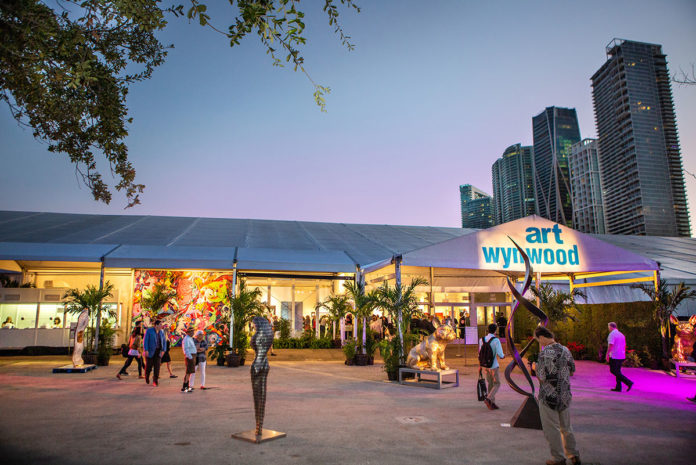
ART WYNWOOD ANNOUNCES NINTH EDITION WITH OVER 50 INTERNATIONAL GALLERIES PRESENTING WORLD-CLASS BLUE CHIP, MODERN AND CONTEMPORARY ARTWORK Presidents Day Weekend Thursday, February 13 – Monday, February 17, 2020 MIAMI, FL – (February 3, 2020) – Art Wynwood, the premier winter contemporary art fair produced by Art Miami, will return for its ninth edition at Herald Plaza on Biscayne Bay in Downtown Miami. The fair will open on Thursday, February 13th with a VIP Preview benefitting the Institute of Contemporary Art, Miami (ICA Miami) before opening to the public over Presidents Day Weekend – Friday, February 14th through Monday, February 17th, 2020. Since 2012, Art Wynwood has been South Florida’s leading destination for contemporary and modern art. The fair offers collectors the opportunity to acquire curated works from emerging talent in the contemporary market, mid-career artists, and blue-chip contemporary, post-war and modern masters and features an elevated array of murals, pop surrealism, street art and other genres. Additionally, for the second year, the world-renowned Miami Yacht Show will be adjacent to Art Wynwood. The in-water display of new and pre-owned vessels will showcase the most extraordinary and uniquely designed yachts and superyachts from the world’s foremost custom boat builders. Art Wynwood 2019 attracted key collectors, curators, art advisors, designers, and art aficionados from around the world. On the heels of the successful Art Miami and CONTEXT Art Miami fairs, Art Wynwood 2020 is expected to draw prominent attendees to the waterfront destination with a diverse selection of artwork presented by over 50 galleries from more than a dozen countries, including France, Canada, the Netherlands, England, Italy and the United States. Visitors can expect a collection of new exhibitors — Galleria Arte Martinelli will present a group of works by established international artists, including a 1964 water-paint on canvas by Lucio Fontana, an artist known for breaking through the two-dimensionality of the traditional picture plane. In addition, The Bonnier Gallery will present an exceptional collection, including “Section,” a 1985 piece by American artist Robert Ryman, and Cy Twombly’s 1952 piece, “Still Life With Doorknob.” Lelia Mordoch Gallery will present Jose Arellano (b.1977), a Miami-based sculptor who creates interactive visual semblances from museum board and xylene-based acrylic paint. Additional new exhibitors to look forward to include Pontone Gallery, Burgess Modern and Contemporary, Galerie Brésil, HOFA Gallery and Mark Borghi Fine Art among others. Art Wynwood’s highly anticipated 2020 edition is set to debut a mix of new special projects, ranging from modern to contemporary art, alongside the main section. Mark Borghi Fine Art will curate a special installation of works by Chakaia Booker in conjunction with a VIP Reception for ICA Board Members during the VIP Preview. Special project highlights include Pontone Gallery’s presentation of the sculptural work of Pablo Atchugarry in addition to works by Lee Lee Nam. ArtLabbé Gallery will present Amelia Campino, Ca’D’Oro will present David Datuna and Burgess Contemporary will showcase a series of paintings by Marcus Jansen. Additionally, Long-Sharp Gallery returns to Art Wynwood with a special presentation of rare hand drawings by Andy Warhol that has never been exhibited in the United States, a new monumental sculpture by artist Jason Myers and works from Picasso to Pop. PARTICIPATING GALLERIES Analog Contemporary, Philadelphia | Anthony Brunelli Fine Arts, Binghamton | Archeus / PostModern, London | ArtLabbé Gallery, Coral Gables | Avant Gallery, Miami | Bel Air Fine Art, locations worldwide | Blink Group Projects, Miami | BOCCARA ART, New York | Burgess Modern & Contemporary, Ft. Lauderdale | C Fine Art, New York | Cernuda Arte, Coral Gables | Clark Gallery, Lincoln, MA | Contemporary Art Projects USA, Miami Beach | Contessa Gallery, Palm Beach | Dane Fine Art, Philadelphia | Eternity Gallery, Miami | Evan Lurie Gallery, Carmel, IN | FREDERIC GOT, Paris | Galería Casa Cuadrada, Bogotá | Galerie Brésil, Sao Paulo | Galerie De Bellefeuille, Montreal | Galerie le Capricorne, Saint Paul de Vence | Galleria arte Martinelli, Lodi | Galleria Ca’ D’Oro, Miami | Galleria Stefano Forni, Bologna | Gallery AE, Seoul | Gallery Tableau, Seoul | Graeme Jackson, Boca Raton | HOFA Gallery, Los Angeles | Janus Gallery, New York | Jasa Fine Art, Miami | Latin Art Core, Miami | Laurent Marthaler Contemporary, Montreux | Lelia Mordoch Gallery, Paris | Liquid art system, Capri | Liz Clement Contemporary, New York | Long Sharp Gallery, Indianapolis | MAC Art, Ft Lauderdale | Mark Borghi, New York | Mark Hachem, Paris | Masterworks Fine Art Gallery, Oakland | Miami Art Society, Miami | ModArt Gallery, Miami | Modern Marvel, New York | Okay Spark, Norfolk | Oliver Cole Gallery, Miami | Peimbert Art Gallery, Los Angeles | Pontone Gallery, London | Projects Gallery, Miami | Robert Fontaine Gallery, Miami Beach | Sponder Gallery, Boca Raton | Super Buddha, Miami | The Bonnier Gallery, Miami | The Lawley Art Group, Dallas | Waltman Ortega Fine Art, Miami | Wanrooij Gallery, Amsterdam | Yuan Ru Gallery, Taipei IMAGES Download select high resolution images of the Fair and featured artworks here. 2020 VIP PREVIEW BENEFACTOR The INSTITUTE OF CONTEMPORARY ART, MIAMI (ICA MIAMI) is dedicated to promoting continuous experimentation in contemporary art, advancing new scholarships and fostering the exchange of art and ideas throughout the Miami region and internationally. Through an energetic calendar of exhibitions and programs, and its collection, ICA Miami provides an important international platform for the work of local, emerging, and under-recognized artists, and advances the public appreciation and understanding of the most innovative art of our time. The museum is deeply committed to providing open, public access to artistic excellence by offering year-round free admission. icamiami.org SPONSORSHIPS ● Artsy.net is the official online partner of Art Wynwood. Art enthusiasts can use Artsy to browse exhibitor booths, make inquiries on available art works and access fair information online via Artsy.net and the Artsy app for iPhone & iPad. Artsy’s exclusive online previews will launch in advance of the fair with a special first-look for press and VIPs. artsy.net ● JW Marriott Marquis Miami & Hotel Beaux Arts Miami – Official Luxury Hotels of Art Miami will both host special installations in their lobbies highlighting works from participating Art Wynwood galleries from around the world. ● ArtRageous Kids Center Organized by the Miami Children’s Museum, the ArtRageous Kid’s Center provides hands-on, interactive art discovery projects for children aged 4 – 12 years during show hours. Activity stations will focus on the visual art forms, such as ceramics, painting, sculpting and printmaking. For information, please contact Anais at 305-373-5437 ext 124 or [email protected] 2020 SPONSORS AND PARTNERS The official Art Wynwood 2020 champagne sponsor is Moët & Chandon and the official vodka sponsor is Tito’s Handmade Vodka. The official luxury hotel partners are JW Marriott Marquis Miami and Hotel Beaux Arts Miami. Additional partners and sponsors include: Boca Raton Museum of Art, Perez Art Museum Miami, FIU Jewish Museum of Florida, FIU Patricia & Phillip Frost Art Museum, LOWE, Miami Children’s Museum, Wolfsonian FIU, HistoryMiami Museum, Culture Owl, The Bass, NSU Art Museum, LocustProjects, Museum of Contemporary Art North Miami, GROSS, Oolite Arts, Miami Art Dealers Association, Wynwood Miami, Resort World Bimini Bahamas, Turon Travel, Bourlet Art Logistics, Concrete Beach Brewery, TUUCI, Lombardi Properties, Harvard Business School, The Wynwood Building, Goldman Properties, Wynwood Walls, Joey’s, Wynwood Kitchen & Bar, Boulud Sud, Miami International Film Festival, Midtown Oyster Bar, Salumeria 104, Spuntino Catering, Perry J. Cohen Foundation, LOQI, The Art Newspaper, Art + Auction, ArtFacts.net, Miami Art Guide, Miami Herald, Venü, Art Circuits, WLRN, Miami New Times, Selecta Magazine, Haute Living, Hyperallergic, ArtNexus, ArtPulse, ArtDistricts, New York Observer, Whitewall and Around Town Arts & Culture Magazine. HOURS AND LOCATION Fair Hours: Opening Night VIP Preview: Thursday, Feb. 13: 6PM – 10PM General Admission: Friday, Feb. 14 – Sunday, Feb. 16: 11AM – 7PM Monday, Feb. 17: 11AM – 6PM Location: The Art Wynwood Pavilion, One Herald Plaza @ NE 14th Street, on Biscayne Bay between the Venetian Causeway & MacArthur Causeway, Downtown Miami TICKET INFORMATION One Day Ticket: $35. Multi Day Ticket: $60. Seniors 62+ and Students 12-18 years: $20. VIP Preview Ticket: $200. For further information or tickets, please call 1.305.517.7977, email [email protected] or visit artwynwood.com. PRESS REGISTRATION Visit www.artwynwood.com/press-registration or email [email protected].
VIP RELATIONS, MARKETING, SPONSORS + PARTNERS
Pamela Cohen, Director of Marketing, VIP Relations & Sponsorship [email protected]
(561) 322-5611
MEDIA RELATIONS
Carma Connected [email protected]
(305) 438-9200
Término que alude a aquella abstracción en la que ni la obra en sí ni ninguna de sus partes representan objetos del mundo visible.
Tiene su origen en el suprematismo de Malevich y en construcciones abstractas de Tatlin o Popova, entre otros, además de en el neoplasticismo de Mondrian. En su desarrollo, a partir de los veinte, tienen gran importancia las obras e ideas del grupo de Puteaux, interesados en las bases matemáticas de la composición y los experimentos sistemáticos con el color a partir de las teorías de Eugène Chevreul, utilizando éstos para subrayar vínculos estructurales dentro del lienzo, así como el desarrollo del arte concreto.
La abstracción geométrica se caracteriza por planificar la pintura sobre principios racionales y aspira a la objetividad y a la universalidad defendiendo el uso de elementos neutrales, normalmente geométricos, que confieren claridad, precisión y objetividad a la obra, eliminando a su vez la capacidad sensitiva y expresiva de los materiales y logrando así una composición lógicamente estructurada. Kandinsky fue su precursor.
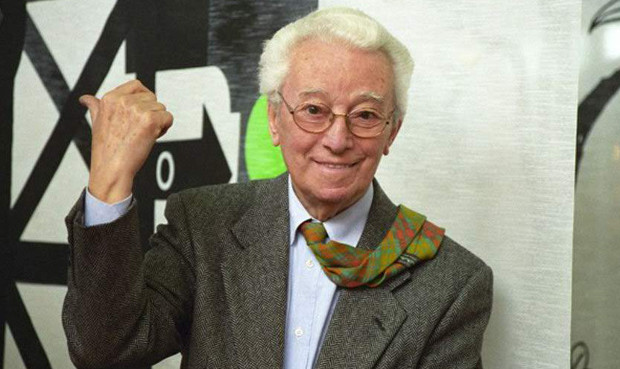
1907 – Milan, ItaliaBruno Munari (1907, Milan – 1998, Milan) es considerado uno de los máximos protagonistas del arte, del diseño industrial y gráfico del siglo XX. Realizó importantes contribuciones fundamentales en diversos campos de la expresión visual (pintura, escultura, cinematografía, diseño industrial, diseño gráfico) y no visual (escritura, poesía, didáctica) con una investigación polifacética sobre el tema del movimiento, la luz, y el desarrollo de la creatividad y la fantasía en la infancia mediante el juego.
Las últimas décadas de su vida, Bruno Munari se centró especialmente en temas relacionados con la didáctica, la psicología y la pedagogía.
«El artista trabaja de forma subjetiva para sí mismo y para una élite, mientras que el diseñador trabaja en grupo para toda la comunidad». Bruno Munari
Durante toda su vida, Bruno Munari tuvo una meta: la búsqueda de formas de simplificar y clarificar el proceso de diseño, llegando a apostar por una educación en el diseño que comenzara en las guarderías. En 1971, con una edad madura, Bruno Munari ya había superado con creces su etapa creativa más productiva y se centró en los contenidos de tipo más didáctico para alcanzar este fin.
Artista y diseñardor de Bruno Munari
En Artista y diseñador (Gustavo Gili, 2019) el maestro Munari se adentra en la dialéctica siempre manifiesta entre ambos campos. Con suma claridad, nos adentra en el lenguaje visual creado por esos dos universos —el del arte y el del diseño— que a menudo confluyen y se entrelazan, pero que en otras ocasiones se distancian y se ignoran.
Para Munari el mundo del arte es el del estilo personal, la crítica, la fantasía, la belleza… Mientras que el del diseño, en cambio, es el del profesional, la industria, la creatividad, la funcionalidad…
Son mundos paralelos, pero no antagónicos, que Bruno Munari disecciona magistralmente en estas páginas. Y así, a través de sus palabras, nos ayuda a vislumbrar la naturaleza profunda de dos de las actividades humanas más estrechamente vinculadas a nuestra facultad creativa. Un iluminador ensayo que sacudirá la mente de cualquier persona vinculada al ámbito de la creatividad.