back to top
Thursday, February 19, 2026
Home Blog Page 216

Manifiesto Madí

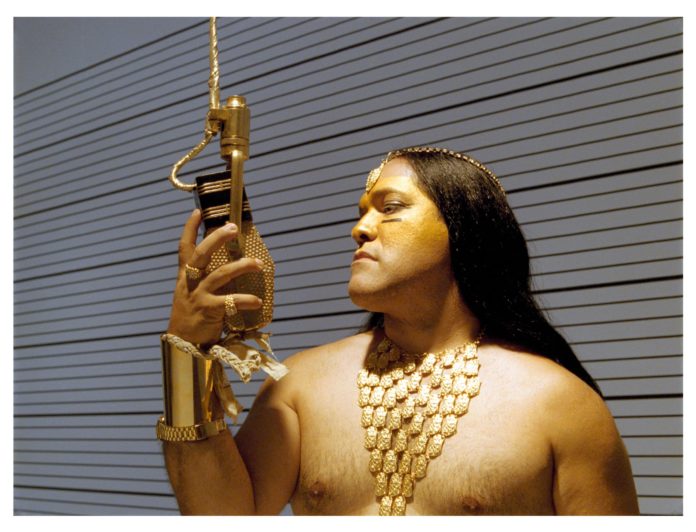
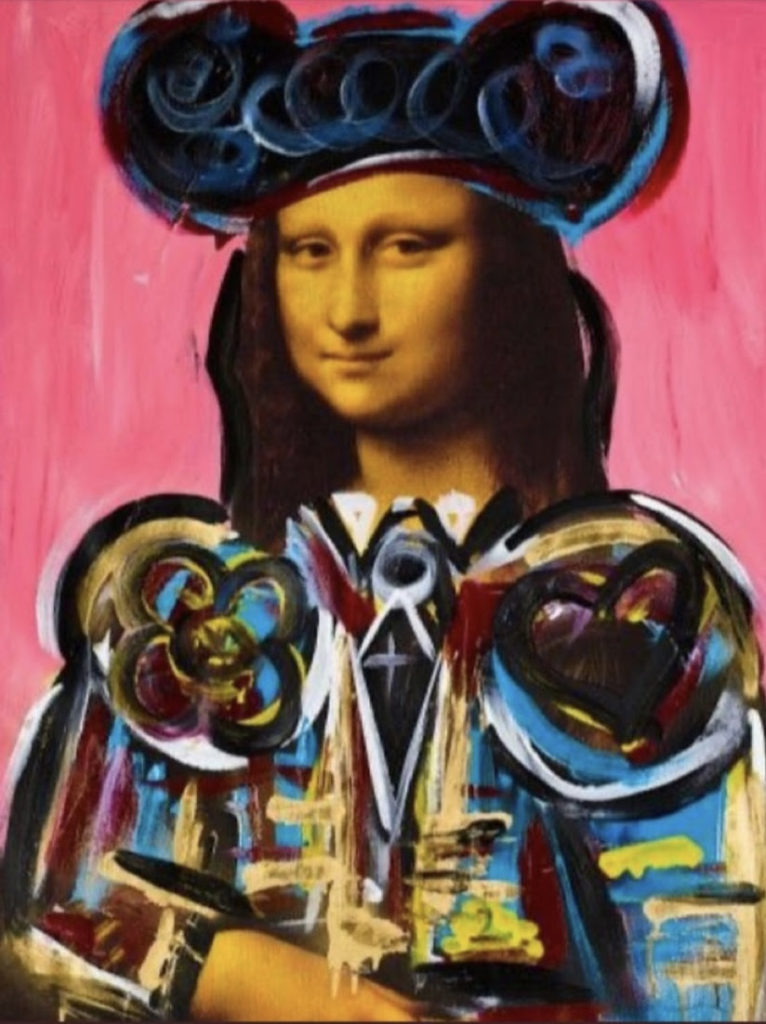
Rafael Montilla Queen Nandi 2020 acrylic on canvas 45x40 inches

Se reconocerá por arte Madí la organización de elementos propios de cada arte en su continuo. En ello está contenida la presencia, la ordenación dinámica móvil, el desarrollo del tema propio, la ludicidad y pluralidad como valores absolutos, quedando por lo tanto abolida toda injerencia de los fenómenos de expresión, representación y significación.
El dibujo Madí es una disposición de puntos y líneas sobre una superficie.
La pintura Madí, color y bidimensionalidad. Marco recortado e irregular, superficie plana y superficie curva o cóncava. Planos articulados, con movimiento lineal, rotativo y de traslación.
La escultura Madí, tridimensioanalidad, no color. Forma total y sólidos con ámbito, con movimiento de articulación, rotación, traslación, etc.
La arquitectura Madí, ambiente y formas móviles, desplazables.
La música Madí, inscripción de sonidos en la sección áurea.
La poesía Madí, proposición inventada, conceptos e imágenes no traducibles por otro medio que no sea el lenguaje. Suceder conceptual puro.
El teatro Madí, escenografía móvil, diálogo inventado.
La novela y cuento Madí, personajes y acción sin lugar ni tiempo localizados o en lugar y tiempo totalmente inventados.
La danza Madí, cuerpo y movimientos circunscriptos a un ambiente medido, sin música.
En los países que alcanzaron la etapa culminante de su desarrollo industrial, el viejo estado de cosas del realismo burgués desaparecido casi totalmente, en ellos el naturalismo se bate en retirada y se defiende muy débilmente.
Es entonces, cuando la abstracción, esencialmente expresiva, romántica, ocupa su lugar. En este orden están involucradas las escuelas de arte figurativo desde el cubismo hasta el surrealismo. Tales escuelas han respondido a necesidades ideológicas de la época y sus realizaciones son aportes inestimables a la solución de los problemas planteados a la cultura de nuestros días. No obstante ello, su tiempo histórico debe darse por pasado. Por otro lado su insistencia en el tema “exterior” a sus cualidades propias es un retroceso al servicio del naturalismo contra el verdadero espíritu constructivo que se extiende por todos los países y culturas, como es el caso del expresionismo, surrealismo, constructivismo, etc.
Con lo concreto –que, en realidad, es un gajo más joven de ese espíritu abstraccionista– se inicia el gran período del Arte No Figurativo, donde el artista, sirviéndose del elemento y su respectivo continuo, crea la obra en toda su pureza, sin hibridaciones y objetos extraídos a su esencia. Pero en “lo concreto” hubo falta de universalidad y consecuencia de organización. Se cayó en hondas e insalvables contradicciones. Se conservaron los grandes vacíos y tabúes del arte antiguo, como ser en la pintura, escultura, poesía, etc., respectivamente la superposición, marco rectangular, atematismo plástico; lo estático, la interferencia entre volumen y ámbito; proposiciones e imágenes gnoseológicas y traducibles gráficamente. La consecuencia de ello fue que el arte concreto no pudo oponerse seriamente, por intermedio de una teoría orgánica y práctica disciplinaria, a los movimientos instruccionistas, que, como el surrealismo, han ganado para sí todo el universo. De ahí el triunfo a pesar de todas las condiciones en contrario, de los impulsos instintivos contra la reflexión, de la intuición contra la conciencia; de la revelación del subconsciente contra el análisis frío, el estudio y la detención rigurosa del creador ante las leyes del objeto a construir; del simbolismo, de lo hermético, de la magia contra la realidad; de la metafísica contra la experiencia.
En cuanto a la teoría y conocimiento del arte, campea en ellos la descripción subjetiva, idealista, reaccionaria.
Resumiendo, el arte antes de Madí:
Un historicismo escolástico, idealista.
Una concepción irracional.
Una técnica académica.
Una composición unilateral, estática, falsa.
Una obra carente de verdadera esencialidad.
Una conciencia paralizada por sus contradicciones sin solución; impermeabilizada a la renovación permanente de la técnica y del estilo.
Contra todo ello se alza Madí, confirmando el deseo fijo, absorbente del hombre de inventar y construir objetos dentro de los valores absolutos de lo eterno, junto a la humanidad en su lucha por la construcción de una nueva sociedad sin clases, que libere la energía y domine el espacio y el tiempo en todos sus sentidos y la materia hasta sus últimas consecuencias. Sin descripciones fundamentales referentes a la totalidad de la organización no es posible construir el objeto ni hacerlo penetrar en el orden constante de la creación. Es así como el concepto invención queda definido en el campo de la técnica y el de creación como una esencia definida totalmente.
Para el madismo, la invención es un “método” interno, superable, y la creación una totalidad incambiable. Madí, por lo tanto, INVENTA Y CREA.

Buenos Aires, 1946.

HUMBERTO POIDOMANI. I MISS YOU SONY

Humberto Poidomani I Miss You Sony
I MISS YOU SONY - HUMBERTO POIDOMANI

HUMBERTO POIDOMANI. I MISS YOU SONY

By Milagros Bello, PhD.


Poidomani’s I miss you Sony is a wall work showing an imaginary woman covered in DVD’s and mixed media repurposed materials. Framed in gold rococo style, the artist repurposed an ensemble of recycled old Dvd’s that once formed his daily references for films, photos, and music, now outdated and useless. Once his delight and pleasure, they formed the allure of his days and the fascination and magic of digital images in their first steps. The work points out to the nostalgy of changing life instances, and the saying goodbye to old practices. In the consciousness of the passing of time, the work exorcises the philosophical stages of lifespan.
The work is profusely treated with strong outlines, gestural marks, and flat parches of pure color, finished the surface with gleaming resin.
At a second reading, the female personage stands as an imponent reference to women and love.

Humberto Poidomani I Miss You Sony
I MISS YOU SONY – HUMBERTO POIDOMANI


Located at the center of the composition, the feminine character imposes her presence and femininity. In her fashion dress it read the phrases” I miss you Sony.” “Te extraño” as the artist’s subjective approach to the fondness and affective connection to the women character, perhaps alluding to his personal biography. The phrase “”We are made of the same material that we dream of”. The Tempest, William Shakespeare”, and “Propero”, are the significant references for the artist, as this masterpiece is about letting go and accepting your fate.
About the artist Humberto Poidomani was born in Argentina. For over twenty years, Poidomani has developed an artistic career centered on ideological notions of societal crisis, ecology, life/death, poverty, which he develops through complex assemblages, sculptures, paintings, boxes and objects, and videos. He has indistinctively developed painting, sculpture, assemblages, installations, with a free-spirited mind that disrupts the notions of traditional art academics. In his painting Poidomani works from small format to monumental, large panoramic canvasses in which he paints a vast reflection of the world. Deep meta-narratives interloop with written phrases, as personal thoughts or as meaningful excerpts from Philosophy, Literature and Theater. In his sculptures, assemblages, installations, art boxes, he creates a dense compound of repurposed industrial and found materials mixed with thick gestural highly textured and colored lines, intercrossed with personal and literary word references. Echoing the provocative stanza of the “arte povera” and in a spirit of subversion, Poidomani creates absurd and comical overlapping combinations of wires, objects, rocks, fabrics with an individual high subjectivity. He points out to the diffraction of our culture and the lack of Utopias in contemporary times. As USA based curator and art critic Milagros Bello points out: “Premonitory art as anticipatory art in which artists prescient the development of an epoch, an event, an upcoming era, and as such display it in their works, is a profound artistic faculty. In his artworks, Poidomani has prefigured and has anticipated incisive current events. From his subconscious self, from this elusive realm, the artist has pulled out the signs of our current society and civilization.”

Poidomani has presented his works in museums, galleries, and art fairs. His solo shows include among others, a retrospective in the Contemporary Art museum of Salta, Salta Province, Argentina; E.C.A. Contemporary Spaces of Art, Mendoza, Argentina, SCOPE NEW YORK MARCH 2019, SCOPE NEW MARCH 2020, SCOPE INMERSIVE SEPTEMBER 2020 with Casa Poidomani and Curator’s Voice Art Project, in New York. He has participated in numerous curated shows and art fairs. He lives and works in Miami, Florida.
Humberto Poidomani is represented by Curators Voice/MIA Curatorial, Miami, Florida, USA

Chiaroscuro Studio of Art

taller de dibujo y pintura

Chiaroscuro Studio of Art

The Florence Academy of Art is an American art school in Florence,

Redefining Realism 19th century academies from Florence, Italy

Chiaroscuro Studio of Art offers top level instruction in realistic painting and drawing. Our curriculum is based on the teaching method used by the famous classical-realist 19th century academies. We believe in the solid artistic basis this kind of training gives to the students, allowing them to achieve high standards of craftsmanship and technical skills. Our teaching methods and techniques provide the tools that students can use to create their own contemporary work and develop a personal artistic language.

Our mission is to promote a return to discipline in the learning stages of art. By teaching traditional, time-tested methods, we guaranteed the aspiring artist with a strong basement in drawing and painting.They also learn all about materials, tips and secrets of the craft, and the way of developing the skills they need to build a high standard professional career in representational, figurative and realist art.

Our goal is to bring to Florida the same high level of instruction and training method our instructors received in Florence-Italy for many years, as well as to create a large and strong community of contemporary realist artists in the area.

5961 NW 102nd Av. Miami, FL 33178

+1 786.208.8607

Boy Blue (Ben Baugham)

Boy Blue (Ben Baugham)

Artists Were Made for People

Boy Blue (Ben Baugham) is a new wave visual communicator, and a street performer hell-bent on bringing the artist (not just art), back into social relevance. He has spent the past few years creating art in public and bringing visual excellence to the most bizarre locations. From construction sites to the office place, Blue has been hired all over the east coast to talk with and engage with people as he creates his works; thus, allowing people of any class, race or creed to feel a genuine connection with artists.

okay, Like she said on Boy Blue. Thank you. This one. That’s why I’m an artist and a street performer. And I just wanted a preface this by saying that art today is going to be a background to our conversation. So let’s just make that happen. Oh, that’s good. That’s good. So I’ve spent the past three years in a street performer, and I’ve talked with so many different people, and I’m talking like CEOs of big businesses to the homeless, And I’m trying to answer a question. I’m looking for an answer. The question is, why are people so uncomfortable with artists and art admiration? You know, everyone’s like artists are douchebags. It’s true, we’re bad people. So and I’ve come to a conclusion. I really have that I think has changed my life forever. So And don’t get offended. Art as we know it right now in my humble opinion needs to die. Okay, Andi, I think I want to be the one to kill it. I think me I want to dedicate my entire life to this cause. So let me explain why I think murder is such a good solution here. You can’t see that anywhere else. Wait, Go back several centuries ago during the Italian Renaissance, we will find something even more amazing than the art that was created. We will find a mindset. It is an attitude that they had so unlike modern artist today. And I am included in this. I’m not just bashing people. Unlike modern artist today, the greatest artists in human history, the greatest one’s Michelangelo, for example. They had art that was fueled by emotions, not based upon emotions. See, they were always making something for somebody else. They were always making something that was for something greater than who they were. See inspiration. It was not an abstract idea. It was a tangible property of our world. It was either a u know something inspired by the art that God created. That would be the planet, or is be something brought upon in light of God’s presence, which was the mind, right? So now when it comes to modern artists, you know, and I’m using this lightly, this brings me to my first point. And that’s art was made for people, not just the artists who make it see. Institution will tell you right now. They tell artist. They push this down our throats that somehow we are gods among men. You know, when you guys don’t understand what we’re trying to say, that just makes you stupid. Okay, That’s not right. Okay, let me give an example. If we send a text message to 15 different people and all of them tell us that they don’t know what we’re saying, that does not make the viewer stupid. That makes the communicator bad at communicating. Okay, Right. Thank you. OK, it makes him bad at communicating. So any artist who wants to become better at what they do will continuously search to become more sufficient communicators for other people. It’s for others. So and this is what led the entire Italian renaissance into becoming the epitome of artistic excellence. We know it as today. I mean, just thinking about this idea has changed me as an artist. So my ideas there now for you there for other people, they really are the emotions that you guys send right back to me allows me to restart that process. And that just exhilarate me. Really does. Until I’m asked why so many artists they asked me one. How do I get better. What I dio. And two, why are we so poor? That’s a great question. Why are we so freakin poor? And the answer is so simple when we deny that institution tells us that we’re gods among men and we see ourselves as public servants to you. Then people stop seeing what we do as a free luxury. And instead, they see it is a valuable service. Okay, so now the other point I wanted a point on This is something I like to call the Trinity of communication. And I’m going to use an example for this. Ah, musician musician goes up on stage. The musician creates art. And then art is given to the viewer, and the viewer gives emotion back to the artist that restarts the process. That’s what inspiration does for us. And that’s why musicians could make any song. You could be stupid. You could be terrible. And all of a sudden they’re rich. Okay, I am jealous. I’m being honest. I’m really jealous. So like, meanwhile, we have, like, our visual artists and they make something in their mom’s basement. I done it and then we put it up somewhere. It’s alone. It’s silent, untouched, and sometimes somebody comes up and they look at this piece and say, Wow, that piece really, really spoke to me But the artists had nothing to do with that conversation at all. In fact, ever so often you might see that little scribble at the bottom right hand corner of the you know, whatever canvas. But they’re not there. They’re not there to complete that trinity of communication. And since they’re not a part of your experience, who cares? Hey, ties back to that allegory say, if a tree falls in the forest and no one’s there to hear it didn’t make a sound. If a song is never heard, is it music? And if a piece of art is hanging on a wall with no artist there to lay claim to its glory, did the artists ever exist in the first place? And who cares? They weren’t a part of the experience anyway, So I mentioned for I’ve been doing a couple of different things to fix this for myself, and personally now I never drawn private ever. I never drawn private. I always make sure someone’s there toe watch me make a mistake someone’s there toe Watch me succeed They’re thereto Watch me innovate Whether I’m Tori the East Coast or I’m doodling in a coffee shop next to you I will be there. I want to be available to you because I want to have that connection with you I really want to talk to all the time. That’s just how it isthe. See, I have been given the opportunity to teach kids in different educational locations because I don’t even know schools. That’s a great place to call. You know, artist mind, right? Yeah. What is that? What’s the school then? Give It gave me this blessing to talk to these socially anxious kids about how to share their art and express themselves like a human. Okay, because that’s what they want. That’s what you want. And this goes out to any artist in the crowd. Craftsman, I don’t care what you are. People are dying to see what you can do. They’re dying to talk to you. I’m dying to talk to you. We want to connect with you like a person, not a God. That’s not what we’re here for. So for the love of God, any artist just show people what you do because we’re waiting for you and I’m dying to talk to you. So I want to leave you with something on. And that’s just the idea that everything that is truly great. I died once and came back better than it was before. I said before, I wanted to kill are not because I hate it, but because I know it’s rebirth as a beautiful form of communication can be so much better. Thank you guys for listening.

How can I share my art with the world?

Big Bang Mirror
Big Bang Mirror

How can I share my art with the world?


No matter where you are on your art journey, you have art to share and you work hard finding the eyeballs that will appreciate it most. Many of us use the “spray and pray” method of approaching many galleries, entering many shows, selling at various venues, and trying all the ways out there to sell art online and in person.

This is a useful strategy. We learn and grow with each experience. The doors that open afford experiences that shape our development.

What if I told you that there are ways to reach out to buyers beyond the organized shows and venues? What if I suggested ways to engage beyond the group of artists, family, and neighbors you typically share your art with? Would you be interested in doing the work to broaden your network?


The answer may be no. There are artists whose strategy is to only sign with certain galleries or show in specific venues. Some may be building a commissioned art based business. They may teach or take on a part time job to pay for expenses until their sales materialize.
If you want to know how I worked to secure shows in art centers and museums across the United States, growing my collector base in new regions, read on.

If I could only use one word to describe how this is possible, it would be “relationships.” It’s hard work. It doesn’t happen overnight. For me it’s taken ten years to secure my first solo museum show. But it can happen. It can’t happen without building relationships.

What does it mean to build relationships? It means you arrange as much in person and on the phone time as you can with people at venues of interest. It means you follow them and read their newsletters and commit to interact with them for as long as it takes. It may be weeks or years before there is an opportunity to engage fully, but when it happens you are ready.

Let me share with you the list I’ve been using for several years now. Some weeks I can spend only an hour or less doing something on this list. Other weeks, I can knock out several. This isn’t a race. I do what I can, when I can.

1. I do an internet search of art centers, venues and museums in areas I will be traveling to soon. I call these venues and speak to someone about what upcoming exhibitions I can apply to, and who the contact person is if I am interested in exhibiting there. I’ve learned I have the most success when I seek out places that regularly hold classes and art exhibits. These are good indicators of an engaged and thriving community of art lovers who may be open to learning more about me.

2. Once I have my list of names and venues, I subscribe to newsletters, follow on social media, and learn all I can about the people and the places. When I visit, I can speak with genuine interest to the people I meet there.


3. Each time I visit the venues, I spend as much time as I can getting to know not just the organizers, but the other people there as well. I talk to the groundskeeper. I seek out the person who runs the front desk or the gift shop, and if I’m lucky they will have coffee with me. I try to get to know everyone, but of course there are usually only a handful of people I am able to develop close working relationships with. Those people are precious to me. Over time, I find opportunities to let them get to know me and my art better.

4. Throughout the steps above, I look for times when I can mention or refer other artists. For example, when I heard about a call recently for sculptors, I reached out to my 3D artist friend to let them know about an application at a visual arts center I am interested in. Of course, I put a bug in their ear by closing with “I hope one day we can exhibit our work together in a show.” I have a group of 4 artist friends I show regularly with. For larger spaces, which typically require 50 paintings or more, it has been a fun experience organizing shows. Those museums require more work than I can commit.

5. I always know when the time is right to pitch a venue with a show. Often, they will approach me. But if I have developed our relationship enough, I know who to approach, they are familiar with my work, and then it’s just a matter of working out logistics. But when I approach them, I always have a theme in mind for the show, my headshot, bio and artist statement are in order, and I have at least ten paintings available to commit for promotional images. I also have a press release prepared for the venue to use and edit as needed. I am able to set up a Dropbox with all of these files, so they can be accessed by the hosts.


6. At this point, the people I am working with know my work ethic. They know that I will do all I can to share and promote the event on social media and through my newsletter. Sometimes I will send postcards to my contacts. I always offer to do an art talk and a painting demonstration at the event. Demos nudge sales because they urge people to stay longer.

7. After the event, I am careful to send private messages to all who were there, if they have shared their contact info with me. I will ask if they would like to continue on this art journey with me by allowing me to share what I’m up to with them via email. I try very hard to record genuine reasons to contact them in the future. If they mention their birthday, or an anniversary, I’ll wish them well that day for example. The more often I can connect with them in a sincere way, the more likely they will be to want to see more of me and my art.


8. Last but not least on my list, I brainstorm ways to use these experiences to generate more. After I signed with my first gallery, I spoke of it with other gallery owners. When I organized a group show at a museum in MT, mentioning that experience helped us book shows in Japan, MD and VA. Artists I’ve met at openings introduced me to curators I’m working with now. I’m teaching at art centers I hope to someday exhibit at. Every interaction may lead to larger audiences for your art.

Using these steps, I have been successful in sharing my artwork with people who I never would have met otherwise.

Ironically, I doubt these folks would be vested in me if I’d just sent them an email with my best art images. I don’t think my resume would impress them, no matter how many best of shows or signature memberships are on it.


People pay attention to the artists they are familiar with.

Work first to become more familiar to more people. Did I just say you should forget about art marketing?

No, I said that developing relationships is a VERY important part of art marketing. When seeking a larger audience for your art, it may be THE most important aspect of art marketing.

How are you sharing your art today? Has this article inspired you to approach new locations? I’d love to know, and others will, too!

Debra Keirce
Regular Contributing Author, FineArtViews
www.DebKArt.com

Artista visual venezolano Alfredo Mele

Alfredo Mele
Alfredo Mele

El artista visual venezolano Alfredo Mele triunfa en Estados Unidos 

Alfredo Mele es un destacado diseñador industrial y artista visual venezolano, altamente especializado en diseño estructural, producción de arte, escultura y fotografía, con una amplia experiencia de más de 20 años de trabajo. Es el creador y fundador de Indsign Industrial & Graphic, empresa que se ha convertido en referencia obligada del mercado en cuanto a la excelencia en diseño, calidad y producción. Su trabajo está presente en más de 15 países y en la actualidad reside en los Estados Unidos de América,  país que se ha convertido en su tercera base de operaciones,  realizando proyectos de alcance internacional en arte, diseño y publicidad, en los que se destaca por  su profesionalismo, alto nivel de conocimiento en la materia y capacidad de generar soluciones. Alfredo Mele ha recibido múltiples galardones y menciones honoríficas por su trabajo, reconocimientos que lo posicionan como uno de los artistas integrales más relevantes del momento. Como artista visual  se caracteriza por la investigación y aplicación de nuevos conceptos en el campo del lenguaje, la comunicación, el folklore y la espiritualidad, integrándolos en propuestas novedosas y de vanguardia. “A lo largo de mi carrera como diseñador, productor y ejecutor, es decir como artista integral, he logrado desarrollar procesos, habilidades, capacidades y destrezas que se reflejan en mi trabajo,  orientado siempre al enriquecimiento del arte”. Mele considera que su sello principal es la dedicación, sumada a una gran destreza técnica y al empeño en hacer una pieza que cumpla con el más elevado estándar de calidad, por esa razón numerosos artistas, museos, galerías y espacios de arte han puesto su confianza en él;  y la producción de sus obras; de allí que le conozcan como “El Artista de los Artistas”.

“Los vecinos de arriba”

Alejandro Dávalos, Dianelys Brito, Mijail Mulkay y Claudia Valdés

“Los vecinos de arriba” es el mayor éxito teatral de la temporada

A dos meses de su estreno se puede afirmar que la obra “Los vecinos de arriba” se vislumbra como un éxito histórico en Miami. La comedia del español Cesc Gay, presentada y producida aquí por Alexis Valdés, fue estrenada el 10 de septiembre, en el Teatro Trail, y no para de producir funciones llenas. Hay que tomar en cuenta que todavía se sienten coletazos de la crisis del coronavirus e, inclusive, hay que tomar ciertas medidas de precaución en lugar públicos, pero eso no parece importar a las casi 10 mil personas que han visto el espectáculo. Esta versión de “Los vecinos de arriba” es dirigida por Alexis y Mijail Mulkay, quien integra el elenco de cuatro artistas que dan vida a los personajes de la graciosa pieza. Los otros son las actrices Claudia Valdés y Dianelys Brito, y Alejandro Dávalos. En suma, un “dream team” de comediantes que da vida a dos parejas muy disímiles que provocan numerosas carcajadas. Una vive en el piso inferior (interpretada por Mijail y Dianelys) y es conservadora, lleva muchos años de convivencia y ha sido ganada por la monotonía en varios sentidos y, en especial, el sexual. Lo contrario pasa con “los vecinos de arriba” (personificados por Alejandro y Claudia), más jóvenes y energéticos, que hacen el amor de forma tan ruidosa que son escuchados permanentemente por “los de abajo”. A los pocos minutos de iniciada la obra las dos parejas se unen con la intención de departir fraternalmente, y allí se desatan conflictos alocados y divertidos. Las funciones son en el Teatro Trail los viernes, a las 9 pm; los sábados, a las 8; y los domingos, a las 5 pm. Los boletos se pueden adquirir en www.teatrotrail.com y 305-443-1009. Usando el código #vecinos10 se obtiene un 10 % de descuento.

El cantante venezolano Pedro J

cantante venezolano Pedro J

El cantante venezolano Pedro J presenta su nuevo disco, “El fenómeno”

El ambiente se ha llenado de música en estos tiempos optimistas; talentos de siempre y talentos nuevos muestran su material, y en ese contexto es saludable la aparición de un artista que tiene un buen recorrido. Se trata del venezolano Pedro J, que sobresalió con un dueto en los inicios del reguetón y desde hace unos años impulsa su trabajo como cantante solista. Pedro J presenta el disco “El fenómeno”, ya disponible en las plataformas digitales. El álbum se inscribe en un atractivo género fusionado de pop estadounidense de la década de los ‘80, música urbana, R&B, reggae y trap. El primer tema promocional de “El fenómeno” es “Química”, que cuenta con su respectivo videoclip en el canal Youtube. 

  Pedro J, que nació en Caracas y reside en Miami, no parecía predestinado a ser cantante: su madre era ama de casa, y su padre, torero y entrenador de caballos pura sangre. Además, en la infancia tenía pánico escénico. “Me daba vergüenza cantar en público”, recuerda, con ternura. Su carrera comenzó a profesionalizarse hace dos décadas, luego de afincarse en Miami. Asomó cantando reguetón, integrando el dúo Papi Shulo (seudónimo suyo) y Buda Kan. La dupla dejó su huella: llegó a grabar tres discos y abrió conciertos de consagrados como Ivy Queen, Zion y Lennox, y Jowell y Randy. 

    Sobre su canción nueva, “Química”, explica que refiere a dos personas que tienen distintas maneras de ser, pero están unidas por la química. Pedro J cuenta con un asesor de lujo: el productor conocido como Guss Music, que también trabaja con Farruko y J Quiles, entre otras figuras. Finalmente, el artista invita a escuchar su “Química” y el resto del repertorio de “El fenómeno”. “En esta nueva etapa de mi carrera me siento imparable y espero contar con el favor del público”, expresa con optimismo. En suma, Pedro J se siente como un fenómeno de la naturaleza.

Geometric Abstract Art

Constructionist Geometric Abstract Art
Geometric abstract art

by Alina Livneva

Geometric Abstract Art

The pictorial language of geometric abstract art is based on the use of simple geometric forms and shapes placed in non-illusionistic space and combined into nonobjective compositions. The style evolved as the logical conclusion of the Cubist deconstruction and reformulation of the established conventions of space and form. Started by Georges Braque and Pablo Picasso in 1907–8, Cubism subverted the traditional depiction relying on the depiction of imitations of forms of the visual world.

The Analytic Cubist phase peaked in mid-1910 and made available to creators and artists the theory of planarity of overlapping frontal surfaces held together by a linear grid.

The next phase–Synthetic Cubism, 1912–14–introduced the flatly painted synthesized shapes, abstract space, and “constructional” elements of the composition. These three facets became the fundamental characteristics of geometric abstraction. Usually, it was combined with the freedom of experimentation with different materials and spatial relationships between various compositional parts, which also emphasized the flatness of the picture surface, as the carrier of applied elements, and the physical “reality” of the explored forms and materials. Geometric abstraction, through the process of purifying art from visual reality, focused on the inherent two-dimensional features of the painting.

Piet Mondrian Composition II in Red, Blue, and Yellow, 1930

This process of purely pictorial reality constructed of elemental geometric shapes assumed different stylistic expressions in various European countries. In Holland, the most important creator and the most famous proponent of geometric abstract language were Piet Mondrian (1872–1944). Along with other members of the De Stijl group–Theo van Doesburg (1883–1931), Bart van der Leck (1876–1958), and Vilmos Huszár (1884–1960). Mondrian’s work was meant to convey “absolute reality,” construed as the world of pure geometric forms according to the vertical-horizontal principle of direct lines and pure spectral colors.

Mondrian’s geometric design, which he termed “Neoplasticism,” developed between 1915 and 1920. For the next thirty years continued to work in his characteristic geometric fashion. Expunged of all references to the actual world, and posited on the geometric side of the canvas through vertical and horizontal lines of varied thickness, complemented by cubes of primary colors, especially blue, red, and yellow. Similar compositional principles underlie the work of the De Stijl artists, who implemented them with slight formal modifications to achieve their individual, personal expression.

Geometric abstract art
Number 55, Kazimir Malevich

The job of this avant-garde artist Kazimir Malevich (1879–1935), in style he termed Suprematism.

Creating nonobjective compositions of elemental forms floating in unstructured white space, Malevich tried to achieve “the absolute,” the highest spiritual reality that he called the “fourth dimension.” Simultaneously, his compatriot Vladimir Tatlin (1885–1953) originated a new geometric abstract idiom in an advanced three-dimensional form, which he dubbed “painterly reliefs” and then “counter-reliefs” (1915–17). These were assemblages of randomly found industrial materials whose geometric form was dictated by their inherent properties, such as wood, metal, or glass. That principle, which Tatlin called “the civilization of materials,” spurred the rise of the Russian avant-garde movement Constructivism (1918–21), which explored geometric form in two and three dimensions.

The primary practitioners of Constructivism included Liubov Popova (1889–1924), Aleksandr Rodchenko (1891–1956) (Museum of Modern Art, New York), Varvara Stepanova (1894–1958), and El Lissitzky (1890–1941). It was Lissitzky who became the transmitter of Constructivism to Germany, where its principles were later embodied in the teachings of Bauhaus. Founded by the architect Walter Gropius in Weimar in 1919, it became throughout the 1920s (and until its dismantling by the Nazis in 1933) the vital proponent of geometric abstraction and contemporary experimental architecture.

As a teaching institution, the Bauhaus surrounded different areas: painting, graphic arts, stage design, theater, and architecture. The art faculty was recruited from among the most distinguished painters of the time: Wassily Kandinsky, Paul Klee, who were devoted to the idea of the purity of geometric form as the most suitable expression of the modernist canon.

In France, during the 1920s, geometric abstraction manifested itself as the Underlying principle of the Art Deco style, which propagated widespread use of the geometric form for decorative purposes in the decorative and applied arts as well as in design. In the 1930s, Paris became the center of geometric abstraction that arose from its Synthetic Cubist sources and concentrated around the group Cercle et Carré (1930), and later Abstraction-Création (1932).

With the outbreak of World War II, the attention of geometric abstraction changed to New York, where the tradition was continued by the American Abstract Artists group (formed in 1937), including Burgoyne Diller and Ilya Bolotowsky. With the advent of the Europeans Josef Albers (1933) and Piet Mondrian (1940), and such significant events as the exhibition Cubism and Abstract Art (1936), organized by the Museum of Modern Art, and the creation of the Museum of Non-Objective Art (1939, today the Guggenheim), the geometric tradition acquired a new resonance. However, it was basically past its creative phase. Its influences, however, attained younger generations of musicians, most directly affecting the Minimalist art of the 1960s, which used pure geometric form, stripped to its austere essentials, as the principal language of expression. Artists such as Donald Judd, Dan Flavin, and Dorothea Rockburne analyzed the geometric tradition and transformed it into their artistic vocabulary.

Abstract geometric art examples

Geometric abstract art
1938, Rythme n°1 Robert Delaunay

ROBERT DELAUNAY

The first works of Robert Delaunay were Neo-Impressionist but with time his work Simultaneous Windows 1912 was his last semi-figurative work before he began experimenting with complete non-objectivity. His most significant contribution to abstract art was co-founding the Orphism art movement, an offshoot of Cubism that focused on pure abstraction and vivid colors. The motion aimed to dispense familiar subject matter and consequently played a vital role in abstract art development. Delaunay’s paintings were based on the optical qualities of brilliant colors that were so dynamic they would serve as the form. By being the chief and most renowned figure of Orphism, Delaunay is rated among the most influential abstract artists.

The knifegrinder, 1912 - Kazimir Malevich
The knifegrinder, 1912 – Kazimir Malevich

KAZIMIR MALEVICH

Kazimir Malevich was the founder of Suprematism, which concentrated on primary geometric forms, such as squares, circles, lines, and the use of a limited range of colors. His Black Square is one of the most famous works in the history of art. Also, an art theoretician he wrote the book The World as Non-Objectivity, which outlined his suprematist theories. He was a crucial figure in the evolution of overall abstraction and reducing a painting into its geometric essence.

Victor Vasarely | Operenccia (1954-1986)

Victor Vasarely

Victor Vasarely creates an optical illusion through precise manipulation of patterns, shapes, and colors. Containing non-representational shapes, he often created an illusion of motion. He worked as a graphic designer and a poster artist. Vasarely finally becomes one of the founders and the most famous figure of the Op art movement. Op art influenced the art world by spreading to areas, including architecture, computer-aided design, animation, and fashion. Vasarely’s painting Zebra (1937) is considered among the earliest examples of OP art. He went on to make some of the movement’s most notable works in both sculpture and painting. Victor Vasarely is Called the “Father of Op Art.”

Number 5, (1949) Mark Rothko

MARK ROTHKO

He immigrated to the United States when he was a kid. He moved through several styles in his artistic career, including Surrealism. Rothko becomes a pioneer of Color Field painting. The color becomes the main subject. Rothko is classified as one of the leading abstract artists. However, he insisted that he was not an abstractionist. His primary focus was detecting mysticism and esoteric aspects of colors and their combinations. Painting was a technique of spiritual expression for Rothko, and lots of viewers have broken down in tears before his works. Despite his announcement, the participation of Rothko to Abstract Expressionism is monumental.

In modern practice, the love for purity in geometry and color follows the legacy of major periods of the past. The fascination with geometric artwork is visible not only in the field of visual art but as a major feature of graphic design and crafts works.

Always at the center of important collections, exhibitions, or auctions, the following works are perfect examples of geometric abstraction.

Cube Éclosions Géométriques #1

Arthur Dorval

He is recognized as one of the most prominent young French artists. In his signature style of the play with color and geometrical shapes, Dorval’s works have a particular movement and vibrancy that is closely connected to architectural objects. Upon studying design and illustration, Dorval decided to focus his imagination on the re-invention of geometric art.

Francois Morellet
Francois Morellet

Today, Francois Morellet is described as one of the leading representatives of geometric art. The application of mathematical systems and geometry concepts places him in the middle of Conceptual and Minimal art production also. Influential for the notion of the demystification of the art as well as the liberation from subjectivity, Morellet’s infinitive structures do not limit the boundary of the canvas. His grid structures, both in painting and in sculpture, are created with an array of non-traditional materials.

Tom McGlynn - Test Pattern 7
Tom McGlynn – Test Pattern 7

Tom McGlynn

Tom McGlynn is known for contrasting colors and minimalist approach. Working across painting, drawing, photography, and sculpture, Mc Glynn also works as a curator. Far from predictable, his color choice creates a feeling of contradicting forces. His test pattern series explores the heart of the contemporary being through the eye’s response to the form and color. His painting denies any emotion or evidence of the artist’s inner being and reflects similar notions of major minimalist works of the past.

Luke Newton - Beads Thrill
Luke Newton – Beads Thrill

Luke Newton

Luke Newton – Beads Thrill – Future Interpretation of the most mundane things. Transforming various everyday objects, like iPods into defensive weapons, or attaching red stickers in a variety of forms on the canvas, Newton stands as one of the important authors of the New Pop Art movement. Entirely created using pearls, this minimalist abstract geometric art investigates the substance and the repetitive type of the tiny black rectangles on the surface.

Fritz Ruprechter - Untitled 2
Fritz Ruprechter

Fritz Ruprechter

Ruprechter is a magician of the watercolor artwork. One of the most important post-minimalist artists, his pictures, vibrate love of color and tranquility. The transparency of the medium includes an element of poetry hidden between the layers of paint. Recognized as one of the most significant Austrian abstract painters, Ruprechter explores various geometrical and linear forms and successfully attracts the fragments into a whole. His drawing Untitled 2 (Blue/Grey) is made with watercolor and lacquer on Masonite and represents a perfect example of his celebrated geometric artwork.

Gheorghe Virtosu

At the current stage, the direction continues to develop in new forms and movements. In modern art, shapes and colors have truly significant significance and even a specific philosophical meaning.

Abstract Geometry Gheorghe Virtosu
Gheorghe Virtosu Behind Human Mask

Great merit of Gheorghe Virtosu is to question the world, its realities, and its hardship. A symbolist painter, aimed at showing man’s thoughts. Through abstractionism and the new geometry of form, the artist asks questions to the observer. The observer has to reflect on the human condition. To characterize his works is the always bright color scheme. In the eternal struggle, light always wins. New ideas are always represented, which aims to find their new dimension in our society.

The Master’s works are characterized by their value: cultural and ideological. Ideology is the bases of a brilliant thought the artist decides to share with all of us. A free sign. A sign that has no need to draw rational bisectors. A sign that once freed from the prison of reason, come to inhabit our world. Through the genius of his sign, traces what are the new guidelines of geometric painting. A painting that is no longer forced to follow rigid “academic” schemes, but which, thank the hand of the artist, finds a new Cartesian axis on which to express its power.

He masterfully traces what we call “the most hidden paths of the psyche”. A psyche that after wandering for years in the labyrinth of ideas can finally express its truth. Virtosu makes the observer participate in what are his most intimate secrets.

Albert Einstein Gheorghe Virtosu
Gheorghe Virtosu Albert Einstein

Abstract and geometric art – since ancient times

Even though avant-garde artists have popularized the genre in the early twentieth century, similar motifs have been used in art since ancient times.

Geometric abstraction is present among many cultures, both as decorative motifs and as art pieces themselves. Islamic art, in its geometric pattern-based artwork, existed centuries before the European movement and influenced Western school. Used in the architecture of Islamic civilizations spanning the 7th century-20th Century, geometric patterns were used to visually connect spirituality with Art and science, both of which were crucial to Islamic thought of this time.

About author: Alina Livneva was born 1985 in Saint Petersburg, Russia. She studied at Saint Petersburg Academy of Arts. Educated in Russia and the United States. Lives in Miami. Has also lived in Russia. Contemporary Art. Collections expert, exhibitions and loans. E: [email protected]

COLOR-FIELD-PAINTING

red-on-red-color field painting

MEANING OF COLOR-FIELD-PAINTING

Color Field Painting

Colourfield Painting is a form of expression of contemporary art, which is characterized by large, homogeneously filled swatches. This technique was developed in the 1950s in America from the Action Painting. Mark Rothko and Barnett Newman (Who’s afraid of red, yellow and blue) are important representatives of this style.

The works are mostly large format and make use of any “visible only” composition. Often the pure color effect on the surface, disturbed only by marginal changes in color but which are compositionally very important. Meet the color differences hard on each other it is called Hard Edge. (Source: wikipedia.de)

Graubner – one representative from Germany dedicated to now for more than 50 years this subject in a very distinctive way See examples on this page..

Please dont´be confused on different ways of writing “color field painting – or colorfield painting or colourfieldpainting or…” – it all means the same issue 🙂

Color Field Painting…

…became some sort of label but despite that there are still artists who refer in their contemporary art work to this. So I´m one of these and will work on because there’s no alternative when searching for deeper meaning of colour. It seems all stories have been told in painting but when you’re not in telling stories while painting but more in “meditating” over what comes through you and what will last it’s obvious that there can’t be anything else but Color Field Painting. Color is the subject of my work with large painted expanses surrounding the viewer.  Is this style meditative and does it come from the subconsciousness? Not really because while painting a much deeper awareness takes part of my mind and soul and becomes an essential part of the process and at least part of the created art… So I will call it from now on “Color Awareness Painting

blue-magenta-color-field-painting

What others say:

As its name indicates, Color Field painting has three components—“color” and “field” and “painting”. In former times a main meaning included that the aim of rejecting illusions of depth and gestural brushwork. So that no “countryside” would emerge in ones mind.  Color Field painters applied color that would often span the entire ground. As they intended the elimination of illusion of something that could remind us on something real, many Color Field Artists treated the ground as a single plane. Robert Atkins would say: “This emphasis on the flatness of the painting mirrored the formalist imperative that painting respect its two-dimensional nature rather than create an illusion of three-dimensionality.” And so they span a complete new meaning an what painting could be – no more illusion (landscape, room…) but more just itself.
source: moca.org

Wikipedia  says:

The color field painting (also: Color Field painting and post- painterly abstraction ) is a form of expression of contemporary art which is characterized by large, homogeneously filled color fields . This art movement in the mid- 1950s developed in America from the Abstract Expressionism. Mark Rothko, Barnett Newman ( Who’s afraid of red , yellow and blue ) and Clyfford Still are important precursors and partly pioneers of this style .

The works are mostly large format . Often the paint is applied without the use of classical art supplies directly to the (horizontal lying on the ground ) unprimed canvas ( emptied , poured , sprayed ) , penetrating directly into the tissue ( Soak – Stain – technology) – quite similar to the coloring of a substance .

The term Color Field Painting was coined by the American art critic Clement Greenberg , whose favorite Jules Olitski belonged . Significant representatives of Color Field Painting ( their main creative periods can be assigned to this flow ) are Ad Reinhardt, Morris Louis, Helen Frankenthaler, Gerhard Richter (Germany) Jules Olitski , Kenneth Noland, Elsworth Kelly and Dorothy Fratt. Fine Collection here […] ”

Various other names for Color Field painting were coined during the 1950s and 60s. The most notable was Post-Painterly Abstraction, the title of an influential 1964 exhibition at the Los Angeles County Museum curated by the critic Clement Greenberg. It encompassed what is now called Hard Edge painting. 

Just as Frankenthaler’s technique was inspired by Jackson Pollock’s poured paintings, so, too, was Color Field Painting an extension of Abstract Expressionism. Pollock, with his all-over compositions, was the first Color Field painter. The inspiration for the dramatic use of color in Color Field painting came from the work of the Abstract Expressionists Mark Rothko and Barnett Newman. Since Color Field painting is invariably abstract, nature-based color has typically been abandoned in favor of more expressive hues. When examined at close range, the expansive canvases of the Color Field painters frequently seem to envelop the viewer in a luxuriant environment of color. A French variant of Color Field painting was known as Supports/Surfaces. The group comprised the artists André-Pierre Arnal, Vincent Bioulés, Louis Cane, Marc Devade, Daniel Dezeuze, NoËl Dolla, Toni Grand, Bernard Pagés, Jean-Pierre Pincemin, Patrick Saytour, André Valensi, and Claude Viallat. Between 1966 and 1974, they frequently showed together, issued manifestos, and published a magazine.

Extracts from ‘Artspeak’ by Robert Atkins (copyright (©) 1990, 1997 by Robert Atkins) reproduced by Abbeville Press, Inc.

Rothko-inspired

My art in color field painting has revolved in the 90s and emerged until today – sometimes inspired by Mark Rothko (Marcus Rothkowitz; 09.25.1903 – 25.02.1970). This type of painting emerged from the abstract impressionism of Jackson Pollock, Jasper Johns or Helen Frankenthaler was brought to the championship by Mark Rothko in the course of his work. It stands beside Barnett Newman and Ad Reinhardt in a modern tradition not only in the color / surface treatment as well as in the extended reflection and intellectual penetration.

Also include the years of work by a Josef Albers (homage to the square) in this category, if a category is necessary at all. Since such an assignment is always committed after the fact through art history, which tends to give the works a certain rigor.

Nowadays color field painting doesn’t affect the “art-circles” – we find so many “not abstract” art that someone might think there wasn´t a art revolution in the early days of the 20th century. That’s not a german tendency as one can see on current art exhibitions all around the globe…

Page 216 of 263
1 214 215 216 217 218 263

Recent Posts