El venezolano Louis BR presenta la canción “Ta’ Viral”
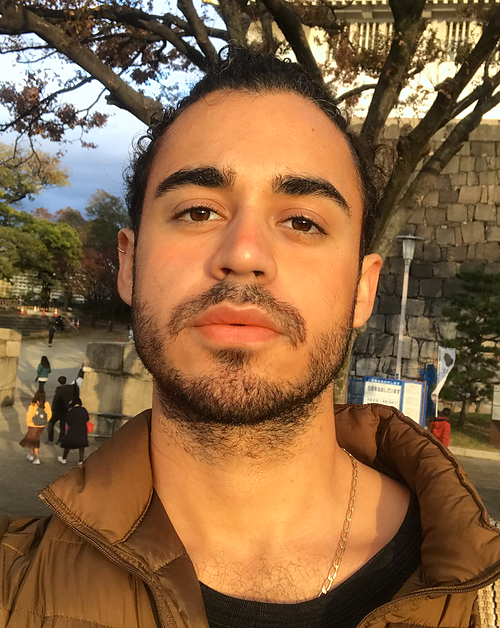
Louis BR salió de su país hace menos de cinco años; vivió en Ecuador, en Colombia, y finalmente en Chile; actualmente está radicado en Miami. Louis B cuenta que “Ta’ Viral” nació de “una energía” que sintió en cierta ocasión, a poco de llegar, saliendo de una discoteca de la ciudad. “Es una mezcla de house, guaracha y reguetón”, asegura el artista, autor de la letra del tema, que producido por JVY BOY y el ingeniero de sonido Carlos DZ. “Ojalá que a través de ‘Ta’ Viral’ el público de aquí conozca más mi música, que he ido desarrollando en estos años, que sean testigos de mi evolución y versatilidad”, apunta. Louis BR, cuyo nombre real es Luis Briceño, nació el 12 de enero del año 2000, en un pueblo cerca de Caracas, Los Teques. Desde pequeño mostró destrezas para la música y el deporte; estudió música (teoría, solfeo y percusión) y paralelamente jugó béisbol. A los 18 años emprende un viaje solo hacia Ecuador, donde tuvo oportunidad de cantar en el show del Miss Ecuador 2018. En Chile vivió durante tres años, convirtiéndose en parte del movimiento del reguetón chileno y el primer venezolano en grabar un sencillo con uno de los artistas nacionales más sonados (Balbi El Chamako). En ese país compuso medio centenar de temas para otros colegas.
Marcelo Verdad presenta el libro “El peor Teddy del Mundo”
Una figura muy interesante se asoma al mundo de la literatura infantil. El autor e ilustrador mexicano Marcelo Verdad lanza el libro “El peor Teddy del Mundo”, para divertir y a la vez dar un mensaje de tolerancia. El libro trata de un niño que se frustra con su oso porque siempre está cansado, ignorando que lo protege de fantasmas como “El monstruo de las cosquillas”. “El peor Teddy del Mundo” está a la venta en inglés y español. Marcelo Verdad es un joven de 30 años criado en Guanajuato, que vive en California desde hace una década. Con este libro debuta como autor, pero tiene una extensa preparación, además de que es un experto maestro de ilustración. “Tengo muchas más historias para contar”, asegura el artista, que pronto se abocará a la realización de un segundo libro. Cuenta que “El peor Teddy del Mundo” se inspira en varias situaciones de la vida, una de las cuales es el afecto desinteresado de los padres hacia los hijos. El libro se sitúa en una casa hispana porque Verdad considera que no estamos suficientemente representados en la literatura infantil. “Me gusta celebrar la diversidad”, sostiene. Es graduado en ArtCenter College of Design, de Pasadena, California. Tiene como inspiraciones a colegas como Shel Silverstein, Taro Gomi y Oliver Jeffers. “Creo en andar suavecito por el planeta y compartir lo que he vivido; si alguien vibra con mi trabajo, buenisimo; si no no pasa nada”, sostiene.
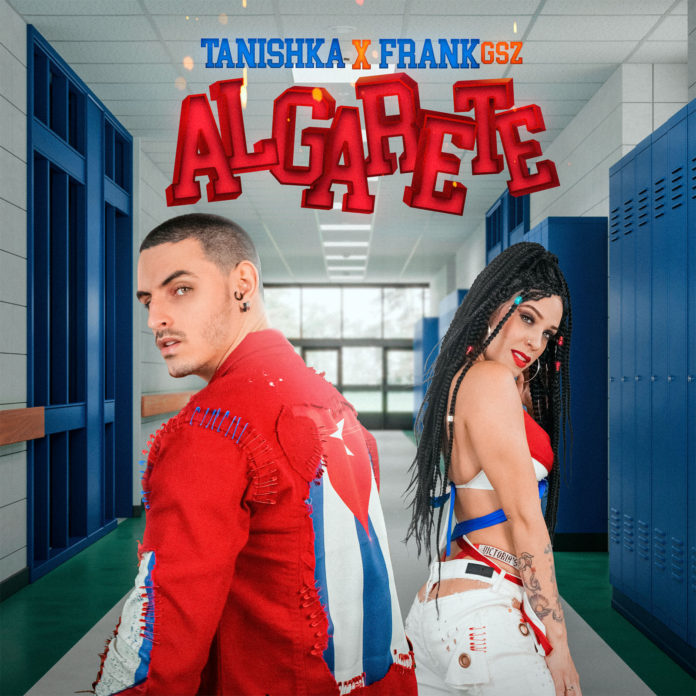
El dúo Tanishka PR y Frank GSZ graba la canción “Algarete”
El dúo integrado por la puertorriqueña Tanishka PR y el cubano Frank GSZ lanza la canción “Algarete”, que ya se encuentra disponible en Youtube y demás plataformas digitales. Tanishka y Frank vienen de carreras independientes y residen en Miami. Ella es bailarina y actriz, y maneja una empresa de entretenimiento, mientras que Frank canta, produce y compone desde la infancia y llegó de Cuba hace cuatro años. Sobre la canción “Algarete” cuentan que es una palabra muy usada en Puerto Rico, que quiere decir “andar a lo loco”, desordenado. “Es para que la gente cuando vaya a la discoteca la pase bien, baile hasta abajo y se libere del estrés”, asegura Tanishka. “El tema también es una fusión de la cultura caribeña”, agrega Frank, que es casado con una venezolana. Tanishka y Frank se conocieron hace más de un año, en un club nocturno de Miami, trabajando en una obra llamada “Musical Radio Rock and Roll”. Ahora están enfocados en la promoción de “Algarete”, pero el dúo prepara la producción de más canciones. “Tenemos mucha química musical y, además, somos del signo Capricornio, es decir que somos muy determinados y persistentes”. Tanishka nació en San Juan. Es hija de dos actores reconocidos de Puerto Rico, Armando Pardo y Letty Contreras. Estudia Danza desde los 4 años. Baila y actúa, además de cantar. Obtuvo un bachillerato en Drama en la Universidad de Río Piedras. Frank nació en La Habana el 15 de enero de 1999 y llegó a Miami en octubre de 2018.
Art Palm Beach Wraps Up Successful First Show The show is celebrating major success and record sales
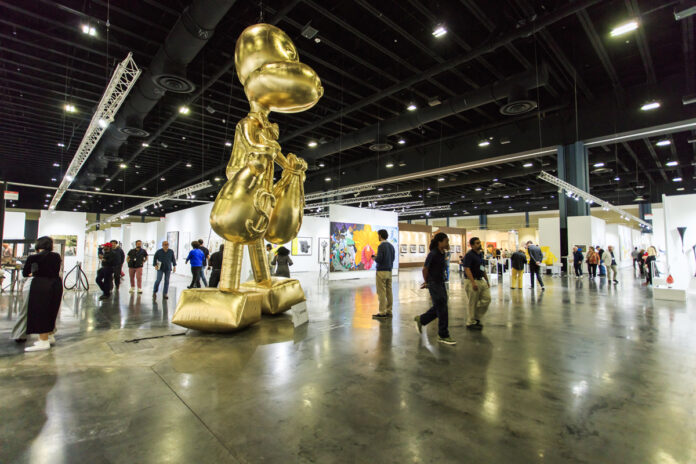
This weekend Art Palm Beach wrapped up its first show at the Palm Beach County Convention Center under new ownership. The show brought in tens of thousands of people and record sales for multiple galleries. Art Palm Beach is the longest running fair dedicated to contemporary, emerging, and modern art in the area. This year, the owners of the LA Art Show, the most prestigious and innovative art show in America, brought their knowledge and expertise to Palm Beach. “We created a new and completely revamped Art Palm Beach”, said Kassandra Voyagis, the producer and director of the show. “We are so proud of what we accomplished taking this show in a new and exciting direction. I could tell by the look on people’s faces when they walked in that they were wowed by the experience we provid-ed.”
The show kicked-off with a successful VIP night in conjunction with St Jude Children’s Re- search Hospital. A patient family spoke about their gratitude for the support from Art Palm
Beach. Fifteen percent of ticket sales from the five-day event benefitted St. Jude. From the “yel- low” carpet to the four Pablo Picasso art pieces for sale to Lorenzo Marini’s most loved immer- sive experience titled “Raintype” — art you can touch — guests and patrons alike commented on
the vibrant energy and fun buzzing through the course of the show. Art Palm Beach garnered national TV attention from networks like Discovery+, The Weather Channel and multiple local news segments highlighting the uniqueness of the show that focused on climate change. As a part of DIVERSEartPB, international artist Marcos Lutyens provided a trance room called “Echo of Oblivion” about drought. Renowned art curator Marisa Caichiolo also featured an immersive experience by artist Guillermo Vezzosi dedicated to the rising sea level. Guests were able to see, feel and touch recycled trash as an art form. Mark your calendars for next year’s show at the Palm Beach County Convention Center Jan. 24th -28th 2024. For more information about the exceptional show go to: ArtPalmBeach.com
A lo largo de la historia, la humanidad ha querido profundizar en los orígenes de la vida sobre la tierra o en los mitos referentes a las diversas religiones, lo cual indica que el ser humano busca siempre un motivo de adoración y religión; prueba de ello la obtenemos en los primitivos habitantes del mundo, que adoraban al Sol, la Luna y a muchos animales.
Sobre el tema numerosas líneas se han escrito y muchos han sido los autores e investigadores, como el mismo Darwin quien sostenía que el hombre era fruto de una evolución y negaba los mitos bíblicos.
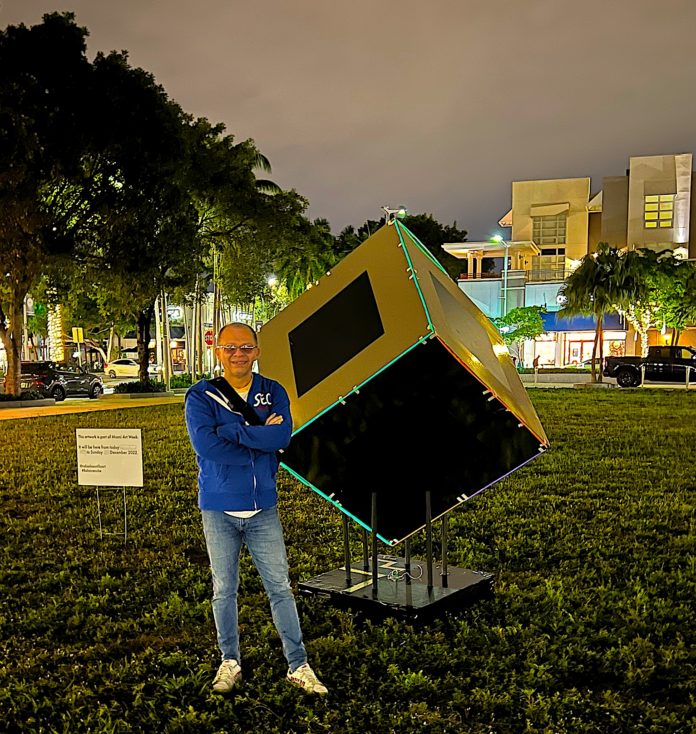
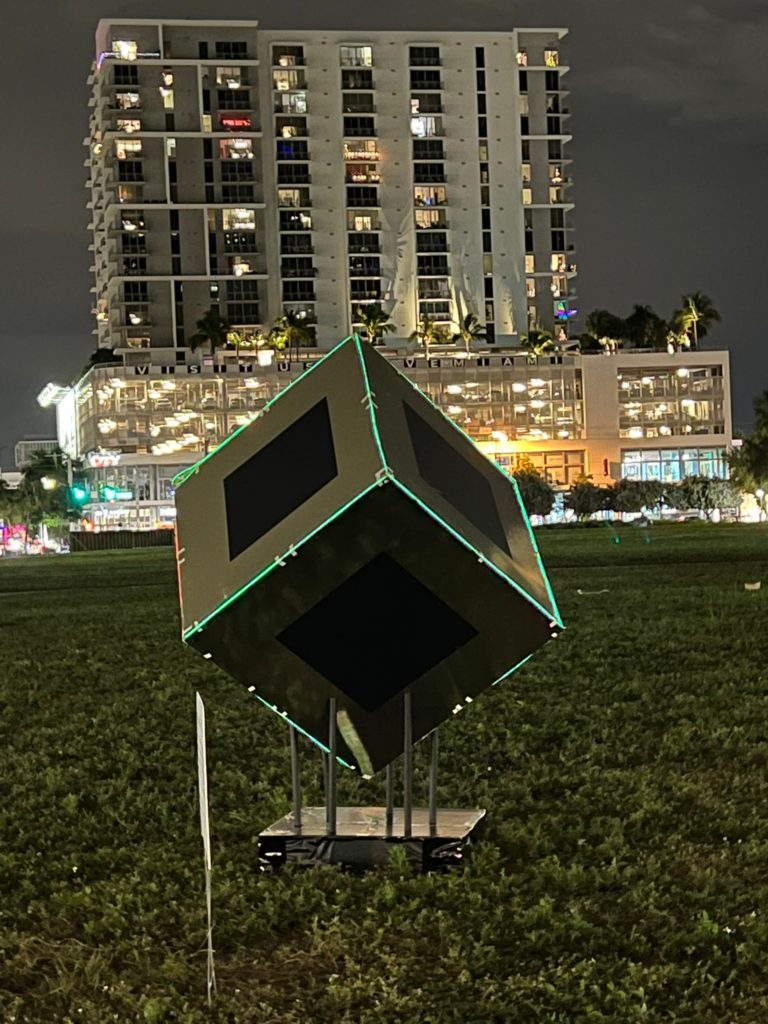
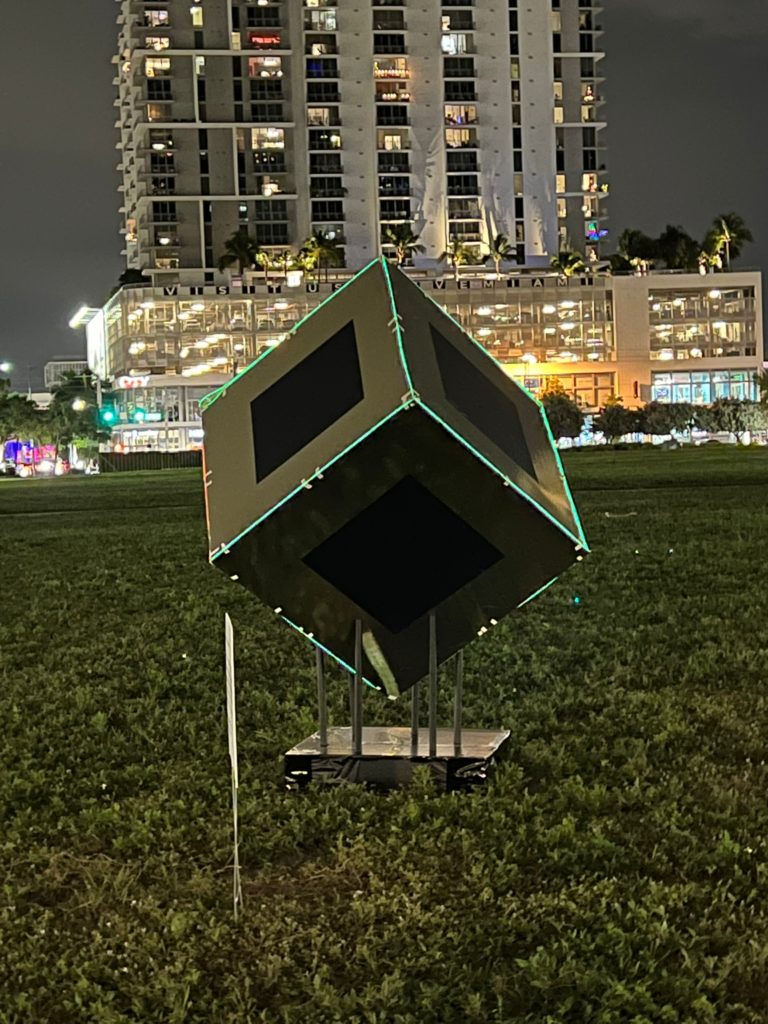
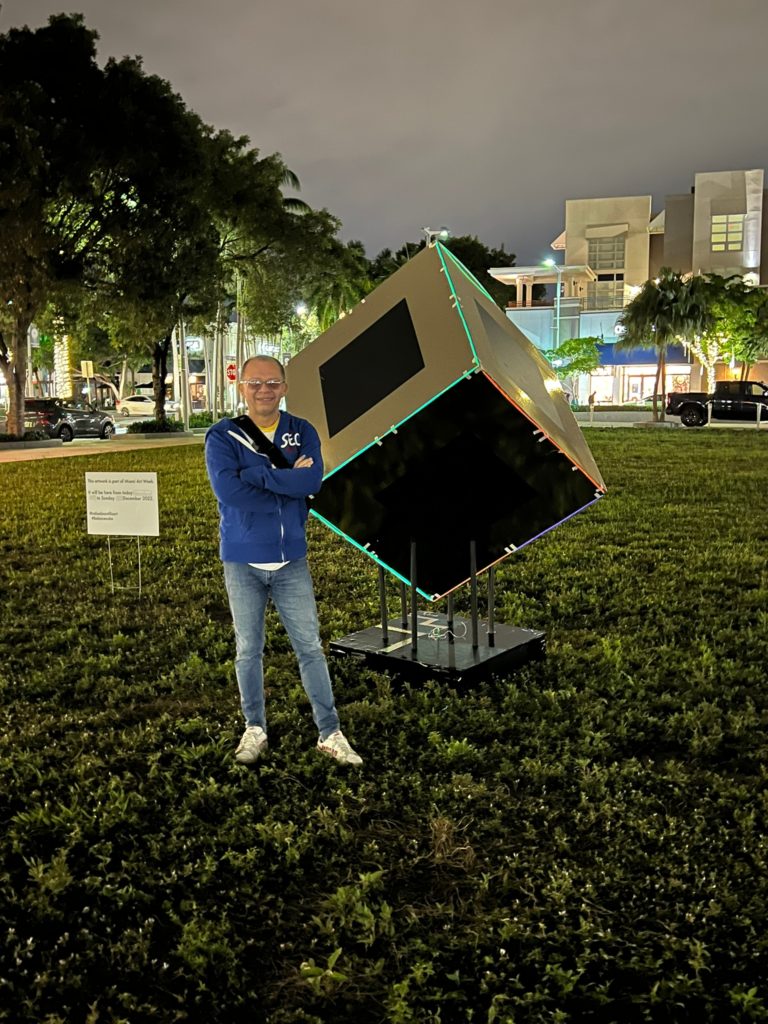
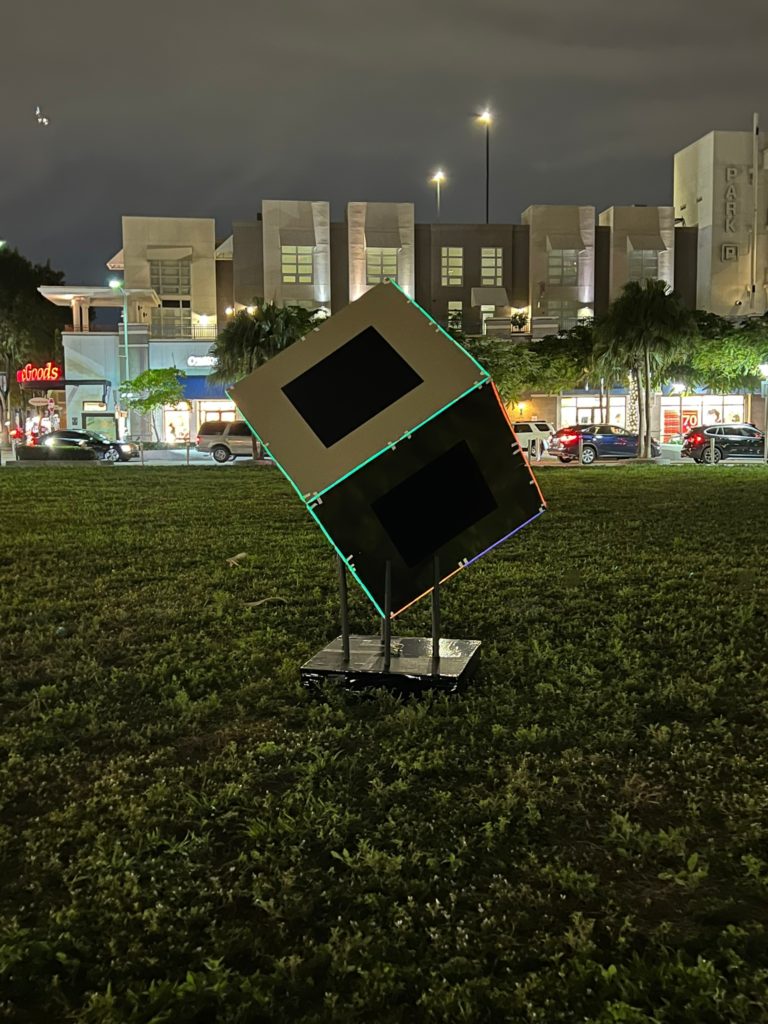
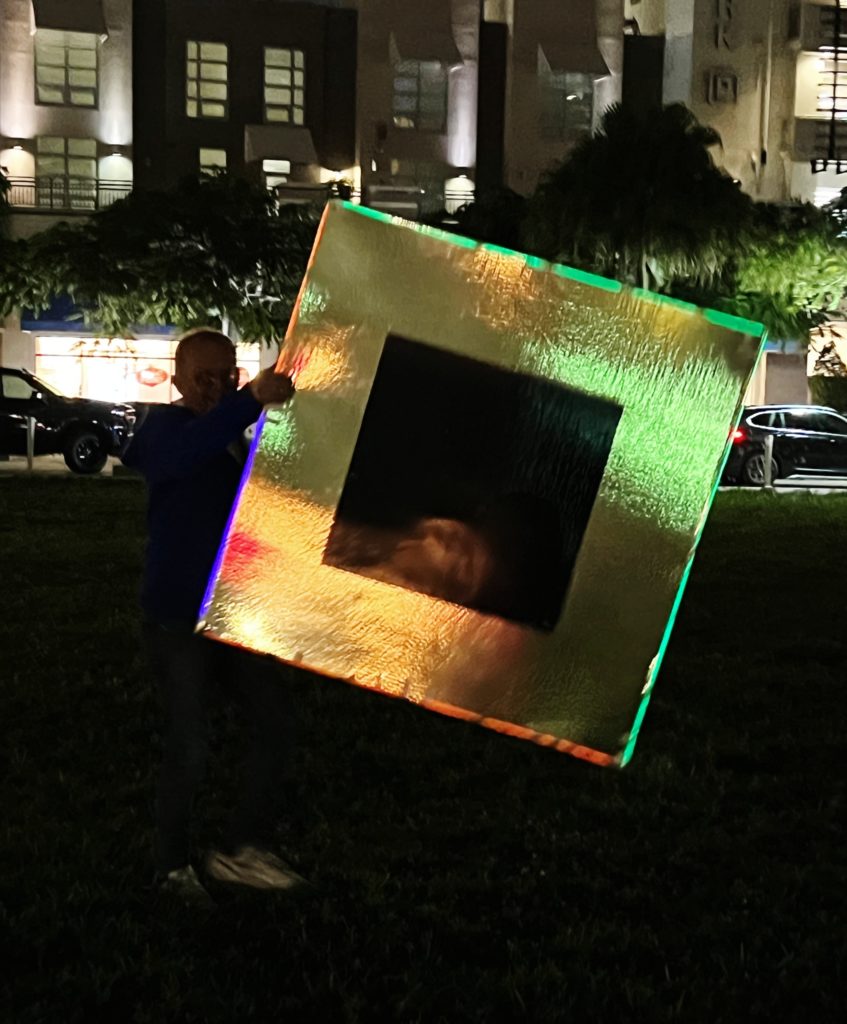
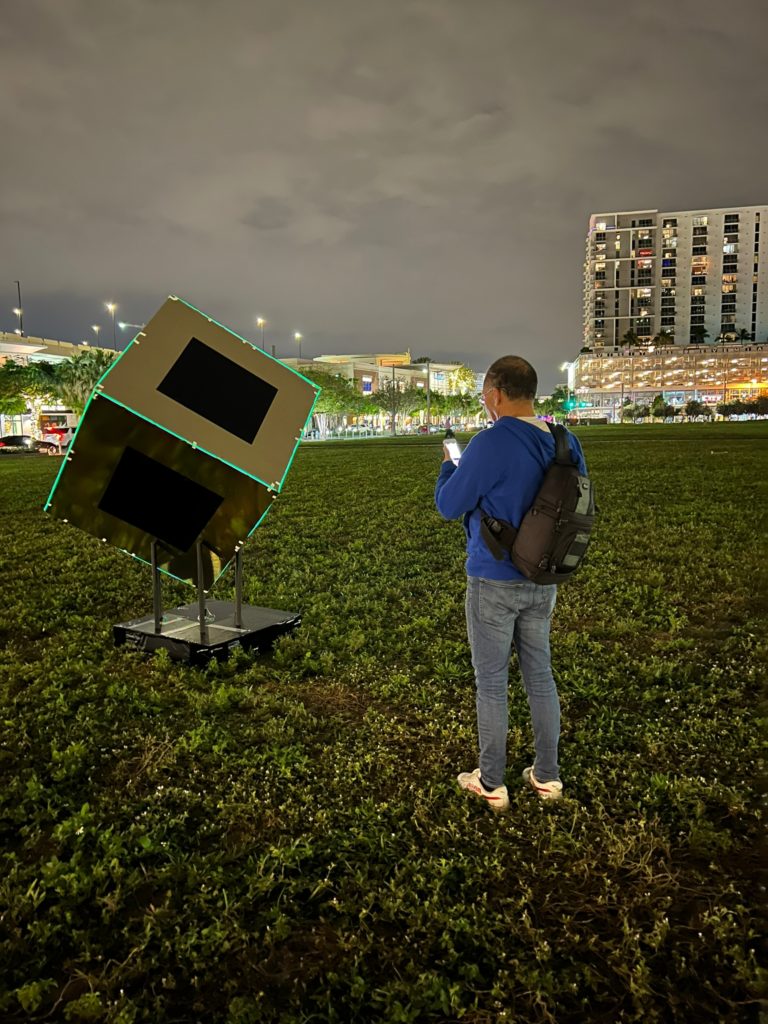
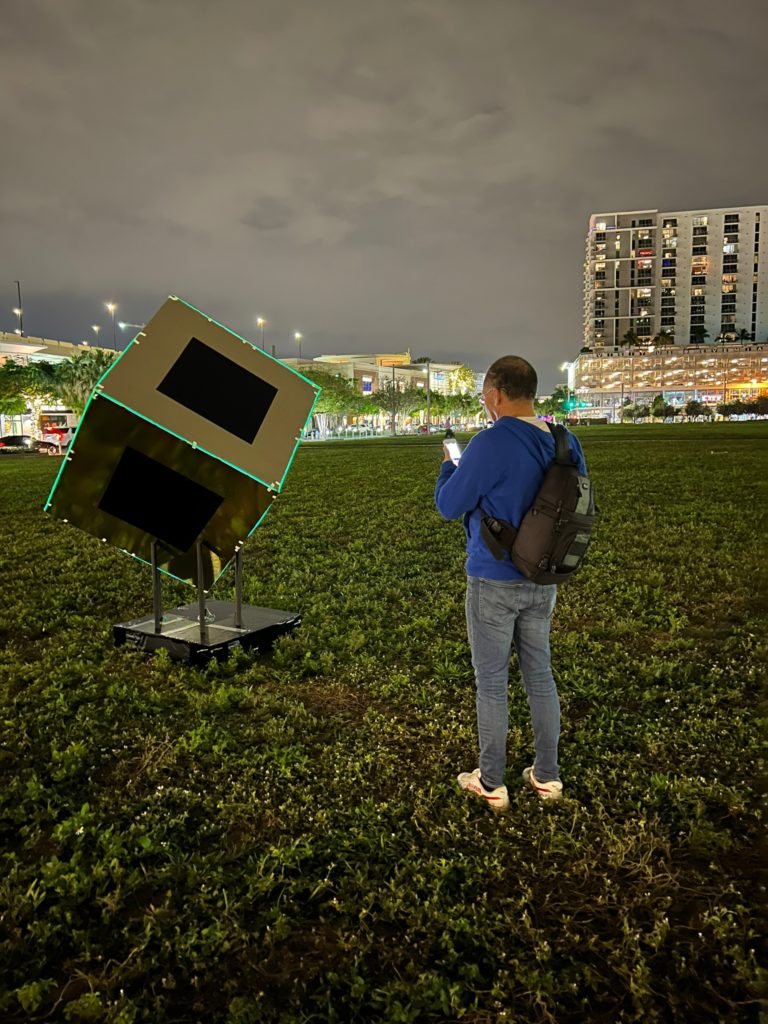
Existen grupos, como los masones, antiguos y revestidos de un secretismo, atractivo para el común de las personas, que poseen gran información digna de conocerse; y es leyendo en algunas publicaciones que he podido hallar referencias al cubo y me permito compartirles, pensando que quizá te pueda interesar.
Parte de la información que aquí transcribo, la obtuve por el libro “El Simbolismo Francmasónico” y el Diccionario Masónico, donde se hace una síntesis de la ciencia masónica, su filosofía, leyendas, mitos y símbolos y del cual extraigo las siguientes citas:
La piedra angular de un edificio debe tener sus superficies completamente cuadradas, a fin de que los muros que sobre ella se levanten no se desvíen de la línea vertical, que es lo único que puede dar fuerza y proporción al edificio. Con las superficies perfectamente cuadradas es, como cuerpo sólido, un cubo perfecto.
Se sabe que la escuadra y el cubo son dos símbolos importantes y significativos. La escuadra es el emblema de la moralidad y el cumplimiento estricto del deber. La palabra inglesa square significa cuadrado y también escuadra. Es así como el cuadrado, como símbolo masónico enseña “a regular la conducta con principios de moral y virtud”.
Entre los griegos, era el símbolo de la perfección y la frase “hombre cúbico y cuadrado” se empleaba para designar a un hombre intachable e íntegro. Quizás sea por eso que Aristóteles decía que “quien soporta valientemente los golpes de la adversa fortuna, conduciéndose honradamente, es un hombre verdaderamente bueno y de postura cuadrada e irreprochable”.
En el lenguaje del simbolismo, el cubo significa la verdad, sabiduría y perfección moral.
La nueva Jerusalem, del libro del Apocalipsis, es descrita con igual longitud que anchura y altura.
En los tiempos primitivos se representaban todos los dioses por medio de piedras cúbicas.
Los mitólogos paganos representaban a Mercurio o Hermes con una piedra cúbica, porque era el símbolo de la verdad. Por su parte, los israelitas dieron la misma forma al tabernáculo, dedicado a la morada de la verdad divina.
El Cubo y la Esfera
La Esfera, al poder girar libremente hacia cualquier dirección, es una forma completamente dinámica y, considerada como la más perfecta parábola material de la misma esencia divina. Origenes decía que las almas, cuando entran en el Paraíso lo hacen rodando, «pues la Esfera es el más perfecto de todos los cuerpos». Cada uno de los puntos de su superficie dista lo mismo del centro; esto ya implica regularidad y orden.
Sin embargo, al mismo tiempo existe en esta figura una paradoja, ya que la Esfera procede de la irradiación de un punto central hacia el exterior, como una explosión. Donde cada punto de la superficie no es sino un punto unido por un radio al centro, lo que, en otras palabras, quiere decir que el centro contendrá el mismo número de puntos que la superficie exterior, es decir, infinito número de ellos
En cuanto a figuras geométricas, el Cubo, se opone visiblemente a la esfera, porque siendo ésta “la más móvil de las figuras geométricas”, el Cubo sería “la más estable” de todas las formas; parece sugerir inamovilidad y, apoyado en cualquiera de sus seis caras, es el símbolo de estabilidad completa, pero también de materialidad.
El proceso de formación de un Cubo es sensiblemente diferente. Un punto en desplazamiento genera una línea recta, una línea recta, a su vez, desplazada, genera una superficie y ésta un volumen. La proyección de cada una de las caras del Cubo así constituido, marca las seis direcciones del espacio; siendo la séptima el propio Cubo de origen.
Muchos arquitectos, de diferentes culturas han tomado en cuenta estas asimilaciones. Y esta complementariedad se aprecia en las construcciones árabes tradicionales formadas por una semiesfera superpuesta a un cubo.
El Cuadrado y el Círculo, a pesar de ser figuras trazadas de diversa forma, y aun siendo opuestas en sus significados y calidades, siempre terminan por ser relacionadas entre sí. Relacionar Cuadrado y Círculo (Cubo y Esfera), equivale a reconstruir una síntesis originaria superior a cada una de las partes. Pero, si bien el problema matemático no tiene solución, no ocurre lo mismo desde el punto de vista geométrico, existiendo distintas variantes para encontrar un Cuadrado cuya superficie equivalga a la de un Círculo.
Uno de los problemas matemáticos que se han mostrado irresolubles a lo largo de los siglos es el de la cuadratura del Círculo.
¿Qué simboliza el cubo?
Uno de los símbolos más usados en nuestra sociedad, en especial el de su versión negra.
Esta simbología la podemos encontrar en todos los aspectos de la sociedad, desde la religión hasta cultura.
En la religión es bien conocido su uso en las tradiciones musulmanas y judías las cuales no se cortan a la hora de rendir pleitesía a esta forma y color particular.
La Kaaba de la Mecca es una de las representaciones más conocidas de este cubo, y la misma representa el lugar sagrado más importante del Islam, nada menos, donde es interesante observar esa especie de fenómeno hipnótico de las masas alrededor del cubo girando en la dirección de las agujas del reloj.
El cubo en la simbología masónica (Diccionario Masónico, Barcelona, 2007, pp. 151-157).
En las gestas caballerescas, Arturo demuestra su derecho innato a ser rey de toda Inglaterra extrayendo una espada clavada en una gran piedra cuadrangular situada en el altar del templo, variante de la «piedra de reyes». Este simbolismo general de la «piedra de fundamento» remite a la idea axial o «polar» y la espada a un poder viril que hay que extraer de ese principio. También puede significar liberar un poder de la materialidad.
La piedra Cúbica, en Masonería, simboliza el cumplimiento de la obra. Es el equivalente a la Sal de los alquimistas, zona neutra en la que se reencuentran y establecen las influencias opuestas que proceden del Azufre y el Mercurio. El paso de la «piedra bruta» a la «piedra cúbica» representa la elaboración que debe sufrir la individualidad para devenir «apta» a servir de «soporte» a la realización iniciática. Es la «obra al blanco» alquímica.
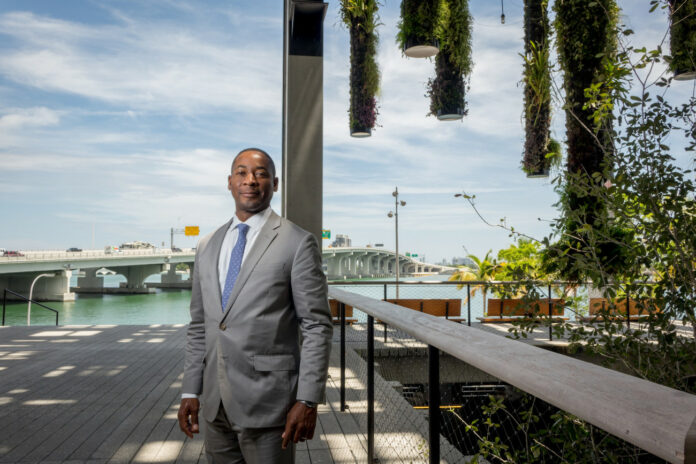
Franklin Sirmans, Director at Pérez Art Museum Miami
Franklin Sirmans is the director of the Pérez Art Museum Miami (PAMM). Prior to taking his position at PAMM, Sirmans was Terri and Michael Smooke Department Head and Curator of Contemporary Art at the Los Angeles County Museum of Art (LACMA) and curator of modern and contemporary art at the Menil Collection in Houston, Texas. from 2010 until 2015. At LACMA Sirmans organized Noah Purifoy: Junk Dada, Variations: Conversations in and Around Abstract Painting, and Futbol: The Beautiful Game, among many other exhibitions. From 2006 to 2010, he was Curator of Modern and Contemporary Art at The Menil Collection in Houston where he organized several exhibitions including NeoHooDoo: Art for a Forgotten Faith, Steve Wolfe: Works on Paper, Maurizio Cattelan: Is There Life Before Death? and Vija Celmins: Television and Disaster, 1964-1966. In 2009 Sirmans was awarded the Gold Rush Award by the Rush Philanthropic Arts Foundation, he was the winner of the 2007 David C. Driskell Prize, and artistic director of Prospect.3 New Orleans from 2012-2014. He has mounted exhibitions as an independent curator at museums in Europe, Asia and the U.S., including the Bronx Museum of the Arts, Comune di Milano in Italy and the Museum Villa Stuck in Munich.
Some of his notable projects include “Basquiat” (Brooklyn Museum; Museum of Contemporary Art, Los Angeles; and the Museum of Fine Arts, Houston; 2005); “Make it Now: New Sculpture in New York” (Sculpture Center, 2005); “One Planet Under a Groove: Contemporary Art and Hip Hop” (Bronx Museum of Art; Spelman College Museum of Fine Art, Atlanta; and the Walker Art Center, Minneapolis; 2001-2003); and “Ralph Bunche: Diplomat for Peace and Justice” (Queens Museum of Art, 2004).
He has also been a curatorial advisor at PS 1 since February of 2006, and has organized exhibitions such as “Bearable Lightness” and solo presentations of artists including SunTek Chung, Philip Maysles, Curtis Mitchell and Senam Okudzeto. He has taught art history most recently at both Maryland Institute College of Art and Princeton University.
A former U.S. editor of “Flash Art” and editor-in-chief of “ArtAsiaPacific,” Mr. Sirmans has written widely on art and culture for such publications as “Art in America,” “The New York Times,” “Essence” and “Newsweek International.” Sirmans has also contributed monographic essays for catalogues on artists including Kevin ei-Ichi DeForest, Kehinde Wiley, Gajin Fujita, Wendell Gladstone and David Hammons.
Born in New York City in 1969, Sirmans was raised in Harlem, Albany and New Rochelle, New York. He earned English and Art History degrees from Wesleyan University, where he wrote his honors thesis on the artist Jean-Michel Basquiat.
Franklin Sirmans is an independent curator, writer, editor and lecturer based in New York City. A former U.S. Editor of Flash Art and Editor-in-Chief of Art Asia Pacific magazines, Sirmans has written for several journals and newspapers on art and culture, including The New York Times, Newsweek International, Art in America, ArtNews, Grand Street and Essence Magazine.
He is cocurator of Basquiat (2005-2006: Brooklyn Museum, Los Angeles Museum of Contemporary Art and the Museum of Fine Arts, Houston). He was cocurator of Make It Now: New Sculpture in New York at Sculpture Center; One Planet Under A Groove: Contemporary Art and Hip Hop (2001-2003: Bronx Museum of Art, Spelman College Art Gallery, Atlanta, the Walker Art Center, Minneapolis and Villa Stuck, Munich, Germany); and Ralph Bunche: Diplomat for Peace and Justice at the Queens Museum of Art (2004). He has also curated several other exhibitions including Americas Remixed in Milan, Italy; Mass Appeal in Ottawa, Montreal, Halifax and Sackville, Canada; and annual exhibitions for Atlanta (2003), Baltimore (2005) and Los Angeles (1999). Sirmans has also organized several exhibitions for commercial galleries including A Moments Notice in Houston, Things Fall Apart in Chicago, Notorious Impropriety in Boston, Color Theory in Torino, and New Video in Seoul; and New Wave, The Color of Sound, Summer Jam,Retroactive I and Rumors of War in New York.
Sirmans has edited numerous catalogues on contemporary art including Transforming the Crown: African, Asian and Caribbean Artists in Britain, (University of Chicago Press), Jean-Michel Basquiat (Tony Shafrazi Gallery), Freestyle and Black Belt at The Studio Museum in Harlem, and contributed to Gary Simmons at the MCA, Chicago and Double Consciousness: Black Conceptual Art Since 1970 (Contemporary Art Museum, Houston), in addition to several monographs on artists including Edgar Arceneaux, Monika Bravo, Iona Brown, Mia Enell, Manuel Esnoz, Charles Gaines, Kojo Griffin, Dario Robleto and Kehinde Wiley.
Sirmans was the 2005 Maryland Art Place Critic-in-Residence and an instructor at the Maryland Institute College of Art and Princeton University.
Born in New York City (Queens), Sirmans was raised in Harlem, Albany and New Rochelle, New York. He attended Manhattan Country School, Albany Academy and New Rochelle High School before receiving a B.A. in Art History and English from Wesleyan University (1991).
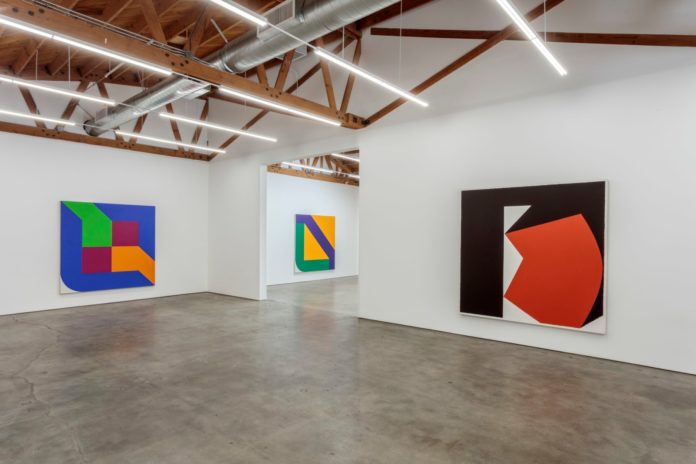
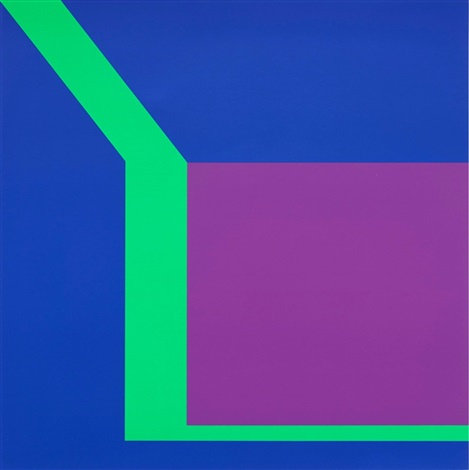
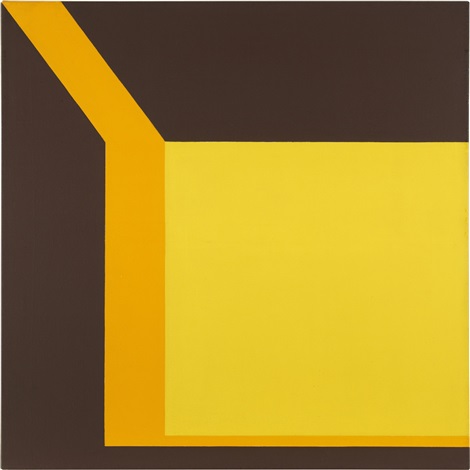
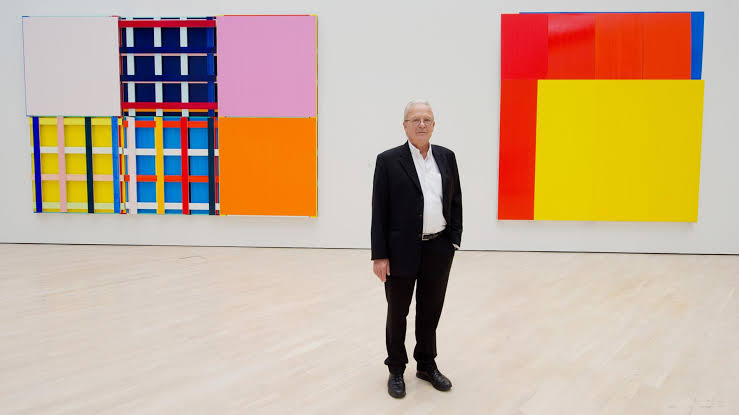
Installation View of Georg Karl Pfahler, Hard Edge | 1963 -1984, February 18 - March 19, 2022
Georg Karl Pfahler, German, 1926–2002
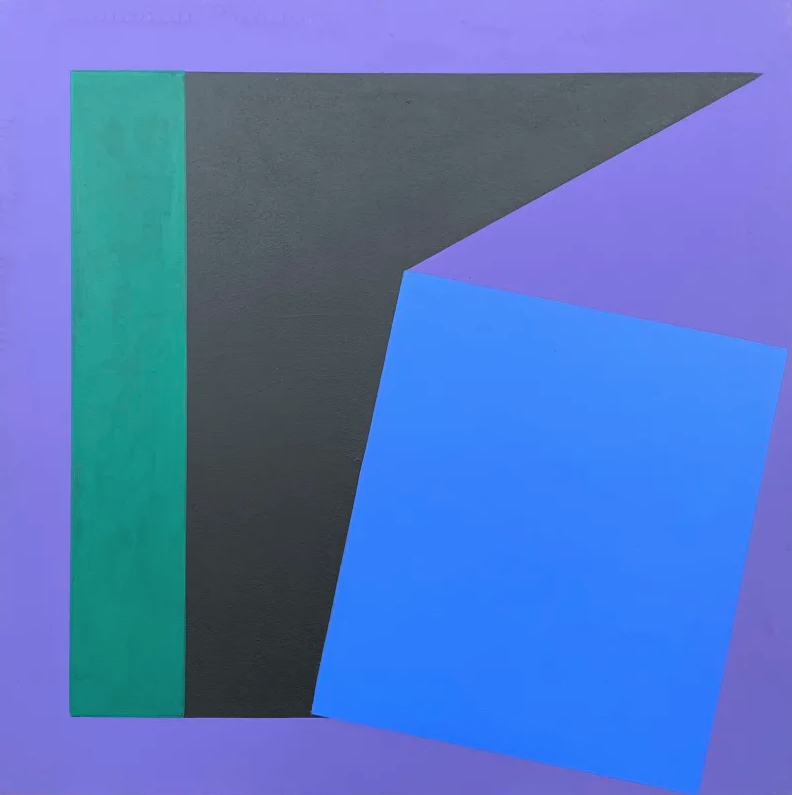
Pfahler dedicated his entire career to the investigation of the relationship between colour, shape and space, an objective he steadfastly pursued.
‘Colour has a value of its own, colour is weight, colour is quality, colour possesses an inherent limitation, of itself, through itself, through other colours, colour creates space, colour is form and space’ – Georg Karl Pfahler, 1968.
Rising to prominence in the early 1960s as one of the first hard edge painters in Europe, known for his vibrant and colourful works, Georg Karl Pfahler was an internationally recognised artist who represented Germany at the Venice Biennale in 1970 alongside Günther Uecker, Heinz Mack, and Thomas Lenk; and at the São Paulo Biennale in 1981. Pfahler dedicated his entire career to the investigation of the relationship between colour, shape and space, an objective he steadfastly pursued until his death in 2002. In doing so he was—and remains to this day—at the forefront of the colour field painting movement.
Pfahler was born in 1926 and studied at the Kunstakademie Stuttgart under Willi Baumeister, graduating in 1954. Influenced by the tradition of European Art Informel, he quickly adopted an innovative abstract geometric painting style, with block-like forms on crisp backgrounds appearing on his canvasses as early as 1962. It was then that Pfahler continued to reduce his style even further to exclusively focus on the dynamic between shapes, and to examine the deeper relationships between space and colour. In doing so Pfahler became a thought leader and one of the first European artists to simultaneously work in action, colour field, and hard edge painting—styles that his American contemporaries like Frank Stella, Ellsworth Kelly, Kenneth Noland and Leon Polk Smith, among others, explored as well.
In the late 1970s Pfahler’s work began to take increasingly gestural forms, introducing sweeping blocks of coloured shapes set against minimalistic black or white backgrounds, a stylistic preoccupation that continued to influence his work throughout the 1980s and into the early 1990s. By the late 1990s Pfahler’s compositions had progressed into a new and final direction, where a greater number of forms, layered on top of each other almost like a collage of coloured shapes are distributed across the surface of the canvas, adding a new and never before seen spatial dimension to his paintings.
Georg Karl Pfahler was a leading German painter known for his Hard-Edge abstractions. The artist dedicated his entire career to the investigation of the relationship between color, shape, and space, and was considered at the forefront of the Color Field movement. “In Pfahler’s painting the color has both a displacing and a constitutive function, which bewilders and stimulates the observer to critical reflection,” Peter Beye once wrote of his work. Born in 1926, Pfahler studied at the Kunstakademie Stuttgart under Willi Baumeister, graduating in 1954. Initially working as a sculptor, it was Baumeister who encouraged Pfahler to focus on painting. Influenced by the tradition of European Art Informel, he quickly began to adopt an innovative abstract geometric painting style by the early 1960s. Pfahler continued to reduce his style even further to exclusively focus on the dynamic between shapes, and to examine the deeper relationships between space and color. By the mid 1960s, Pfahler had exhibited alongside artists such as Frank Stella, Ellsworth Kelly, and Kenneth Noland in shows such as “Signale” at the Kunsthalle Basel, Switzerland. In 1966, Pfahler had his first show in the United States at Fischbach Gallery, curated by Barnett Newman. Pfahler went on to represent Germany alongside Gunther Uecker, Heinz Mack, and Kaspar Thomas Lenk at the Venice Biennale in 1970. In the decades that followed, Pfahler continued to experiment with the constraints and boundaries of painting. He died on January 6, 2002 in Emetzheim, Germany. Today, the artist’s works are held in the collections of The Museum of Modern Art in New York, the Städel Museum in Frankfurt, and the Neue Nationalgalerie in Berlin, among others.
BIOGRAPHY
Rising to prominence in the early 1960s as one of the first hard edge painters in Europe, known for his vibrant and colorful works, Georg Karl Pfahler was an internationally recognized artist who represented Germany at the Venice Biennale in 1970 alongside Günther Uecker, Heinz Mack, and Thomas Lenk; and at the São Paulo Biennale in 1981.
Pfahler was born in 1926 and studied at the Kunstakademie Stuttgart under Willi Baumeister, graduating in 1954. Initially working as a sculptor, it was Baumeister who encouraged Pfahler to focus on painting. Influenced by the tradition of European Art Informel, he quickly simplified his paintings to adopt an innovative abstract geometric painting style, with block-like forms on crisp backgrounds appearing on his canvasses as early as 1962.
It was then that Pfahler continued to reduce his style even further to exclusively focus on the dynamic between shapes, and to examine the deeper relationships between space and color. In doing so Pfahler became a thought leader and one of the first European artists to simultaneously work in action, color field, and hard edge painting—styles that his American contemporaries like Frank Stella, Ellsworth Kelly, Kenneth Noland, and Leon Polk Smith, among others, explored as well.
By the mid 1960s Pfahler had arrived on the international stage. Exhibitions such as “Signale” in Basel, Switzerland in 1965 contrasted color field artists from Europe and the United States. Pfahler showed his work alongside Al Held, Elsworth Kelly, Ken Noland, and Jules Olitski, and the critically acclaimed show cemented his status as a leading European artist of his generation. In 1966 Pfahler had his first show in the United States, where Barnett Newman curated his exhibition at Fischbach Gallery in New York. Then, at the Venice Biennale in 1970, Pfahler created one of the highlights of his career to much acclaim; a walkable structure that allowed visitors to physically experience the shape, color and spacial context that is central to his work.
In the late 1970s Pfahler’s work began to take increasingly gestural forms, introducing sweeping blocks of colored shapes set against minimalistic black or white backgrounds, a stylistic preoccupation that continued to influence his work throughout the 1980s and into the early 1990s. By the late 1990s Pfahler’s compositions had progressed into a new and final direction, where a greater number of forms, layered on top of each other almost like a collage of colored shapes are distributed across the surface of the canvas, adding a new and never before seen spacial dimension to his paintings.
Pfahler dedicated his entire career to the investigation of the relationship between color, shape and space, an objective he steadfastly pursued until his death in 2002. In doing so he was—and remains to this day—at the forefront of the color field painting movement, creating an impressive depth of work that is represeneted in several important private and public collections around the world.
“If you want to do something, to stay alive, you have to think of something radical.”
Minimalist Abstract Art
Imi Knoebel, purist explorations of form, color, space, material and support have made him an important and formative voice in 20th-century Minimalist abstract art.
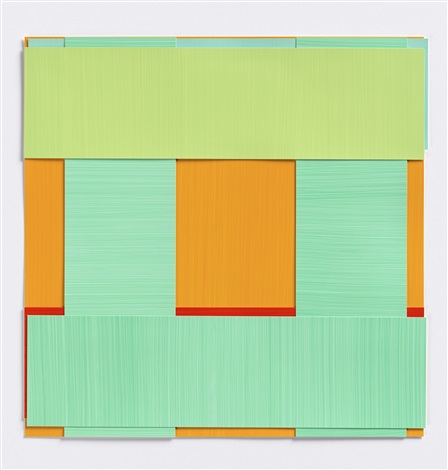
Knoebel was born in Dessau, Germany, in 1940. Minimalist hybrids of painting and sculpture explore relationships between color and structure. Knoebel’s nonrepresentational works innovate on the modernist ideas and styles of Joseph Beuys, Kazimir Malevich, and the Bauhaus; the artist is interested in seriality, spare geometries, reductive color, and the use of industrial materials such as Masonite. Knoebel studied under Beuys at the Kunstakademie Düsseldorf and under László Moholy-Nagy at the Werkkunstschule Darmstadt; he has exhibited in Berlin, New York, Paris, Zürich, Tokyo, London, Vienna, and Rome. His work belongs in the collections of the Essl Museum, the Kunstsammlung Nordrhein-Westfalen, the Museo Reina Sofía, the Art Institute of Chicago, and the Museum of Modern Art. While Knoebel is best known for his sculptural paintings, his practice also involves drawing, photography, projections, and installation. His work has sold for six figures at auction.
I thought: everything has been done already. Yves Klein has painted his canvas blue, Lucia Fontana has cut slashes into his. What’s left? If you want to do something, to stay alive, you have to think of something at least as radical.
Knoebel employs a pared-down, formal vocabulary, his artistic practice is remarkably varied, encompassing painting, sculpture, drawing, photography, projections and installations. Knoebel’s oeuvre is dominated by large-scale, modular shapes and commanding color relationships, devoid of metaphor and allusion. Although Knoebel employs a pared-down, formal vocabulary, his artistic practice is remarkably varied, encompassing painting, sculpture, drawing, photography, projections and installations.
Imi Knoebel
Imi Knoebel drew formative influence from early Modernism in his consistent return to the notion of pure perception through the exploration of form and color. While his early pieces were black and white, as in the series “Linienbildern” (Line Paintings) (1966-69), he began to explore vibrant, saturated color in 1974 with his friend and classmate Blinky Palermo, to whom he would dedicate “24 Farben für Blinky” (“24 Colors for Blinky”) (1977), a series of brightly colored irregular shapes.
Imi Knoebel lives and works in Düsseldorf. He was the subject of solo museum exhibitions at Museum Haus Konstruktiv, Zurich, Switzerland (2018); Museum Haus Lange und Haus Esters, Krefeld, Germany (2015); Kunstsammlung Nordrhein-Westfalen, K21, Düsseldorf, Germany (2015); Kunstmuseum Wolfsburg, Germany (2014); Museum der bildenden Künste, Leipzig, Germany (2011); Gemeentemuseum, The Hague (2010); Neue Nationalgalerie, Berlin (2009); Deutsche Guggenheim, Berlin (2009); Dia:Beacon, New York (2008); Hamburger Kunsthalle, Germany (2004); Kestner Gesellschaft, Hannover, Germany (2002); Institut Valencià d’Art Modern, Valencia, Spain (1997); Kunstmuseum Luzern, Switzerland (1997); Haus der Kunst, Munich, Germany (1996); and Stedelijk Museum, Amsterdam (1996). His work has been collected by prestigious public and private collections worldwide.
From 1962 to 1964, Knoebel attended the Werkkunstschule in Darmstadt, where he took courses in structural design and constructive composition, according to the ideas of the Bauhaus artists Johannes Itten (Swiss, 1888–1967) and Lászlo Moholy-Nagy (Hungarian, 1885–1946). There, he met Imi Giese in 1964. Together, the two transferred to the Düsseldorfer Kunstakademie, where they both took a class with Joseph Beuys (German, 1921–1986). Knoebel began to create analytical works, with an interplay of colors and forms. Together with a few fellow students, he formed a Minimalist Art movement.
Knoebel initially dealt mainly with line images, light projections, and white images, and took a strong reductionist position. Beginning in 1974, he began to use color. In the same decade, he experimented with superimposed colored wood and aluminum panels and slats, which he used in certain spatial relations to each other, creating scale sculptures.
Knoebel was awarded an honorary doctorate from the Friedrich Schiller University Jena in 2006. In 2011, he created several stained glass windows for the Reims Cathedral. He is the recipient of numerous art awards, and his works can be seen in exhibitions around the world.
Imi Knoebel Face 2 Ed (2002–2013 Photo: courtesy Galerie Thomas Modern
Countering romanticism, the central tradition of German art, Knoebel revives the purity of utopian modernism, using pared down forms of constructivism to take his painting to a zero point. He attempts expression without representation or the restrictions of ideological painting programs. The goal is to purify and cleanse the present from the past and to start again, relying on new materials and aesthetic forms to move forward. Painters who came of age in the postwar era dealt with a fresh cultural memory of the ascendency and fall of German nationalism, West Germany’s rapid economic recovery and expansion after the demise of fascism, and the division and subsequent union of East and West Germany during the communist era. Knoebel’s approach was to look for the basic roots of art, which he felt were not in rhetoric but in things, in the simple interaction between humans and the essential conditions of their world
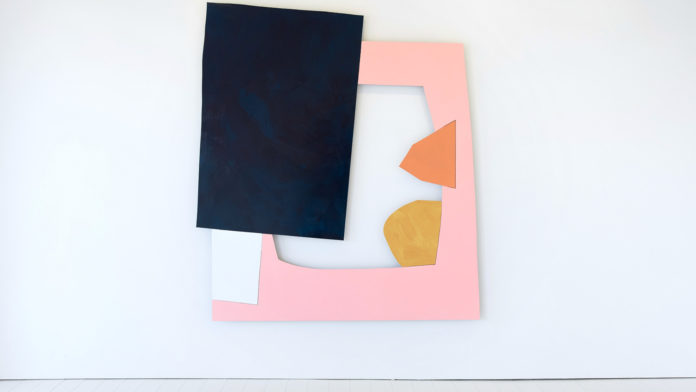
The Latinists series, 1987, clearly shows many of Knoebel’s concerns and interests. The forms, like those of American minimalism, are rudimentary (squares, rectangles, parallelograms) as are the materials of fiberboard, unused stretcher bars, and flat industrial white paint. Unlike American minimalism, however, Knoebel’s intention has nothing to do with finding a rational, positivist center by which to make art. Instead, his spare starting points become the criteria from which Knoebel’s intuitions take over, leading him to arrange his humble materials in ways that appeal to his aesthetic experiences and his perceptions of beautiful composition. The results are paintings that play into the realm of sculpture, retaining the basic figure/ground and picture plane conditions of a painting but extending off the wall and into the space, activating the room.
Biography
Knoebel has exhibited widely throughout his career, including solo shows at Haus Der Kunst in Munich (1996), Stedelijk Museum in Amsterdam (1996) and Neue Nationalgalerie in Berlin (2009). In 2011, the historic Reims Cathedral inaugurated a series of six monumental stained glass panes created by Knoebel on the occasion of its 800th anniversary. His work can also be found in the public collections of the Museum of Modern Art in New York, Dia:Beacon in Beacon, New York, the Museum of Contemporary Art, Los Angeles, Museo Reina Sofia, Madrid, Hamburger Bahnhof, Berlin, and the Musée National d’Art Moderne, Paris. Knoebel currently lives and works in Düsseldorf, Germany.
Education
1964 – 1971 Academy of Arts, Düsseldorf, Germany
Awards
2016 Officier des Arts et des Lettres, Haus der Stiftungen, Düsseldorf, Germany
2011 Kythera-Prize, Düsseldorf, Germany
2008 Glass Windows, Cathedral Reims, France
2006 Honorary doctor of the Friedrich Schiller Universität, Jena, Germany
Solo Exhibitions
2022
Galerie Jochen Hempel, Leipzig, Germany
2021
Dia:Beacon, New York, NY, USA
Galerie Bärbel Grässlin, Frankfurt am Main, Germany
2020
Galerie Bärbel Grässlin, Frankfurt am Main, GermanyWhite Cube, London, UK
2019
Galerie Heinrich Ehrhardt, Madrid, Spain
Jahn und Jahn, Munich, Germany
Patrick De Brock Gallery, Knokke, Belgium
Galerie Fahneman, Berlin, Germany
Galerie Thaddaeus Ropac, Paris, France
Kewenig, Berlin, Germany
2018
Museum Haus Konstruktiv, Zurich, Switzerland
Galerie Christian Lethert, Cologne, Germany
2017
New Works, Galerie Thaddaeus Ropac, Salzburg, Austria
Liaison Astéroïde, Galerie Thaddaeus Ropac, Paris, France
Red Yellow Blue, Museum der Bildenden Künste, Leipzig, Germany
Imi Knoebel – Fernand Léger: une rencontre, Musée National Fernand Léger, Biot, France
2015
Linienbilder 1966-68, Villa Griesebach, Berlin, Germany
Triller, Galerie Heinrich Ehrhardt, Madrid, Spain Anima Mundi, Galerie Thomas Modern, Munich, Germany Malewitsch zu Ehren, K21 Ständehaus, Düsseldorf, GermanyKernstücke, Museum Haus Esters, Krefeld, Germany Linienbilder 1966-68, Villa Grisebach, Düsseldorf, Germany Inside the White Cube, White Cube (Bermondsey), London, UK Recent Works, Patrick De Brock Gallery, Knokke, Belgium Galerie Bärbel Grässlin, Frankfurt am Main, GermanyWeiß – Schwarz, Galerie Fahnemann, Berlin, Germany
Inauguration of Imi Knoebel’s glass windows for the Notre-Dame Cathedral in Reims (May 11, 2015), Reims, France
2014
Rosa Ort, Galerie Kewenig, Berlin, Germany
Position, Galerie Bernard Jordan, Zürich, Switzerland Arbeiten aus den Jahren 1970-2014, Galerie Fahnemann, Berlin, Germany
Imi Knoebel, Works 1966 – 2014, Kunstmuseum Wolfsburg, Wolfsburg, Germany Raum 19 IV, Galerie Christian Lethert, Cologne, Germany
Position, Catherine Putman Galerie, Paris, France
Mahlzeit, Galerie Bärbel Grässlin, Frankfurt am Main, Germany
2013Das und Das, Galerie Thaddaeus Ropac, Salzburg, Austria
Galerie von Bartha, S-chanf, Switzerland
LUEB, Barbel Grasslin, Frankfurt am Main, Germany
Position, Jordan/Seydoux, Berlin, Germany
Eine Ausstellung, Parkhaus, Düsseldorf, Germany
Akira Ikeda Gallery, Tokyo, Japan
Galerie Hans Strelow, Düsseldorf
2012
Hirschfaktor, Zentrum für Kunst und Medientechnologie, Karlsruhe, Germany
The Third Room, Kunsthalle Düsseldorf, Düsseldorf, Germany
Vera Munro Gallery, Hamburg, Germany
Galerie Clemens Fahnemann, Berlin, Germany
Galerie Hans Strelow, Düsseldorf, Germany
24 Colors – For Blinky, Dia:Beacon, Dia Art Foundation, NY, USA
2011
Werke aus der Sammlung Schaufler, Schauwerk Sindelfingen, Sindelfingen, Germany
Rosenkranz Kubus X, Museum der bildenden Künste, Leipzig, Germany
Kartoffelbilder, Galerie nächst St. Stephan, Vienna, Austria
Design of the gothic windows for the Cathedral of Reims, Reims, France
Weiss Schwarz, Galerie Bärbel Grässlin, Frankfurt
2010
Weiss – Schwarz, Galerie Thaddaeus Ropac, Salzburg, Austria
Mary Boone Gallery, New York, NY, USA
Der Deutsche, Giacomo Guidi Arte Contemporanea, Rome, Italy
Just love me, MUDAM – Musée d’art moderne grand-duc Jean, Luxembourg
2009
Ich Nicht und Enduros, Deutsche Guggenheim, Berlin, Germany
Zu Hilfe, Zu Hilfe…, Neue Nationalgalerie, Berlin, Germany
Werke aus der Sammlung Siegfried und Jutta Weishaupt, Kunsthalle Weishaupt, Ulm, Germany
Joseph Beuys and His Students – SSM – Sakip Sabanci Müzesi, Istanbul, Turkey
Galerie Fahnemann, Berlin
7 x 14 – Jubiläumsausstellung, Staatliche Kunsthalle Baden-Baden, Germany
2008Concept Space, Gunma, Japan
24 Colors – for Blinky, Dia:Beacon, Beacon, New York
Knife Cuts, Dia Art Foundation, The Dan Flavin Art Institute, Bridgehampton, New York
2007
Imi Knoebel – Werke 1966-2006, Wilhelm Hack Museum, Ludwigshafen, Germany
Anthony McCall and Imi Knoebel, San Francisco Museum of Modern Art, San Francisco, CA, USA
Galerie St. Johann, Saarbrücken, Germany
Amor intellectualis, Galerie Hans Strelow, Düsseldorf, Germany
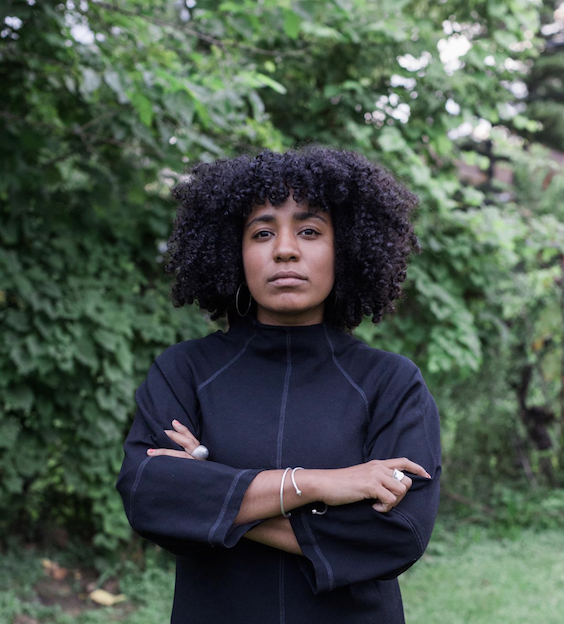
Jova Lynne is a multi-disciplinary artist born and raised in New York City, of Jamaican and Colombian heritage. Lynne is interested in the parallels between fictional, historical and personal archives in identity development. Lynne seeks to subvert anthropological practice in utilizing lens, sculpture and performative practices. She is interested in the cognitive dissonance one experiences when navigating material, text and media-based archive specifically as it relates to Black culture. Lynne completed a Masters of Fine Arts in Photography at Cranbrook Academy of Art in May 2017. Since then Lynne has been based out of Detroit, MI, and has exhibited widely including institutions such as Crystal Bridges Museum of American Art, Detroit Institute of Art and Redbull Arts. Lynne is a grantee from various foundations which has supported her work in media and social practice based projects in Kingston, Jamaica and Berlin, Germany in addition to her work in the United States.
Education Masters of Fine Arts, Photography, Cranbrook Academy of Art, May 2017 Bloomfield Hills, MI Bachelor of Arts, Film/Video, Hampshire College, May 2010 Amherst, MA
Solo Exhibitions 2022 Soon Come, Simone DeSousa Gallery, Video, Photography, Sculpture Detroit, MI 2021 Hopes Garden, Red Bull Arts Detroit , Video, Photography, Sculpture Detroit, MI 2020 The Tourist, Neon Heater, Video Installation Findlay, OH 2019 A Cathartic Exercise in Rage, Vox Populi, Solo Exhibition, Video, Photography and Sculpture Philadelphia, PA 2018 Soft Thrones, University of Toledo Art Museum, Solo Exhibition, Video and Sculpture Toledo, OH 2018 Paradise Travel Company, Pops Packing, Solo Exhibition, Performative Installation Detroit, MI 2015 CONVERGE, Yerba Buena Center for the Arts, Performance San Francisco, CA
Group Exhibitions 2023 State of the Art II, Currier Museum of Art Keen, New Hampshire 2022 State of the Art II, MOCA Jacksonville Jacksonville, FL 2022 State of the Art II, Art Museum of South Texas Corpus Christi, TX 2022 Friction, SOIL Seattle, WA 2022 Untitled, Blanc Gallery Chicago, IL 2021 Queering Cream City, SAVE ART SPACE Milwaukee, WI 2021 With Eyes Open, Cranbrook Art Museum Bloomfield Hills, MI 2021 Unraveled. Restructured. Revealed, Trout Museum of Art Appleton, WI 2020 State of the Art II, Crystal Bridges Museum of American Art Bentonville, AR 2019 Breaching the Margins, Urban Institute for Contemporary Art, Sculpture Grand Rapids, MI 2019 BEACON, Torrance Art Museum, Video Torrance, CA 2019 MIND BODY, Petcoke Gallery, Video, Detroit, MI 2019 To Bring You My Love, The Neon Heater, Video and Photography Findlay, OH 2018 Tourists Coconut, Stroboskop Art Space, Video Warsaw, Poland 2018 Provisions, Caribbeing House, Sculpture Brooklyn, NY 2018 A Welcoming, Brooklyn Museum, Sculpture Brooklyn, NY 2018 Remedios The Beauty, G-CAAD Gallery, Video St.Louis, MO 2018 Sugar Sugar, Public Pool, Video and Sculpture Detroit, MI 2017 SIDEWALK Performing Arts Festival, Collaborative Performance Detroit, MI 2017 BEACON, Beacon Sacramento, Video Projection Sacramento, CA 2017 Graduate Degree Show, Cranbrook Museum of Art, Photo Installation Bloomfield Hills, MI 2017 Walking With Serpents, Forum Gallery, Sculptural Installation Bloomfield Hills, MI 2017 Stick it to the WALL, Forum Gallery, Photography Bloomfield Hills, MI 2016 CONTEXT, Rocks Box Contemporary Art, Sculpture Pontiac, MI 2016 FOUR WOMEN, Studio 14, Sculpture Bloomfield Hills, MI 2015 B.U.F.U, Forum Gallery, Cranbrook Academy of Art, Video Installation Bloomfield Hills, MI
Workshops and Residencies 2022 Anderson Ranch Arts Center Artist Fellow Snowmass Village, CO 2020 Halcyon Arts Lab Fellow Washington, DC 2020 Mass MoCA, Artist-in-Residence North Adams, MA 2020 Vermont Studio Center, Artist-in-Residence Johnson, VT 2019 ACRE, Artist-in-Residence Wisconsin, USA 2019 The Pennsylvania State University School of Visual Arts, Artist-in-Residence University Park, PA 2017 Ox-Bow School of Arts and Artist Residency, Fall Artist-in-Residence Saugatuck, MI 2016 SO((U))L HQ, Artist-in-Residence Kingston, Jamaica 2016 Talking Dolls, Artist-in-Residence Detroit, MI 2015 Advanced Mold Making II, The Crucible Oakland, CA 2014 Adobe, Media Professionals Development Training San Francisco, CA
Fair Presentations 2021 Printed Matter Art Book Fair 2021 New Art Dealers Alliance, Miami Art Week, Simone Desousa Gallery, Photography 2020 New Art Dealers Alliance Presents, Simone Desousa Gallery, Photography and Video Installation International Presentation
Selected Presentations 2021 University of Illinois, Photograph as Archive Ann Arbor, MI 2020 University of Michigan, Unlearning Failure in Photographic and Performance Practice Ann Arbor, MI 2020 Six Feet Apart, Lens Based Performance with Jova Lynne Johnson, VT 2019 Wayne State University, Enduring Archives with Jova Lynne Detroit, M 2019 Cranbrook Academy of Art, Enduring the body-Enduring Performance with Jova Lynne Detroit, MI 2019 Conversations with the Curator Detroit, MI 2018 New Art Dealers Alliance, In Conversation with Tyree Guyton Miami, FL 2018 Sculpture X, Notions of Disruption Toledo, OH 2018 Wayne State University, Performing Identities Detroit, MI 2018 Sculpture Center, Navigating the Art World Cleveland, OH 2018 College of Creative Studies, TALK: JOVA LYNNE Detroit, MI 2016 Detroit Institute of Arts, In Conversation with Jova Lynne and Njia Kai Detroit, MI 2013-16 Allied Media Conference, The Black Survival Mixtape, Artivism as Power Detroit, MI 2015 Market Street Prototyping Festival, Intersections Between Art and Activism San Francisco, CA 2014 Institute for the Future, Open Cities Festival, Youth Cities for the Future San Francisco, CA 2013 Next is Now, Video Art and Cultural Exploration San Francisco, CA
Selected Grants and Awards 2019 Knight Foundation, Knight Arts Challenge, Grant Recipient Detroit, MI 2017 Global Arts Fund, Astraea Foundation, Grant Recipient New York, NY 2016 Detroit Narrative Agency, Grant Recipient Detroit, MI 2016 American Association of University Women, Grant Recipient Washington D.C 2015 Cranbrook Academy of Art Merit Scholarship Bloomfield Hills, MI 2013 Center for Cultural Innovation, Next Generation Art Professionals, Grant Recipient San Francisco, CA 2011 The New York Foundation, Grant Recipient New York, NY
Bibliography 2020 Jova Lynne’s Majestic Portraits, October 2020 Published by The Detroit News 2020 Highlighting Detroit’s Invisible Artists: Art Workers, August 2020 Published by HyperAllergic 2020 Hour Detroit, A weekend with Artist Jova Lynne, February 2020 Published by HOUR DETROIT Editors 2019 ArtForum, Top 6 Artists to Watch November 2019 Published by ArtForum Editors 2019 New York Times Magazine, Tyree Guyton Turned a Detroit Street Into a Museum, Why is he taking it down?, Published by M.H Miller 2019 Contemporary& Magazine, How to Give Space, Published by Olivia Gilmore 2018 HyperAllergic, Booking a Trip to the Elusive Land Called Paradise, published by Sarah Rose Sharp 2018 Document Journal, The Class and Racial Complexities of Leisure, Published by Megan Wray 2017 Refigural, Featured Artist, Issue 12. 2016 BLAC Detroit, Renaissance Before Revival, published by Taylor Renee Aldridge 2015 Mask Magazine, Premiering SUCKA FREE – Queer Visibility in Music by Anjum Aska
Memberships and Collectives 2017 BULK SPACE, Co-Founder 2016 Black Artists Meet-Up–Detroit, Co-Founder/Facilitator 2016 POST M.O.V.E Cranbrook 2015 Diversity Club-Facilitator 2015 Black Survival Mixtape, Collaborator 2014 WOAH Collective, Co-Founder – Video and Film
Selected Collections Wedge Collection Progressive Art Collection Detroit Institute of Arts Cranbrook Art Museum Private Collections*
Selected Curated Exhibitions 2020 Forethought DarkRoom Detroit, Detroit, MI 2020 ArtWORK Art Mile, Detroit, MI 2020 With or Without You: America Shylo Arts, Detroit, MI 2020 Distant Future Vermont Studio Center, Johnson, VT 2019 Crossing Night: Regional Identities x Global Context Museum of Contemporary Art Detroit, Detroit, MI 2019 Useless Utility Museum of Contemporary Art Detroit, Detroit, MI 2018 Process Museum of Contemporary Art Detroit, Detroit, MI 2018 2+2=8: Thirty Years Heidelberg Museum of Contemporary Art Detroit, Detroit, MI 2017 FOUR WOMEN Studio 14, Bloomfield Hills, MI 2015 Emergent (Eco)nomy Yerba buena Center for the Arts , San Francisco, CA 2014 Visions of An Abolitionist Future Yerba buena Center for the Arts , San Francisco, CA
Selected Professional Experience 2019-Present Museum of Contemporary Art Detroit, Susanne Feld Hillberry Senior Curator Detroit, MI 2017-2019 Museum of Contemporary Art Detroit, Ford Foundation Curatorial Fellow Detroit, MI 2017-18 Allied Media Projects, People In Arts and Education, Program Coordinator Detroit, MI 2015-16 Cranbrook Academy of Art, Department Assistant, Visiting Artist/Public Programs Bloomfield Hills, MI 2015-16 Detroit Future Schools, Teaching Artist Detroit, MI 2012-15 Yerba Buena Center for the Arts, Youth Arts and Education Manager San Francisco, CA 2012-13 Oakland Leaf, Teaching Artist Oakland, CA
Por Eduardo Planchart Licea, curador y crítico de arte
En ellas se expresa la falsa solidez de la materia, y la existencia de un tiempo relativo que se transforma según la velocidad, verdades que el desarrollo de la física se encargaría de reafirmar.
Dentro de la concepción de arte experimental que delimitaré no entenderemos únicamente aquellas manifestaciones que adhieran a sus obras materiales o técnicas industriales, pues consideramos a este un criterio excesivamente limitante que dejaría afuera tendencias netamente vanguardistas como el cubismos, futurismo, el expresionismos y el surrealismo,etc..
Por ello, asumimos dentro de la experimentalidad tendencias o artistas que develan un nuevo sentido, y una búsqueda constante que abra nuevos caminos al arte y se enfrentan a concepciones diferentes del objeto plástico, que pueden llegar incluso a liberarse del soporte material o desmaterializarlo.
No debemos dejar de lado que en el desarrollo del arte moderno y contemporáneo no se hallan eliminado elementos de la pintura:“En la pintura moderna se han difundido y practicado tanto las técnicas operativas de la línea, del claroscuro y del color que han condicionado la casi totalidad de las corrientes artísticas. Basta con pensar que muchos de los surrealistas han continuado valiéndose de ellos y que hasta la pintura informalista ha seguido siendo pintura sobre lienzo. Además muchos indicios recientes demuestran que también en el terreno del llamado arte pobre se da un revival de la pintura hecha con pincel, casi como una rebelión del hombre marcusiano contra el empleo masivo de las técnicas condicionadas por nuestra sociedad de consumo”. [1]
Este vínculo de las vanguardias artísticas con la pintura de pincel tiene una significación que se puede interpretar como expresión de una dimensión ética del arte, que se niega a perder su carácter artesanal como una forma de evitar su deshumanización, lo cual expresa algunos investigadores enfáticamente: “A pesar de las sensacionales novedades que han renovado por completo el comportamiento técnico de muchas corrientes artísticas de las últimas décadas de siglo, son muchos los artistas individuales o los movimientos pictóricos que continúan utilizando una pintura de línea, claroscuro y color.., tenemos que reconocer que incluso en el momento del triunfo de la tecnología, y en plena sociedad de consumo, sobrevive la fe humanista que espera del homo faber, del hombre artesano, la recuperación ética de la humanidad.”[2] .
Los criterios de experimentalidad que nacen con el Constructivismo Ruso y la Bauhaus se manifiesta idealmente en una conciliación entre lo artesanal y la técnica industrial que busca dar nacimiento a un nuevo humanismo e incluso la búsqueda de un arte liberado del gusto y de los criterios clásicos de belleza como se plantea en las obras de Marcel Duchamp, realizadas con técnicas artesanales.
A medida que se entre en el siglo XX, el arte empieza asumir las técnicas e instrumentos industriales, pero con criterios artesanales y humanizadores tal como se manifiesta en los Relieves y Contrarrelieves,la creación de la Bauhaus, la soldadura en las esculturas de J.V. González.
Acercarnos a todos estos movimientos nos permitirá poner en duda las afirmaciones de la posmodernidad como ruptura de un paradigma que logro trascender las barreras de la modernidad.
Estas tensiones entre se manifiestan en Pollock, su obra puede ser considerada como el límite de la pintura hecha con color, plena de humanidad, revelando visiones donde el artista a través de elementos propios de la pintura de caballete como son el óleo y el lienzo crea una nueva manera de hacer pintura dándole un nuevo giro con su “action painting”, acentuando un concepto del hacer artístico que deja en la obra la impronta del acto creativo a través de la revalorización de lo casual y lo accidental, planteando la obra como proceso, lo cual tiene sus raíces en las propuestas de Marcel Duchamp.
Podríamos afirmar que el arte se ha ido revolucionando a sí mismo, al fusionar artes diversas como la pintura la escultura, y la arquitectura en la Bahaus y el constructivismo, la fotografía en los fotomontajes y la rayografia, la acumulación de desperdicios en los ensamblajes o Mertz de K. Schwitter, los readymade dentro de la esfera del dadaísmo.
Asumen maneras diferentes de hacer arte, rompen con la bidimensionalidad incorporando la realidad a la obra creando un espacio plástico que trasciende tanto la ilusión de origen renacentista como de las multiperspectivas cubistas, disolviendo el formato rectangular, incorporando elementos y materias dispares dentro de una misma propuesta como son los desperdicios tecnológicos liberándose de las composiciones bellas y armónicas, asumir lo cotidiano al hacer artístico, son estos pasos en parte responsables de los criterios de la experimentalidad actual que surgieron desde principios de siglo.
Por tanto, entenderemos como al arte experimental asociado a la búsqueda de nuevas formas de expresión y comunicación que no se estabilizan o congelan en una convención o códigos visuales, sino que sus rasgos dominantes son la búsqueda constante e implacable que intenta plasmar una nueva concepción de la realidad y del objeto plástico.
Y entre estas categorías son de interés particular: la fusión de las artes y técnicas, incorporación de nuevas maneras de percibir y sentir la creación, lo cual está íntimamente entrelazado a roles diferentes que asume el artista y las diversas concepciones del hacer creativo que se enfatizan en la investigación con materiales y técnicas extrapictóricas que dan nacimiento a nuevos conceptos del objeto plástico y del espacio-tiempo.
Entre los movimientos que plantean un acercamiento entre estas dimensiones, creando una plástica experimental entendida como una búsqueda de nuevas formas de expresión que comunicaran un nuevo horizonte plástico, el futurismo(1909-1919), sin dudas ocupa un lugar especial.
Desde esta perspectiva lo que determinó en parte la su experimentalidad guiada por la búsqueda que se lanzó al encuentro del dinamismo de la máquina, del tiempo y el espacio mecánico -que fue negado por los antimecanismo del dadaísmo- reconciliando así el arte con la ciencia y la concepción de belleza que subyace en lo tecnológico.
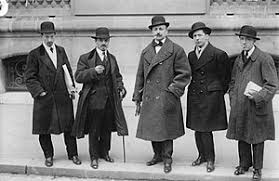
Esto se manifiesta a través de diversas propuestas (Bocciono, Carrà, Balla, etc..,) y ámbitos de la cultura, este movimiento tenía una concepción de arte integral, acentuado por un nihilismo y una ruptura con el sentido común que antecedió al dadaísmo.
Y se explicita en una manifiesto literario publicado el 20 de Febrero de 1909 en el periódico parisino “Le Fígaro”, firmado por el poeta y dramaturgo italiano Marinetti, quien provenía del ambiente de los poetas simbolistas franceses, defensores y divulgadores de las ideas anarquistas.
A este se continuaron otros textos como el Manifiesto de Pintores Futuristas (1910), Manifiesto Técnico (1910), Manifiesto de Escultura Futurista (1911).
Los aportes del futurismo rebasaron el terreno de lo plástico, habiendo determinado un estilo poético, musical, teatral y arquitectónico, involucrándose pasionalmente también en la política, de ahí su desvalorización, debido al trágico acercamiento del movimiento al fascismos y al belicismo, nconsecuencia de la irreverente agresiva que demostraron en sus manifiestos y acciones.
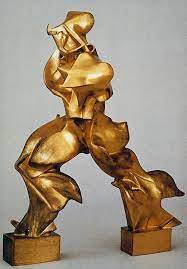
Como consecuencia de estas posiciones dos de sus más prometedores exponentes Umberto Boccioni y Antonio Sant´Elia murieron en la Primera Guerra Mundial. Esta exigencia demoledora y angustiosa por destruir el pasado y la tradición, no puede ser comprendida sino se contextualiza el movimiento en el momento histórico en que se desarrolló la cultura italiana que había sido dominada completamente por el culto al glorioso pasado, pero a pesar de la irreverencia del futurismo la negación no fue total.
La amplitud en terreno cultural de este movimiento lo señalan casi todos los investigadores del tema. Esta integración de las artes creando tendencias artística en diversos ámbitos culturales es una clara evidencia de las implicaciones de la experimentalidad futurista y de su actualidad, en el sentido de que muchos de sus logros aún tienen vigencia.
Se demuestra en este movimiento lo fructífero de una vanguardia que se plantea problemas concretos, intentando llevarlos a sus últimas consecuencias. Es este un sentido que es necesario destacar: la experimentalidad como el desarrollo de una problemática abierta que evita el cerramiento la cosificación de los lenguajes plásticos.
Tras esta búsqueda se desvelaba una visión del mundo que desmaterializó el objeto al indagar en la modificaciones generadas en los cuerpos por el movimientos y su dinámica interrelación con el ambiente, esto se manifiesta en obras de Boccioni como “Estados de Ánimo: las Despedida”, 1911; “La Fuerza de la Calle”, 1911, ambas en tela sobre óleo.
En ellas se expresa la falsa solidez de la materia, y la existencia de un tiempo relativo que se transforma según la velocidad, verdades que el desarrollo de la física se encargaría de reafirmar.
Las Vanguardias Artísticas del Siglo XX, define al futurismo como un movimiento polémico, de batalla cultural; fue un movimiento sintomático de una situación histórica; un acervo de ideas y de instintos, dentro del cual, si bien no claramente se expresan algunas exigencias reales de la nueva época: la necesidad de ser modernos, de aferrar la verdad de una vida transformada por la era técnica, la necesidad de hallar una expresión adecuada a los tiempos de la revolución industrial. El error profundo del futurismo fue no considerar la suerte del hombre en el engranaje mecánico. Sólo Boccioni, e inicialmente Carrà, se dieron cuenta de este problema.
Tuvo la influencia este movimiento del Constructivismo Ruso, lo cual es algo más que una suposición, pues Marinetti viajó a Rusia a dar varias conferencias en 1913, pero no fue bien recibido su nacionalismo belicista. En el estilo irreverente, negador y contradictorio de exponer sus postulados el futurismo se anticipo a Dada. Se establecieron los fundamentos de esta nueva estética, y de su íntima relación con la tecnología en sus manifiestos:
“4.- Nosotros afirmamos que la magnificencia del mundo se ha enriquecido con una belleza nueva: la belleza de la velocidad. Un automóvil de carreras con su capó adornado de gruesos tubos semejantes a serpientes de hálito explosivo…, un automóvil rugientes que parece correr sobre la metralla es más bello que la Victoria de Samotracia…, nosotros debemos inspirarnos en los milagros tangibles de la vida contemporánea, en la férrea red de velocidad que abraza la Tierra, en los transatlánticos, en los acorazados, en los vuelos maravillosos que surcan los cielos, en la audacia tenebrosa de los audaces submarinos, en la lucha espasmódica por la conquista de lo desconocido.”
Uno de los rasgos comunes del futurismo con otros movimientos es la idea de captar la esencia de la realidad, y Es Boccioni uno de sus máximos exponentes a la “búsqueda intuitiva de la forma única que dé continuidad en el espacio, es decir, de la forma única del infinito sucederse.”
[3] A la vez plantea una relación religante con la realidad, y con el cosmos, lo cual se desprende de la afirmaciones de Boccioni:“Para nosotros el cuadro es la vida misma intuida en sus transformaciones dentro del objeto y no fuera de él.., daremos su expansión, su fuerza, su manifestarse, que crearán su relación simultánea con el ambiente.»”
[4] Introduce Boccioni la idea de que la realidad es resultado de la interrelación del objeto y el espacio, lo cual determina la compenetración de planos y lo que llama líneas fuerzas, enriqueciendo de esta manera la relación del ambiente sobre el objeto plástico propia del impresionismo:“Por primera vez un objeto vive y se completa en el ambiente, influyéndose recíprocamente…, nuestros cuerpos entran en los divanes en que nos sentamos, y los divanes entran en nosotros, del mismo que el tranvía que pasa entra en las casas, las cuales, a su vez, se arrojan sobre el tranvía que pasa y se amalgama con él».” [5]
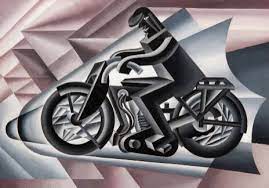
Este dinamismo y ritmo que es develado por la velocidad de la máquina, determina un nuevo tema dentro del arte, una manera de percibir la realidad, una creencia en los milagros tangibles de la ciencia y en categorías inexistentes hasta ese momento en la historia del arte como son la inmaterialidad de la realidad, la interrelación del objeto con el entorno, la simultaneidad, la continuidad, la compenetración de planos que conducen a la desmaterialización del espacio pictórico y a una nueva concepción del espacio y el tiempo, determinando los rasgos generales de la manera de representar el objeto plástico.
Auspician el triunfo indiscriminado del maquisnismo en el mundo del futuro, su técnica no es en modo alguna racional ni científica, pues la unidad de lo real en el movimiento se consigue esencialmente a través de la intuición que excluye de por sí un proceso racional. Se trata de un hecho que, con el tiempo, se revelará mistificante, y así principalmente desde los comienzos del futurismo, la mayoría de los artistas de vanguardia estarán dispuestos asumir únicamente los ropajes de la técnica.
Los aportes del futurismo en torno al problema del espacio y la desmaterialización son de interés: “Lo que intentan superar los futuristas es un espacio apriorística y euclidiano, el espacio como algo absoluto, sustituyéndolo por un espacio relativo consecuencia de la incidencia en él de los factores externos, los cuales en ciertos modo provocan la desmaterialización concreta del espacio pictórico. Esta desmaterialización según el propio Boccioni, llevó a los futuristas a un trascendentalismo físico. Es también de gran importancia la distinción entre movimiento absoluto y relativo para la comprensión de la concepción futuristas del dinamismo”.
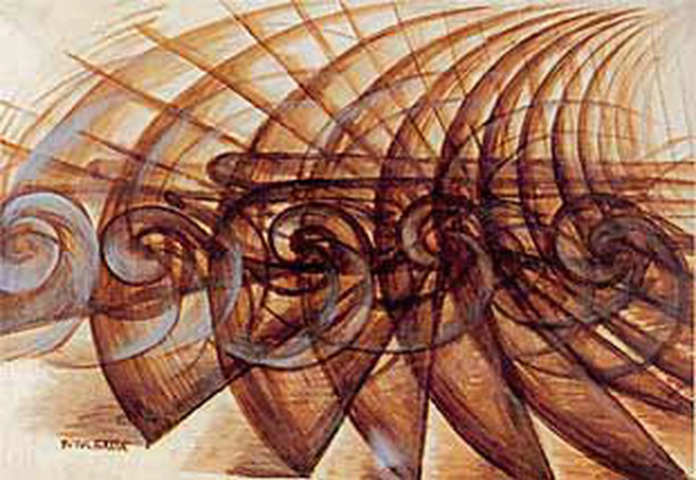
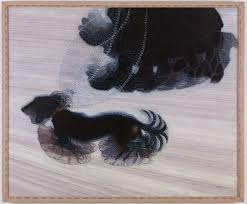
Boccioni en su libro Pittura, Scultura Futurista distingue dos tipos de movimiento: el absoluto y el relativo. El absoluto es aquel que es propio del objeto que se mueve; el relativo es aquel que surge de la transformación que sufre el objeto al moverse tanto en relación a un espacio móvil como a un entorno inmóvil. El dinamismo es entonces la acción simultánea del movimiento absoluto y el relativo.
El movimiento absoluto del que habla es propiamente un movimiento cinematográfico e incluso fotográfico ya conseguido por la técnica de la época; recuérdese en tal sentido las fotografías estroboscópicas o las cronofotografías: el problema se resume en ir captando las distintas posiciones de un cuerpo u objeto que se desplaza de un punto A a un punto B. Giacomo Balla sin duda, con sus obras “Dinamismo de un Perro”, “Perro con Traílla”, “Muchacha Corriendo en una Galería” o su “Ritmo de un Violinista”, representó este tipo de movimiento.´
Para dimensionar la importancia que tal concepción supone dentro del arte moderno debemos acercarnos tanto al impresionismo como al cubismo, pues en cierto modo el futurismo intentó reunirlos en una irreconciliable síntesis. Se valió así de los aportes plásticos de ambos movimientos para poder plasmar su visión de la realidad, esto determina otro rasgo de este experimentalismo: el sintetizar los diversos lenguajes plásticos de la época en sus propuestas, lo cual sigue siendo un rasgos de las vanguardias estéticas.
Entre los aportes de mayor importancia por tanto del futurismo, debemos señalar sintetizando lo dicho su acercamiento a lo industrial y a la máquina en particular, establecer por tanto una nueva relación entre el objeto esto plantea la creación de un nuevo arte con nuevos temas y maneras diferentes de plantearlo. Es una ruptura total con la tradición cultural dominante, creando uno de los primeros esbozos de una visión sintética de las artes al integrar la pintura, la arquitectura, la escultura, la literatura, el diseño y la música en un movimiento.