Home Blog Page 2

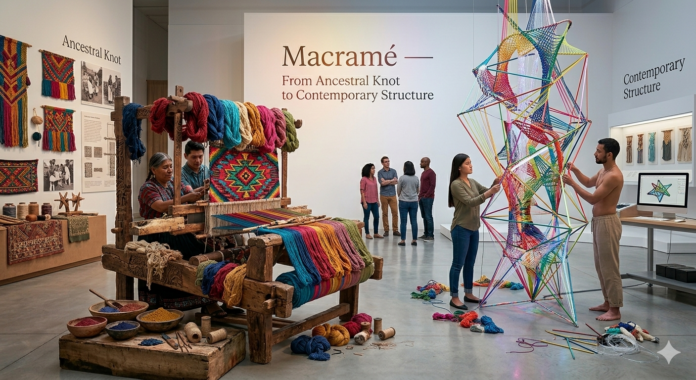
Macramé — From Ancestral Knot to Contemporary Structure

Macramé — From Ancestral Knot to Contemporary Structure

Macramé — From Ancestral Knot to Contemporary Structure

Macramé, the art of constructing textiles through knots rather than weaving or knitting, occupies a singular position within the history of fiber practices. Defined by the manipulation of cord through tension, repetition, and pattern, it is at once primitive and sophisticated, rooted in ancestral techniques yet fully aligned with contemporary sculptural thinking.

The Ancestral Knot: Origins and Transmission

The origins of macramé precede its name. Archaeological and historical evidence traces knot-based textile decoration back to ancient civilizations such as the Babylonians and Assyrians, where braided and fringed elements adorned garments and ceremonial objects.

What we recognize as macramé today likely emerged in the 13th century among Arab weavers, who developed decorative knotting techniques to finish the loose ends of woven fabrics—transforming necessity into ornament. The very word is believed to derive from the Arabic migramah, meaning “fringe” or “ornamental veil.”

From the Islamic world, the technique traveled through Spain and Italy into Europe, carried by trade routes and cultural exchange. By the 17th and 19th centuries, macramé had become a refined decorative practice within European domestic interiors, appearing in textiles, lace, and ornamental furnishings.

Simultaneously, sailors played a crucial role in its dissemination, producing knotted objects aboard ships—belts, hammocks, and decorative items—embedding macramé within a global vernacular of labor and mobility.

Structure Without Loom: A Different Textile Logic

Unlike weaving, macramé does not rely on a loom. Its fundamental unit is the knot, constructed through the direct manipulation of cord by hand. This absence of machinery is not a limitation but a conceptual distinction:

  • no fixed warp and weft
  • no predetermined grid
  • structure emerges through sequential decisions and tension

The most common knots—square knots, half-hitches, spiral knots—form a modular system capable of generating both flat patterns and volumetric structures.

In this sense, macramé is closer to drawing in space than to traditional textile construction. Each knot is a point of intersection, a moment of decision, accumulating into a larger structural logic.

Decline and Revival: The 20th Century

Macramé’s history is cyclical. After periods of prominence in Europe, it receded before experiencing a major revival in the 1960s and 1970s. This resurgence was driven by countercultural movements and, crucially, by feminist artists who challenged the hierarchy between fine art and craft.

During this period, macramé moved beyond decoration into artistic experimentation:

  • wall hangings became sculptural
  • knots became compositional elements
  • materials expanded beyond traditional fibers

This moment marked the integration of macramé into the broader field of fiber art, where knotting joined weaving, braiding, and coiling as legitimate artistic strategies.

Contemporary Macramé: From Craft to Sculpture

In contemporary art, macramé has undergone a profound transformation. No longer confined to domestic objects, it now operates as a spatial and conceptual medium.

Artists today use macramé to:

  • construct large-scale installations suspended in space
  • explore tension, gravity, and structural balance
  • integrate unconventional materials—metal, plastic, industrial rope
  • create immersive environments that engage the viewer physically

The knot becomes a unit of architecture, capable of generating complex, three-dimensional forms without rigid frameworks.

Material, Labor, and Time

Macramé foregrounds the relationship between hand, material, and duration. Each knot is tied individually, embedding time into the structure. This repetitive labor transforms the work into a record of process—a visible accumulation of gestures.

From a museological perspective, this aligns macramé with contemporary concerns around:

  • labor and visibility
  • the value of the handmade
  • resistance to industrial and digital production

Its tactile nature invites a sensory engagement that contrasts sharply with the immateriality of much contemporary culture.

Macramé as Contemporary Metaphor

In the 21st century, macramé resonates beyond its material form. It functions as a metaphor for:

  • networks and connectivity
  • systems built through interdependence
  • the tension between order and improvisation

Each knot is both independent and relational—holding its place within a larger structure while depending on others for stability.

Conclusion: The Persistence of the Knot

Macramé endures because it is fundamentally about connection. From ancient fringes to contemporary installations, it transforms simple gestures into complex systems.

What once secured the edges of fabric now constructs entire environments. What began as utility has become language, structure, and thought.

In 2026, macramé is no longer a nostalgic craft. It is a living, evolving practice—one that reveals how the simplest act, the tying of a knot, can still articulate some of the most sophisticated ideas in contemporary art.

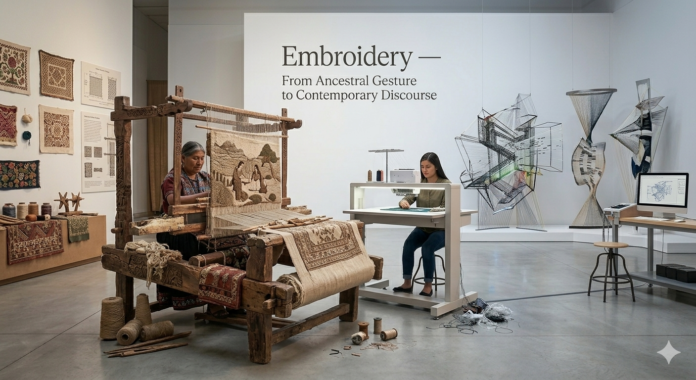
Embroidery — From Ancestral Gesture to Contemporary Discourse

Embroidery
Embroidery — From Ancestral Gesture to Contemporary Discourse

Embroidery — From Ancestral Gesture to Contemporary Discourse

Embroidery, the act of inscribing thread into fabric with needle and hand, is one of the most enduring artistic practices in human history. At once intimate and expansive, it has traversed centuries as a medium of decoration, storytelling, identity, and resistance. From ancestral textiles to contemporary conceptual works, embroidery has evolved from a domestic craft into a critical language within contemporary art.

The Ancestral Mark: Embroidery as Memory

Historically, embroidery functioned as a cultural archive. Across civilizations—whether in Central Asia, the Middle East, Europe, Africa, or the Americas—embroidered textiles encoded systems of belief, social status, and communal memory.

Unlike weaving, which constructs the fabric itself, embroidery operates on the surface, intervening after the fact. This distinction is crucial: embroidery is inherently additive and narrative. It marks, embellishes, and transforms an existing ground, much like writing on a page.

Each stitch—whether ceremonial or utilitarian—carried meaning:

  • patterns signified lineage or region
  • motifs conveyed myth or spirituality
  • technique reflected labor, gender roles, and social structures

Embroidery was not merely decoration; it was a language stitched into cloth.

The Grammar of Stitch

Even in its most basic forms, embroidery is structured through a limited but powerful vocabulary of stitches:

  • Running stitch: a linear, rhythmic mark—suggestive of movement and continuity
  • Backstitch: precise and controlled—used for clarity, outline, and definition
  • Satin stitch: dense and luminous—transforming line into surface
  • French knots: punctuations of texture—small accumulations of presence

These foundational gestures form a grammar of mark-making, comparable to drawing or writing. In contemporary practice, artists often return to these elementary stitches, not as craft exercises, but as conceptual tools.

From Domestic Craft to Artistic Medium

For centuries, embroidery was confined to the domestic sphere, frequently associated with femininity and undervalued within dominant art historical narratives. The 20th century began to unsettle this hierarchy, as artists and theorists questioned the boundaries between fine art and craft.

Embroidery emerged as a site of reclamation and critique:

  • reclaiming overlooked labor
  • challenging gendered divisions of artistic practice
  • asserting the intellectual and aesthetic complexity of textile work

This shift parallels broader museological revisions, where institutions increasingly recognize embroidery as part of the expanded field of contemporary art.

Contemporary Embroidery: Surface as Concept

In contemporary practice, embroidery is no longer limited to ornament or representation. It has become a conceptual intervention into surface, image, and meaning.

Artists today:

  • embroider over photographs and printed images, disrupting visual certainty
  • use text and language, transforming thread into a form of writing
  • incorporate unconventional materials—plastic, metal, found fabrics
  • expand embroidery into installation, sculpture, and performance

The stitched mark becomes both material and metaphor—a trace of time, labor, and intention.

Embroidery and the Politics of the Hand

Embroidery’s slow, repetitive process foregrounds time and embodiment. Each stitch records a gesture, a moment of attention. In an age dominated by digital production, this slowness acquires political significance.

Embroidery resists:

  • speed
  • mass production
  • immateriality

Instead, it insists on:

  • presence
  • care
  • duration

From a curatorial perspective, this positions embroidery within a broader discourse of labor and visibility, where the handmade becomes a form of critical resistance.

Beyond Fabric: Expansion and Experimentation

Contemporary embroidery often transcends its traditional support. It appears on:

  • paper
  • industrial materials
  • architectural surfaces

In some cases, embroidery becomes spatial—threads extending into the environment, dissolving the boundary between surface and space. This expansion aligns embroidery with sculpture and installation, reinforcing its role as a multidimensional practice.

Embroidery as Writing, Embroidery as Thought

Perhaps the most compelling aspect of embroidery today is its proximity to language. The act of stitching resembles writing—line by line, mark by mark. Yet unlike ink, thread introduces:

  • texture
  • resistance
  • physical depth

Embroidery becomes a form of thinking through the hand, where ideas are not simply represented but materially constructed.

Final thoughts: The Persistence of the Mark

Embroidery endures because it operates at the intersection of intimacy and structure, tradition and innovation, surface and depth.

From ancestral garments to contemporary installations, it continues to evolve while retaining its essential gesture: the puncture of fabric, the passage of thread, the accumulation of meaning.

In 2026, embroidery is no longer peripheral. It is a central medium through which artists explore identity, memory, and the conditions of making itself.

What appears delicate is, in fact, profoundly resilient—
a quiet but persistent assertion that even the smallest mark can carry the weight of history, labor, and imagination.

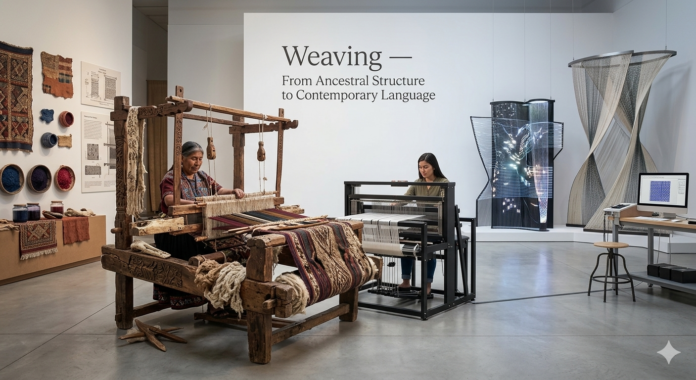
Weaving — From Ancestral Structure to Contemporary Language

Weaving
Weaving — From Ancestral Structure to Contemporary Language

Weaving — From Ancestral Structure to Contemporary Language

Weaving is among the oldest artistic and technological practices of humanity—a foundational gesture through which civilizations constructed not only textiles, but systems of meaning. Defined by the interlacing of warp and weft, weaving operates at the intersection of structure, rhythm, and time. From ancestral looms to contemporary installations, it has evolved from necessity into a critical language of contemporary art.

The Ancestral Grid: Weaving as Origin

Long before painting or sculpture assumed their canonical status, weaving functioned as a primary cultural expression. Across Indigenous, African, Asian, and pre-Columbian traditions, textiles encoded cosmologies, hierarchies, and identities. The loom itself—horizontal or vertical—was not merely a tool, but a cosmological device, organizing the world into tension (warp) and passage (weft).

The distinction between warp and weft is both technical and symbolic:

  • Warp threads: strong, stable, held under tension—structure, continuity, order
  • Weft threads: flexible, moving across—variation, narrative, intervention

This binary underpins not only textile production but a broader philosophical model: structure versus agency, system versus improvisation.

Material Intelligence

The intelligence of weaving lies in its materials. Traditionally:

  • Cotton offers absorbency and clarity—ideal for functional textiles
  • Wool introduces warmth, elasticity, and mass—suited for blankets and rugs
  • Linen and silk bring luminosity and tension—refined, almost architectural qualities

Contemporary practice expands this palette to include bamboo, Tencel, synthetic fibers, and even paper, each introducing new behaviors of light, gravity, and fragility.

Even the technical language of yarn—fractions such as 8/2 or 16/2—reveals a system of measurement distinct from other textile traditions, emphasizing structure over softness, precision over volume.

Modernism and the Rewriting of Weaving

The 20th century marked a critical shift. With the Bauhaus, weaving entered modernist discourse not as craft but as design, abstraction, and architecture. Figures such as Anni Albers redefined the medium, treating the woven surface as a site of experimentation with pattern, perception, and industrial logic.

Yet even then, weaving remained marginal within art history—its association with the feminine and the functional limiting its institutional recognition.

Contemporary Weaving: Beyond the Loom

In contemporary art, weaving has fully entered the expanded field. It is no longer confined to textile production but has become a method of thinking and constructing space.

Artists today:

  • deconstruct the loom
  • suspend warp threads in architectural environments
  • fragment woven surfaces into sculptural forms
  • integrate unconventional materials—plastic, metal, found objects

Weaving becomes less about fabric and more about systems, networks, and interconnection.

Paper Weaving and Fragility

One of the most compelling contemporary developments is paper weaving. By replacing fiber with paper, artists introduce a material that is:

  • fragile
  • archival
  • historically loaded (linked to text, image, and documentation)

Paper weaving collapses distinctions between drawing, collage, and textile. It transforms the act of weaving into a gesture of reconstruction—cutting, reordering, and reassembling visual information.

Here, the grid is no longer neutral. It becomes a site of disruption, where images are fragmented and reconfigured, echoing the instability of contemporary visual culture.

Weaving as Metaphor in the 21st Century

In 2026, weaving resonates far beyond material practice. It has become a central metaphor for contemporary life:

  • social networks as woven systems
  • identities as interlaced narratives
  • histories as layered and entangled

From a curatorial perspective, weaving aligns with a broader shift toward practices that emphasize process, interdependence, and relationality. It resists singular authorship, foregrounding instead the logic of connection.

Labor, Time, and Resistance

Weaving remains inherently slow. Each intersection of thread marks a moment of labor, a unit of time embedded in the object. In an era defined by speed and immateriality, this slowness becomes a form of resistance.

The woven object carries:

  • duration
  • repetition
  • care

It asks the viewer to engage differently—to read not only the image, but the time it contains.

Conclusion: The Persistence of Structure

What makes weaving enduring is its dual nature: it is both primitive and contemporary, functional and conceptual, material and metaphorical.

From ancestral looms to paper-based installations, weaving continues to evolve while maintaining its essential logic—the crossing of threads, the negotiation of tension, the creation of structure through relation.

In this sense, weaving is not simply a technique.
It is a model for understanding the world—one in which everything exists through connection, and meaning emerges not from isolated elements, but from the spaces where they intersect.

Fabrik Projects

Fabrik Projects is a contemporary art gallery

Fabrik Projects

“Art is not what you see, but what you make others see.”

—Edgar Degas

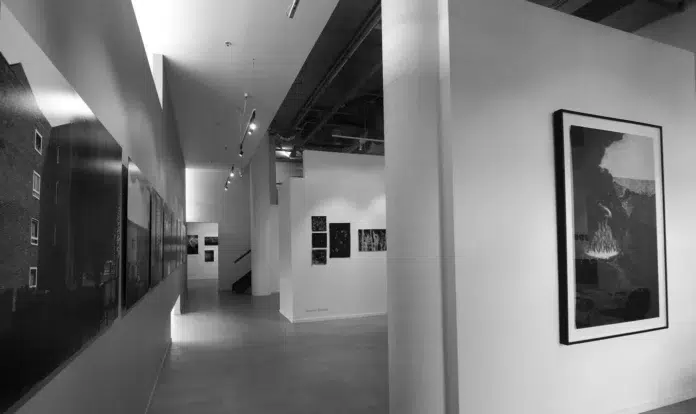
Fabrik Projects is a contemporary art gallery based in Los Angeles, dedicated to supporting and promoting emerging and mid-career artists across various disciplines. The gallery serves as a platform for nurturing fresh ideas and fostering collaborations between artists, curators, and collectors. 

With a strong emphasis on contemporary photography, Fabrik Projects showcases a diverse range of photographic styles, including documentary, fine art, portraiture, landscape, and experimental photography.

More than just representing artists, Fabrik Projects commits to being a central hub for the exchange of ideas about art and culture. The gallery actively pursues collaborations with artists, curators, and public institutions to create thought-provoking exhibitions.

FABRIK PROJECTS GALLERY

912 EAST 3RD STREET
LOS ANGELES, CA 90013

[email protected]
Fabrikprojects.com

Artista:

Amadea Bailey

Andy Burgess

Carol Bodlander

Choi Sori

Chuni Park

Dina Goldstein

Donn Delson

Douglas Busch

Douglas Stockdale

E.F. Kitchen

E.K. Waller

Enrique Gomez De Molina

Eric Renard

Eric Sanders

Forough Yavari

Glen Wexler

Griffin Loop

Henri Van Noordenburg

Ibim Cookey

J.T. Burke

James Fink

Jane Szabo

Jessie Chaney

Jessus Hernandez

Jioh Choi

JT Burke

Linda Saccoccio

Luc Leestemaker

Marjorie Salvaterra

Maureen Haldeman

Nancy R Wise

Nemesis

Nigel Swinn

Rob Grad

Rod Cusic

SameSource

Sebastiaan Knot

Sharon Weiner

Stephen Rowe

Stuart Kusher

Weldon Brewster

Yuri Boyko

Zelene Schlosberg

GalleriesNow

GalleriesNow
GalleriesNow

GalleriesNow

GalleriesNow is the leading gallery guide for discovering and exploring art exhibitions internationally.

Since 2014, we have been connecting hundreds of international galleries with our highly engaged audience of collectors, curators, and art lovers. We work with a carefully curated group of member galleries, both large and small, to provide an accurate, dynamic, and constantly updated resource.

In addition to our GalleriesNow.net website and app, we’ve published both online and physical maps for cities including London, NYC, Seoul, Paris, Switzerland, Hong Kong, Los Angeles, Miami, São Paulo, and Brussels. We developed NearMe functionality to discover galleries nearby, offer installation views, and provide VR photography to make it easy to see great art—whether it’s around the corner or across the globe. Our online shop also offers a convenient way to access rare art publications and works of art from our member galleries.

Galleries & Institutions in USA

A

  • ACA Galleries — New York
  • Almine Rech — Brussels, Gstaad, London, Monaco, New York, Paris, Shanghai
  • Anita Shapolsky Gallery — New York
  • AT Art & Interiors — Los Angeles

B

  • Barbara Mathes Gallery — New York
  • Ben Brown Fine Arts — Hong Kong, London, New York
  • Berry Campbell — New York
  • Bluerider ART — London, Los Angeles, Shanghai, Taipei
  • The Broad — Los Angeles
  • Galerie Buchholz — Berlin, Cologne, New York

C

  • Candice Madey — New York
  • Carpenters Workshop Gallery — London, Los Angeles, New York, Paris
  • Carvalho — New York
  • Colector — Dallas, Monterrey
  • Colnaghi — London, Madrid, New York
  • CSB Fine Arts — New York

D

  • David Richard Gallery — New York
  • Di Donna — New York
  • D LAN GALLERIES — New York

E

  • Edwynn Houk Gallery — New York
  • Eerdmans — New York
  • Esther Schipper — Berlin, New York, Paris, Seoul

F

  • Fleiss-Vallois — New York
  • The Foundation of ART NYC — New York, Venice
  • Friedrichs Pontone — New York

G

  • The J. Paul Getty Museum — Los Angeles
  • galerie gmurzynska — New York, Zug, Zürich
  • Goodman Gallery — London, New York
  • Graham Shay 1857 — New York
  • Gray — Chicago
  • GRIMM — London, New York
  • Guggenheim Museum — New York

H

  • Halsey McKay Gallery — New York
  • Hammer Museum — Los Angeles
  • Hauser & Wirth — Basel, Bruton, Hong Kong, London, Los Angeles, Mahón, Monaco, New York, Paris, St. Moritz, Zürich
  • Gallery Henoch — New York
  • Hirschl & Adler — New York
  • HB381 — Los Angeles, New York
  • Huntington Library — Los Angeles
  • Hutchinson Modern & Contemporary — New York

J

  • Jack Shainman Gallery — Kinderhook, New York

L

  • L.A. Louver — Los Angeles
  • Leila Heller Gallery — New York
  • Galerie Lelong — New York, Paris
  • Leon Tovar Gallery — New York
  • Lévy Gorvy Dayan — London, New York
  • Lincoln Glenn — New York
  • Lisson Gallery — London, Los Angeles, New York, Shanghai
  • Los Angeles County Museum of Art (LACMA) — Los Angeles
  • Louis Stern Fine Arts — Los Angeles
  • Luhring Augustine — New York
  • Luis De Jesus Los Angeles — Los Angeles

M

  • Marian Goodman Gallery — Los Angeles, New York, Paris
  • Meliksetian | Briggs — Dallas
  • The Metropolitan Museum of Art — New York
  • Michael Rosenfeld Gallery — New York
  • The Museum of Modern Art (MoMA) — New York
  • Museum of Contemporary Art — Los Angeles
  • Museum of Contemporary Art Chicago — Chicago

N

  • Nagas — New York
  • Nahmad Contemporary — New York
  • Nara Roesler — New York
  • New Museum — New York
  • Nicola Vassell Gallery — New York
  • Nohra Haime Gallery — New York

O

  • Opera Gallery — London, New York

P

  • The Painting Center — New York
  • parrasch heijnen — Los Angeles
  • Perrotin — Dubai, Hong Kong, Las Vegas, London, Los Angeles, New York, Paris, Seoul, Shanghai, Tokyo
  • Philip Martin Gallery — Los Angeles
  • Public Art Fund — Boston, Chicago, New York

R

  • Roberts Projects — Los Angeles
  • Robilant+Voena — London, Milan, New York, Paris
  • Rusha & Co. — Los Angeles

S

  • SANATORIUM — Istanbul, New York
  • Schoelkopf — New York
  • Sean Kelly Gallery — Los Angeles, New York
  • The Gallery at Soho Grand — New York
  • Sotheby’s — Cologne, Geneva, Hong Kong, London, Los Angeles, Milan, New York, Palm Beach, Paris, Singapore, Zürich
  • Stellarhighway — New York
  • Susan Sheehan Gallery — New York

T

  • Templon — Brussels, New York, Paris
  • Timothy Taylor — London, New York
  • Tina Kim Gallery — New York
  • Tropical Berlin — Los Angeles

U

  • Upsilon Gallery — London, New York

V

  • VeneKlasen — London, New York

W

  • Whitney Museum — New York

Y

  • Yancey Richardson Gallery — New York

Visual artists

Michele Abeles

Marina Abramović

Robert Adams

Igshaan Adams

Lindsay Adams

Etel Adnan

Yuji Agematsu

Carolina Aguirre

Soryun Ahn

Eija-Liisa Ahtila

Kelly Akashi

John Akomfrah

Monira Al Qadiri

Getulio Alviani

Antonio Henrique Amaral

Ghada Amer

Isabella Amram

Hurvin Anderson

Carl Anderson

Brook Andrew

Layla Andrews

Benny Andrews

Giovanni Anselmo

Eleanor Antin

Karel Appel

Ei Arakawa

Nikolas Gambaroff

Ei Arakawa-Nash

Cory Arcangel

Daniel Arsham

Art & Language

Genevieve Asse

Ed Atkins

Frank Auerbach

Tauba Auerbach

March Avery

Milton Avery

Frank Avray Wilson

Amani Azari

Firelei Báez

Ain Bailey

Max Bainbridge

Melissa Joseph

John Baldessari

Jonathan Baldock

Ranti Bam

Nada Baraka

Thiago Barbalho

Barnaby Barford

Clive Barker

Carolyn Barker-Mill

Adam Barker-Mill

James Barnor

Jill Baroff

Yto Barrada

Robert Barry

Marion Baruch

Georg Baselitz

Dan Basen

Lillian Bassman

Christiane Baumgartner

Glen Baxter

Kevin Beasley

Ericka Beckman

Abdelkader Benchamma

Marius Bercea

Thomas Berding

Tizta Berhanu

Leon Berkowitz

Renate Bertlmann

Walead Beshty

Forrest Bess

Joseph Beuys

Max Bill

Hélène Binet

Peter Blake

Lucas Blalock

David Blandy

Magda Blasinska

Jenna Bliss

Buck Ellison

Jasmine Gregory

Sholto Blissett

Alighiero Boetti

Agostino Bonalumi

Derek Boshier

Frédéric Bruly Bouabré

Louise Bourgeois

Carol Bove

Frank Bowling

Szabolcs Bozó

Bracha

Colin Brant

Sebastiaan Bremer

Cecily Brown

Roger Brown

Paulo Bruscky

Berlinde De Bruyckere

Laura Buckley

Zoë Buckman

Michèle Buhofer

Lily Bunney

Lucinda Burgess

Victor Burgin

Carlos Cairoli

Johanna Calle

Pier Paolo Calzolari

Sergio Camargo

Louis Cane

Yoan Capote

James Capper

Gillian Carnegie

Anthony Caro

Valentin Carron

Patrick Caulfield

Caziel

Loris Cecchini

Enrique Martinez Celaya

Paul Cézanne

Lynn Chadwick

Helen Chadwick

Gaston Chaissac

Kristy Chan

Alice Channer

Elleanna Chapman

Alan Charlton

Eunice Cheung Wai Man

Eduardo Chillida

Ha Chong-Hyun

Toby Christian

Lygia Clark

Francesco Clemente

Jarvis Cocker

Bernard Cohen

Sas Colby

Keith Smith

Teju Cole

Anne Collier

Mac Collins

Mat Collishaw

Roy Colmer

Gianni Colombo

Anaïs Comer

George Condo

Fiona Connor

David Raymond Conroy

Pietro Consagra

Aki Cooren

Arnaud Cooren

Rhys Coren

Adriano Costa

Tony Cragg

Coco Crampton

Martin Creed

Henry Crespo

Gregory Crewdson

Carlos Cruz-Diez

Mikey Cuddihy

Alexandre Da Cunha

Samuel Laurence Cunnane

Sara Cwynar

Natalie Czech

Alex Da Corte

Dadamaino

Dai Yinglun

Dai Junpeng

Salvador Dalí

Matthew Darbyshire

Jesse Darling

Ian Davenport

Jose Dávila

Lynn Davis

Lisa Corinne Davis

Dandy Day

Levi De Jong

Willem de Rooij

Richard Deacon

Tacita Dean

Judith Dean

Beauford Delaney

Jeremy Deller

Mathilde Denize

Simon Denny

Sonya Derviz

Gu Dexin

Patrizio Di Massimo

Aliou Diack

Francesca DiMattio

Jim Dine

Lois Dodd

Peter Doig

Antony Donaldson

Ingrid Donat

Jingge Dong

Kees van Dongen

Daniel Dove

Nick Doyle

Djibril Dramé

Jean Dubuffet

Abigail Dudley

Lili Dujourie

Anh Duong

KV Duong

Jimmie Durham

Ilse D’Hollander

Keith Edmier
Jemma Egan
William Eggleston
Henrik Eiben
Michaela Eichwald
Nicole Eisenman
Buck Ellison
Ndidi Emefiele
Tracey Emin
Rose English
Mitch Epstein
Ulrich Erben
Eugenio Espinoza
Mohmed Essam
Kirsten Everberg
Ruth Ewan

Cesare Fabbri
Luciano Fabro
Jadé Fadojutimi
Angus Fairhurst
Sam Falls
Jens Fänge
Mahmoud Farah
Sharif Farrag
Omer Fast
Alan Feltus
Petra Feriancová
Thierry Feuz
Genieve Figgis
Perle Fine
Peter Fischli
David Weiss
Gina Fischli
Lizzie Fitch
Ryan Trecartin
Wolfgang Flad
Dan Flavin
Gerasimos Floratos
Lucio Fontana
Günther Förg
Christina Forrer
Aaron Fowler
Helen Frankenthaler
Anna Freeman Bentley
Lucian Freud
Leonardo Frigo
Bernard Frize
Simon Fujiwara

Anya Gallaccio
Fernanda Galvão
Esther Gamsu
Ryan Gander
Néstor García
Jonah Gebka
Gelitin
Isa Genzken
Florian Genzken
Franz Gertsch
Ficre Ghebreyesus
Luigi Ghirri
John Gibbons
Jeffrey Gibson
Stephen Gill
Tricia Gillman
Gregor Gleiwitz
Ali Glover
Domenico Gnoli
Judith Godwin
John Golding
Paul Gondry
Ana González
Felix Gonzalez-Torres
Arshile Gorky
Antony Gormley
Rodney Graham
Dan Graham
Todd Gray
Jasmine Gregory
Deborah Grice
Pablo Griss
Kate Groobey
Guido Guidi
Nicola Gunnarsson
Özlem Günyol
Mustafa Kunt
Xuran Guo
Shi Guowei
Andreas Gursky
Philip Guston
Ruben Gutiérrez

Miryam Haddad
Issam Hafiez
Trulee Hall
Nigel Hall
Dido Hallett
Peter Halley
Abe Hamilton
Julie Hamisky
Domitilla Harding
Grace Hartigan
Bridget Harvey
Hugh Hayden
Elinor Haynes
Massoud Hayoun
Yannig Hedel
Julie Heffernan
Raphael Hefti
Alex Heim
Robert Heinecken
Stefanie Heinze
Angela Heisch
Adrian Henri
Alisa Henriquez
Bill Henson
Alice Herbst
Georg Herold
Carmen Herrera
Nicola Hicks
John Hilliard
Katharina Hinsberg
Key Hiraga
Valerie Hird
Ann Hirsch
Damien Hirst
David Hockney
Dana Hoey
William Hogarth
Andy Holden
Loie Hollowell
Roni Horn
Jonathan Horowitz
Heather Horton
Dom Sylvester Houédard
Rachel Howard
Kat Howard
Nhu Xuan Hua
Donna Huanca
Patrick Hughes
Kudzanai-Violet Hwami

Ryoji Ikeda
Leiko Ikemura
Camilla Iliefski
Eva Zethraeus
Yinka Ilori
Pello Irazu
Albert Irvin
Tiina Itkonen

Oliver Lee Jackson
Arthur Jafa
Sebastian Jefford
Jiang Dahai
Wang Jianwei
Chantal Joffe
Richard Johansson
Alan Johnston
Rachel Jones
Allen Jones
Sarah Jones
Jacqueline de Jong
Michael Joo
Peter Joseph
Melissa Joseph
Eva Jospin
Youngju Joung
György Jovánovics
JR
Donald Judd
Harminder Judge
Yujin Jung

Ilya Kabakov
Emilia Kabakov
Zhanna Kadyrova
Jitish Kallat
Eddy Kamuanga Ilunga
Kan Hung-Ju
Suki Seokyeong Kang
Anish Kapoor
Alex Katz
Allison Katz
Marya Kazoun
Mary Reid Kelley
Ellsworth Kelly
Peter Kennard
William Kentridge
Steffen Kern
Clay Ketter
Toba Khedoori
Martand Khosla
Morteza Khosravi
Edward Kienholz
Melissa Kime
John Kirby
Richard Kirwan
Reinhold Koehler
Abdoulaye Konaté
Koo Jeong A
Vivienne Koorland
Çağla Köseoğulları
Leon Kossoff
Jannis Kounellis
Christine Kozlov
Lee Krasner
Emily Kraus
Maria Kreyn
Les Krims
Abraham Kritzman
Tetsumi Kudo
Tadaaki Kuwayama

Joseph Lacasse
David LaChapelle
Gerald Laing
Claude Lalanne
Wifredo Lam
Luisa Lambri
Anouk Lamm
Sean Landers
Maria Lassnig
Elad Lassry
John Latham
Bob Law
Le Corbusier
Jennifer J. Lee
Lee Eun
Doowon Lee
Marc Lee
Kalliopi Lemos
Zoe Leonard
Leoncillo
Les Lalanne
Barbara Levittoux-Świderska
Sol LeWitt
Li Liangchen
Yaya Yajie Liang
Glenn Ligon
Linder
Erik Lindman
Donald Locke
Hew Locke
Robert Longo
Bertina Lopes
Liza Lou
Roelof Louw
Sarah Lucas
Abigail Lucien
James Luna
Kate Lyddon
John Lyons

Rachel Maclean
Kathryn MacNaughton
Alsadig Mahmoud
Laila Majid
Mark Manders
Sally Mann
Yehong Mao
Christian Marclay
Marino Marini
Antonio Marras
Sergio Marrero
Agnes Martin
Borja Martín-Moreno
Eddie Martinez
Mario Martinez
Zana Masombuka
Takesada Matsutani
Eliseo Mattiacci
Shara Mays
Paul McCarthy
John McCracken
Don McCullin
Dave McDermott
Rodney McMillian
Emma McNally
Juanita McNeely
James McNeill Whistler
Steve McQueen
Fausto Melotti
Lindsey Mendick
Andy Mendoza
Zayd Menk
Zachary Merle
Mario Merz
Jack Milroy
Mónica de Miranda
Helen Mirra
Haroon Mirza
Joan Mitchell
Waleed Mohammed
Ribal Molaeb
Andrew Moncrief
Sebastian Neeb
Gabriel de la Mora
Giorgio Morandi
Mohammed Morda
Abelardo Morell
François Morellet
Daido Moriyama
Dennis Morris
Mali Morris
Robert Motherwell
Sadamasa Motonaga
Jean-Luc Moulène
Tian Mu
Lizzie Munn
Jayson Musson
Jean-Luc Mylayne
Myoung Ho Lee
Ishbel Myerscough

Elie Nadelman
Johannes Nagel
Ron Nagle
Laurel Nakadate
Cassi Namoda
Joshua Nazario Lugo
Sebastian Neeb
Loredana Nemes
Mariele Neudecker
Helmut Newton
Ellie Kayu Ng
Julien Nguyen
Everlyn Nicodemus
Gladys Nilsson
Paul Noble
Tim Noble
Sue Webster
Massimo Nordio
Jedd Novatt

Hyunju Oh
George Ohr
Guy Oliver
Catherine Opie
Julian Opie
Danielle Orchard
Angel Otero
Thérèse Oulton
Virginia Overton
Roy Oxlade
Giovanni Ozzola
Jack O’Brien

Paul P.
Roxy Paine
Présence Panchounette
Giulio Paolini
Eduardo Paolozzi
Athena Papadopoulos
Elisa Pardo Puch
So Young Park
GaHee Park
Gordon Parks
Claudio Parmiggiani
Martin Parr
Sojourner Truth Parsons
Jürgen Partenheimer
Pino Pascali
Amol K Patil
Celia Paul
Hamish Pearch
Anna Pederson
Alicia Penalba
Mano Penalva
Adam Pendleton
Irving Penn
Giuseppe Penone
Joyce Pensato
Grayson Perry
Alexis Peskine
Elizabeth Peyton
Ann Pibal
Francis Picabia
Pablo Picasso
Signe Pierce
Cathie Pilkington
Matthew Pillsbury
Diogo Pimentão
Valentina Pini
Michelangelo Pistoletto
Paola Pivi
Paulo Nimer Pjota
Robert Polidori
Sigmar Polke
Arnaldo Pomodoro
Larry Poons
Simon Popper
James Prapaithong
Kathy Prendergast
Elizabeth Price
Seth Price
Walter Price
Ken Price
Richard Prince
Emilio Prini
Jean Prouvé
Laure Prouvost
Max Prus
Puppies Puppies

Qian Qian
Christina Quarles
Gema Quiles
Saad Qureshi

Raquel Rabinovich
Jo Ractliffe
Thomias Radin
Michael Raedecker
Jon Rafman
Alexis Ralaivao
Carol Rama
Harold Ramírez
Li Ran
Justine Randall
Celeste Rapone
Paula Rego
Li Li Ren
Mateo Revillo
James Richards
Jeanine Richards
John Riddy
Bridget Riley
Faith Ringgold
Chris Rivers
Carol Robertson
David Robilliard
Abel Rodríguez
Alessandro Roma
Ugo Rondinone
Rachel Rosenthal
Rachel Rossin
Mimmo Rotella
Glen Rubsamen
Thomas Ruff
Robert Ryman

Betye Saar
Anri Sala
Hashim Samarchi
Linet Sánchez
Fred Sandback
Sigrid Sandström
Chung Sang-Hwa
Praise Sanni-Adeniyi
Armig Santos
Arcangelo Sassolino
Emilio Scanavino
Paolo Scheggi
Thomas Scheibitz
Katja Schenker
Lina Scheynius
Gregor Schneider
Greta Schödl
Pieter Schoolwerth
Nora Schultz
Samara Scott
Sean Scully
Berni Searle
Manuela Sedmach
Tomio Seike
Colin Self
Park Seo-Bo
Kang Seung Lee
Mamali Shafahi
Domenico Gutknecht
George Shaw
Annie Shead
Cindy Sherman
Lieko Shiga
Chiharu Shiota
Erin Shirreff
Sanaad Shreef
David Shrigley
Laurie Simmons
Marianna Simnett
Dayanita Singh
Alexandre Singh
Mario Sironi
Dirk Skreber
David Smalling
Jack Smith
Anj Smith
Michael E. Smith
Dillwyn Smith
Jaune Quick-to-See Smith
Alexandria Smith
Keith Smith
Robert Smithson
Sophie Smorczewski
Sheida Soleimani
Annegret Soltau
Joanna van Son
Monika Sosnowska
Amparo de la Sota
Jesús Rafael Soto
Edra Soto
Ettore Sottsass
Louis Soutter
Jo Spence
Jasper Spicero
Willy Spiller
Molly Springfield
Elinor Stanley
Georgina Starr
Tino Stefanoni
Jennifer Steinkamp
Frank Stella
Amy Stephens
Olivia Sterling
John Stezaker
Niklaus Stoecklin
Tim Stoner
Robin Stretz
Thomas Struth
Larry Sultan
Sung Jik Yang
Rachel Sussman
Trevor Sutton
Risaku Suzuki
Takashi Suzuki
El Hadji Sy
Shaan Syed

Moffat Takadiwa
Reika Takebayashi
Takis
Moses Tan
Avani Tanya
Antoni Tàpies
Pascale Marthine Tayou
Paul Thek
Franciszka Themerson
Stefan Themerson
Chris Thompson
David Thorpe
Wolfgang Tillmans
Joe Tilson
Mimi Chen Ting
Marit Tingleff
Oliver Tirré
Hap Tivey
Graeme Todd
Rafał Topolewski
Ryan Trecartin
Tatiana Trouvé
Tseng Ting Yu
Hiroki Tsukuda
Pichakorn Chukiew
Becky Tucker
Nasan Tur
Gavin Turk
Julian Turner
Joseph Mallord William Turner
Richard Tuttle

Unyimeabasi Udoh
Lee Ufan
Euan Uglow
Kevin Umaña
Günter Umberg
Francis Upritchard
Juan Uslé

Sara VanDerBeek
Josip Vaništa
Grazia Varisco
Carlos Vega
Germán Venegas
Luciano Ventrone
Pierre Vermeulen
Théo Viardin
Marcel Vidal
Edgardo Antonio Vigo
Nanda Vigo
Erin Vincent
Bill Viola
Not Vital
Charline von Heyl

Julia Wachtel
Heath Wae
Adia Wahid
Shelagh Wakely
Caroline Walker
Jeff Wall
Ho-sa Wang
Fanseng Wang
Nick Waplington
Andy Warhol
Agnes Waruguru
Grace Weaver
Richard Kenton Webb
Carrie Mae Weems
Willem Weismann
Ai Weiwei
Tom Wesselmann
Lotte Westphael
James White
Eric White
Emmi Whitehorse
Rachel Whiteread
Stanley Whitney
George Widener
Didier William
Christopher Williams
William T. Williams
Zoë Williams
Letha Wilson
Véronique Wirbel
Chloe Wise
Uwe Wittwer
Michael Wolf
Adolf Wölfli
Issy Wood
Grace Woodcock
Clare Woods
Daphne Wright
Wu Huaheng
Erwin Wurm
Peter Wüthrich

Liu Xiaodong
Qiu Xiaofei
Gu Xiaoping
Yin Xiuzhen

Yamamoto Masao
Marie Yates
Berke Yazıcıoğlu
Lynette Yiadom-Boakye
Ying Yefu
Song E Yoon
Kenji Yoshida
Osman Yousefzada
Ni Youyu
Sun Yuan
Peng Yu
Li Yuan-Chia
Flora Yukhnovich
Yun Hyong-keun

Akram Zaatari
Alyina Zaidi
Alina Zamanova
Eva Zethraeus
Chen Zhen
Xu Zhen
Toby Ziegler
Carlo Zinelli
Heimo Zobernig
Þórdís Erla Zoëga
Gilberto Zorio

Fernando Botero in Seoul

Fernando Botero in Seoul

Fernando Botero in Seoul

A Landmark Retrospective Celebrates His Enduring Global Legacy

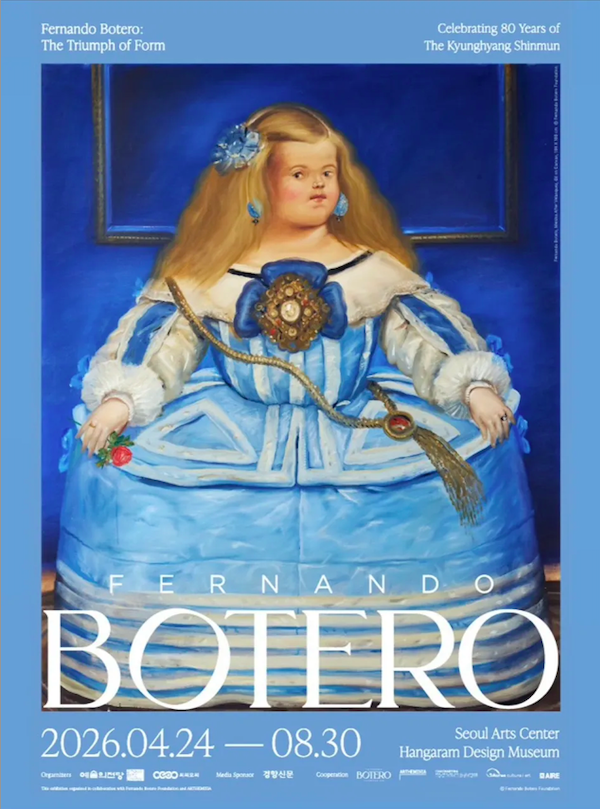
We are pleased to share that Fernando Botero returns to Korea after 11 years with a major retrospective at the Hangaram Art Museum, Seoul Arts Center.

Curated by Lina Botero and organized in collaboration with the Fernando Botero Foundation, the exhibition features over 112 works, several of which have never been exhibited before. This remarkable presentation celebrates Botero’s enduring impact and reaffirms the deep connection between his work and Korean audiences.

For those of us who have long believed in the power and singularity of Botero’s vision, this is a meaningful moment. His language of volume, sensuality, irony, and humanity continues to resonate across continents, speaking to audiences with the same force and tenderness that have defined his work for decades.

Fernando Botero created a visual language that belongs to the world,” said Gary Nader. “To see that language embraced once again in Seoul through such an ambitious exhibition is both moving and significant. It is a beautiful reminder that truly great art never stops speaking.

At Gary Nader Art Centre, where we have had the honor of representing Botero’s work for decades, we celebrate this important chapter with admiration and pride.

Fernando Botero: The Triumph of Form

Hangaram Art Museum — Seoul Arts Center

April 24 – August 30, 2026

Sharon Berebichez

Sharon Berebichez
Sharon Berebichez Presents Unstable Ground at P71

Sharon Berebichez Presents Unstable Ground at P71

An inaugural solo exhibition exploring memory, care, and emotional inheritance

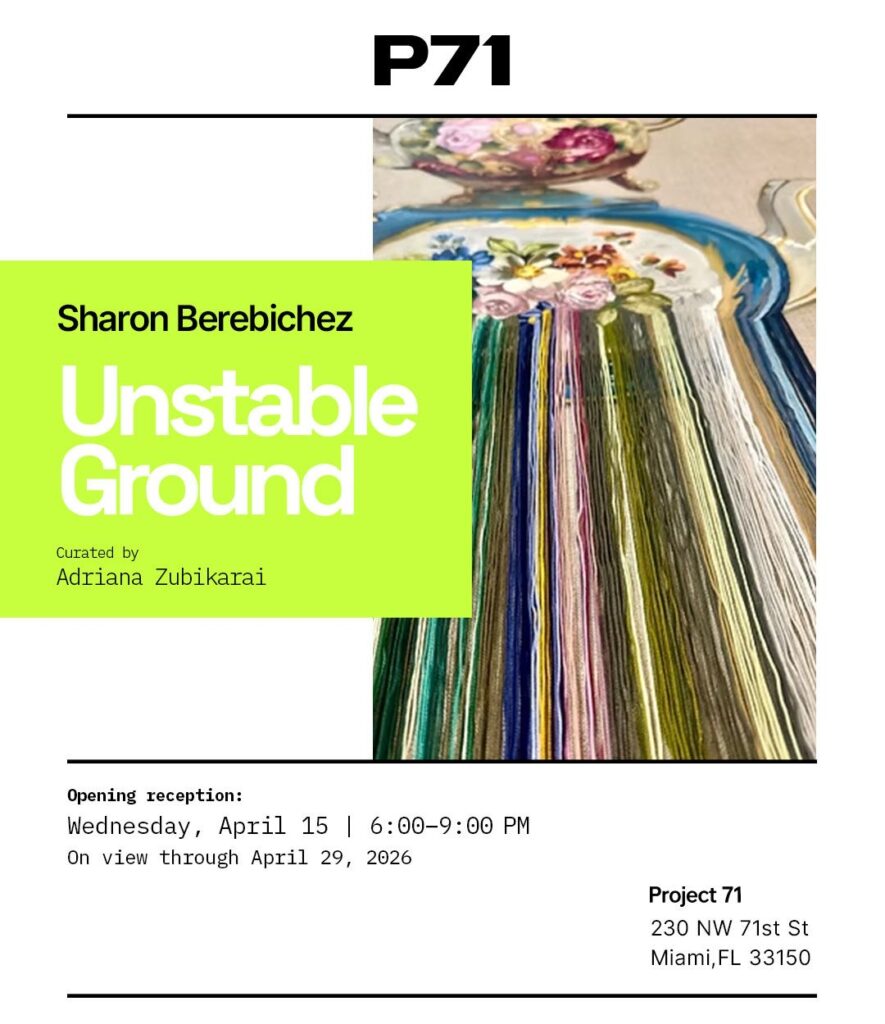
Miami, FL — P71 is proud to present Unstable Ground, its inaugural exhibition and a solo presentation by Sharon Berebichez.

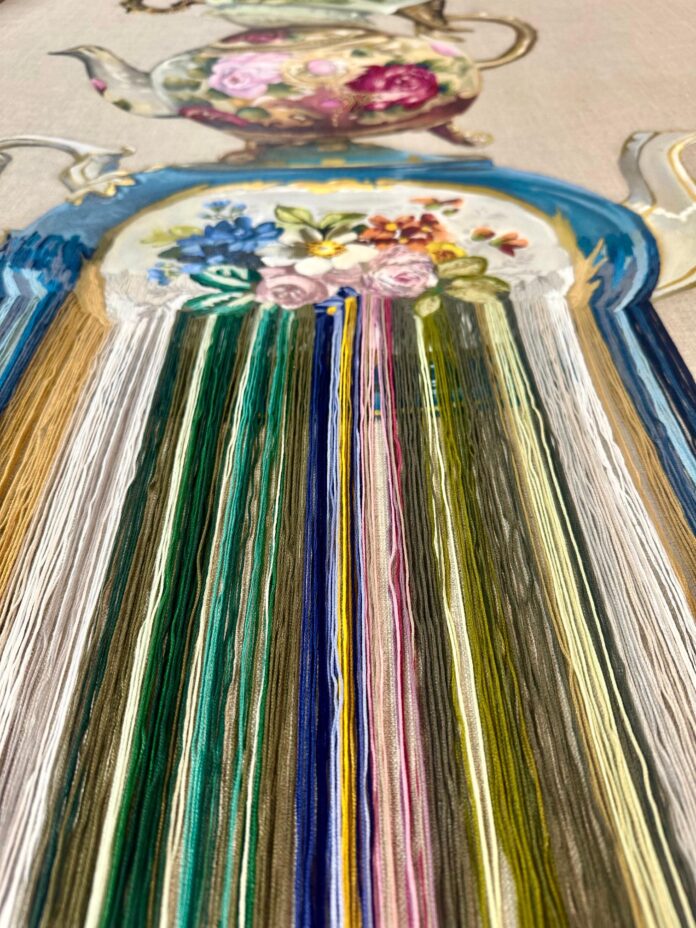
Unstable Ground invites viewers to reflect on the invisible architectures of care and the emotional landscapes formed within them. Featuring a selection of works from the artist’s ongoing Borderline Motherhood series, the exhibition brings together paintings and sculptural works that navigate the fragile terrain of memory, care, and emotional inheritance.

Through her practice, Berebichez constructs a visual language that oscillates between balance and rupture, rhythm and instability. Drawing from her experience as the daughter of a mother with borderline personality disorder, the work examines the complexities of attachment, vulnerability, and unpredictability.

Sharon Berebichez

Material Language and Symbolism

Berebichez’s choice of materials and imagery is both deliberate and evocative. Working with thrifted ceramic tea sets and symbols associated with maternal care, she creates carefully balanced compositions that are painted, embroidered, beaded, and assembled into singular sculptural forms.

These elements—both delicate and weight-bearing—embody a tension between fragility and resilience. Floral patterns and gold trim evoke an idealized sense of domestic harmony, while simulated spilled liquids and precariously balanced arrangements suggest an ever-present risk of collapse.

What initially appears composed and luminous reveals itself, upon closer inspection, as contingent and vulnerable—capable of shattering, spilling, or slipping out of balance at any moment.

About the Artist

Sharon Berebichez is a Mexican-born, process-based artist and educator currently living in Miami, Florida. She is a member of Collective 62, where she maintains her studio practice and teaches art classes.

Her work is deeply informed by her identity as a Jewish woman and a third-generation migrant.

Opening Reception

The public is invited to the opening reception on:

Wednesday, April 15, 2026
6:00 – 9:00 PM

at P71, with the opportunity to meet Sharon Berebichez and experience the work firsthand.

Exhibition Details

  • Exhibition: Unstable Ground
  • Artist: Sharon Berebichez
  • Curator: Adriana Zubikarai
  • Dates: April 15–29, 2026
  • Opening Reception: April 15, 2026, 6:00–9:00 PM
  • Location: P71, 230 NW 71st St, Miami, FL 33150

About P71

P71 is a contemporary art initiative in Little River, Miami, conceived as a hybrid platform for artistic production, experimentation, and community building. It brings together artist studios and a cultural lab model to foster dialogue, collaboration, and a shared curatorial framework.

artexpo new york 2026

artexpo new york 2026

Artexpo New York 2026

El Spotlight Program y la expansión del ecosistema artístico contemporáneo

Del 9 al 12 de abril de 2026, Artexpo New York 2026 reafirma su posición como una de las plataformas más democráticas y dinámicas del arte contemporáneo global. A diferencia de ferias más institucionalizadas, Artexpo opera en un territorio híbrido: entre mercado, laboratorio curatorial y espacio de experimentación abierta.

El Spotlight Program de esta edición no solo visibiliza artistas y galerías emergentes, sino que construye un dispositivo curatorial descentralizado, donde la experiencia del espectador se convierte en un acto activo de descubrimiento.

I. El Spotlight Program: curaduría como cartografía del presente

La selección de este año —que incluye propuestas como Artwise Online, Muisca Gallery, Drew Marc Gallery, Christopher Lotus, Christian Burnham y Catherine Blackburn— funciona como una cartografía de prácticas contemporáneas que oscilan entre lo material, lo digital y lo conceptual.

Más que una lista de participantes, el programa articula una pregunta fundamental:

¿Cómo se redefine la noción de autoría y materialidad en un contexto saturado de imágenes y mediaciones?

Aquí, la curaduría no impone una narrativa única, sino que propone un campo expandido de relaciones.

II. ART LAB: el laboratorio como formato curatorial

Uno de los elementos más significativos de esta edición es la consolidación del ART LAB como espacio de experimentación.

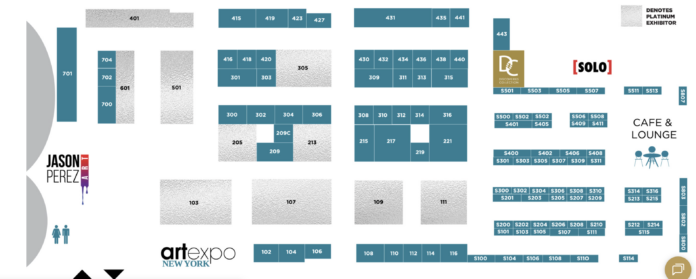
Jason Perez Art Collective — La energía de lo marginal

El Art Collective Lounge en el Mezzanine presenta una convergencia de:

  • Outsider art
  • Arte urbano
  • Cultura pop
  • Prácticas callejeras

Este espacio no busca legitimarse desde la institucionalidad, sino desde la intensidad del gesto y la inmediatez del proceso. Las demostraciones en vivo y la interacción directa con los artistas transforman al espectador en testigo del acto creativo.

Aquí, el arte deja de ser objeto y se convierte en evento performativo.

“Second Glance”: percepción y desplazamiento

En el booth de K-Art Projects USA, Carola Orieta Sperman y Christian A. Albarracín proponen una investigación sobre la percepción.

  • Sperman fragmenta la ciudad de Nueva York mediante capas de fotografía y acrílico, generando una imagen en constante movimiento
  • Albarracín transforma el papel en estructuras tridimensionales que activan el espacio arquitectónico

Ambos artistas operan desde una lógica fenomenológica:

La obra no se ve una vez; se construye en la mirada reiterada.

“Social Media Slave”: crítica de la identidad digital

La instalación de Juan Luis Perez introduce una dimensión crítica sobre la subjetividad contemporánea.

A través de escultura en técnica mixta, el artista confronta:

  • La performatividad del yo digital
  • La ilusión de conexión
  • La fragmentación de la identidad

En este contexto, la obra funciona como un espejo incómodo:

No documenta la realidad digital; la desmantela.

“Seasons”: la persistencia de lo clásico

En contraste, Luis Alvarez Roure presenta una aproximación profundamente ligada a la tradición pictórica.

Su serie Seasons retoma:

  • Técnicas de los antiguos maestros
  • Dibujo virtuoso
  • Estudio psicológico del retrato

Sin embargo, lejos de ser nostálgica, su obra propone una resistencia:

La lentitud como forma de radicalidad en una cultura acelerada.

Discoveries Collection: democratización del coleccionismo

La Discoveries Collection introduce una dimensión económica relevante: obras por debajo de $3,000 seleccionadas por el equipo curatorial.

Esto plantea una tensión interesante:

  • Por un lado, el acceso ampliado al coleccionismo
  • Por otro, la posible estetización del mercado emergente

Aun así, funciona como un puente entre nuevos públicos y prácticas contemporáneas.

III. El artista en vivo: proceso como espectáculo

El programa de Meet the Artists & Live Demonstrations —con participantes como Alfred Addo, Barry E. Jackson, Caridad Sola y Haydn Lewis— enfatiza una transformación clave en el ecosistema artístico:

El proceso creativo se convierte en contenido.

Desde una perspectiva museológica, esto desplaza el valor de la obra terminada hacia la experiencia del hacer.

IV. Entre mercado y experiencia: una lectura crítica

Artexpo New York no pretende competir con ferias como Frieze o Art Basel en términos de prestigio institucional. Su fuerza radica en otro lugar:

  • La accesibilidad
  • La diversidad de propuestas
  • La inmediatez del encuentro

Sin embargo, esta apertura también plantea preguntas críticas:

  • ¿Hasta qué punto la espectacularización del proceso diluye el rigor conceptual?
  • ¿Puede el arte mantener su profundidad en un entorno orientado al consumo rápido?

La respuesta no es unívoca. Pero precisamente ahí reside el interés de Artexpo:

En su capacidad de operar en la tensión entre arte, mercado y experiencia.

V. Conclusión

El Spotlight Program de Artexpo New York 2026 no es simplemente una vitrina de talento emergente. Es un ecosistema en movimiento, donde convergen:

  • Prácticas experimentales
  • Narrativas críticas
  • Estrategias de mercado
  • Nuevas formas de interacción con el público

E x h i b i t o r s

A & E FINE ART | SARONA GALLERY – 431

ADDO GALLERY – 415

AGI FINE ART – 103

ALISSA ROSE ARTS – S303

ANAN ZHANG, YUQI SHI

ANDY ART CURATOR CO., LTD – 423

ANGELA LANELL ART – S305

ANNA ELIZABETH

ART BY NEELAM – S300

ART BY RUJUTA – S304

ARTAVITA – WORLD WIDE ART – 107

ARTbyMelbly_

ARTEALSUR – 441

ARTIFACT PROJECTS – 221

ARTISANS JAPAN – 316

ARTLXNYC – S214

ARTNWORDZFINEART – 700

ARTPETROVNIK – 219

ARTREVOLUTION GALLERY – S110

ARTWISE – 432

ASHA NAIK

AURICH ARTIST GROUP – 306

BARRY E. JACKSON – S203

CAMI FRARE – S402

CARINA AMAYA – S306

CAS ART – 106

CATHERINE MEIN

CATHERINE BLACKBURN – S507

CHADWICK CONCEPTS – 300

CHENGLIN LI

CHRISTIAN BURNHAM – S507

CHRISTIANE DAVID FINE ART – S207

CHUNTI YANG – S409

COHART – S114

COLLEEN KASTNER – S308

D.COLABELLA FINE ART GALLERY – 205

DAVID ADAMS – S310

DAVID IVANISHVILI – S210

DAVID RICHARDSON – S101

DELPUMA FINE ART – 116

DIAMOND LOTUS – 104

DIANA ROSA

DINA BELYAYEVA – S807

DR. ERICK MOTA – 308

DREW MARC GALLERY – 215

DRAWINUTAHN – S106

EDWARD BASKT – S505

EFFETTO ARTE FOUNDATION – 302

ENERGY WITH NATASHA – 436

EUSOULITO ART GALLERY – 435

EVA MARCH – S401

EVIE I – S511

FAMESPACE – 213

FIRST REFLECTIONS & MARISH – 110

FOTOVAT GALLERY – S800

FRANK BAER PHOTOS – 102

GALERIA AZUR – 401

GALLERY A. T. 108 – 419

GALLERY AT FIFTH – 430

GALLERY MAKOWSKI – 217

GALLERY SIACCA – 303

GAVI KAPLAN – S201

GX GALLERY – 440

HAYDNS ART – S314

HISAKAZU SUZUKI ART – S803

IA ARSENISHVILI – S208

INNOART – S103

IRENE AGAPION – S209

IRYNA LIALKO – S408

ISABELLE DELACRE

JACQUELINE RUDOLPH STUDIO – S400

JAMIE NOWINSKI AND RICARDO NOWINSKI

JAPAN PROMOTION – 701

JASON BRIAN FOX – 114

JASON PEREZ ART – MEZZANINE

JC GALLERY, NY – S316

JORDAN BARKER – 112

K – ART PROJECTS USA – 109

KAREN ARTHURS

KATHY CHATTORAJ – 438

KEVIN & cEvin – S500

KHRISSY – S501

LET’S CURATE PRESENTS JESS JACOBS & JAN YASUE

LIU CHWEN FANG – S405

LUIS ROS ART – S205

M ART GALLERY – 416

MASHAEL FAL – 427

MAVÉA GALLERY – 311

MCP2 ART STUDIO – 704

MECENAVIE – 305

MEREDITH MAYER

MICHAEL STORRINGS, LLC. – S104

MICHAL PERRY – S506

MIDNITEMIDNIGHTS – 309

MIDO GALLERY – 111

MIDORI – S503

MITCHELL CRAIG – 315

MODUPE ODUSOTE – S406

MONGOLIAN FINE ARTS GALLERY BY Shurelen – 304

MONIQUE-MARGUERITE VERGNIEUX-SANDIEUX

NINA KOSSMAN – S105

NY KOREAN ARTISTS ASSOCIATION – 309

OLIVIA JANNA GENEREAUX – 418

ORAC – 702

PAL ARGENTINA – 313

PAWEL WOJTAK – s215

PERSEUS GALLERY – 501, 601

PEYTON SCOTT – S204

PHIKRIA KOKHODZE – S212

PHILMYPORTRAITS – S213

PIGASOS

PONCHART – S513

PRAJAKTA JOSHI – S200

PRAYER ART – S802

PRIYA MURAHARI PHOTOGRAPHY – S111

RAJUL SHAH – S302

REN SHAO

RHB

RICHARD RIVERIN – 108

ROBERT DAVID ATKINSON – 434

RON PURVIS – S202

RONGJIE DESIGN

RY ALEXANDER PHOTOGRAPHY – S107

SACHOV ART – S311

SAILUP ARTS – 314

SARAH ROCKOWER STUDIO – S508

SBRT CONTEMPORARY ART – 312

SCHEHERAZADE OKILANI GOERTZEL & GWENDALIN ARANYA – S108

SERGEI KARDASHIAN

SHAOLIN ZHONG – S115

SONALI MOHANTY – S301

SONG CHAO – 420

SUQUN STUDIO – 310

TAHARA MIO

the gallery STEINER – 209, 209C

THE MUISCA GALLERY – 301

VALENTINA NOLLI – S504

VALERIE TIMMONS

VLADIMIR VITKOVSKY – S206

YANINA DE MARTINO – S502

YULIYA GREBEN ART – S100

ZAK POP ART – S411

Artexpo New York

Platinum Galleries & Exhibitors 2026

PLATINUM

Celebrating those who helped shape the legacy of Artexpo New York

Cityscapes

  • AGI Fine Art — Booth 103
  • K-Art Projects USA — Booth 109

Figurative

  • Artavita / World Wide Art — Booth 107
  • MIDO Gallery — Booth 111

Abstract

  • D. Colabella Fine Art Gallery — Booth 205
  • Galeria Azur — Booth 401
  • Mecenavie — Booth 305

Contemporary

  • FAMESPACE — Booth 213

Mixed Representation

  • Perseus Gallery — Booths 501 & 601

EXHIBITORS

Abstract

  • Alissa Rose Arts — S303
  • Anna Elizabeth
  • Art by Neelam — S300
  • AuRich Artist Group — 306
  • Carina Amaya — S306
  • Catherine Mein
  • Delpuma Fine Art — 116
  • Energy With Natasha — 436
  • EVA MARCH — S401
  • Frank Baer — 102
  • Jaime Nowinski & Ricardo Nowinski
  • Japan Promotion — 701
  • Jason Brian Fox — 114
  • Jordan Barker — 112
  • MONIQUE-MARGUERITE VERGNIEUX-SANDIEUX
  • ORAC — 702
  • PonChart — S513
  • Rajul Shah — S302
  • Ren Shao Studio
  • SailUp Arts — 314
  • Sarah Rockower Studio — S508
  • SBRT Contemporary Art — 312
  • Valentina Nolli — S504
  • Valerie Timmons

Figurative

  • ARTEALSUR — 441
  • Artisans Japan — 316
  • Asha Naik
  • Barry E. Jackson — S203
  • Cami Frare Art — S402
  • CAS ART — S106
  • Catherine Blackburn — S507
  • Colleen Kastner — S308
  • Diana Rosa
  • HISAKAZU SUZUKI ART — S803
  • ISABELLE DELACRE
  • Jacqueline Rudolph Studio — S400
  • Karen Arthurs
  • Khrissy Clement — S501
  • Let’s Curate Presents: Jess Jacobs & Jan Yasue
  • Liu Chwen Fang — S405
  • MIDORI — S503
  • Mitchell Craig — 315
  • Modupe Odusote — S406
  • Pawel Wojtak — S215
  • Phikria Kokhodze — S212
  • Sachov Art — S311
  • Sonali Mohanty — S301
  • Yanina de Martino — S502
  • Yuliya Greben Art — S100

Contemporary

  • David Richardson — S101
  • Drew Marc Gallery — 215
  • M ART Gallery — 416
  • McP2 Art Studio — S704
  • Michael Storrings — S104
  • Michal Perry — S506
  • Pal Argentina — 313
  • Song Chao — S420

Photography

  • Artrevolutionart Gallery — S110
  • PRIYA MURAHARI PHOTOGRAPHY — S111
  • Robert David Atkinson — 434
  • Rongjie Design
  • Ry Alexander — S107
  • TAHARA MIO

Landscape

  • DAVID IVANISHVILI — 210
  • Gallery SIACCA — 303
  • Haydn’s Art — S314
  • Kathy Chattoraj — 438
  • RHB

Cityscapes

  • Gavi Kaplan — S201
  • Michael Storrings — S104

Animals

  • Artbymelbly_
  • Dina Belyayeva — S807
  • Modupe Odusote — S406
  • Richard Riverin — 108
  • Sergei Kardashian

Mixed Media / Multimedia

  • Christian Burnham — S307
  • Micha Kuechenhoff & Grant Rosen (ArtNWordz) — 300
  • MONGOLIAN FINE ARTS GALLERY by Shurelen — 304
  • Song Chao — S420

Sculpture / Metal / Glass / Fiber / Ceramic

  • DIAMOND LOTUS — 104 (Glass)
  • MIDORI — S503 (Metal Art)
  • HISAKAZU SUZUKI ART — S803 (Fiber)
  • Prayer Art — S802 (Ceramic)
  • SBRT Contemporary Art — 312 (Ceramic)
  • Ron Purvis — S202 (Sculpture)

Drawing / Charcoal / Illustration

  • Angela Lanell — S305
  • ArtWise — 423

Fashion / Conceptual / Experimental

  • Anan Zhang & Yuqi Shi (Fashion)
  • Scheherazade Okilani Goertzel & Gwendalin Aranya — S108 (Surrealism)
  • Pigasos (Cubism / Nature)

Nota curatorial

Esta edición de Artexpo New York 2026 revela una estructura plural donde conviven prácticas tradicionales y lenguajes contemporáneos en expansión. La clasificación por categorías no solo organiza, sino que evidencia:

  • La persistencia de lo figurativo
  • La expansión de lo abstracto
  • La hibridación de medios
  • La creciente presencia de prácticas interdisciplinarias

Más que una lista de expositores, este conjunto funciona como un mapa del ecosistema artístico global contemporáneo.
Neuroquímica de los estados de flow

Neurochemistry of Flow States
The Flow State:Neurochemistry, Creativity & the Artist's Mind.

Neuroquímica de los estados de flow (Neurochemistry of Flow States)

Cómo entrar en flow a voluntad y expandir la creatividad en el arte contemporáneo

En la historia del arte, los momentos de mayor intensidad creativa han sido descritos como estados de revelación, trance o posesión. Desde los escritos de Johann Wolfgang von Goethe hasta las intuiciones filosóficas de Friedrich Nietzsche, existe una constante: la experiencia de creación auténtica parece surgir desde un estado alterado de conciencia.

En el siglo XX, este fenómeno fue sistematizado científicamente por Mihaly Csikszentmihalyi bajo el concepto de flow: un estado de absorción total donde acción y conciencia se fusionan.

Hoy, gracias a investigaciones contemporáneas —incluyendo el trabajo de Steven Kotler y el Flow Research Collective— entendemos que este estado no es místico, sino neurobiológico. Y más importante aún: puede ser entrenado y activado deliberadamente.

I. La arquitectura neuroquímica del flow

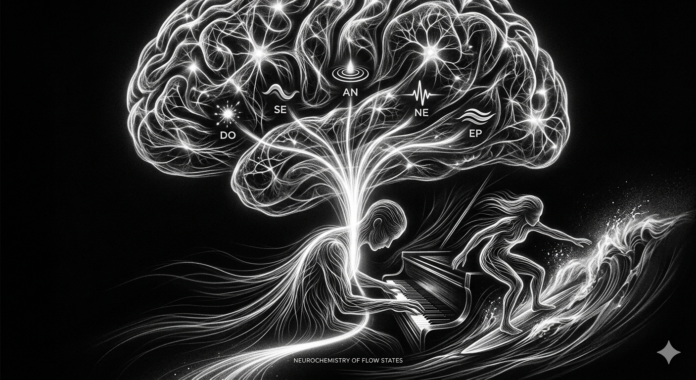
El estado de flow está sostenido por una compleja sinfonía neuroquímica. Durante este estado, el cerebro libera cinco sustancias clave:

  • Dopamina → enfoque, motivación, reconocimiento de patrones
  • Norepinefrina → energía, atención, aceleración cognitiva
  • Anandamida → pensamiento lateral, conexión de ideas distantes
  • Serotonina → bienestar, regulación emocional
  • Endorfinas → reducción del dolor, sensación de placer

Estas sustancias no solo optimizan el rendimiento físico, sino que transforman la cognición. El artista en flow no solo produce más, sino que percibe más, conecta más y arriesga más.

Como señalas en el texto base:

El cerebro entra en una “cascada neuroquímica” que amplifica velocidad, profundidad y capacidad de procesamiento

II. El artista en flow: percepción expandida

Desde una perspectiva museológica y estética, el flow redefine la relación entre artista, obra y percepción.

En este estado:

  • El tiempo se distorsiona (horas → minutos)
  • La percepción sensorial se intensifica
  • La intuición sustituye al razonamiento analítico
  • La autoconciencia disminuye

Este fenómeno es conocido en neurociencia como hipofrontalidad transitoria, una reducción temporal de la actividad en el córtex prefrontal.

Para el artista visual, esto implica algo radical:

La suspensión del yo como filtro crítico permite el acceso directo al proceso creativo.

Es en este punto donde la pintura deja de ser representación y se convierte en evento cognitivo.

III. Creatividad como recombinación: el rol del flow

La creatividad no es un acto ex nihilo. Es un proceso recombinatorio: nuevas ideas emergen del encuentro entre información reciente y estructuras previas.

El flow potencia este proceso en tres niveles:

1. Entrada masiva de información

La dopamina y la norepinefrina intensifican el enfoque, permitiendo absorber más estímulos por segundo.

2. Reconocimiento de patrones

Se reduce el “ruido” cognitivo, facilitando conexiones entre elementos aparentemente inconexos.

3. Pensamiento lateral

La anandamida permite vincular ideas distantes, núcleo de la innovación artística.

Los estudios del Flow Research Collective sugieren aumentos de hasta 700% en creatividad.

IV. Motivación intrínseca: el motor invisible del artista

Desde la psicología, el flow es un estado autotélico: la actividad se justifica por sí misma.

Esto es crucial en el arte contemporáneo, donde el valor no siempre es inmediato ni económico.

El sistema motivacional sigue una secuencia:

  1. Curiosidad → atención sin esfuerzo
  2. Pasión → foco sostenido
  3. Propósito → dirección simbólica
  4. Autonomía → libertad creativa
  5. Maestría → refinamiento técnico

Para el artista, esto se traduce en una práctica donde el estudio no es un lugar de producción, sino de investigación existencial.

V. Cómo entrar en flow “a voluntad”: protocolo para artistas visuales

Contrario al mito romántico, el flow no depende de la inspiración, sino de condiciones específicas.

1. Equilibrio desafío-habilidad

Trabaja en el límite de tu capacidad.

  • Demasiado fácil → aburrimiento
  • Demasiado difícil → ansiedad

El arte ocurre en la zona de tensión controlada.

2. Bloques de concentración profunda

  • 90–120 minutos sin interrupciones
  • Sin teléfono, sin redes
  • Preparación previa del espacio

La interrupción rompe el estado y puede requerir hasta 15 minutos para recuperarlo

3. Diseñar estímulos dopaminérgicos

Introduce en tu práctica:

  • Novedad → nuevos materiales, formatos
  • Complejidad → problemas visuales abiertos
  • Riesgo → decisiones irreversibles en la obra
  • Asombro → exposición a lo desconocido (naturaleza, ciencia, archivo)

4. Activar el cuerpo

El flow no es solo mental. Es psicofísico.

  • Movimiento previo (caminar, estiramientos)
  • Respiración consciente
  • Ritmo corporal alineado con la acción

5. Ritmo circadiano

Identifica tu momento de máxima lucidez:

  • Madrugada → alta claridad conceptual
  • Noche → mayor apertura asociativa

El artista debe trabajar cuando el sistema nervioso está alineado.

VI. Flow y aprendizaje acelerado

Uno de los descubrimientos más relevantes es que el flow acelera la adquisición de habilidades.

Los neuroquímicos actúan como marcadores de relevancia:

“Esto es importante, consérvalo.”

Estudios asociados a DARPA muestran:

  • Aprendizaje 230% más rápido
  • Reducción significativa del tiempo hacia la maestría

Para el artista, esto implica que:

La repetición en flow no es práctica, es transformación estructural del cerebro.

VII. Hacia una estética del flow

Desde una perspectiva filosófica, el flow plantea una pregunta fundamental:

¿Es la obra el resultado del artista, o el artista el resultado del estado?

En el flow, la autoría se diluye. La obra emerge como un sistema autoorganizado donde:

  • El gesto precede al pensamiento
  • La forma precede al significado
  • La intuición precede a la intención

Esto reconfigura la noción misma de creación en el arte contemporáneo.

Conclusión

El flow no es solo una herramienta de productividad. Es un estado ontológico donde el ser humano accede a su máxima capacidad de percepción, acción y creación.

Para el artista visual, dominar el flow implica:

  • Expandir su lenguaje
  • Acelerar su aprendizaje
  • Profundizar su investigación
  • Y, sobre todo, acceder a niveles de creatividad que trascienden la voluntad consciente

En última instancia:

El flow no mejora el arte.
Revela el potencial latente del artista.

PM/AM

PM/AM Gallery
PM/AM Gallery — A Hybrid Model for the Emerging Global Condition

PM/AM Gallery — A Hybrid Model for the Emerging Global Condition

PM/AM Gallery occupies a strategically and symbolically charged position at the intersection of Soho and Fitzrovia—two districts historically tied to London’s cultural production and creative industries. Yet beyond its geography, PM/AM distinguishes itself through a hybrid institutional model that merges exhibition-making, residency programming, and editorial practice into a cohesive platform.

From a curatorial and museological perspective, PM/AM operates as a multi-layered ecosystem rather than a conventional gallery. Its dual exhibition floors accommodate a dynamic program that moves fluidly between emerging, recently graduated, and mid-career international artists, while its lower-ground studio functions as a residency space. This integration of production and presentation collapses the traditional separation between studio and gallery, positioning artistic development as a visible and ongoing process rather than a concealed prelude to exhibition.

Central to PM/AM’s ethos is a commitment to engaging with the complexities of contemporary identity and global interconnection. The gallery actively foregrounds artists whose practices emerge from diasporic contexts, reflecting a broader shift in contemporary art toward plural, transnational narratives. In this sense, PM/AM aligns itself with a generation of institutions that seek to decenter dominant art-historical frameworks, privileging instead a multiplicity of voices and lived experiences.

Critically, the gallery’s emphasis on incubation—both through its residency program and its long-term engagement with artists—positions it within a lineage of developmental institutions. However, unlike traditional non-profit or academic models, PM/AM operates within the commercial sphere while maintaining a pedagogical and research-oriented approach. Its activities in publishing, consultation, and editorial production further extend its role beyond exhibition, constructing a discursive environment in which artworks are contextualized, interpreted, and circulated.

The gallery’s collaborative openness—working with external curators, writers, and institutions—reinforces its identity as a networked platform, responsive to the shifting conditions of the global art world. This adaptability is particularly significant in London, a city where the density of galleries often leads to homogenization. PM/AM resists this tendency by cultivating a program that is both forward-looking and critically engaged, attentive to the emergent rather than the already validated.

In museological terms, PM/AM can be understood as a proto-institution: a space that anticipates future models of art engagement by integrating creation, exhibition, and discourse within a single framework. It does not merely present art; it actively participates in shaping the trajectories of artists and the narratives through which their work is understood.

Ultimately, PM/AM Gallery reflects a broader transformation within contemporary art—one in which the gallery is no longer a static container, but a living structure of exchange, production, and cultural negotiation.

Address: 37 Eastcastle St, London W1W 8DR, United Kingdom
https://www.pmam.org/

Staff

Patrick Barstow
Founder

Chloé Beroud
Executive Gallery Assistant to Paddy Barstow

Lee Colwill
Director (at Large)

Jill Pettit
Gallery Manager 

Ronald Lamyh
Operations Manager

James Watson
Finance Director


Artist in Residence

2025

  • David Hanes
  • Chi Tien Lin Cheng
  • Hwi Hahm

2024

  • Lucy Robson
  • Mary Shangyu Cai
  • J Carino

2023

  • Natalie Terenzini
  • Auudi Dorsey
  • Raelis Vasquez
  • Alejandra Moros
  • Chidinma Nnoli
  • Mia Chaplin
  • Caroline Jackson

2022

  • Tega Akpokona
  • Ryan Cosbert
  • Mia Middleton
  • Emmanuel Awuni
  • Emmanuel Massillon
  • Matthew Eguavoen

2020

Anthony Miler

PM/AM
37 Eastcastle Street
London W1W 8DR
United Kingdom

Opening Hours
Tuesday, Wednesday by appointment.
Thursday to Saturday 12-5pm
Sunday and Monday closed.


Contact

[email protected]
[email protected]

Exhibited Artists

Absher, Caroline

Adjei Tawiah

Affotey, Annan

Ajani, Remi

Akele, Jesse

Akinfe, Okiki Victoria

Akpokona, Tega

Al-Atallah, Shadi

Alejandra Moros

Alessandro Fogo

Alfie Caine

Aly Helyer

Amanda Ba

Andi Fisher

Angelini, Paola

Anholt, Tom

Annor, Cornelius

Anthony, Crystal Yayra

Auudi Dorsey

Awuni, Emmanuel

Ba, Amanda

Beatrice Scaccia

Behlau, Stefan

Benjamin Senior

Ben Walker

Berger, Laura

Bickmore, Kate

Blue M., Zoé

Bobek, Katrine

Bonell, Jose

Bradley, Ry David

Bright, Layo

Brooklin Soumahoro

Brosinski, Jenny

Burton, Richard

Cai, Mary Shangyu

Caine, Alfie

Caleb Hahne

Carino, J.

Carl E. Hazlewood

Caroline Absher

Caroline Jackson

Chaplin, Mia

Chariker, Mark Ryan

Chidinma Nnoli

Chloe West

Chris Dorland

Chris Hood

Cindy Phoenix

Clegg, Oliver

Collins, James

Conny Maier

Cornelius Annor

Cosbert, Ryan

Cousin, Emma

Cowansage, Corydon

Crews-Chubb, Daniel

Cristián Fernández Ocampo

Crystal Yayra Anthony

Dana James

Daniel Crews-Chubb

Danielle Roberts

Darby Milbrath

De Angelis, Luca

Dennis Loesch

Dennis, Jo

Diamond, Olive

Didier Williams

Dmytrenko, Daria

Dorland, Chris

Dorsey, Auudi

Doug Rickard

Dunkelberg, Hannah Sophie

Eguavoen, Matthew

Ellie Pratt

Elmer Guevara

Emma Cousin

Emma Stern

Emmanuel Awuni

Emmanuel Massillon

Erica Mao

Erin Lawlor

Facciola, Francesca

Fan, Dingyue (Luna)

Fernández Ocampo, Cristián

Fisher, Andi

Florence Peake

Fogo, Alessandro

Francesca Facciola

Friedland, Nancy

Gal Schindler

Garwood, Vanessa

Geerk, Lenz

George Rouy

Gilpin, Rebecca

Giovanelli, Louise

Golden, Shyama

Guevara, Elmer

Guo, Yage

Gutheil, Oska

Hahm, Hwi

Hahne, Caleb

Hamed Maiye

Han, Shen

Hanes, David

Hannah Sophie Dunkelberg

Hansel, Matthew (Matt Hansel)

Hanson, Ellen

Harris, Savannah Marie

Hazlewood, Carl E.

Hector, Katie

Helyer, Aly

Herbelin, Nathanaëlle (Nathanaëlle Herbezin)

Hilda Kortei

Hood, Chris

Hosnedlová, Klára

Hosnedl, Igor

Howse, Tom

Irzyk, Nick

Isaac Mann

Ismail, Isshaq

Isshaq Ismail

Ittah Yoda

Ivar Wigan

Jablon, Samuel

Jackson, Caroline

Jack Warne

James Collins

James Owens

James Ulmer

James, Dana

Jasmine Little

Jessie Makinson

Jin Han Lee

Jo Dennis

Johnson, Leasho

Jones, Samuel Levi

Jon Pilkington

Jose Bonnell

Ju, Yeonsu

Justin Williams

Kemp, Lily

Knop, Pierre

Kortei, Hilda

Kristian Touborg

Kuschke, Gina

Layo Bright

Laura Berger

Lauryn Welch

Leasho Johnson

Lee, Jin Han

Lee, Sarah

Lenz Geerk

Lily Kemp

Lina Scheynius

Ling, Tanya

Lipp, Mevlana

Little, Jasmine

Loesch, Dennis

Lonsdale, Tahnee

Lord Ohene

Louise Giovanelli

Luca de Angelis

Luke Silva

Madeline Peckenpaugh

Malik, Muna

Manford, JJ

Mann, Isaac

Mao, Erica

Mario Moore

Mark Ryan Chariker

Massillon, Emmanuel

Matt Hansel

Matthew Eguavoen

McFarlane, Kenrick

Mevlana Lipp

Mia Chaplin

Mia Middleton

Middleton, Mia

Milbrath, Darby

Mike Shultis

Monsieur Zohore

Moore, Mario

Moritz Wegwerth

Moros, Alejandra

Mrozowski, Ryan

Muna Malik

Mutuku, Joseph Baraka Munyao

Na Chainkua Reindorf

Natalie Terenzini

Nathanaëlle Herbelin

Neil Raitt

Nick Irzyk

Nnoli, Chidinma

Ohene, Lord

Okiki Victoria Akinfe

Olivia Sterling

Oliver Clegg

Orme, Ryan

Orta, Emily

Oska Gutheil

Owens, James

Ozwyn, Gaia

Paola Angelini

Park, Wendy

Paul Anthony Smith

Peake, Florence

Peckenpaugh, Madeline

Phoenix, Cindy

Pierre Knop

Pilkington, Jon

Pratt, Ellie

Quintana, Caleb Hahne

Raelis Vasquez

Raitt, Neil

Reindorf, Na Chainkua

Remi Ajani

Richard Burton

Roberts, Danielle

Roche, Emma

Robson, Lucy

Rouy, George

Ry David Bradley

Ryan Cosbert

Ryan Mrozowski

Ryan Orme

Saheed, Wahab

Samuel Levi Jones

Sarah Lee

Savannah Marie Harris

Scaccia, Beatrice

Schindler, Gal

Senior, Benjamin

Serrano, Edgar

Shadi Al-Atallah

Shanna Waddell

Shaqúelle Whyte

Shen Han

Shultis, Mike

Silva, Luke

Sinae Yoo

Smith, Paul Anthony

Soumahoro, Brooklin

Stamm, Michael

Stefan Behlau

Sterling, Olivia

Stern, Emma

Tahnee Lonsdale

Tanya Ling

Tawiah, Adjei

Teede, Helen

Tega Akpokona

Terenzini, Natalie

Tom Anholt

Tom Howse

Touborg, Kristian

Towers, Noelia

Ulmer, James

Umanetz, Vladimir

Vanessa Garwood

Vasquez, Raelis

Wahab Saheed

Walker, Ben

Wang, Augustina

Wang, Xiao

Warne, Jack

Welch, Lauryn

Wendy Park

West, Chloe

Whiteford, Blair

Whyte, Shaqúelle

Wigan, Ivar

William, Didier

Williams, Justin

Xiao Wang

Yage Guo

Yeonsu Ju

Yoda, Ittah

Yoo, Sinae

Zoé Blue M.

Page 2 of 284
1 2 3 4 284