Home Blog Page 4

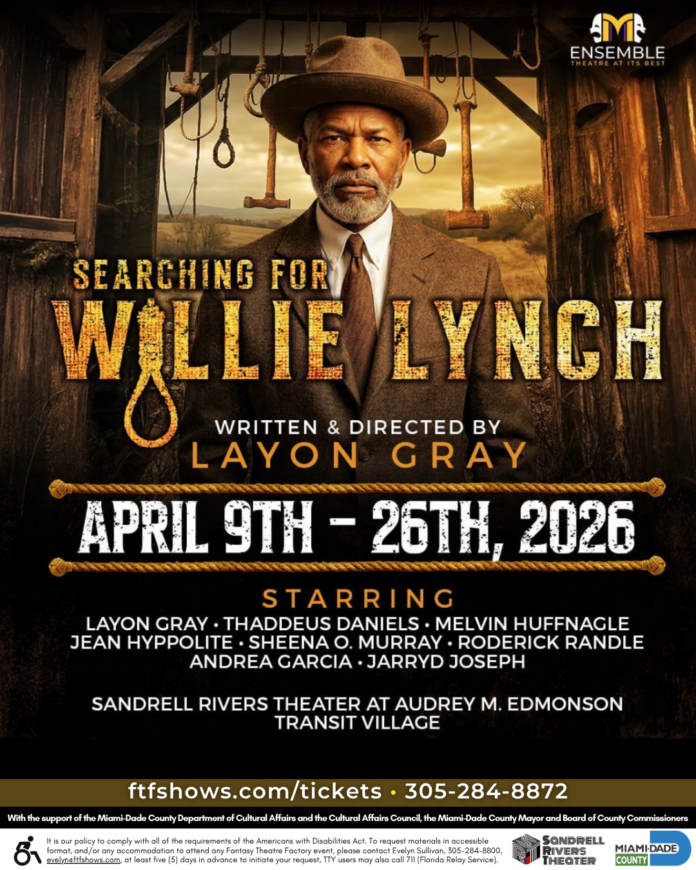
Searching for Willie Lynch

Searching for Willie Lynch

Searching for Willie Lynch

The M Ensemble Company

Apr 9 – 26, 2026

Location: 6103 NW 7th Ave, Miami, FL 33127

A story that confronts the past—and follows it into the present.
Opening this week at the Sandrell Rivers Theater, The M Ensemble Company presents Searching for Willie Lynch, a new play written and directed by Layon Gray.
Spanning 19301965, and 2008, the production follows three families connected across time—each uncovering pieces of a history that continues to shape their lives.
At the center is a question that doesn’t easily resolve:
What has been passed down—and what still needs to be understood?
Through a theatrical structure that blends realism with a mysterious portal linking generations, the story moves between eras, revealing how division, identity, and inherited narratives echo across decades.
Performance Schedule:
Opening Night: Thursday, April 9 • 8:00 PM
Evenings: April 10, 11, 17, 18, 24, 25 • 8:00 PM
Matinees: April 12, 19, 25, 26 • 3:00 PM


Produced by the M Ensemble Company, one of South Florida’s leading Black theatre institutions, this production continues a legacy of work that engages directly with history, culture, and community.

This is a play that invites reflection, conversation, and attention.

Now on stage for a limited run.
Buy Tickets for Searching for Willie Lynch

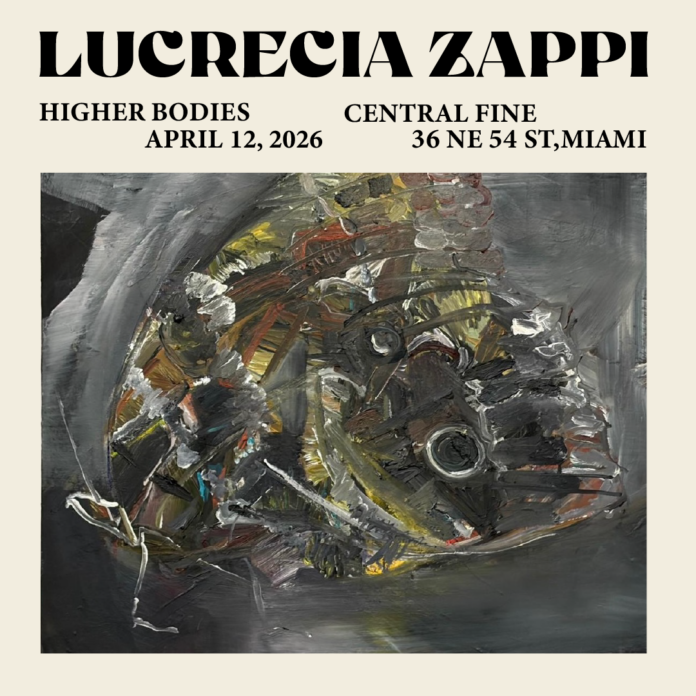
Lucrecia Zappi Higher Bodies 

Argus 2025-2026 Oil on linen 15 x 18 in 38 x 45 cm

Lucrecia Zappi 
Higher Bodies 

Opening Reception: Sunday April 12th, 2026 6pm-8:30pm

36 NE 54th Street, Miami, FL 33137
Gallery Hours: Tuesdays, Thursdays & Saturdays, 11 AM – 5 PM (and by appointment)

We are proud to announce Higher Bodies, a solo presentation by Lucrecia Zappi.
Lucrecia Zappi presents her first solo exhibition, a group of gestural paintings centered on flesh, stage, and displacement. Born in Buenos Aires, raised in São Paulo, and based in New York, she brings a transnational sensibility to canvases that operate as arenas where the body endures and shifts.
Between spectacle and vulnerability, figures emerge exposed, only to recede again. The space at times becomes a stage – at once monumental and devotional – where the figure is both subject and witness. Her language, visceral and restrained, unfolds across surfaces slathered with metallic silver that glints like armor, recalling Moorish architectural elements as they appear in Brazilian vernacular – structures that filter vision and light. Mirrors echo nature itself, doubling and dispersing it, so that perception becomes multiplied and alive.

A central diptych inspired by Hansel and Gretel reimagines the tale through an innocent lens, inflected with Freudian undertones. It conjures a dreamlike realm, a passage marked by fantasy, uncanny disorientation, and the pursuit of a better place. The journey reads as initiation – a movement toward the unknown that hovers between myth and, in a contemporary register, a crossing.

At the core of her work lies what the artist calls “sulfate,” a residue of endurance. The paintings feel weathered, abraded, as if shaped by constant retelling. Within these layers, Lucrecia’s parallel life as a novelist surfaces in inscriptions that echo the work’s chromatic intensity. Her canvases hold fragments where narrative is embedded, interrupted, and rewritten, moving closer to rhythm than to overt speech.
In this debut exhibition, wonder and unease coexist. Migration expands into myth. And the body, whether human or feral, remains in a constant state of flux. Lucrecia Zappi was born in Argentina and grew up in Brazil. Last year she showed her work in two group exhibitions at CENTRAL FINE and participated at a group presentation at Art Basel Miami Beach 2025. She’s an awarded novelist, with three published novels in several countries and with a career in visual arts journalism, writing mostly for the major Brazilian newspaper “Folha de S. Paulo.”

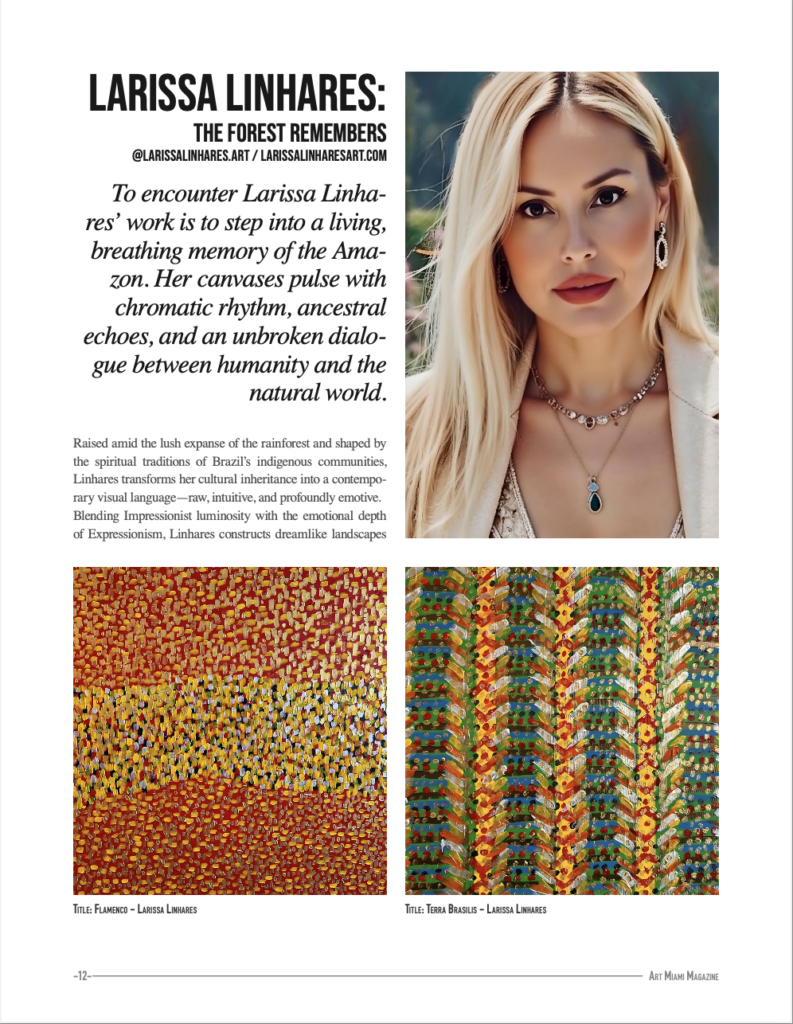
Larissa Linhares: The Forest Remembers

Larissa Linhares:
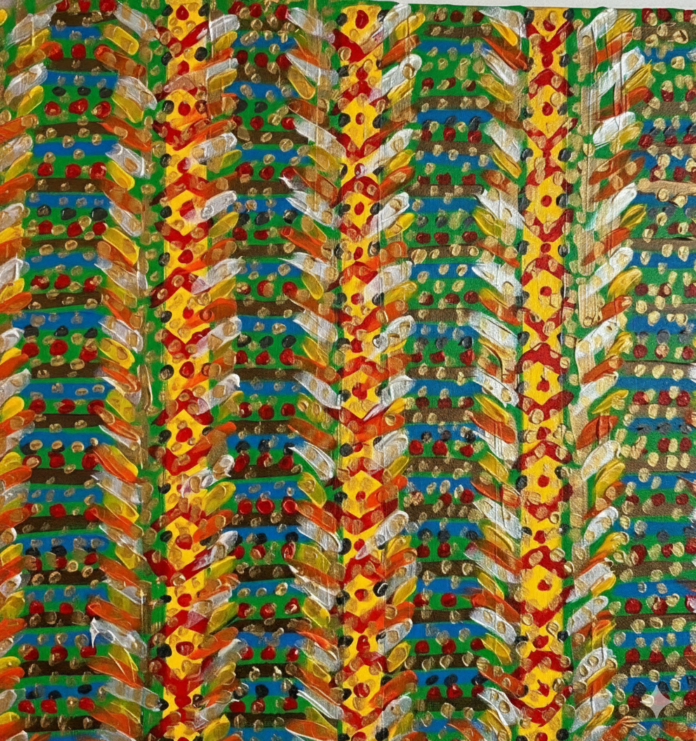
Larissa Linhares: Terra Brasilis

Larissa Linhares: The Forest Remembers

@larissalinhares.art / Larissalinharesart.com

To encounter Larissa Linhares’ work is to step into a living, breathing memory of the Amazon. Her canvases pulse with chromatic rhythm, ancestral echoes, and an unbroken dialogue between humanity and the natural world. Raised amid the lush expanse of the rainforest and shaped by the spiritual traditions of Brazil’s indigenous communities, Linhares transforms her cultural inheritance into a contemporary visual language—raw, intuitive, and profoundly emotive.

Blending Impressionist luminosity with the emotional depth of Expressionism, Linhares constructs dreamlike landscapes that hover between memory and myth. Her colors—saturated, trembling, alive—convey more than light; they embody pulse, prayer, and presence. Each brushstroke becomes an invocation, a rhythm of belonging that ties her inner world to the earth’s eternal vibration.

Linhares paints from within the forest, both literally and spiritually. “The forest whispered through my paint,” she reflects—a statement that encapsulates her process of surrender and symbiosis. Her works are not representations of nature but incarnations of it: portals through which viewers may rediscover the lost intimacy between body, spirit, and land.

Her art resists categorization. It is at once autobiographical and universal, rooted in heritage yet unbound by form. Linhares’s paintings awaken something elemental within us—a recognition of our shared origins, our fragility, and our capacity for renewal.

In her world, painting becomes a ceremony. The canvas becomes a forest. And color becomes a language older than words—one that still remembers who we are.

Larissa Linhares:
Larissa Linhares:
Larissa Linhares:

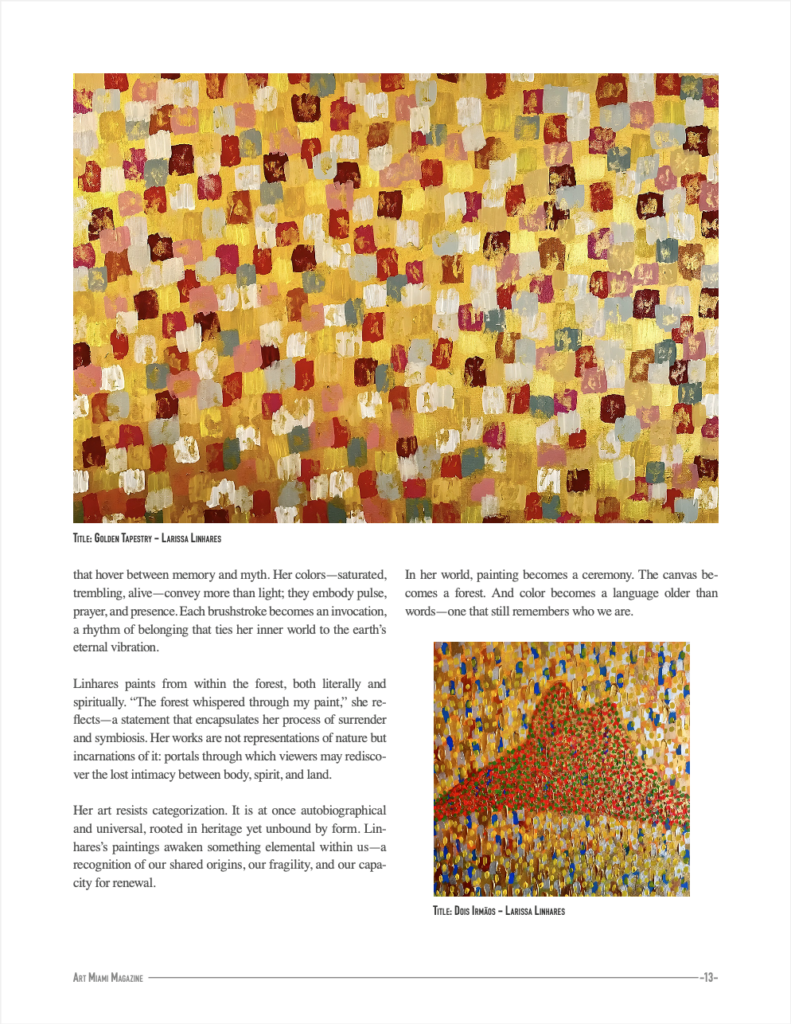
Lauren Jane Clancy: Aesthetics of Endurance

Lauren Jane Clancy

Lauren Jane Clancy: Aesthetics of Endurance

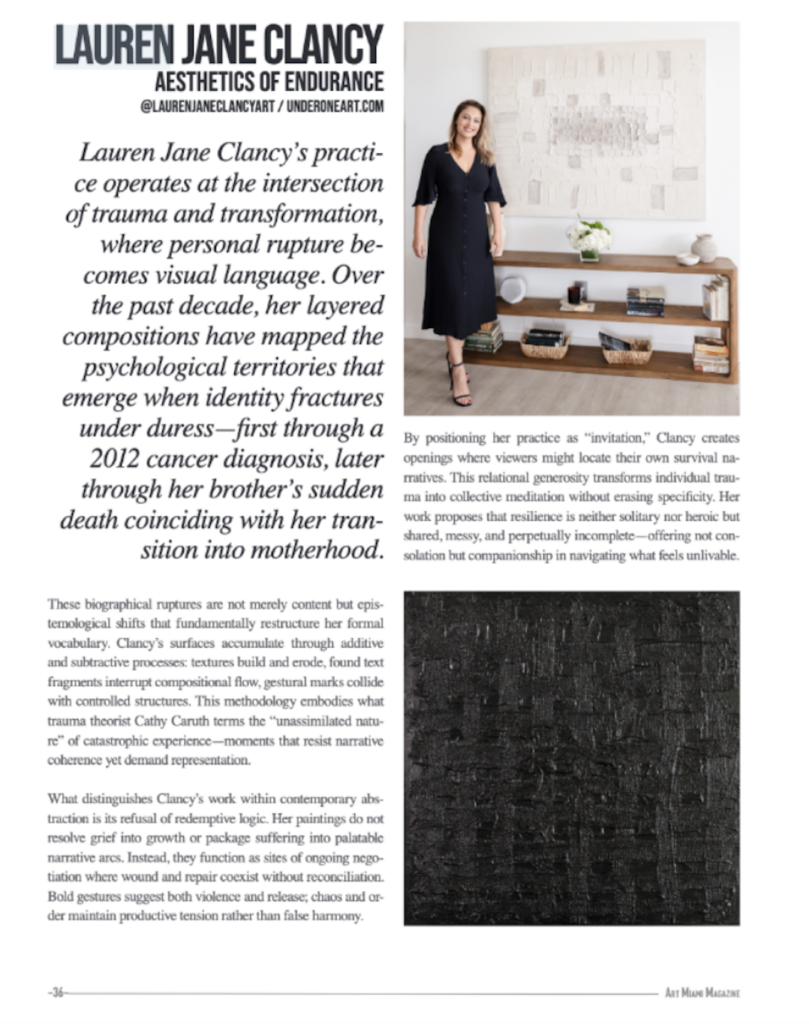
@laurenjaneclancyart / Underoneart.com

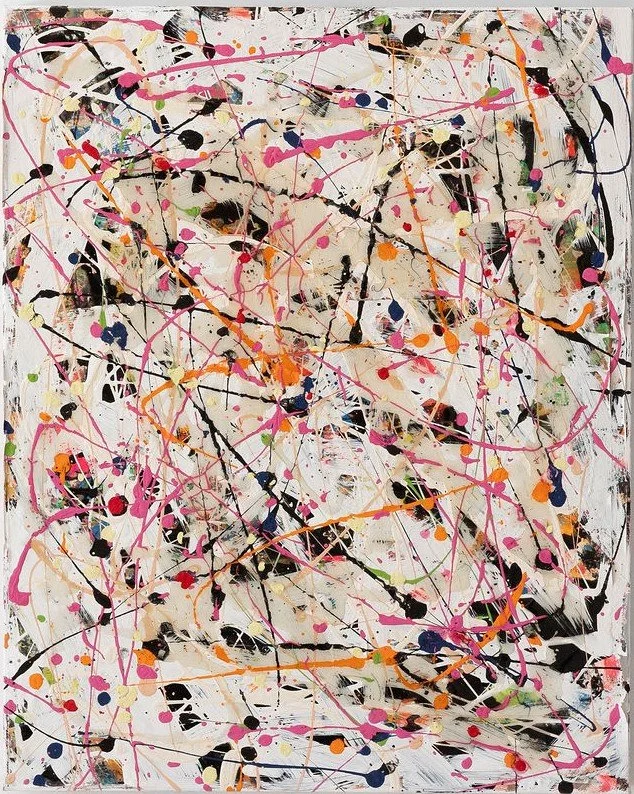
Lauren Jane Clancy’s practice operates at the intersection of trauma and transformation, where personal rupture becomes visual language. Over the past decade, her layered compositions have mapped the psychological territories that emerge when identity fractures under duress—first through a 2012 cancer diagnosis, later through her brother’s sudden death coinciding with her transition into motherhood.

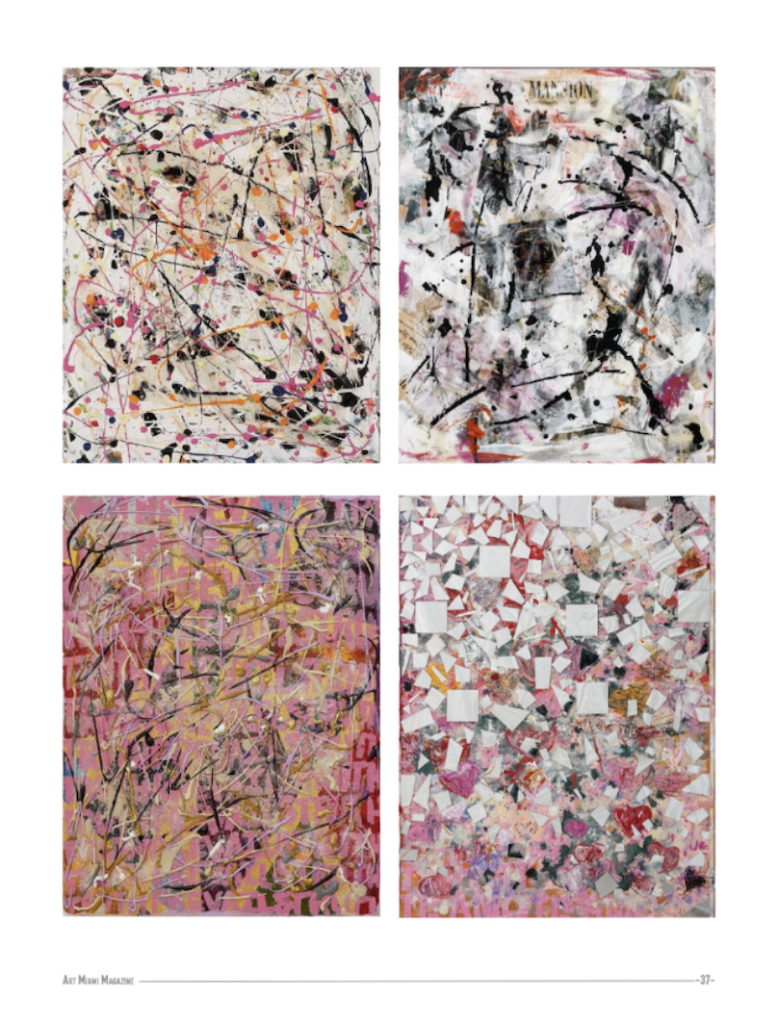
These biographical ruptures are not merely content but epistemological shifts that fundamentally restructure her formal vocabulary. Clancy’s surfaces accumulate through additive and subtractive processes: textures build and erode, found text fragments interrupt compositional flow, gestural marks collide with controlled structures. This methodology embodies what trauma theorist Cathy Caruth terms the “unassimilated nature” of catastrophic experience—moments that resist narrative coherence yet demand representation.

What distinguishes Clancy’s work within contemporary abstraction is its refusal of redemptive logic. Her paintings do not resolve grief into growth or package suffering into palatable narrative arcs. Instead, they function as sites of ongoing negotiation where wound and repair coexist without reconciliation. Bold gestures suggest both violence and release; chaos and order maintain productive tension rather than false harmony.

By positioning her practice as “invitation,” Clancy creates openings where viewers might locate their own survival narratives. This relational generosity transforms individual trauma into collective meditation without erasing specificity. Her work proposes that resilience is neither solitary nor heroic but shared, messy, and perpetually incomplete—offering not consolation but companionship in navigating what feels unlivable.

Lauren Jane Clancy -Art Miami Magazine
Lauren Jane Clancy
Lauren Jane Clancy
Lauren Jane Clancy

Wabi-Sabi

Wabi-Sabi

8 core Japanese aesthetic values, each deeply rooted in traditional Japanese culture and art:

  1. Wabi-sabi (侘寂)
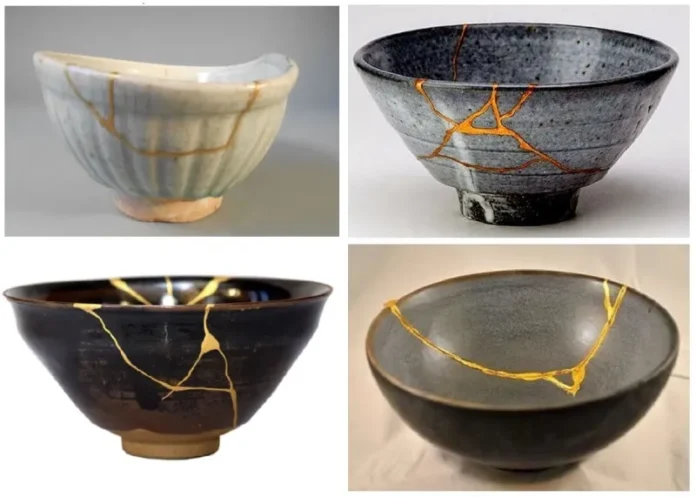
    • This concept embraces the beauty of imperfection, impermanence, and incompleteness, finding value in the marks of time and use on objects and spaces. It encourages an appreciation for the natural aging process and the unique character that develops over time.  Beauty in imperfection, impermanence, and simplicity. Embraces the natural aging process and the incomplete.
  2. Shibui (渋い)
    • This aesthetic describes objects and spaces that are simple, subtle, and understated, yet possess a deep and enduring beauty. Shibui design avoids unnecessary ornamentation, focusing instead on essential elements like texture, asymmetry, and a balance between complexity and simplicity.  Subtle and refined elegance. It values understated beauty and depth, often revealing more upon closer inspection.
  3. Iki (粋)
    • Iki, primarily associated with Edo-period (1603-1868) aesthetics, emphasizes chicness and stylishness, often with a sense of understated elegance and a hint of rebellion against conventional norms.  Chic, sophistication, and originality. A refined stylishness with spontaneity and minimalism, often seen in fashion and urban culture.
  4. Yūgen (幽玄)
    • Yugen refers to a sense of profound mystery and subtle grace, often achieved through the use of light and shadow, understated colors, and the suggestion of deeper meaning beyond what is immediately visible.  Mysterious depth or subtle grace. It refers to an awareness of the universe that triggers emotional responses too deep for words.
  5. Ma (間)
    • Negative space or pause. The space between things that gives them meaning—seen in architecture, music, and conversation.
  6. Mottainai (もったいない)
    • A sense of regret over waste. Encourages mindfulness in the use of resources, fostering appreciation and sustainability.
  7. Mono no aware (物の哀れ)
    • The gentle sadness or empathy toward the ephemeral nature of life. It celebrates the fleeting beauty of moments.
  8. Kanso (簡素)
    • Simplicity and elimination of clutter. Rooted in Zen, it values purity, clarity, and the essence of form.

These principles are interwoven into traditional and contemporary Japanese design, from tea ceremonies and gardens to architecture and fashion.

  • Wabi-Sabi:.This concept embraces the beauty of imperfection, impermanence, and incompleteness, finding value in the marks of time and use on objects and spaces. It encourages an appreciation for the natural aging process and the unique character that develops over time. 
  • Shibui:.This aesthetic describes objects and spaces that are simple, subtle, and understated, yet possess a deep and enduring beauty. Shibui design avoids unnecessary ornamentation, focusing instead on essential elements like texture, asymmetry, and a balance between complexity and simplicity. 
  • Yugen:.Yugen refers to a sense of profound mystery and subtle grace, often achieved through the use of light and shadow, understated colors, and the suggestion of deeper meaning beyond what is immediately visible. 
  • Iki:.Iki, primarily associated with Edo-period (1603-1868) aesthetics, emphasizes chicness and stylishness, often with a sense of understated elegance and a hint of rebellion against conventional norms. 

“Wabi Sabi: The Wisdom in Imperfection” by Nobuo Suzuki explores the Japanese aesthetic and philosophical concept of wabi-sabi, which embraces the beauty of imperfection, transience, and the natural world.

Fukinsei (不均斉): asymmetry, irregularity;

Kanso (簡素): simplicity;

Koko (考古): basic, weathered;

Shizen (自然): without pretense, natural as a human behaviour;

Yūgen (幽玄): subtly profound grace, not obvious;

Datsuzoku (脱俗): unbounded by convention, free;

Seijaku (静寂): tranquility, silence.

Here are 7 lessons from the book:

1. Embrace Imperfection: Wabi Sabi celebrates the beauty of imperfection and transience. Recognizing and accepting flaws and imperfections can lead to a deeper appreciation of the present moment and the uniqueness of each experience.

2. Find Beauty in Simplicity: Simplicity and minimalism are central to Wabi Sabi. Finding beauty in simple, unadorned things can bring a sense of calm and clarity to life.

3. Appreciate Transience: Everything in life is temporary and ever-changing. Embracing the fleeting nature of life helps us value moments and experiences more deeply, and encourages us to live fully in the present.

4. Value the Natural Process of Aging: Aging and the wear and tear of time contribute to the character and beauty of objects and people. Wabi Sabi teaches us to appreciate the natural process of aging and to find value in the stories and experiences that come with it.

5. Accept Impermanence: The idea that nothing lasts forever encourages acceptance of change and loss. Accepting impermanence helps in letting go of attachment and finding peace in the face of life’s uncertainties.

6. Cultivate Mindfulness: Wabi Sabi encourages mindfulness and presence. By being fully engaged in the present moment, we can appreciate the subtle beauty in everyday life and experiences.

7. Seek Authenticity: Authenticity and genuineness are key aspects of Wabi Sabi. Embracing what is real and true, rather than striving for perfection or idealized standards, leads to a more fulfilling and meaningful life.

Daria Tuminas

Daria Tuminas

Daria Tuminas

Daria Tuminas no solo curaduría fotografía; la disecciona, la reinventa, la empuja más allá del papel impreso o la pared de la galería. Su trayectoria es un recorrido quirúrgico por las múltiples vidas de la imagen fotográfica: en el fotolibro, en la exhibición, en el espacio público, en el pensamiento crítico que la rodea. Su trabajo en FOTODOK y Foam Museum no es simplemente programar exposiciones, sino construir diálogos visuales que cuestionan cómo vemos, qué recordamos y qué decidimos olvidar.

Tuminas entiende que la fotografía es una bestia inquieta: no se deja encerrar en un marco, ni en la comodidad del libro de arte. Su rol en Unseen Book Market demostró que el fotolibro no es un objeto muerto sino una experiencia en expansión. Y cuando co-fundó Growing Pains en 2022, dejó claro que no solo está aquí para escribir sobre imágenes, sino para hacerlas circular, amplificar voces de mujeres y artistas no binarios que han sido sistemáticamente dejados fuera de la conversación.

Su próxima exposición en WORM, Rotterdam, con Radiations of War de Yana Kononova, es el ejemplo perfecto de su curaduría como acto de tensión: una confrontación entre lo visible y lo invisible, entre lo documental y lo espectral. Tuminas no busca respuestas fáciles ni imágenes complacientes; lo suyo es la fotografía como campo de batalla conceptual.

Si alguien cree que los fotolibros y las exposiciones son meros objetos de contemplación pasiva, no ha seguido el trabajo de Tuminas. Ella está aquí para incomodar, para abrir grietas en el discurso, para recordarnos que la fotografía no solo captura el mundo, sino que lo construye.

Éline Gourgues

Éline Gourgues

Éline Gourgues

@elinegrgs

Éline Gourgues no es solo una curadora independiente; es una arquitecta cultural que está desmantelando y reconstruyendo la escena artística caribeña desde sus cimientos. Desde Fort-de-France, su práctica no sigue las reglas del establishment artístico global, sino que las reescribe con el lenguaje de una región que históricamente ha sido narrada por otros. Su trabajo en Station Culturelle, en colaboración con Éléna Arnoux, es un manifiesto en sí mismo: una plataforma que no solo da espacio a la emergencia artística del Caribe, sino que la impulsa, la proyecta y la convierte en un movimiento con peso propio.

Su recorrido es una lección de cómo la curaduría puede ser tanto un acto de resistencia como un ejercicio de creación de mitologías nuevas. No es casual que su enfoque se oriente hacia prácticas que desafían las normas y reescriben los códigos visuales impuestos por las hegemonías culturales. Desde las salas del International Center of Photography en Nueva York hasta la Maison de la Photographie Amazonienne en Guyana, Gourgues ha tejido una red que no solo exhibe arte, sino que le da contexto, le devuelve su historia y lo posiciona en el mapa sin necesidad de pedir permiso.

Lo que hace fascinante su trabajo es esa habilidad quirúrgica para identificar narrativas que han sido silenciadas, desplazadas o simplemente ignoradas por la mirada eurocéntrica. Sus proyectos no son solo exhibiciones, son territorios conquistados por artistas que finalmente pueden contar sus propias historias sin intermediarios. En un mundo donde la cultura visual sigue atrapada en una lucha entre el centro y la periferia, la obra de Gourgues es un recordatorio de que el arte caribeño no es una nota al pie en la historia del arte contemporáneo: es una voz que exige ser escuchada en sus propios términos.

Collé Artists

Collage

Collé Artists was founded as a project of Atelier Pardon in order to document and publicize the ongoing research into the medium of collage as conducted by the Pardon Collection.

Nicholas Pardon, Founder

(b.1983) is the Founder of Pardon, a modern family office and venture studio working at the intersection of art & entrepreneurship. Pardon unites with next-gen wealth creators to champion culture-shaping initiatives and fund impact-driven ideas. Nicholas is also the founder of the Pardon Collection, a collection of contemporary conceptual art with an emphasis on collage.

Mario Zoots, Curator

(b.1981) lives and works in Denver, CO, where he received his MFA from the University of Denver in 2014. As a lens-based artist, he employs modes of appropriation and collage. Altering mass-produced images, found photographs, and pop culture icons to reimagine and question the belief systems that shape our world.

Tyler Cash, Designer

(b.1993) Tyler brings his widespread expertise in art, entrepreneurship, design, and hospitality to the visual world of Collé. He has a broad background as a multidisciplinary designer, collaborating with numerous small businesses and agencies within the creative industry. He holds a Bachelor of Fine Arts degree in Graphic Design from Biola University and is based in Orange County, California.

Name/Nationality
Accidental Collage United Kingdom
Ace Alamillo Philippines
Francine Alves Brazil
Anthony Amadeo United States
Pariwat Anantachina Thailand
La Société Anonyme Netherlands
Jonathan Auch Germany
Nola Ayoola Nigeria
Edgard Barbosa United States
Omar Barquet Mexico
Todd Bartel United States
Millie Bartlett Australia
Marisa Bazan United States
Allan Bealy United States
Aaron Beebe United States
Miriam Beichert Germany
Alex Belser United States
Nicole Beno Canada
Brenda Biondo United States
Liberty Blake United States
Susana Blasco Spain
Fred Blauth United States
Jordan Bohannon United States
Cecilia Bonilla United Kingdom
Agata Borowska Poland
Denis Boudart France
Sonia Boué England
Brado United States
Danilo Brandão Australia
Kirkland Bray United States
Laurence Briat France
Adam Brierley United States
Anja Brunt Netherlands
Andrea Burgay United States
Chris Burnett United States
Maxwell Burnstein Canada
Mark Busch Denmark
Blake Cale United States
Sara Campaci Germany
Luján Candria United States
Albert Cano Spain
Sara Cardona Mexico
Mighty Joe Castro United States
Victoria Cecé United Kingdom
Dara Cerv United States
Constantinos Chaidalis Greece
Jorge Chamorro Spain
Zoë Charlton United States
Clashing Squirrel France
Forestter Cobalt United States
Gail Coito United States
Andrei Cojocaru France
Anabelle Condé Belgium
Scott Cottrell United States
Ferran Coves Spain
Eli Craven United States
Kate Cuthbert Australia
DR.ME United Kingdom
Zeynep Dagli United Kingdom
Paola Dcroz Spain
Edoardo De Falchi Italy
Gonzalo De Miguel Spain
Chiara De Zan Italy
Michael DeSutter United States
Elke Desutter Belgium
Ben DiNino United States
Truett Dietz United States
Jake Dombroski United States
Lotte Bruning Donskoi Portugal
Chris Dorland United States
Michael Eble United States
Jean Edelbluth France
Travis Egedy United States
Philipp Eichhorn Germany
Julita Elbe Germany
Electric Beast United States
Xoana Elias Spain
Rebeka Elizegi Spain
Kellette Elliott United States
Sophia Poppy Ericksen United States
Anneke Eussen Netherlands
Dan Evans United States
Rhed Fawell Scotland
Jack Felice United States
Mike Fernandez United States
A.P. Fiedler United States
Lesley Finn United States
Musta Fior France
Guillermo Flores Mexico
Nina Fraser Portugal
Fred Free United States
Jesse Freeman Japan
David Fresno Spain
John Gall United States
James Gallagher United States
Andrés Gamiochipi Mexico
Melanie Garcia Canada
Enrique Garcia Mexico
Pamela García Valero Mexico
Fanny Garnichat France
Kunel Gaur Canada
Emily Geirnaert France
Nicolo Gentile United States
Anthony Gerace United Kingdom
Eva Gjaltema Germany
Charlie Goering United States
Vera Gomes Norway
Gracia the Artist United States
Jeremy Grant United States
Anthony Grant United States
Samuel Graveline Canada
Daniel J. Gregory United Kingdom
Nigel Grimmer United Kingdom
Maggie Groat Canada
Rocío Gándara Mexico
Robert Hall United Kingdom
Cody Haltom United States
Luis Hampshire Mexico
Michael Harnish United States
Mark Harris United States
Harrison Collage United States
Paul Henderson Canada
Michael Hentz United States
Ricardo Miguel Hernández Cuba
Tom Hodgkinson England
James Hosking United States
Kevin Hoth United States
Jess Humphrey United States
Mars Ibarreche United States
Maïté Jane Belgium
Samantha Jensen United States
Prapat Jiwarangsan Thailand
Elyse Jokinen United States
Les Jones England
Laurie Kanyer United States
Jake Kennedy United Kingdom
Jen Klinedinst United States
Guld Knast Denmark
Clive Knights United States
Kodaek_2020 Germany
Aaron Krach United States
Vincent La Scala United States
Eva Lake United States
Morgan Lappin United States
Nick Larsen United States
Rita Lavalle United States
Cristina Lavilla Spain
Alex Eckman Lawn United States
Sean Lee England
Philippe Caron Lefebvre Canada
David Leleu France
Daniel Lint United States
Ira Lombardia United States
Paul Loughney United States
Arnaud Loumeau France
Oliver Lunn United Kingdom
Adeshola Makinde United States
Malacarta Italy
Angel Marcano Mexico
Luis Martin United States
Sofia Masini Italy
Hyland Mather Netherlands
Max-o-matic Spain
Ry McCullough United States
Janice McDonald United States
Andrea McGinty United States
Ian McHale United States
Mike McQuade United States
Travis Medford United States
Valeria Meizles Moldova
Marcia M. L. Mello United States
Jeroen Migneaux Belgium
Miranda Millward United Kingdom
Marryam Moma United States
Rodrigo Moreira United States
Javier Hirschfeld Moreno United Kingdom
Andrea Mortson Canada
Gert Motmans Belgium
Harriet Moutsopolous Australia
Steven Moz United States
Mr. Nelson Netherlands
Rashad Ali Muhammad United States
D.M. Nagu Germany
Carol Nazatto Brazil
Hans Neleman United States
Caco Neves Brazil
Brooke Newberry United States
Casey Niccoli United States
Lee Noble United States
Bill Noir France
Ray Ogar United States
Mobolaji Ogunrosoye Nigeria
Onajevwe Onajevwe United States
Katrien Orlans Belgium
Frida Pain England
Javier Palma Honduras
Mime Paris France
David Paull United States
Gelah Penn United States
Celina Pereira United States
Alejandro Peters Guatemala
Wlad Pieroni Brazil
Bonnita Postma Netherlands
Mac Premo United States
Audrey Pulp France
Charles Purvis United States
Laura Quevedo Spain
Maria Elisa Quiaro Germany
Isabel Reitemeyer Germany
Louis Reith Netherlands
Agata Rek United States
Andrew Rice United States
Gillaume Bougie Riopel Canada
Alexandra Roberta Romania
Juan Romero France
Matthew Rose France
Lara Rouse United States
Emily Rowley United Kingdom
Joe Rudko United States
Vanessa Saba United States
Pablo Sainz Mexico
Jolo Salvador Philippines
Mau Samayoa United Kingdom
Carmen Santamarina Spain
Rafael Santiago United States
Dewey Saunders United States
Alexandra Savior United States
Libby Saylor United States
Conny Goelz Schmitt United States
Doug Schulte United States
The Scissorhands Germany
Phil Scott Denmark
Sharon and Guy United States
Matthew Shelley United States
Laura Shill United States
Eugenie Shinkle United Kingdom
Sarah Z Short United States
Mark Sink United States
Trevor Sloan Canada
Dean Smith United States
Melanie Smith United Kingdom
Gabriel Soares Brazil
Sio Song South Korea
Sonmima Russia
James Springall France
Joseph Staples Canada
Austin Sterpka United States
Vanessa Stevens United States
Aleksandar Stoicovici Germany
Sundry Sullen United States
Sergei Sviatchenko Denmark
George Sydney Denmark
Irja Syvertsen Belgium
THESKINNYTYPE England
Christina Tapper United States
Luke Tarpey United Kingdom
Claudia Tiarez Italy
Steve Tierney Australia
Maria Tokar United Kingdom
Stephen Tomasko United States
Duane Toops United States
Ian Tothill United Kingdom
Cecil Touchon United States
Jas Turk United States
Jelle Van Den Heede Belgium
Vónbjørt Vang Denmark
Niko Vartiainen Finland
Kubi Vasak Australia
Richard Vergez United States
Raphaël Vicenzi Belgium
Robert Voigts United States
Rochelle Voyles United States
Vesna Vrdoljak Netherlands
Mark Wagner United States
Clare Watt United States
Laura Weiler United States
Shane Wheatcroft United Kingdom
Jacob Whibley Canada
John Whitlock United States
Charles Wilkin United States
Jesse Willems Belgium
Katie Williamson United Kingdom
Katie Wolf United States
Vanessa Woods United States
Jens Wortmann Germany
Danim Yoon South Korea
Clara Z Argentina
Josiah Z. United States
Matthew Zaremba United States
Anthony Zinonos United States
Pablo Serret de Ena Denmark
Jasper van der Loos Netherlands
Tracy von Ahsen United States
Zülal Çizmeci Turkey

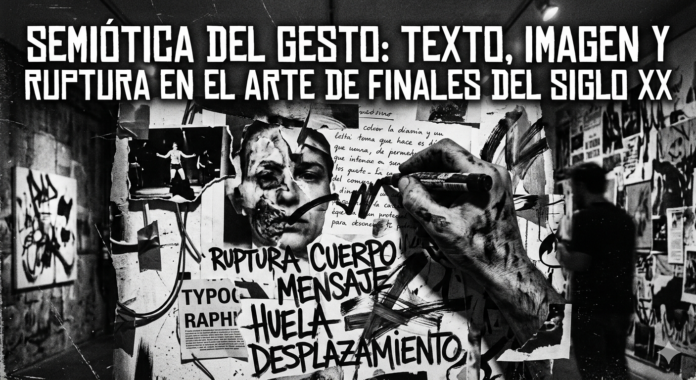
Semiótica del gesto: texto, imagen y ruptura en el arte de finales del siglo XX

Semiótica del gesto: texto, imagen y ruptura en el arte de finales del siglo XX

Semiótica del gesto: texto, imagen y ruptura en el arte de finales del siglo XX

1. Núcleo conceptual: lenguaje, Caribe y pintura expandida

Jean-Michel Basquiat
Figura central del neoexpresionismo neoyorquino de los años ochenta. Su obra articula una síntesis entre graffiti, escritura y pintura, produciendo un lenguaje visual híbrido donde texto e imagen funcionan como estructuras semióticas abiertas. Su práctica aborda historia, raza, violencia simbólica y cultura urbana desde una perspectiva profundamente contemporánea.

Hervé Télémaque
Artista haitiano radicado en París, vinculado al pop europeo y a discursos postcoloniales. Su obra se caracteriza por la incorporación de signos, fragmentos lingüísticos y referencias culturales del Caribe, desarrollando una pintura donde lo semiótico y lo político se entrelazan en un sistema crítico de representación.

2. Contexto urbano y cultura visual: graffiti y downtown New York

Keith Haring
Artista fundamental de la escena neoyorquina de los años ochenta. Tradujo el lenguaje del graffiti en un sistema icónico universal, reduciendo la figura a signos esenciales que abordan temas como poder, sexualidad, enfermedad y cultura de masas.

Lee Quiñones
Uno de los pioneros del graffiti en Nueva York. Elevó esta práctica desde la firma individual hacia composiciones narrativas complejas, utilizando los trenes como soporte para relatos visuales de carácter social y político.

3. Influencias pictóricas: gesto, materialidad y texto

Robert Rauschenberg
Figura clave en la transición del expresionismo abstracto hacia prácticas contemporáneas. Introdujo el ensamblaje y el uso de materiales cotidianos, expandiendo la pintura hacia un campo híbrido entre imagen, objeto y signo.

Cy Twombly
Desarrolló una pintura basada en la escritura como gesto. Su obra combina grafismo, poesía y abstracción, anticipando la relación entre lenguaje y pintura que será central en Basquiat.

Raymond Saunders
Artista que integró texto, identidad racial y crítica cultural dentro de la pintura. Su práctica cuestiona las categorías tradicionales entre abstracción y figuración, influyendo directamente en la dimensión política del lenguaje pictórico de Basquiat.

Sam Gilliam
Innovador del expresionismo abstracto, conocido por liberar la pintura del bastidor. Su enfoque enfatiza el color como experiencia física y espacial, contribuyendo a una comprensión expandida del medio pictórico.

4. Referencias históricas: modernismo y expansión del lenguaje artístico

Pablo Picasso
Figura fundacional del arte moderno. Su fragmentación del cuerpo y apropiación de lenguajes no occidentales abrieron nuevas posibilidades formales que influyen en las prácticas híbridas del siglo XX.

Joseph Beuys
Artista conceptual que redefinió el arte como acción social. Su noción de “escultura social” amplía el campo artístico hacia lo simbólico, lo político y lo colectivo.

Gerhard Richter
Su obra explora la tensión entre abstracción y representación, cuestionando la imagen como portadora de verdad. Este problema resuena en la fragmentación visual y semántica presente en Basquiat.

5. Contexto cultural afroamericano: música, color y experiencia

Archibald Motley Jr.
Pintor asociado al Renacimiento de Harlem. Su obra representa la vida urbana afroamericana mediante una paleta vibrante y escenas dinámicas, estableciendo una relación directa entre color, música (especialmente el jazz y el blues) y experiencia cultural.

Síntesis curatorial

El conjunto de artistas configura una red de influencias donde convergen tres ejes fundamentales:

  1. La transformación del graffiti en lenguaje pictórico (Basquiat, Haring, Quiñones)
  2. La integración de texto, signo y gesto en la pintura (Twombly, Saunders, Rauschenberg)
  3. La dimensión cultural afroatlántica como estructura estética (Télémaque, Motley)

Dentro de este sistema, Basquiat emerge como una figura de síntesis: un artista que no solo absorbe estas tradiciones, sino que las reorganiza en un lenguaje visual radicalmente contemporáneo.

LatinX Artists

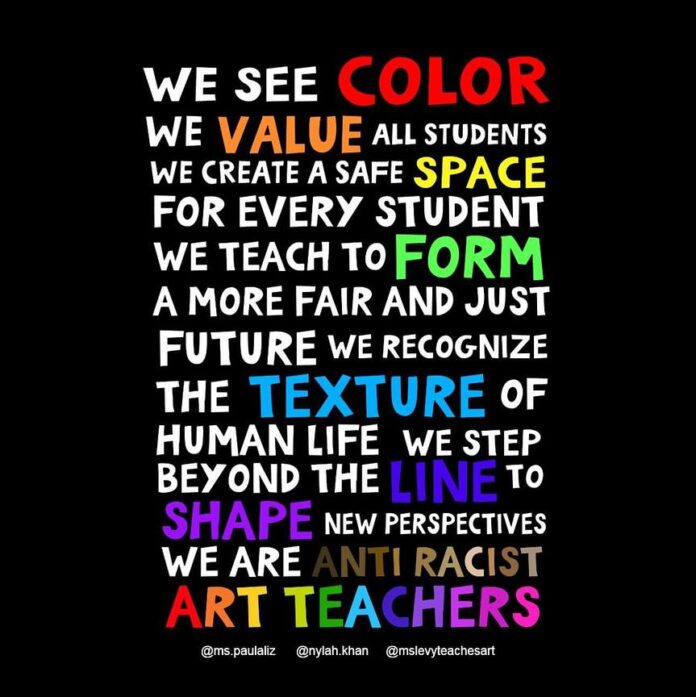
Anti-Racist Art Teachers

LatinX Artists

Artists listed in alphabetical order by first/preferred name.

Artists have many layered identities and art educators need to present them as such.  
Representing diverse artists in your curriculum is only part of an Anti-Bias, Anti-Racist curriculum.  It needs to be more than a symbolic effort and art educators need to take into account intersectionality when introducing these artists to students.  How do aspects of an artists’ social and political identities (ex. gender, sex, race, class, sexuality, religion, ability, physical appearance, etc.) intersect within their work?   
In addition, we recognize that race is socially constructed and it is impossible to put humans in clearly defined categories by race. Racial identity is deeply personal, and artists within any given subgroup define themselves differently. Race, ethnicity, and nationality are all factors artist’s individually consider as their personal identity. However, as mentioned previously that is not all that there is to their identity. We know that artists have many layered identities and art educators need to do the research to present them as such. These groupings are not perfect, as humans are not meant to be divided into boxes. We hope this resource can help art educators identify who is missing from their curriculum in order to create a curriculum more representative of the incredible diversity among students and artists today.

Terminology 

Amerindians: The indigenous population of Latin America.

Boricua:  a Puerto Rican, or person of Puerto Rican descent. It is also the name Puerto Rico’s indigenous Indians, the Taino, gave to their island.  

ChicanX: a Mexican American (can be used in place of the masculine, feminine and gender binary form).

Hispanic and Latino are often used interchangeably though they actually mean two different things. Hispanic refers to people who speak Spanish and/or are descended from Spanish-speaking populations, while Latino refers to people who are from or descended from people from Latin America.

Latin American: relating to or characteristic of Latin America or its inhabitants.

LatinX: a person of Latin origin or descent.

Latin America is a group of countries and dependencies in the Western Hemisphere where Romance languages such as Spanish, Portuguese, and French are predominantly spoken. It is broader than the terms Ibero-America or Hispanic America in categorizing the New World. The term comes from the fact that the predominant languages of the countries originated with the Latin language.  Latin America consists of 20 countries and 14 dependent territories that cover an area that stretches from Mexico to Tierra del Fuego and includes much of the Caribbean. It includes more than 20 nations: Mexico in North America; Guatemala, Honduras, El Salvador, Nicaragua, Costa Rica and Panama in Central America; Colombia, Venezuela, Ecuador, Peru, Bolivia, Chile, French Guiana, Paraguay, Brazil, Argentina and Uruguay in South America; Cuba, the Dominican Republic, Haiti, and Puerto Rico in the Caribbean.

Xicanismo: transcends a label of being Mexican or Mexican American. The “X” connects the person to a recognition of their indigenous identity that is often overlooked by many Mexicans. This identity of Xicanismo reclaims indigenaity by using the “X” which is commonly used for the “ch” sound in indigenous languages.

Name/Nationality
Abdias do Nascimento Brazilian
Adal Maldonado Puerto Rican
Adriana Villagra Paraguayan
Alan Peláez Lopez Afro-Indigenous Mexican
Alán Serna Mexican
Alejandro Macias Mexican American
Alessandra Exposito Cuban / American
Alex Da Corte American Venezuelan
Alexis Diaz Puerto Rican
Aliza Nisenbaum Mexican
Allora & Calzadilla Puerto Rican (Duo)
Alex Rubio Chicano
Ana Leovy Mexican
Ana Serrano Mexican American
Ana Mendieta Cuban
Ana Teresa Barboza Peruvian
Andrea Pérez Bessin Puerto Rican
Angel Otero Puerto Rican
Antonio Maldonado Puerto Rican
Antonio Martorell Puerto Rican
Antuco Chicaiza Ecuadorian
Anuto Chavajay Ixtetela Guatemalan
Arturo Herrera Venezuelan
Arthur Gonzalez American
Augusto Marín Puerto Rican
Beatriz Cortez Salvadorian
Beatriz Milhazes Brazilian
Belkis Ayón Cuban
Betsy Casañas Latina
Broobs Chicanx
Carla Fernández Mexican
Carmen Argote Mexican American
Carmen Herrera Cuban
Carmen Lomas Garza Chicana
Carlos Mercado Puerto Rican
Carolina Caycedo Colombian
Carolyn Castaño Colombian American
Chemi Rosado-Seijo Puerto Rican
Clarissa Tossin Brazilian
Cognate Collective Mexican American
Carol Rossetti Brazilian
Christina Erives Mexican Heritage
Clemencia Lucena Colombian
Criselda Vasquez Mexican-American
Damián Ortega Mexican
Daniela Garcia Mexican American / Latina
Diego Rivera Mexican
Doris Salcedo Colombian
Eduardo Kobra Brazilian
Elia Alba Dominican American
Elizabeth Barreto Puerto Rican
Elle Pérez Puerto Rican
Emilia Cruz Mexican American
Emanuel Martinez Mexican American
Eric J. Garcia Chicano
Ernesto Neto Brazilian
Ernesto Yerena Montejano Chicano / Indigenous
Ester Hernandez Chicana
Emmanuel Aguilera Mexican
Farid Rueda Mexican
Firelei Báez Dominican
Frida Kahlo Mexican
Francis Robateau Belizean American
Freddy Rodríguez Dominican
Favianna Rodriguez American
Felix Quintana Salvadoran-American
Gabi Pérez-Silver Puerto Rican
Gabriel Orozco Mexican
Gabriel Dawe Mexican
Gabriel García Román Mexican-American
Gabriella Sanchez American
Garvin Sierra Puerto Rican
George Rodriguez Mexican American
Gilbert “Magu” Luján Chicano
Gina Gwen Palacios Mexican American
Graciela Iturbide Mexican
Guadalupe Maravilla Salvadoran
Hoesy Corona Mexican
Humberto Ramos Mexican
J. Leigh Garcia Biracial Latina
Jacqueline Valenzuela Mexican-American
Jaime Romano Puerto Rican
Jean-Michel Basquiat Haitian / Puerto Rican
Jesse Treviño Mexican American
Jesus Barraza Xicanx
Jesus Treviño Mexican American
Joaquín Torres-García Uruguayan-Spanish
John Valdez Chicano
Jorge Soto Sánchez Puerto Rican
Joiri Minaya Dominican-American
José Antonio Torres Martino Puerto Rican
José Cuneo Perinetti Uruguayan
José R. Alicea Puerto Rican
José Guadalupe Posada Mexican
José A. Rosa Castellanos Puerto Rican
José Braulio Bedia Valdés Cuban
Josie Del Castillo American
Juan Carlos Escobedo Mexican-American
Juan Downey Chilean-American
Juan Sánchez Puerto Rican
Juana Valdes Cuban
Judith Francisca Baca Chicana
Julio Salgado Mexican
Justin Favela Guatemalan-Mexican-American
Karlito Miller Espinosa Costa Rican
Kukuli Velarde Peruvian
Larry Fuente American
Layqa Nuna Yawar Ecuadorian / Kichwa-Kañari
Leopoldo Méndez Mexican
Lexx Xicana
Lilliam Nieves Puerto Rican
Liliana Porter Argentinian
Lorena Cruz Mexican-American
Lourdes Jiménez Mexican American
Luis Jiménez Mexican American
Lucía Méndez Rivas Dominican
Luz Donoso Chilean
Mamani Mamani Bolivian (Aymara)
Manuel Mendive Afro-Cuban
Marco Hernandez Mexican
Marco Sánchez Mexican
Marela Zacarías Mexican
Maria Amalia Honduran
María Magdalena Campos-Pons Cuban
Mario Testino Peruvian
MATA RUDA (Karl Miller Espinosa) Latin-American
Matthew Willie Garcia Hispanic
Melesio Casas Chicano
Melanie Cervantes Xicana
Micius Stephane Haitian
Morel Doucet Haitian American
Myrna Báez Puerto Rican
Nick Quijano Puerto Rican
Natalia Arbelaez Colombian American
Olga Albizu Puerto Rican
Oswaldo Guayasamín Ecuadorian
Omar Chacon Colombian
Patrick Martinez American
Patssi Valdez Chicana
Paula Liz Puerto Rican
Pepón Osorio Puerto Rican
Pedro Reyes Mexican
Priscilla Monge Costa Rican
Rafael López del Campo Puerto Rican
Rafa Esparza Mexican American
Rafael Soriano Cuban
Raphael Montañez Ortiz Yaqui-Puerto Rican
Raúl de Nieves Mexican
Rachelle Mozman Solano Panamanian
Ramiro Gomez Mexican American
Raquel Gutiérrez American
Ricardo Jaén Panamanian American
River Garza Tongva & Mexican
Roberto Lugo Puerto Rican
Rodríguez Calero Puerto Rican
Ronny Quevedo Ecuadorian
Roberto Gutierrez Chicano
Robert Vargas Mexican-American
Rosenda Alvarez Faro Puerto Rican
Salvador Jiménez-Flores Mexican
Scherezade García Dominican
Sofia Maldonado Puerto Rican
Suzy González Xicana
Sara Barriera Mexican & Puerto Rican
Tania Bruguera Cuban
Tanya Aguiñiga Mexican American
Tarsila do Amaral Brazilian
Teresita De La Torre Mexican
Teresita Fernández Cuban
Tony Aguero Costa Rican
Tony Bechara Puerto Rican
Tony Capellán Dominican
Teresa Burga Peruvian
Victoria Villasana Mexican
Vik Muniz Brazilian
Voluspa Jarpa Saldías Chilean
Vick Quezada Mexican American
Wence Martinez Mexican (Zapotec)
Wendi Ruth Valladares Mexican American
William Camargo Chicanx
William Cordova Peruvian
Wilson Borja Colombian
Xochi Solis Mexican American
Yreina D. Cervántez Chicana
Yvette Mayorga Mexican American
Yolanda Lopez Chicana

Page 4 of 284
1 2 3 4 5 6 284