Bogotá será epicentro regional de la educación artística y cultural
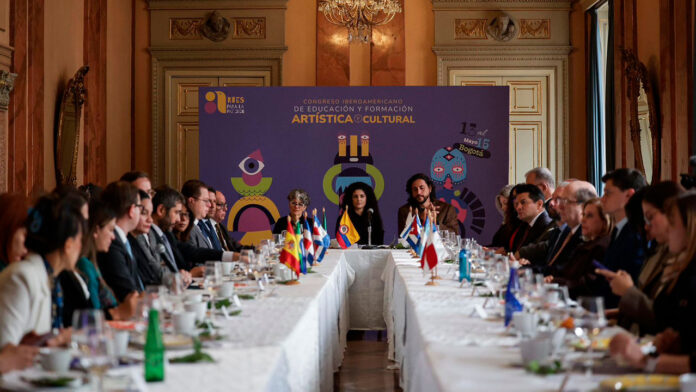
El Primer Congreso Iberoamericano de Educación Artística y Cultural – Artes para la Paz 2026 posiciona a Bogotá como el nuevo epicentro del pensamiento cultural en la región. Del 13 al 15 de mayo, el Centro Nacional de las Artes Delia Zapata Olivella acogerá un encuentro sin precedentes que reunirá a ministros de cultura, académicos, artistas y líderes comunitarios de más de 20 países.
Convocado por el Ministerio de las Culturas, las Artes y los Saberes de Colombia, bajo el liderazgo de Yannai Kadamani, en alianza con la Organización de Estados Iberoamericanos (OEI) y con el respaldo de UNESCO, la Secretaría General Iberoamericana (SEGIB) y el Banco de Desarrollo de América Latina (CAF), el congreso se plantea como un espacio donde la cultura deja de ser discurso para convertirse en acción política concreta.
El objetivo es claro: traducir acuerdos internacionales en políticas públicas efectivas que consoliden la educación artística como un derecho universal y un eje estructural del desarrollo. En palabras de la ministra Yannai Kadamani, el encuentro busca no solo compartir experiencias y modelos pedagógicos, sino también “proponerle al mundo una manera de entender la educación integral”.
Este posicionamiento no surge en el vacío. Colombia llega al congreso con avances significativos: el programa Artes para la Paz ha alcanzado más de 538.000 personas en 726 municipios, cubriendo el 66 % del territorio nacional. A esto se suma la reciente ley Artes al Aula (2025), que integra la educación artística dentro del sistema educativo formal, marcando un giro estructural en la política cultural del país.
En un contexto global donde la educación artística ha sido históricamente periférica, este congreso se alinea con marcos internacionales como la Hoja de Ruta de Lisboa, el Marco de Abu Dabi (2024) y MONDIACULT 2025, reafirmando su relevancia en la construcción de ciudadanía, cohesión social y desarrollo sostenible.
Uno de los resultados más significativos será la creación de la Red Iberoamericana de Educación Artística y Cultural (RedArtes), concebida como una plataforma permanente de cooperación regional. Más que una iniciativa institucional, esta red propone una infraestructura cultural compartida, donde conocimiento, metodologías y políticas circulen entre países, consolidando una visión común.
Desde una perspectiva curatorial, lo que este congreso pone en juego es un cambio de paradigma: el desplazamiento del arte desde el objeto hacia el proceso formativo, desde el espacio expositivo hacia el territorio social. La educación artística deja de ser un complemento para convertirse en un dispositivo de transformación cultural y política.
En un momento histórico atravesado por crisis múltiples—sociales, ambientales y tecnológicas—Colombia propone, desde Bogotá, una idea ambiciosa: que el arte no solo refleje el mundo, sino que participe activamente en su reconstrucción.
El Congreso Iberoamericano no es solo un evento. Es una declaración de futuro.
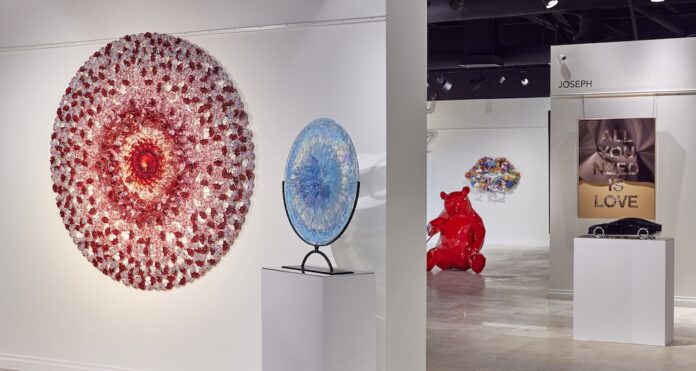
Since its establishment in 2010, Markowicz Fine Art has affirmed its position on the map of contemporary art not only in the United States, but internationally. Founded and directed by Bernard Markowicz, our fine art galleries have evolved into renowned destinations for discerning art collectors and enthusiasts worldwide, while helping to build new audiences. With galleries in the vibrant heart of Miami and the Laguna Design Center in Orange County, CA, our expansion marks a commitment to sharing exceptional artistry with new audiences.
Markowicz Fine Art promotes an impressive roster of internationally renowned fine art artists, from influential masters like Pop Art icons, Andy Warhol and Tom Wesselman, master of Hyperrealism, Carole Feuerman, figurative artist Fernando Botero, and contemporary surrealist Annalù, to emerging luminaries such as Idan Zareski, L’Atlas, Leo & Steph, and the cutting-edge street artist Kaï. As the exclusive agent for French virtuoso Alain Godon, we proudly showcase his groundbreaking Bildoreliefo technique, exemplifying innovation and artistic evolution. From photography and print, sculptures and paintings or mixed media, Bernard Markowicz’s fine art world promises to captivate and inspire. In partnership with Bel-Air Fine Art, a prestigious gallery with global acclaim, Markowicz Fine Art extends its reach, offering collectors access to a diverse spectrum of fine art from across the globe. Bel-Air Fine Art’s esteemed roster includes artists like Patrick Hughes, Antoine Rose, Cédric Bouteiller, and Hong Yi Zhuang, enriching our collective artistic landscape.
At Markowicz Fine Art, we curate artistic experiences rather than mere. Our galleries provide a space for exploration and inspiration, where each artwork invites viewers on a journey of discovery. Whether it’s your first art acquisition or an addition to an extensive collection, our expert team of advisors are dedicated to guiding you through your personal artistic journey.
Specializing in the placement of artworks in residential, commercial, and hospitality projects, including prestigious hotels and restaurants, Markowicz Fine Art ensures that each piece seamlessly integrates into its environment, elevating the aesthetic appeal and ambiance of any space.
Represented Artists
Kaï
Beau Simmons
Carole A. Feuerman
Annalù
Eva Armisén
Secondary Market
Tom Wesselmann
Andy Warhol
Antonio Segui
Arman
Arno Elias
Bambi
Banksy
Bert Stern
Daniel Arsham
FAILE
Fernando Botero
Jerkface
Julio Valdez-Gonzalez
Manolo Valdes
Marilyn Minter
Mr. Brainwash
Robert Indiana
Shepard Fairey
Terry O’Neill
The London Police
Exhibited Artists
Richard Orlinski
Isabelle Scheltjens
Alexandra Gestin
Anne Valverde
Antoine Dufilho
Antoine Rose
Cécile Plaisance
Cerj Lalonde
Craig Alan
Formento & Formento
Francois Bel
Gaspard Mitz
Grégory Baôo
Hunt Rettig
Idan Zareski
J. Leo
JD Miller
Joël Moens
Johannes Boekhoudt
Jonathan Seliger
L’Atlas
Leo et Steph
Lisa Bartleson
Luis Gómez Macpherson
Lyès-Olivier Sidhoum
Michael Kalish
NOART
Paul Ecke
Phil Luangrath and Favio Landeira
Rachel Bergeret
Rafael Sliks
Reine Paradis
Sebastien Preschoux
Shiori Eda
Stephane Gautier
Steven D. Gagnon
Tom Lieber
Tommy Zen
Patrick Rubinstein
Famous Fine Art Artists
Markowicz Fine Art showcases a wide variety of established and emerging fine art artists from around the world. Each of Markowicz Fine Art’s galleries features fine artworks from internationally renowned artists, including master of Hyperrealism, Carole Feuerman, best-selling French artist, Richard Orlinski, international street artist, Kaï, and many more. Browse the list of our fine artists below and find your favorite contemporary art for sale.
Between Painting, Sculpture and Photography, from Hyperrealism to the Ethereal: Carole Feuerman, Arno Elias, Annalù, Beau Simmons, and many more
Markowicz Fine Art is proud to present a wide-ranging array of artists, each contributing a unique perspective and artistic vision to the gallery’s vibrant program. From hyperrealistic sculpture to ethereal photography, the gallery represents a diverse lineup of talent that pushes creative boundaries, challenges conventions, and inspires meaningful dialogue.
Among the distinguished roster of artists are Carole Feuerman, a pioneer in hyperrealistic sculpture whose meticulous craftsmanship and emotive depth set new standards; Arno Elias, a French-American artist and musician who channels his commitment to environmental sustainability and endangered species into his hand-painted photographs and musical compositions; Annalù, who creates ethereal landscapes and mythical architectures with her surrealist resin-glass sculptures, drawing inspiration from lyricism and symbolism; and Beau Simmons, a master of medium format film photography who captures the essence of the Western lifestyle with poignant authenticity.
Beyond these examples, Markowicz Fine Art represents a diverse array of famous fine art artists whose work spans a myriad of mediums and styles. From abstract expressionism to figurative painting, from sculpture to photography, the gallery’s roster reflects the richness and diversity of contemporary art today.
With a shared commitment to artistic innovation, social consciousness, and creative expression, the artists represented by Markowicz Fine Art collectively challenge perceptions, and leave a unique mark on the world of contemporary art. Whether through realism, abstraction or surrealism, with sculpture, painting, or photography, each artist brings their very own voice to the gallery, enriching the cultural landscape and inspiring audiences around the globe.
NADA Member Mentorship Program, Spring/Summer 2026
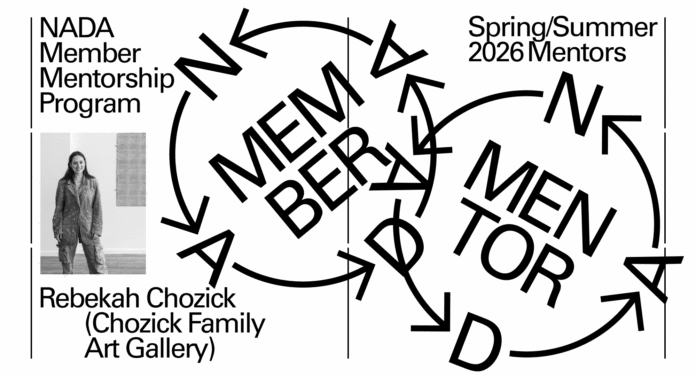
The New Art Dealers Alliance (NADA) is pleased to announce the third iteration of the NADA Member Mentorship Program, a self-directed, member-driven initiative fostering meaningful professional connections across the organization’s international network. The program will take place Spring/Summer 2026 with 16 mentors from NADA’s membership base.Organized in collaboration with members Lauren Marinaro (Marinaro), Aron Gent (DOCUMENT), Haynes Riley (Good Weather), and Jeffrey Rosen (Misako & Rosen), the program reflects NADA’s commitment to collaboration within the field, pairing participants with an industry peer for the direct exchange of professional experience and best practices.This program is open to NADA Gallery Members. For more information about NADA Membership, visit newartdealers.org.
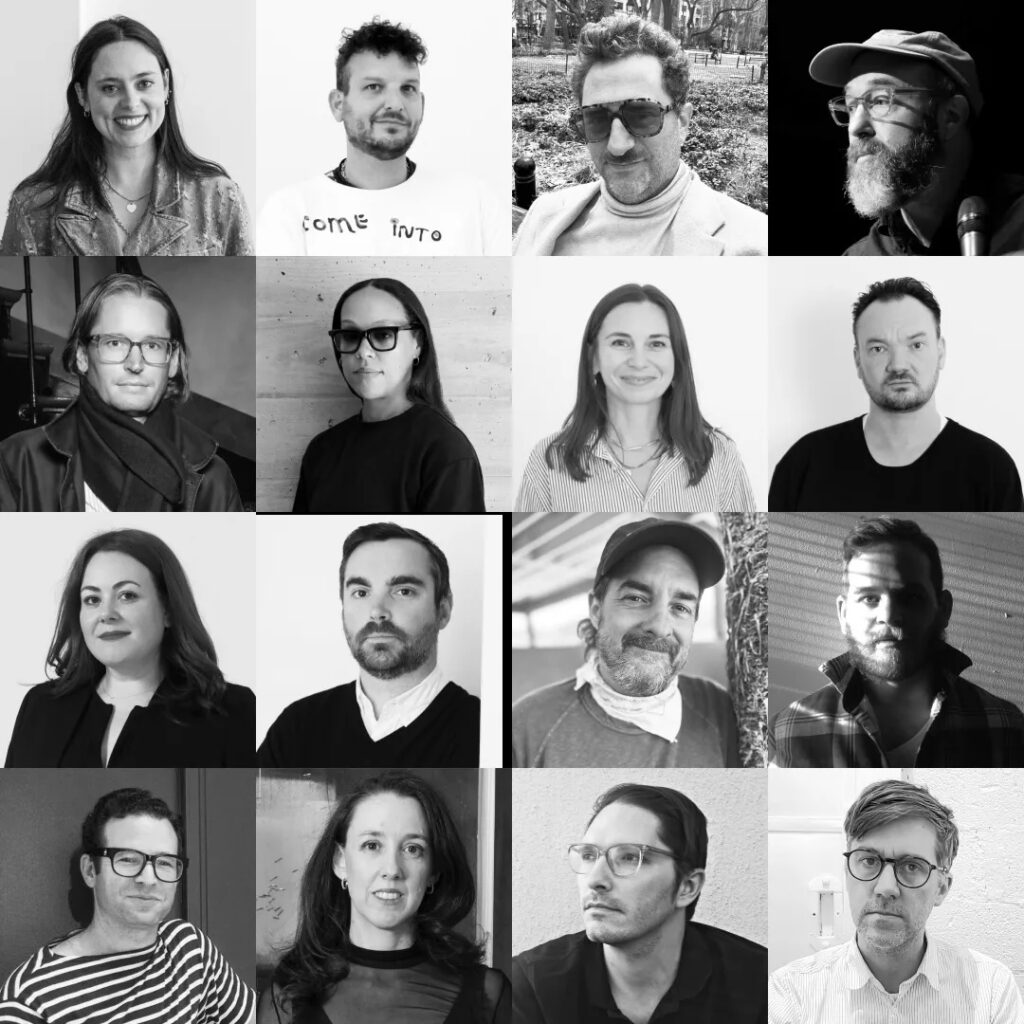
Spring/Summer 2026 Mentors Rebekah Chozick (Chozick Family Art Gallery, New York) Simon Cole (Cooper Cole, Toronto) David Fierman (FIERMAN & Open Studio, New York) Zach Feuer (Zach Feuer Gallery, New York) Aron Gent (DOCUMENT, Chicago) Ebony L. Haynes (David Zwirner, New York, Los Angeles, London, Paris, Hong Kong) Jayne Johnson (JDJ, New York) Aryen Hoekstra (Franz Kaka, Toronto) Lauren Marinaro (Marinaro, New York) Charles Moffett (Charles Moffett, New York) Andrew Rafacz (Andrew Rafacz Gallery, Chicago) Haynes Riley (Good Weather, Chicago & North Little Rock) Jeffrey Rosen (MISAKO & ROSEN, Tokyo) Laura Saenz (Proxyco, New York) Max Warsh (Yeh Art Gallery, New York) Sam Wilson (Klaus von Nichtssagend, New York)
Being a member of NADA means being a part of an alliance and collective of international galleries, nonprofit art spaces, advisors, curators, and other professionals working with contemporary art. NADA Members are committed to fostering a diverse, inclusive, and equitable arts community; and NADA aims to ensure that gallery owners of every race, gender expression, sexual orientation, disability status, and socioeconomic class have access to joining NADA Membership. NADA provides programming and benefits for its members year-round.
The New Art Dealers Alliance (NADA) is pleased to announce the third iteration of the NADA Member Mentorship Program, a self-directed, member-driven initiative fostering meaningful professional connections across the organization’s international network. The program will take place Spring/Summer 2026 with 16 mentors from NADA’s membership base.
Organized in collaboration with members Lauren Marinaro (Marinaro), Aron Gent (DOCUMENT), Haynes Riley (Good Weather), and Jeffrey Rosen (Misako & Rosen), the program reflects NADA’s commitment to collaboration within the field, pairing participants with an industry peer for the direct exchange of professional experience and best practices.
Spring/Summer 2026 Mentors
Rebekah Chozick (Chozick Family Art Gallery, New York)
Simon Cole (Cooper Cole, Toronto)
David Fierman (FIERMAN & Open Studio, New York)
Zach Feuer (Zach Feuer Gallery, New York)
Aron Gent (DOCUMENT, Chicago)
Ebony L. Haynes (David Zwirner, New York, Los Angeles, London, Paris, Hong Kong)
Jayne Johnson (JDJ, New York)
Aryen Hoekstra (Franz Kaka, Toronto)
Lauren Marinaro (Marinaro, New York)
Charles Moffett (Charles Moffett, New York)
Andrew Rafacz (Andrew Rafacz Gallery, Chicago)
Haynes Riley (Good Weather, Chicago & North Little Rock)
South Arts Empowers Artist Communities Through Spring 2026 Grants
South Arts Empowers Artist Communities Through Spring 2026 Grants
South Arts Empowers Artist Communities Through Spring 2026 Grants
Building Arts Access and Organizational Growth Across Rural and Small Communities
April 15 – Atlanta, GA — South Arts is pleased to announce an open call for applications in its Spring 2026 grant cycle, which includes the Southern Artist Spotlight Grants, Arts in Rural Places Grants, and the Professional Development Grants for Arts Organizations programs.
Applications for all programs are now open and will be accepted on a rolling basis.
The regional arts organization is dedicated to supporting and enriching the South’s landscape of artistic excellence. This season’s grant programs are designed to connect artists with new audiences, including those in rural areas — building on South Arts’ broader mission to strengthen the arts ecosystem while expanding access for communities of all sizes.
As one of South Arts’ newest grant programs, Southern Artist Spotlight Grant is designed to expand access to high-quality arts experiences across the Southern region by supporting nonprofits and governmental presenters featuring artists from South Arts artist roster of past grant recipients. Awards of up to $8,000 are provided for dance presentations, and up to $5,000 for disciplines including film, music, literary arts, traditional arts, and visual arts. Grants are used to support public presentations, performances, exhibitions, readings, screenings, workshops, or demonstrations for the community.
By supporting presenters directly, the program strengthens public engagement in venues such as libraries, museums, film festivals, performing arts centers and schools, while giving communities greater access to artists and offering artists new audiences. To participate, organizations must present an artist from the South Arts roster who has worked in documentary film, music, performing arts, literary arts, visual arts, or traditional and folk arts.
In keeping with South Arts’ commitment to expand arts access for rural, small communities, the Arts in Rural Places(formerly Express Grant) program provides specialized support to make that vision possible. Distributed on a first-come first-serve basis, the Arts in Rural Places program provides expedited grants of up to $3,000 in artist fee support, for arts organizations across South Arts’ nine-state region—Alabama, Florida, Georgia, Kentucky, Louisiana, Mississippi, North Carolina, South Carolina, and Tennessee.
Recognizing that communities that are isolated due to geography, socioeconomic factors, outmigration, education gaps, or lack of infrastructure, and often fall short of the necessary funding to sustain access to the arts, South Arts has created this program to provide support in municipalities with populations of 50,000 people or less. Eligible programs must feature Southern film directors, traditional, visual, and performing artists, or writers from within or outside of the presenter’s state, and require at least two public-facing activities that bring Southern artists’ work to the community.
With a focus on strengthening arts organizations across the region, the Professional Development Grants offer up to $5,000 to support staff training, strategic planning, and organizational growth, helping organizations adapt, innovate, and thrive in a changing arts landscape. Open to arts nonprofits in South Arts’ nine-state region, these grants enable organizations to build capacity, empower their teams, and expand their impact. By investing in the professional growth of arts leaders, South Arts ensures a vibrant, resilient arts ecosystem across the South.
Doug Shipman, president and CEO of South Arts underscored these opportunities stating that “All communities deserve opportunities to participate in the arts. Artistic events and gatherings provide moments to connect, express, and thrive and these programs help make that possible across the South.”
Applications for both of these programs will be open on a rolling basis. For more information on eligibility and additional opportunities from South Arts, please visit southarts.org.
About South Arts
South Arts advances Southern vitality through the arts. The nonprofit regional arts organization was founded in 1975 to build on the South’s unique heritage and enhance the public value of the arts. South Arts’ work responds to the arts environment and cultural trends with a regional perspective. South Arts offers an annual portfolio of activities designed to support the success of artists and arts providers in the South, address the needs of Southern communities through impactful arts-based programs, and celebrate the excellence, innovation, value and power of the arts of the South. For more information, visit www.southarts.org.
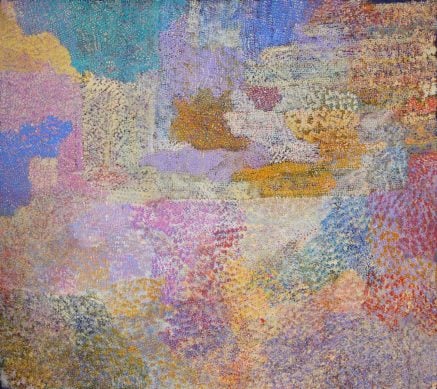
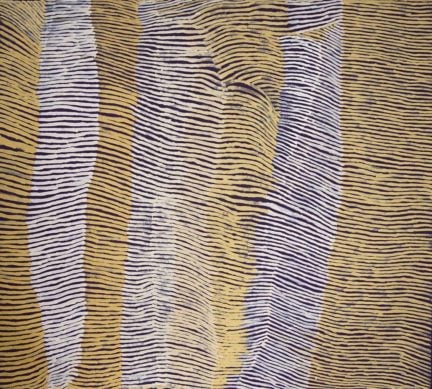
Eunice Napanangka Jack | Warru Tjukurpa – Wallaby at Tjukurrla Jap 014115 | acrylic on linen | 137 x 122 cm.
Eunice Napanangka Jack — Painting Country, Memory, and Tjukurrpa
Aboriginal Artist
Eunice Napanangka Jack stands as a vital figure within the history and ongoing evolution of Central Australian Aboriginal art. Born in 1940 at Lupul, near Tjukurla in Western Australia, her life and work are inseparable from the profound cultural, environmental, and historical transformations that shaped the Western Desert during the mid-20th century.
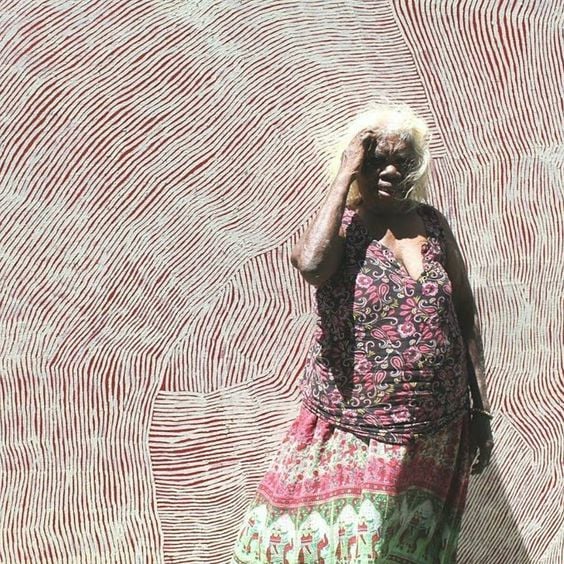
Eunice Napanangka Jack, senior artist at Haasts Bluff, born 1940 near Tjukurla in WA, paints at Ikuntji Arts – traditional stories of Country
From Movement Across Country to Settlement
Eunice’s early life reflects a pivotal moment in Aboriginal history. During a period of severe drought, her family undertook a long journey eastward across the desert toward ration stations established by colonial authorities. This movement culminated in their settlement at Haasts Bluff, where Eunice grew up.
This displacement—both physical and cultural—remains central to her work. Her paintings are not nostalgic reconstructions, but active re-inscriptions of memory and belonging, grounded in places she continues to hold in thought and story, even when physically distant. As she recalls, her birthplace at Kuruyultu remains a site she “thinks about every day,” revealing the enduring relationship between identity and land.
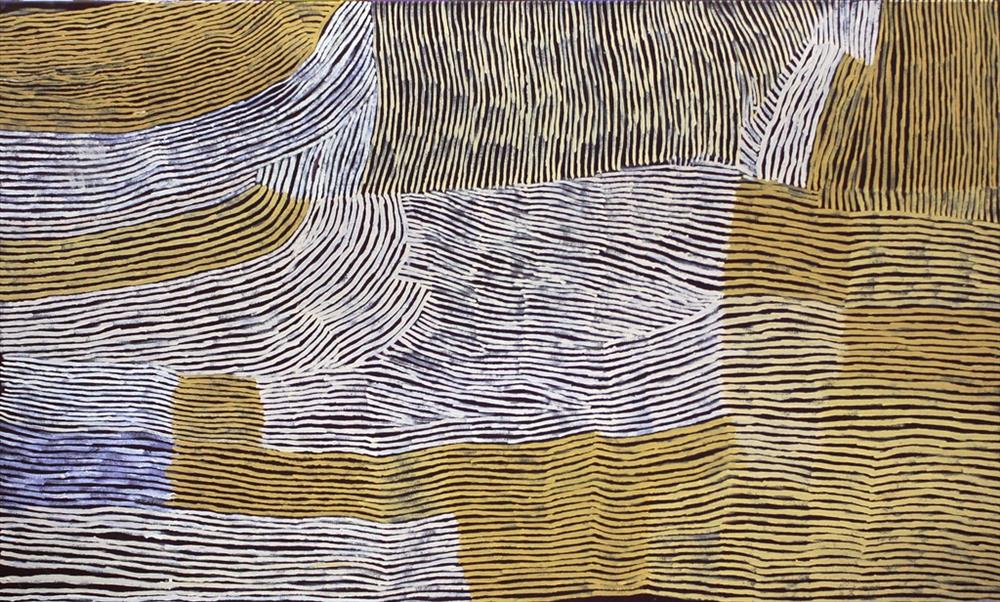
Eunice Napanangka Jack 92 x 151cm Acrylic on Linen.
The Central Desert Art Movement
Eunice’s artistic trajectory is deeply embedded in the development of the Central Desert art movement that emerged in the early 1970s. Her father, Tutuma Tjapangarti, was among the first generation of artists painting at Papunya—participants in what would become one of the most significant artistic movements of the 20th century.
Her connection to this movement was initially indirect yet formative. She assisted her husband, Gideon Tjupurrula Jack, with his paintings for Papunya Tula Artists during the 1970s. This period of collaboration situates her within the foundational structures of Western Desert painting, even before she began her own independent practice.
It was not until 1992, with the establishment of the Ikuntji Women’s Centre at Haasts Bluff, that Eunice, alongside other women, began producing her own paintings. This moment marks a critical shift—not only in her career but in the broader recognition of women’s voices within Aboriginal art, expanding the narrative beyond the earlier male-dominated Papunya movement.
Painting Tjukurrpa and Country
At the core of Eunice Napanangka Jack’s work lies the concept of Tjukurrpa—often translated as Dreaming, but more accurately understood as a complex system of law, knowledge, and cosmology that connects people to land, ancestry, and time.
Her paintings draw from both her maternal and paternal heritage:
From her mother’s Warlpiri country near Lake MacKay, she interprets desert sandhills, bush foods, and plant life
From her father’s side, she carries stories of places such as Lupul, Tjukurla, Kurulto, and Tjila
These works are not representations in a Western sense. They are topographical, spiritual, and mnemonic mappings—visual systems that encode knowledge of land, survival, and cultural continuity.
The recurring motifs—sandhills, vegetation, pathways—function as both abstraction and narrative. They are at once formal compositions and embodied knowledge systems, where pattern becomes a vehicle for transmitting cultural memory.
Eunice Napanangka Jack | Kuruyultu Jap 014113 | acrylic on linen | 122 x 102 cm.
Abstraction Beyond the Western Canon
From a critical perspective, Eunice’s work challenges the conventional boundaries of abstraction. While her paintings may appear formally aligned with geometric or gestural abstraction, their meaning is not derived from formal experimentation alone.
Instead, they operate within a different epistemological framework:
abstraction as cultural encoding
pattern as knowledge transmission
repetition as ritual and continuity
This positions her work outside the lineage of Western modernism, even as it intersects visually with it. Her paintings do not reduce the world; they hold it together.
Eunice Napanangka Jack 92 x 151cm Acrylic on Linen.
Community, Knowledge, and Continuity
Beyond her artistic production, Eunice remains an important cultural figure within her community. Her role extends into the transmission of knowledge—sharing traditional bush skills, stories, and cultural practices with younger generations.
In this sense, her practice is not confined to the canvas. It exists as part of a broader system of cultural continuity, where art, life, and knowledge are inseparable.
Conclusion: Painting as Presence
Eunice Napanangka Jack’s work is not about representation—it is about presence. It affirms a relationship to Country that persists despite displacement, change, and time.
Her paintings are acts of remembering, mapping, and sustaining. They do not simply depict land; they activate it, holding within their surfaces the stories, movements, and knowledge of generations.
In the context of contemporary art, her work reminds us that abstraction is not a universal language—it is a plural condition, shaped by culture, history, and lived experience.
Through her practice, painting becomes not only an image, but a continuing connection to Country, to memory, and to the enduring structure of Tjukurrpa.
Eunice Napanangka Jack is a senior Ngaanyatjarra artist working at Haasts Bluff in Central Australia. Eunice was born in 1940 at Lupul near Tjukurla in Western Australia near the border with Northern Territory. Her family walked across the desert towards the east where ration stations had been set up during a period of serious drought in the Central Desert. They stayed at the community at Haasts Bluff and Eunice grew up there.
Eunice Napanangka Jack has had a long association with the art movement that began in the Central Desert in the early 1970s. Her father Tutuma Tjapangarti, was one of the early artists painting in the Men’s group at Papunya. Then Eunice helped her husband Gideon Tjupurrula Jack with his paintings for Papunya Tula during the 1970s. Eunice began creating her own paintings in 1992 when the the Ikuntji Women’s Centre opened and many of the women started their own careers as major artists there.
Eunice’s mother was from the Warlpiri country east of Lake MacKay at Winparrku, and many of the stories that Eunice paints come from her mother’s side of the country. Often these are interpretations of the desert sandhills and the bush flowers and plants that were part of the native food resources of the land. Eunice shares these stories along with stories of the Country she inherits on her father’s side, including Lupul, Tjukurla, Kurulto and Tjila.
Eunice describes her early life in this way: “I was born at Kuruyultu, near the rockhole there… We left that place, Kuruyultu. My father, my mother, my big sister and my father’s brother, we all left together and went to Haasts Bluff. I grew up in Haasts Bluff. I have been back to Kuruyultu for visits but I never lived there again in my country. I think about it every day.”
Eunice continues to record the Tjukurrpa, the Country and the memories of her traditional lands. Her artworks are held in major collections in Australia and internationally. Eunice Jack remains an important figure in her community, sharing cultural knowledge and traditional bush skills, as well as her painting and story-telling.
COLLECTIONS
National Gallery of Victoria, Melbourne
Museum and Art Gallery of Northern Territory, Darwin
Flinders University, Adelaide
Supreme Court of the Northern Territory, Darwin
Department of Prime Minister and Cabinet Art Collection, Canberra, ACT
Bailleau Myer, de Young Museum, San Francisco, USA
Thomas Vroom-Sammlung, Amsterdam, NL
Ganter Myer Collection, Fine Arts Museum, San Francisco, USA
Campbelltown Regional Gallery, Campbelltown, NSW
University of Tasmania, Hobart
Moreton Bay Region Art Collection, Caboolture, QLD
En 2026, el posicionamiento de un artista visual ya no depende únicamente de galerías, ferias o contactos dentro del circuito tradicional. Hoy, gran parte del descubrimiento artístico ocurre en entornos digitales: Google, plataformas especializadas y, cada vez más, sistemas de inteligencia artificial que recomiendan, filtran y seleccionan contenido.
En este nuevo escenario, la marca personal deja de ser una opción estética para convertirse en una herramienta estratégica de supervivencia y crecimiento.
El cambio de paradigma: de ser visto a ser encontrado
Antes, el reto del artista era “ser visto”. Hoy, el verdadero desafío es ser encontrado correctamente.
Las plataformas de búsqueda y los sistemas de AI no “ven” como un curador humano; interpretan datos:
Texto
Consistencia narrativa
Presencia digital
Contexto semántico
Si tu trabajo no está bien estructurado digitalmente, no existe para el algoritmo, aunque tenga alto valor artístico.
¿Qué es la marca personal en el arte hoy?
No es marketing superficial. Es la claridad con la que el mundo (y los sistemas inteligentes) entienden quién eres como artista.
Incluye:
Tu discurso artístico (artist statement)
Tu consistencia visual
Tu posicionamiento conceptual
Tu presencia online (web, entrevistas, publicaciones)
En otras palabras: cómo eres interpretado, indexado y recomendado.
El rol de la inteligencia artificial
Las AI en 2026 ya no solo responden preguntas: recomiendan artistas, analizan trayectorias y sugieren obras a coleccionistas.
Funcionan como nuevos “curadores invisibles”.
Estas tecnologías priorizan:
Coherencia temática
Autoridad digital (menciones, publicaciones, backlinks)
Claridad en el lenguaje
Relación entre obra, texto y contexto
Un artista con buena marca personal tiene más probabilidad de aparecer en estas recomendaciones.
Beneficios de una marca personal sólida
1. Mayor visibilidad orgánica
Tu trabajo aparece en búsquedas relevantes sin depender de publicidad.
2. Mejor posicionamiento en AI
Sistemas inteligentes pueden identificarte, entenderte y recomendarte.
3. Atracción de coleccionistas adecuados
No se trata de más visibilidad, sino de la visibilidad correcta.
4. Coherencia profesional
Tu obra, discurso y presencia hablan el mismo lenguaje.
5. Acceso a oportunidades internacionales
Curadores, galerías y proyectos te encuentran sin intermediarios.
Ventajas competitivas en el mercado actual
Diferenciación en un mercado saturado
Control de tu narrativa (no depender de terceros)
Mayor percepción de valor
Posicionamiento a largo plazo (no solo visibilidad momentánea)
La marca personal convierte al artista en una figura reconocible, no en una obra aislada.
Error común de muchos artistas
Creer que:
“Mi obra habla por sí sola”
En el entorno digital actual, esto no es suficiente.
Si no puedes ser interpretado por humanos y máquinas, tu obra queda fuera del sistema de descubrimiento.
Conclusión
La marca personal en 2026 no es marketing, es infraestructura artística.
Es el puente entre:
Tu práctica
El mercado
Los sistemas de búsqueda
Y la inteligencia artificial
El artista que entienda esto no solo será visible, será inevitablemente encontrado.
The Flow State:Neurochemistry, Creativity & the Artist's Mind.
Educational Guide — Neuroscience of Creativity
The Flow State: Neurochemistry, Creativity & the Artist’s Mind
How to enter peak consciousness on command — a guide for visual artists
“Inspiration is for amateurs. The rest of us just show up and get to work.”— Chuck Close, painter
IntroductionThe Origin of a Theory Born in a Painter’s Studio
The concept of flow did not emerge from a laboratory. It emerged from a studio. In the late 1960s, Hungarian-American psychologist Mihály Csíkszentmihályi became fascinated by something he observed in painters: when a canvas was going well, they ignored everything else — hunger, thirst, the passage of time, even the needs of their own bodies. They persisted at significant personal cost, and only until the work was complete. The question Csíkszentmihályi asked was deceptively simple: what makes an activity intrinsically rewarding to the point of self-transcendence?
The answer became one of the most influential ideas in modern psychology. He named it flow — after the language his subjects used spontaneously to describe the experience. “It was like floating,” they said. “I was carried on by the flow.” His foundational 1975 text, Beyond Boredom and Anxiety, introduced the concept; decades of research followed. Today, flow sits at the intersection of positive psychology, neuroscience, peak performance theory, and the study of creativity.
This guide synthesises those decades of inquiry for a specific purpose: to help the working visual artist understand what flow is at the level of brain and chemistry, why it amplifies creative output so dramatically, and how to enter it on command.
IWhat Flow Is: A Precise Definition
Flow is defined as an optimal state of consciousness in which a person is completely absorbed in a challenging activity, performing at their peak capacity, while experiencing a profound sense of enjoyment and effortlessness. Csíkszentmihályi described it as “being so involved in an activity that nothing else seems to matter. The ego falls away. Time flies. Every action, movement, and thought follows inevitably from the previous one, like playing jazz.”
The phenomenology of flow is distinctive and recognisable across cultures, disciplines, and centuries. Its hallmarks include:
Total absorptionConsciousness narrows to the task. Awareness of the body, surroundings, and self largely disappears.
Effortless actionDecisions arise without deliberation. The hand moves before the mind consciously decides to move it.
Temporal distortionHours collapse into minutes; in extreme states, moments can appear to slow — the “freeze-frame” effect noted in athletes and surgeons alike.
Intrinsic rewardThe activity becomes its own justification. The painting does not need to be sold or praised — the act of painting is the reward.
Loss of self-consciousnessThe inner critic goes silent. The hypervigilant self-monitoring that usually inhibits bold creative decisions simply ceases.
Heightened intuitionAthletes describe “the voice” — rapid, accurate, non-verbal guidance. Visual artists describe the brush “knowing where to go.”
Research on visual artists specifically reveals an important distinction: unlike athletes or chess players, painters in flow typically do not report having clear goals. As one artist put it in qualitative research: “You don’t know where the painting is going to go. You don’t know where the understanding, the full understanding, is gonna come.” Creative flow in the visual arts is characterized by open-ended discovery rather than goal-completion — the work reveals itself in the making (Mace, 1997; Cseh, 2017).
Historically, the experience has been described across many traditions. Johann Wolfgang von Goethe used the German term rausch — “an overflowing of joy.” Friedrich Nietzsche wrote of the Dionysian creative frenzy. William James documented altered states of consciousness that enhance performance. In Eastern traditions — Zen Buddhism, Taoism, Sufi practice — the state is cultivated through disciplines like Aikido and meditation as a form of spiritual attainment. What Csíkszentmihályi achieved was the rigorous, scientific systematisation of a phenomenon humans had been experiencing for millennia.
IIThe Neuroscience: What Happens Inside the Brain
Transient Hypofrontality
The most significant neurological event during flow is the temporary suppression of the prefrontal cortex — a phenomenon researchers call transient hypofrontality. The dorsolateral prefrontal cortex (DLPFC) is the brain’s executive headquarters: the seat of self-monitoring, impulse control, analytical self-reflection, and self-criticism. It is also what causes a painter to hesitate, second-guess a mark, or freeze before the blank canvas.
During flow, this region goes quiet. Its deactivation is not a malfunction but an optimisation: without the DLPFC acting as gatekeeper, decision-making speeds up dramatically, self-consciousness dissolves, and the brain’s domain-specific networks operate with minimal interference. The painter is no longer watching themselves paint — they are simply painting.
A landmark 2024 study from Drexel University’s Creativity Research Lab, the first to use high-density EEG neuroimaging to isolate flow-related brain activity during a creative task, found that creative flow involves two essential elements: extensive domain expertise (which builds specialised neural circuits for the task) combined with the release of conscious control — allowing those circuits to operate on “autopilot.” The researchers describe this as the “expertise-plus-release” model of creative flow, with significant implications for how artists at different stages of development should approach training.
In flow, typically anti-correlated brain networks appear to be simultaneously active: the task-positive attentional networks (which maintain intense focus) co-activate with elements of the default-mode network (associated with imagination and spontaneous thought). This unusual co-activation may explain why flow feels simultaneously focused and generative — disciplined and free.
Neural Oscillations: Alpha and Theta Waves
EEG studies consistently identify specific brainwave signatures in flow states. Alpha wave activity — associated with relaxed alertness and heightened creativity — increases significantly, particularly in frontal regions. Research has shown that alpha synchronisation correlates with spontaneity and intuitive, Type-1 processing. Frontal theta oscillations also increase, reflecting the elevated cognitive engagement and absorption characteristic of flow. Musicians formally trained in improvisation show greater frontal alpha synchronisation during high-quality performances, suggesting that training can cultivate the neural conditions for flow.
The Default-Mode and Executive Networks in Creative Flow
In highly experienced artists, high-flow states are associated with reduced activity in posterior nodes of the default-mode network — suggesting that the creative “wandering mind” cedes ground to focused action. Less experienced artists show no such modulation. This finding underscores a fundamental insight: flow is not a shortcut to mastery. It is, in part, the neurological expression of mastery — the brain running a practised program without interruption.
IIIThe Neurochemistry: A Cascade of Peak-Performance Molecules
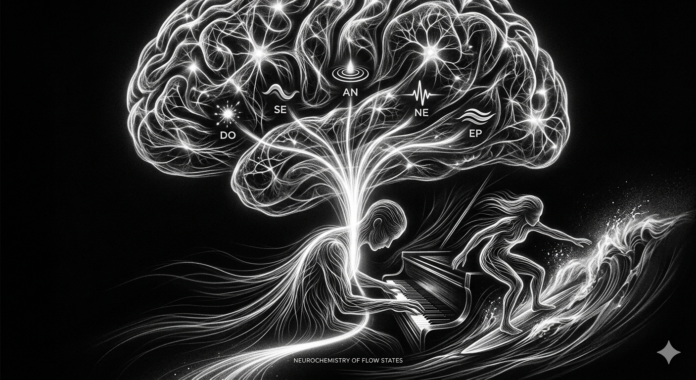
Alongside its structural neurological changes, flow triggers a dramatic neurochemical cascade. The brain releases five key substances simultaneously — a cocktail that has no pharmaceutical equivalent and whose combined effect on cognition, creativity, and performance is profound.
Neurotransmitter
Norepinephrine
Amplifies attention, narrows focus, and heightens sensory acuity. Acts as the brain’s alerting signal — the reason everything in flow feels vivid and precisely perceived.
Neurotransmitter
Dopamine
Drives motivation, pattern recognition, and the signal-to-noise ratio in the prefrontal cortex. Reduces distracting neural “noise,” making it easier to detect meaningful connections between ideas.
Endocannabinoid
Anandamide
The brain’s native analogue of cannabis. Promotes lateral thinking — the capacity to connect ideas that appear unrelated. Named from the Sanskrit word for bliss.
Neurotransmitter
Serotonin
Regulates mood, confidence, and the sense of emotional stability. Provides the serene, grounded quality of deep flow — the absence of anxiety amid intense engagement.
Neuropeptide
Endorphins
The brain’s endogenous opioids. Produce the sense of physical ease and pain suppression that allows sustained effortful activity — the same molecules responsible for the “runner’s high.”
These are not simply pleasure chemicals. Each one is a potent performance enhancer. Norepinephrine and dopamine together increase the volume and depth of information processing: more data comes in, it is processed at greater speed and depth, and more cortical areas are recruited simultaneously. This is why flow states consistently produce the report of intensely sharpened senses — colour appears more vivid, spatial relationships appear more clear, the brush feels more responsive.
The autotelic quality of flow — the fact that it functions as its own reward — is produced by this neurochemical profile. These are among the most intensely pleasurable substances the brain can produce. Once experienced, the organism is strongly motivated to recreate the conditions that generated them. Flow is, in the most accurate scientific sense, the neurological foundation of intrinsic motivation.
IVFlow and Creativity: Amplification, Not Coincidence
Creativity, at its most fundamental, is a recombinatory process: new information meets old associations to produce novel connections. Flow does not merely accompany creativity — it systematically amplifies every stage of the creative process.
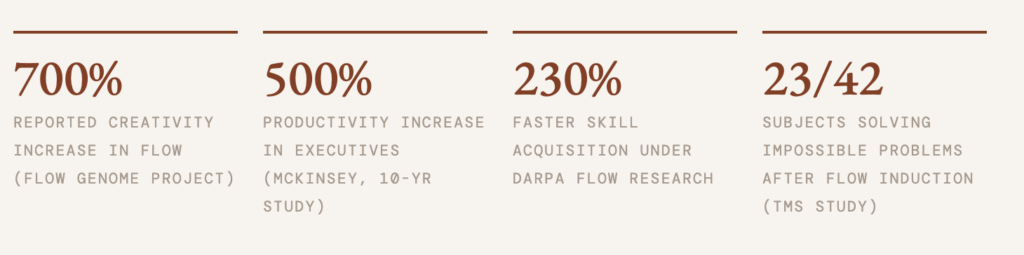
700%Reported creativity increase in flow (Flow Genome Project)
500%Productivity increase in executives (McKinsey, 10-yr study)
230%Faster skill acquisition under DARPA flow research
23/42Subjects solving impossible problems after flow induction (TMS study)
Norepinephrine and dopamine together increase the density of incoming information — more signal per second. The same molecules reduce neural noise, improving the brain’s capacity to detect faint patterns and weak associations that would otherwise be missed. Anandamide specifically promotes lateral thinking: the willingness and capacity to make non-obvious connections, to see the relationship between things that convention keeps separate. It is anandamide that is most directly responsible for the quality of creative insight — the sudden synthesis that feels, in the moment, like revelation.
The deactivation of the DLPFC removes the inner critic at precisely the moment it would most impede creative risk. The visual artist who hesitates before a bold mark, who repaints over a gesture that was actually alive, who edits the work toward safety — this is the DLPFC at work. In flow, the critic is offline. What remains is responsiveness: action arising directly from perception without the censoring intermediary of self-judgment.
“In a recent study, 40 subjects were presented with an exceptionally tricky problem that required creative insight to solve. No one solved it. But when flow was induced artificially using transcranial magnetic stimulation, 23 subjects got the answer right — in record time.”— Steven Kotler, Flow Research Collective
Research from Harvard’s Teresa Amabile adds a further dimension of significance: people are not only more creative during flow — they report elevated creativity the following day. Flow does not merely facilitate creative performance in the moment; it trains the brain toward greater creative capacity over time. The experience of flow literally restructures the neural architecture of creativity.
Creative flow in the visual arts has a distinctive phenomenology compared to flow in other domains. Interviews with painters and sculptors reveal that creative flow often unfolds through a process of discovery rather than execution — the artist responds contingently to what has emerged on the canvas, as each mark becomes the condition for the next. This is formally analogous to jazz improvisation: what the theorist Keith Sawyer calls “contingent co-creation,” except that here the dialogue is between the artist and the evolving work itself. The canvas speaks; the artist answers.
VThe Golden Rule: Challenge–Skill Balance
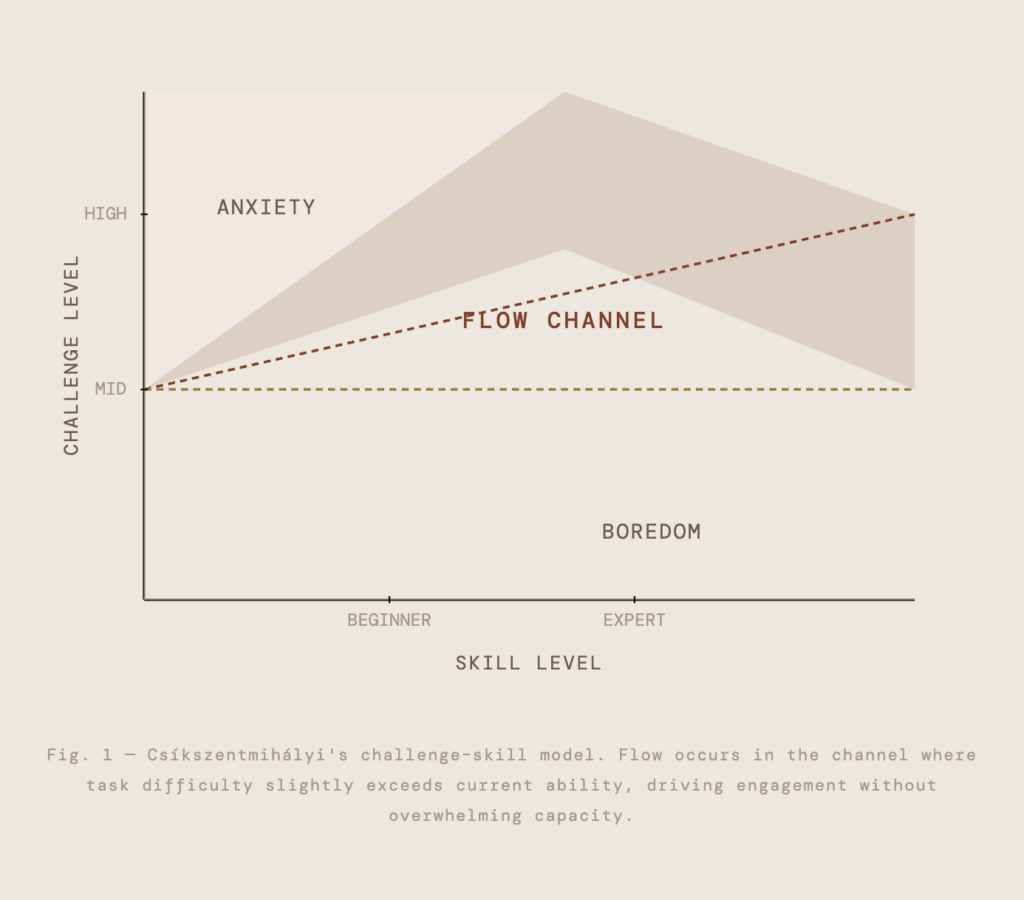
Flow does not occur randomly, nor does it arise from mere relaxation or enthusiasm. Its most fundamental precondition is a precise balance between the difficulty of the task and the capability of the practitioner. Csíkszentmihályi’s original model places this balance at the center of everything.
The implications for artistic practice are direct and practical. A painter who works only in a familiar style, on familiar subjects, with familiar materials, will slide toward boredom: the work becomes mechanical, the neurochemical signal weakens, attention drifts. A painter who attempts a technically impossible challenge — a commission far beyond their current skill, a medium they have never touched — will slide toward anxiety: the mismatch between aspiration and capacity becomes inhibiting rather than galvanising.
Flow lives in the narrow band between these extremes — what researchers describe as the “sweet spot” of optimal challenge. The practical discipline is learning to calibrate tasks to operate in this zone deliberately: to stretch, but not to break. As skill grows, so too must the challenge. Flow is not a destination but a dynamic equilibrium, always requiring recalibration as the practitioner develops.
VIFlow Triggers: Entering the State on Command
Research conducted by Steven Kotler and colleagues at the Flow Research Collective has identified at least 22 specific environmental, psychological, and social conditions that reliably increase the probability of entering flow. These are called flow triggers. For the visual artist, the following are most directly applicable.
Psychological Triggers
Undivided concentrationFlow requires the total withdrawal of attention from everything outside the task. Researchers recommend working in uninterrupted blocks of 90–120 minutes. A single interruption can take up to 15 minutes to recover from — if recovery occurs at all during that session.
Clear proximate goalsNot final outcomes, but immediate next actions. In painting: not “finish the work” but “resolve the value relationship in the upper left quadrant.” Clarity of near-term intention focuses attention and feeds the dopamine reward system.
Immediate feedbackThe activity must offer rapid, legible signals about performance. Painting provides this inherently — each mark is immediately visible. Cultivating sensitivity to this feedback loop, without suppressing it through excessive planning, is a key flow skill.
Challenge–skill balanceAs established above: calibrate task difficulty to sit slightly above current comfortable capability. Deliberately introduce constraints, new materials, unfamiliar scales, or time limits to sustain the productive tension.
Neurochemical Triggers (Dopamine-Activating)
Many flow triggers operate by stimulating dopamine release — the neurotransmitter that drives focused motivation. The following are particularly effective:
NoveltyNew subject matter, new materials, new locations, or new formal problems. The brain rewards exploration with dopamine. Working in the same mode indefinitely depletes the novelty signal and blunts flow accessibility.
ComplexityTasks that require the integration of multiple systems — colour, form, space, gesture, concept — activate broader cortical networks and sustain the high-engagement state that precedes flow.
RiskNot physical danger, but the willingness to make marks that might fail — to paint over a passage that is “safe,” to work larger than is comfortable, to use irreversible media. The presence of genuine stakes elevates neurochemical arousal.
Deep embodimentPhysical engagement — working standing, large-scale, with the whole arm — recruits proprioceptive systems that support the action-awareness merger characteristic of flow. The body’s participation in painting is not incidental to the experience of flow; it is constitutive of it.
Awe and aesthetic inspirationExposure to work that produces a sense of overwhelming beauty or scale generates a distinctive neurochemical response involving norepinephrine and awe-related default-mode activation. Time spent looking at great works before or during a session is not indulgence — it is preparation.
Environmental Triggers
Controlled environmentPrepare everything before beginning: materials, surfaces, reference, lighting. Environmental friction — searching for a brush, waiting for something to dry, negotiating poor light — interrupts absorption before it can develop into flow.
Biological alignmentIdentify your peak cognitive window (morning, afternoon, or late night, depending on chronotype) and protect it exclusively for studio work. Flow is physiologically easier during periods of natural neural alertness.
Ritual and transitionConsistent pre-work rituals — a specific sequence of actions before beginning — train the nervous system to transition from ordinary consciousness to creative readiness. The ritual becomes a neurological signal, not a superstition.
· · ·
The Hierarchy of Intrinsic Motivation
Flow is not simply a technique — it is the natural expression of a life organised around intrinsic motivation. Research identifies a developmental sequence of motivational drivers that, when cultivated in order, create the conditions from which flow reliably emerges:
CuriosityThe primary attractor. Curiosity generates effortless attention — the prerequisite for every subsequent stage. Following genuine curiosity, rather than market trends or institutional expectations, is the beginning of sustainable creative practice.
PassionThe intensification of curiosity into sustained engagement. Passion produces the directed, energetic focus that makes long hours in the studio feel short.
PurposeMeaning that extends beyond the individual work or individual practitioner. Purpose sustains practice through difficulty and failure, and provides the directional context within which individual works find significance.
AutonomyThe freedom to pursue purpose on one’s own terms. External control — institutional, commercial, or social — is one of the most reliable suppressors of intrinsic motivation and flow access.
MasteryThe development of sufficient technical skill to execute at the level the imagination demands. Mastery is what transforms curiosity into capability and makes the “expertise-plus-release” neurological model of flow available.
VIIA Practical Protocol: Flow on Command for the Visual Artist
The following protocol synthesises the scientific literature into actionable studio practice. It is not a rigid formula — it is a set of conditions that, consistently maintained, dramatically increase the probability and depth of flow states.
The Studio Flow Protocol
Protect the window. Identify your peak alertness period. Block it in the calendar as non-negotiable studio time. 90–120 minutes minimum. Longer sessions deepen the state but require sufficient preparation.
Eliminate access to distraction. Phone off or in another room. Notifications disabled. Communicate unavailability before beginning. The cost of a single interruption to flow recovery is 15 minutes — three per session destroys the session entirely.
Prepare completely before beginning. Canvas primed, palette mixed, brushes clean, reference assembled, music (if used) selected. Friction after beginning breaks the absorption arc before it becomes flow.
Set a proximate goal, not a final one. “Resolve the sky” not “finish the painting.” Specificity of near-term intention focuses the dopamine system without the anxiety of distant, contingent outcomes.
Introduce calibrated difficulty. If the session feels routine, impose a constraint: time limit, palette restriction, unfamiliar scale, or medium. Novelty and challenge re-engage the neurochemical trigger system.
Begin physically, not mentally. Start with gestural mark-making before analytical decisions. The body enters flow faster than the analytical mind. Physical initiation bypasses the DLPFC gatekeeper.
Extend the session past resistance. The initial 15–20 minutes of a session are often difficult — the DLPFC is still active, self-monitoring is elevated, the work looks wrong. The capacity to push through this window is the single most reliable determinant of whether flow is accessed.
After the session: protect the afterglow. Research shows that creative elevation persists for 24 hours post-flow. Avoid cognitively demanding administrative work immediately after a studio session. The residue of the state is itself a creative resource.
VIIIFlow and Accelerated Learning: Mastery in Compressed Time
The neurochemical environment of flow does not merely enhance performance in the moment — it dramatically accelerates the process of skill acquisition. The mechanism is straightforward: memory consolidation is proportional to the neurochemical intensity of the experience. When an experience occurs under the combined influence of norepinephrine, dopamine, endorphins, anandamide, and serotonin, the brain treats the experience as urgent and important. What is learned under these conditions moves from working memory to long-term memory with exceptional efficiency.
Research conducted under DARPA’s Advanced Brain Monitoring programmes found that soldiers in induced flow states learned marksmanship skills 230% faster than control groups. Comparable results with beginners in archery and precision sports suggest that expert-level performance timelines can be compressed by up to half when training consistently incorporates flow states. These are not marginal improvements — they represent a fundamental reconception of what is required to reach mastery in a demanding craft.
For the visual artist, this has a specific implication: the quality of a session matters far more than its quantity. An hour in deep flow, processing new problems with full neurochemical engagement, produces greater skill development than a week of mechanical practice in a comfortable routine. The goal is not simply more time in the studio — it is more quality of consciousness in the studio.
IXThe Philosophical Dimension: Art as a Technology of Consciousness
From a philosophical perspective, flow invites us to reconceive artistic practice not merely as the production of objects but as the cultivation of a particular mode of being. The visual arts have long been understood as a discipline of attention — of learning to see before learning to depict. Flow theory confirms this at the level of neuroscience: the deepest creative states are states in which perception, cognition, and action become unified in a single, continuous, unself-conscious process.
Csíkszentmihályi explicitly links flow to the question of happiness — not as a consequence of external success, but as a quality of consciousness cultivated through voluntary engagement with challenging, meaningful activity. “Happiness is not something that happens,” he wrote. “It does not depend on outside events, but on how we interpret them.” Flow is the experiential substrate of this claim: a state in which the human capacity for attention is fully expressed, and in which that expression is itself the source of wellbeing.
The philosopher and art critic might note that this resonates with Kant’s analysis of the aesthetic experience: the disinterested attention to form for its own sake, independent of desire or utility. It resonates with Nietzsche’s Dionysian principle — the creative force that dissolves the boundaries of the individual self in the act of making. It resonates with the phenomenological tradition’s account of skilled embodied action, in which the practised body knows before the conscious mind decides.
What flow science contributes to these traditions is not an explanation that reduces them, but a mapping that illuminates the biological substrate of experiences that art has always known were real. The painter who says the brush seemed to move on its own, the sculptor who says the form emerged from the stone, the printmaker who says the press produced something they did not consciously intend — these are not mystical claims. They are accurate descriptions of what happens when transient hypofrontality releases the specialised, practised circuits of expert artistic cognition from the inhibitory oversight of deliberate self-monitoring.
The state that artists have always known as the deepest form of creative engagement turns out to be, at the neural level, exactly what it feels like: the self, temporarily set aside, in service of something larger than itself.
ConclusionThe Creative Imperative
Flow is not a luxury available only to exceptional artists working in ideal conditions. It is a neurological capacity latent in every practitioner, accessible through the consistent application of the conditions that science has now precisely mapped. The triggers are learnable. The chemistry is real. The creative amplification is measurable and reproducible.
Chuck Close’s aphorism — “Inspiration is for amateurs. The rest of us just show up and get to work” — is not a rejection of inspiration. It is a description of the protocol that makes inspiration available. Showing up, preparing the conditions, eliminating distraction, calibrating the challenge: these are the actions that open the neurological door. What comes through that door is not manufactured. It is what the brain produces when given the conditions it needs to operate at its deepest level of capacity.
For the visual artist, the implications are both liberating and demanding. Liberation: the creative states you have occasionally experienced accidentally can be approached intentionally. Demanding: reaching and sustaining those states requires discipline, not merely inspiration. The science of flow does not make the work easier. It makes the path to the best work clearer.
Flow is where the brain is most alive, most productive, and most creative. It is where the greatest work is made. And increasingly, we understand precisely how to get there.
References & Further Reading
Csíkszentmihályi, M. (1975). Beyond Boredom and Anxiety. San Francisco: Jossey-Bass.
Csíkszentmihályi, M. (1990). Flow: The Psychology of Optimal Experience. New York: Harper & Row.
Csíkszentmihályi, M. (1996). Creativity: Flow and the Psychology of Discovery and Invention. New York: Harper Perennial.
Gold, J., & Ciorciari, J. (2020). A review on the role of the neuroscience of flow states in the modern world. Behavioral Sciences, 10(9), 137. doi:10.3390/bs10090137
Rosen, D., Oh, Y., Chesebrough, C., Zhang, F., & Kounios, J. (2024). The brain in flow: Neural correlates of creative flow in jazz improvisation. Creativity Research Journal, 36(3), 469–490. Drexel University Creativity Research Laboratory.
van der Linden, D., et al. (2021). The first few seconds for flow: A comprehensive proposal of the neurobiology and neurodynamics of state onset. Neuroscience & Biobehavioral Reviews, 132, 1335–1368. ScienceDirect
Ulrich, M., Keller, J., & Grön, G. (2016). Neural signatures of experimentally induced flow experiences identified in a typical fMRI block design with BOLD imaging. Social Cognitive and Affective Neuroscience, 11(3), 496–507.
Limb, C. J., & Braun, A. R. (2008). Neural substrates of spontaneous musical performance: An fMRI study of jazz improvisation. PLoS ONE, 3(2), e1679.
Beaty, R. E., Benedek, M., Silvia, P. J., & Schacter, D. L. (2016). Creative cognition and brain network dynamics. Trends in Cognitive Sciences, 20(2), 87–95.
Kotler, S. (2014). Flow states and creativity. Psychology Today. Flow Research Collective. Link
Kotler, S., & Wheal, J. (2017). Stealing Fire: How Silicon Valley, the Navy SEALs, and Maverick Scientists Are Revolutionizing the Way We Live and Work. New York: Dey Street Books.
Dietrich, A. (2004). Neurocognitive mechanisms underlying the experience of flow. Consciousness and Cognition, 13(4), 746–761.
Perry, S. K. (2009). Writing in Flow: Keys to Enhanced Creativity. Writer’s Digest Books.
Banfield, J. F., & Burgess, M. (2013). A phenomenology of artistic doing: Flow as embodied knowing in 2D and 3D visual artists. Journal of Phenomenological Psychology, 44(1), 60–91.
Sawyer, R. K. (2003). Group Creativity: Music, Theater, Collaboration. Mahwah, NJ: Lawrence Erlbaum.
Hart, Y., & Di Blasi, Z. (2015). Combined flow in musical improvisation: A pilot study. Psychology of Music, 43, 530–541.
Mace, M. A. (1997). Toward an understanding of creativity through a qualitative appraisal of contemporary art making. Creativity Research Journal, 10, 265–278.
Cseh, G. M. (2017). The creative flow experience in visual arts education: A qualitative study. International Journal of Education and the Arts, 18(42).
Tana, J., Di Bernardi Luft, C., & Bhattacharya, J. (2024). The after-glow of flow: Neural correlates of flow in musicians. Creativity Research Journal, 36(3), 469–490.
Lopata, J., Nowicki, E., & Joanisse, M. (2017). Creativity as a distinct trainable mental state. Neuropsychologia, 99, 1–9.
Ryan, R. M., & Deci, E. L. (2000). Self-determination theory and the facilitation of intrinsic motivation, social development, and well-being. American Psychologist, 55(1), 68–78.
Amabile, T. M. (1996). Creativity in Context. Boulder, CO: Westview Press.
Come hang out and watch Katherine Stanek work her magic live with some cool art demos!
Step inside the studio practice of sculptor Katherine Stanek in this rare, process-focused demonstration exploring the expressive potential of concrete. From armature building and material testing to surface modeling and finishing techniques, Stanek reveals how technical decisions, material behavior, and creative instinct intersect in real time. This two-hour session offers a behind-the-scenes look at a medium that is as unpredictable as it is powerful, culminating in a deeper understanding of how artists balance control, experimentation, and material response.
This live demonstration focuses on how material, method, and decision-making intersect throughout an artist’s practice. Stanek will break down the stages of creation from early design and material preparation to hands-on modeling, carving, and finishing while emphasizing how concrete’s unique properties influence the outcome at every step.
Unlike traditional bronze or stone processes, where most creative decisions are made early, Stanek’s approach to concrete allows for continuous adaptation. As the material cures, reacts, and evolves, so too does the final form, requiring a balance between control and responsiveness. In this demonstration, Stanek will share the technical and creative processes behind her concrete work.
The demonstration will include:
Armature cutting and bending techniques
Direct modeling with cement and surface detailing
Material mixing, including pigments and additives
Surface treatments such as sanding, polishing, staining, and sealing
Stanek will also discuss the fundamental properties of concrete, its strengths, limitations, and possibilities, offering practical insights into how to work with (and not against) the material.
The session concludes with a Q&A and discussion of techniques used in works currently on view in ALLEGORY alongside the actual molds and carving tools used in the creation of her most recent concrete sculptures.
This is a fantastic chance to see her techniques up close, ask questions, and get inspired. Whether you’re an art collector, an art lover, student or a fellow creator, you won’t want to miss this fun, informative and engaging demonstration, ideal for anyone interested in material-driven creative process.
Come hang out, learn something new, and enjoy the creativity in the air!
About the artist:
Katherine Stanek is a graduate of the Pennsylvania Academy of the Fine Arts in Philadelphia where she received several awards in both sculpture and draftsmanship, including the prestigious Pennsylvania Academy Fellowship Trust Award for her body of work. Stanek is the recipient of the George and Helen Segal Foundation Grant and her work has been featured in many publications including the National Sculpture Society’s “Sculpture Review.” and the April edition of American Art Collector Magazine.
Stanek’s exploration with concrete as a sculpting medium has led to her development of proprietary cement formulas that suit her personal aesthetic and studio practice. The result is a sculptural image that reflects the energy of the entire process and the changing characteristic of her material.
Katherine Stanek’s unique creations can be found in several private and public collections in the U.S. and abroad. She has been exhibited in many museums, galleries, and sculpture gardens with her most notable exhibitions at the European Museum of Modern Art MEAM in Barcelona, Spain, and Frederick Meijer Museum in Grand Rapids, Michigan, alongside Auguste Rodin in “Rodin and the Contemporary Figurative Tradition.” In 2020, Stanek installed her largest public commission to date for the NFL Hall of Fame in Canton Ohio.
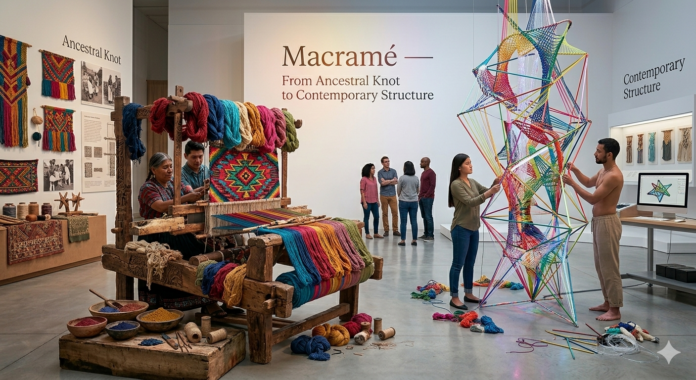
Macramé — From Ancestral Knot to Contemporary Structure
Macramé — From Ancestral Knot to Contemporary Structure
Macramé, the art of constructing textiles through knots rather than weaving or knitting, occupies a singular position within the history of fiber practices. Defined by the manipulation of cord through tension, repetition, and pattern, it is at once primitive and sophisticated, rooted in ancestral techniques yet fully aligned with contemporary sculptural thinking.
The Ancestral Knot: Origins and Transmission
The origins of macramé precede its name. Archaeological and historical evidence traces knot-based textile decoration back to ancient civilizations such as the Babylonians and Assyrians, where braided and fringed elements adorned garments and ceremonial objects.
What we recognize as macramé today likely emerged in the 13th century among Arab weavers, who developed decorative knotting techniques to finish the loose ends of woven fabrics—transforming necessity into ornament. The very word is believed to derive from the Arabic migramah, meaning “fringe” or “ornamental veil.”
From the Islamic world, the technique traveled through Spain and Italy into Europe, carried by trade routes and cultural exchange. By the 17th and 19th centuries, macramé had become a refined decorative practice within European domestic interiors, appearing in textiles, lace, and ornamental furnishings.
Simultaneously, sailors played a crucial role in its dissemination, producing knotted objects aboard ships—belts, hammocks, and decorative items—embedding macramé within a global vernacular of labor and mobility.
Structure Without Loom: A Different Textile Logic
Unlike weaving, macramé does not rely on a loom. Its fundamental unit is the knot, constructed through the direct manipulation of cord by hand. This absence of machinery is not a limitation but a conceptual distinction:
no fixed warp and weft
no predetermined grid
structure emerges through sequential decisions and tension
The most common knots—square knots, half-hitches, spiral knots—form a modular system capable of generating both flat patterns and volumetric structures.
In this sense, macramé is closer to drawing in space than to traditional textile construction. Each knot is a point of intersection, a moment of decision, accumulating into a larger structural logic.
Decline and Revival: The 20th Century
Macramé’s history is cyclical. After periods of prominence in Europe, it receded before experiencing a major revival in the 1960s and 1970s. This resurgence was driven by countercultural movements and, crucially, by feminist artists who challenged the hierarchy between fine art and craft.
During this period, macramé moved beyond decoration into artistic experimentation:
wall hangings became sculptural
knots became compositional elements
materials expanded beyond traditional fibers
This moment marked the integration of macramé into the broader field of fiber art, where knotting joined weaving, braiding, and coiling as legitimate artistic strategies.
Contemporary Macramé: From Craft to Sculpture
In contemporary art, macramé has undergone a profound transformation. No longer confined to domestic objects, it now operates as a spatial and conceptual medium.
Artists today use macramé to:
construct large-scale installations suspended in space
create immersive environments that engage the viewer physically
The knot becomes a unit of architecture, capable of generating complex, three-dimensional forms without rigid frameworks.
Material, Labor, and Time
Macramé foregrounds the relationship between hand, material, and duration. Each knot is tied individually, embedding time into the structure. This repetitive labor transforms the work into a record of process—a visible accumulation of gestures.
From a museological perspective, this aligns macramé with contemporary concerns around:
labor and visibility
the value of the handmade
resistance to industrial and digital production
Its tactile nature invites a sensory engagement that contrasts sharply with the immateriality of much contemporary culture.
Macramé as Contemporary Metaphor
In the 21st century, macramé resonates beyond its material form. It functions as a metaphor for:
networks and connectivity
systems built through interdependence
the tension between order and improvisation
Each knot is both independent and relational—holding its place within a larger structure while depending on others for stability.
Conclusion: The Persistence of the Knot
Macramé endures because it is fundamentally about connection. From ancient fringes to contemporary installations, it transforms simple gestures into complex systems.
What once secured the edges of fabric now constructs entire environments. What began as utility has become language, structure, and thought.
In 2026, macramé is no longer a nostalgic craft. It is a living, evolving practice—one that reveals how the simplest act, the tying of a knot, can still articulate some of the most sophisticated ideas in contemporary art.
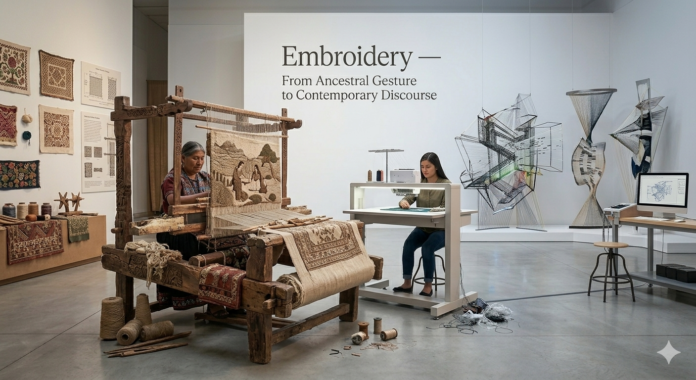
Embroidery — From Ancestral Gesture to Contemporary Discourse
Embroidery — From Ancestral Gesture to Contemporary Discourse
Embroidery, the act of inscribing thread into fabric with needle and hand, is one of the most enduring artistic practices in human history. At once intimate and expansive, it has traversed centuries as a medium of decoration, storytelling, identity, and resistance. From ancestral textiles to contemporary conceptual works, embroidery has evolved from a domestic craft into a critical language within contemporary art.
The Ancestral Mark: Embroidery as Memory
Historically, embroidery functioned as a cultural archive. Across civilizations—whether in Central Asia, the Middle East, Europe, Africa, or the Americas—embroidered textiles encoded systems of belief, social status, and communal memory.
Unlike weaving, which constructs the fabric itself, embroidery operates on the surface, intervening after the fact. This distinction is crucial: embroidery is inherently additive and narrative. It marks, embellishes, and transforms an existing ground, much like writing on a page.
Each stitch—whether ceremonial or utilitarian—carried meaning:
patterns signified lineage or region
motifs conveyed myth or spirituality
technique reflected labor, gender roles, and social structures
Embroidery was not merely decoration; it was a language stitched into cloth.
The Grammar of Stitch
Even in its most basic forms, embroidery is structured through a limited but powerful vocabulary of stitches:
Running stitch: a linear, rhythmic mark—suggestive of movement and continuity
Backstitch: precise and controlled—used for clarity, outline, and definition
Satin stitch: dense and luminous—transforming line into surface
French knots: punctuations of texture—small accumulations of presence
These foundational gestures form a grammar of mark-making, comparable to drawing or writing. In contemporary practice, artists often return to these elementary stitches, not as craft exercises, but as conceptual tools.
From Domestic Craft to Artistic Medium
For centuries, embroidery was confined to the domestic sphere, frequently associated with femininity and undervalued within dominant art historical narratives. The 20th century began to unsettle this hierarchy, as artists and theorists questioned the boundaries between fine art and craft.
Embroidery emerged as a site of reclamation and critique:
reclaiming overlooked labor
challenging gendered divisions of artistic practice
asserting the intellectual and aesthetic complexity of textile work
This shift parallels broader museological revisions, where institutions increasingly recognize embroidery as part of the expanded field of contemporary art.
Contemporary Embroidery: Surface as Concept
In contemporary practice, embroidery is no longer limited to ornament or representation. It has become a conceptual intervention into surface, image, and meaning.
Artists today:
embroider over photographs and printed images, disrupting visual certainty
use text and language, transforming thread into a form of writing
incorporate unconventional materials—plastic, metal, found fabrics
expand embroidery into installation, sculpture, and performance
The stitched mark becomes both material and metaphor—a trace of time, labor, and intention.
Embroidery and the Politics of the Hand
Embroidery’s slow, repetitive process foregrounds time and embodiment. Each stitch records a gesture, a moment of attention. In an age dominated by digital production, this slowness acquires political significance.
Embroidery resists:
speed
mass production
immateriality
Instead, it insists on:
presence
care
duration
From a curatorial perspective, this positions embroidery within a broader discourse of labor and visibility, where the handmade becomes a form of critical resistance.
Beyond Fabric: Expansion and Experimentation
Contemporary embroidery often transcends its traditional support. It appears on:
paper
industrial materials
architectural surfaces
In some cases, embroidery becomes spatial—threads extending into the environment, dissolving the boundary between surface and space. This expansion aligns embroidery with sculpture and installation, reinforcing its role as a multidimensional practice.
Embroidery as Writing, Embroidery as Thought
Perhaps the most compelling aspect of embroidery today is its proximity to language. The act of stitching resembles writing—line by line, mark by mark. Yet unlike ink, thread introduces:
texture
resistance
physical depth
Embroidery becomes a form of thinking through the hand, where ideas are not simply represented but materially constructed.
Final thoughts: The Persistence of the Mark
Embroidery endures because it operates at the intersection of intimacy and structure, tradition and innovation, surface and depth.
From ancestral garments to contemporary installations, it continues to evolve while retaining its essential gesture: the puncture of fabric, the passage of thread, the accumulation of meaning.
In 2026, embroidery is no longer peripheral. It is a central medium through which artists explore identity, memory, and the conditions of making itself.
What appears delicate is, in fact, profoundly resilient— a quiet but persistent assertion that even the smallest mark can carry the weight of history, labor, and imagination.