Home Blog Page 186

HOW TO BECOME A FULL-TIME ARTIST

How To Be Ready To Transition Into A Full-Time Art Career

HOW TO BECOME A FULL-TIME ARTIST

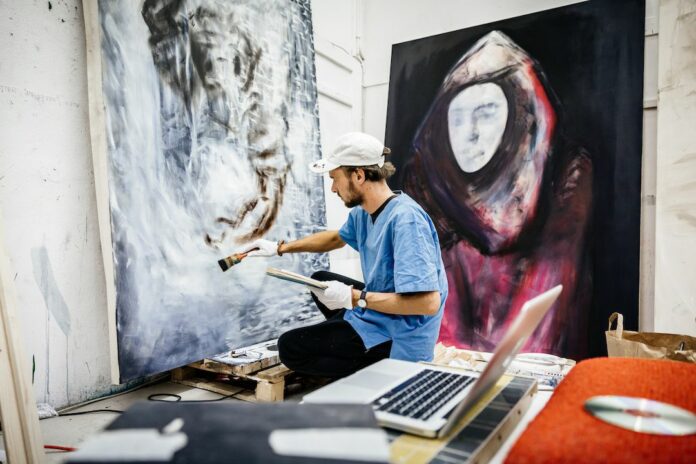
How many times have you been told that art is a dead-end career choice? I know I have heard this said by people so many times, and it is simply not true. If you find yourself asking is art a realistic and achievable career choice, you are in the right place to find out more. It is possible to turn your art into a successful career. Like most things, it isn’t always easy, but there are so many opportunities now if you have a plan and focus on taking it seriously as a career.

1. Turning art into a career

The first step to becoming a full-time artist is to make the decision to take it seriously as a career. This is easier said than done. Some people will tell you, you need to get a ‘real job’ instead. If you want to start making money from art, or want to turn art into your full-time career you have to first work out which career path will best allow you to shine as an artist and display your talents for all to see.

There are so many art career paths to choose from, you might even start your own art business, like me. Once you have found a role that looks like it will work for you, you need to build a portfolio of your work. Lots of people do this at the same time as taking a training course to develop their skills. A portfolio is simply a folder full of examples of what you can do, that you can show to potential clients or employers. It has never been easier to get your portfolio of work out there and get noticed, so don’t be shy about making things happen and taking the initiative.

2. How to find an art job

A career as an artist, or any creative is not always easy. However, it is definitely not limited to painting canvases. The world of art and culture is vast, and it offers so many worthwhile career paths and interesting jobs that are well worth considering. The best artists are very well connected and are good at building relationships in the part of the industry they want to work in. Go to events, sign up for courses, attend gallery nights, anything you can do to start networking with others will help you break into the industry.

3. How much do artists earn? What is an artist’s salary?

The cliché of the starving artist doesn’t have to become a reality, there are lots of art jobs that are very well paid and in high demand. Lots of areas of art can give you unlimited earning potential at the highest level, with some entry-level positions even earning £25k per year or more with technical training and a good skill level. The higher your profile is as an artist, and the better your portfolio of work, the more you are likely to earn. As a self-employed artist or running your own art business you are only limited by your time and imagination, you can build an art business as big or as small as you like.

I have chosen the route of starting my own commission-based art business that has allowed me to work with clients all over the world and start building my name as an artist. I find the commission process incredibly rewarding and I love that my work means so much to my customers. If you want to start making money from your art, I’ve shared my experience building my business in my new book, “Art is my career – How to Start an Art Business”.

Solimán López llega a la UCAB

Solimán López llega a la UCAB

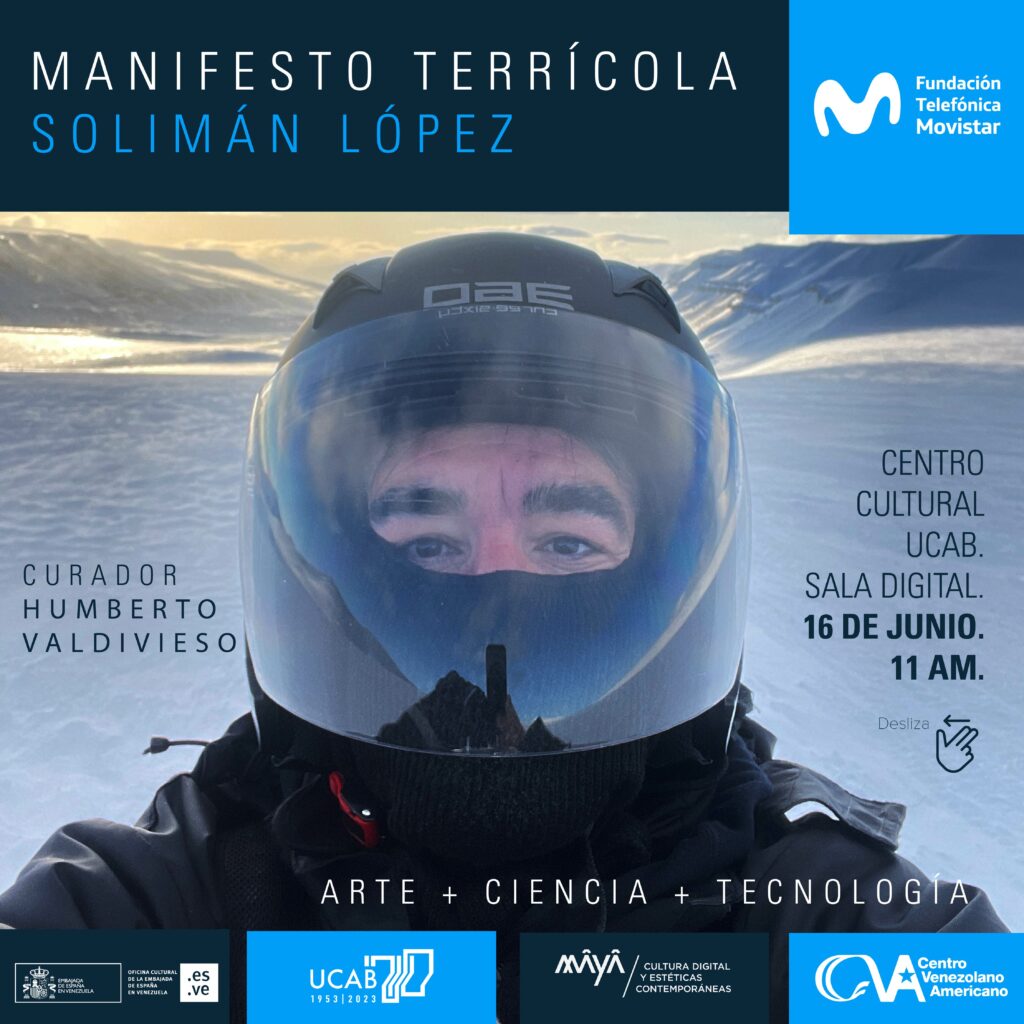
Manifesto Terrícola del artista español Solimán López llega a la UCAB

El 16 de junio de 2023 a las 11:00 a.m., será inaugurada la exposición “Manifesto Terrícola” del artista español Solimán López, en las salas de Arte Digital y sala Experimental del Centro Cultural UCAB, en el marco de la octava sesión del seminario internacional Next, que lleva el mismo título de la exposición, y que se realizará el 14 de junio de 2023 a las 10:00 a.m. (hora Venezuela) y 4:00 p.m. (hora Europa), en la Mega Sala Digital Movistar, ubicada en Los Palos Grandes.

La octava sesión del seminario internacional Next será presentada por el Centro de Investigación y Formación Humanística y Fundación Telefónica, en alianza con el Centro Cultural UCAB, la Embajada de España en Venezuela y el Centro Venezolano Americano, y contará con la participación de Solimán López (artista/España), José Ramón Alcalá (catedrático Bellas Artes/España), Victor Krebs (filósofo/ Pontificia Universidad Católica del Perú), Lorena Rojas Parma (filósofo/ Universidad Católica Andrés Bello, Venezuela) y Humberto Valdivieso (semiólogo-curador/ Universidad Católica Andrés Bello, Venezuela).

Durante este encuentro se disertará sobre el impacto de las tecnologías digitales en la producción de conocimiento, la difusión de mensajes a través de las redes, las estrategias corporativas globales, las políticas públicas, los modos de entretenimiento y el posible tránsito hacia un futuro post y transhumano.

Por otro lado, la muestra expositiva del artista español Solimán López, se presentará simultáneamente en la sala de Arte Digital y en la sala Experimental del Centro Cultural UCAB, desde el 16 de junio hasta finales de julio de 2023, bajo la curaduría de Humberto Valdivieso, y exhibirá el resultado del proyecto de investigación que el artista lleva años desarrollando sobre las relaciones conceptuales entre arte, ciencia, tecnología, biología y sociedad.

El texto consiste en una mirada crítica sobre la posición del artista contemporáneo frente al contexto actual de la humanidad. El manifesto se articula en 4 bloques de contenido que hablan sobre la relación entre la fe y la ciencia, el transhumanismo, la transición ecológica y la humanidad representada por el arte.

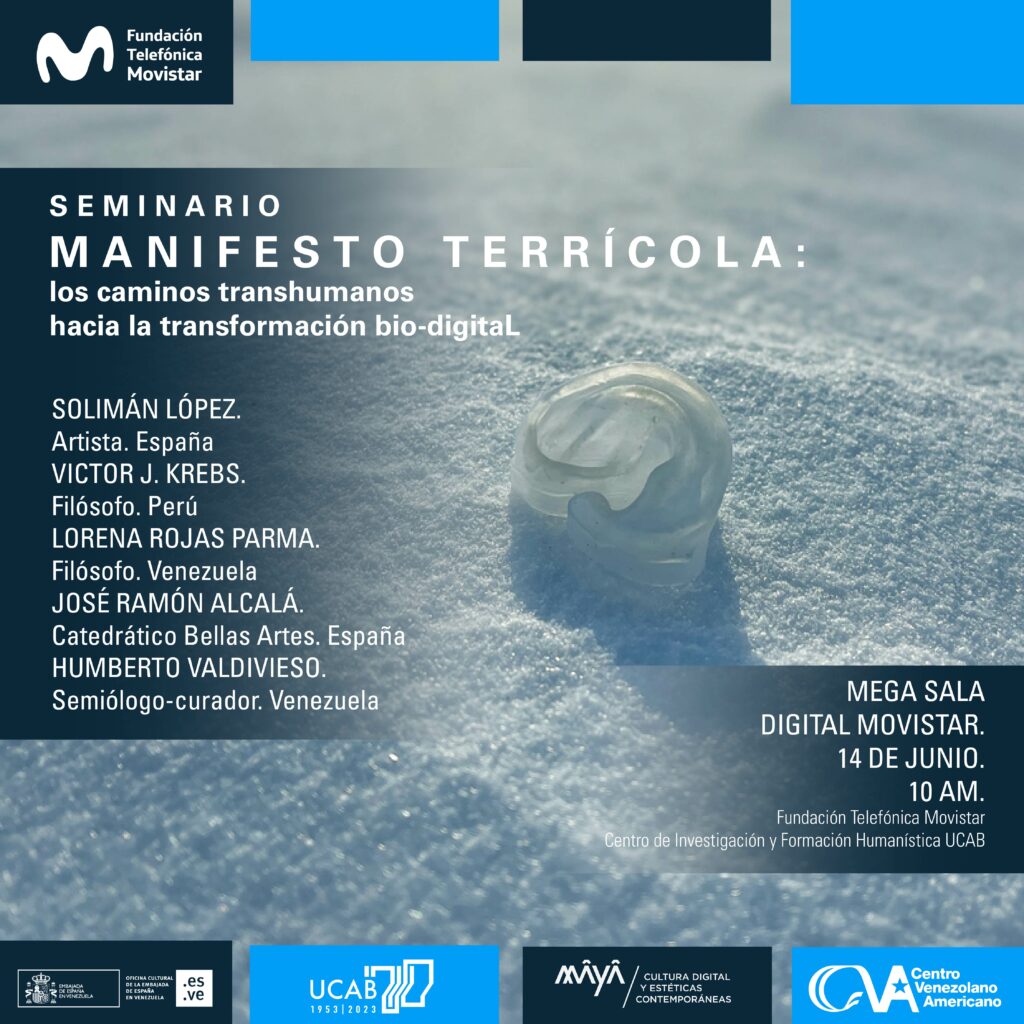
“Este proyecto pensado por López se trata de un documento artístico que muestra el estado actual de la humanidad en distintos ámbitos: economía, ética, psicología, geopolítica, medio ambiente y el arte, entre otros. Su soporte es una materialidad particular pues está almacenado en ADN y encapsulado en una oreja 3D biodegradable producida para su conservación en la Isla de Svalbard, en el Ártico. Lo cual, abre la posibilidad de tener discos duros masivos de información digital almacenada en ADN en los ecosistemas glaciares. Por lo tanto, es un manifiesto artístico que se comporta a la vez como una obra, un texto de intenciones y una herramienta científica”, según afirma Humberto Valdivieso.

Por otra parte, el Manifesto, texto artístico y obra de arte al mismo tiempo, pretende entrar en la historia del arte por su forma y contenido. Por su forma alude a aquellas obras simbólicas de nuestros libros de arte como la famosa oreja de Van Gogh, la de Stelarc o las obras de Joe Davis con orejas de ratones. La oreja de Solimán López pretende no contar una historia personal (el modelo original de la oreja no ha sido desvelado de a quién pertenece) sino que alude a historias colectivas, ya que según el artista: “en la era del fake y la IA empoderada, cualquier historia personal es posible, lo difícil es crear historias colectivas, aquellas que nos cambian y aluden a todos. Mi obra no habla de mí en primera persona, si no de nosotros.”

Nacido en Burgos, España, en 1981, Solimán López es un artista contemporáneo especializado en arte, ciencia, biotecnología, sociología y tecnología. Fundador del Harddiskmuseum, biocriptomoneda OLEA, entidades digitales basadas en ADN Introns y director de Innovación en ESAT (Escuela Superior de Arte y Tecnología de Valencia, España). Su práctica artística conceptual incluye trabajo con inteligencia artificial, biotecnología y ADN, electrónica, interactivo y 3D. Desde el año 2005, su producción ha sido exhibida internacionalmente en eventos, centros de arte y museos en Alemania, Francia, Rusia, Corea del Sur, España, Colombia, Estados Unidos, Cuba, y Pakistán, entre muchos otros países. Su trabajo como investigador en nuevos medios ha sido compartido en varias universidades como la UFSM en Brasil, la Universidad Carlos III de Madrid, el Campus de Google en Madrid, la UPV en Valencia, la Universidad de Cuenca, la Universidad Nacional de Córdoba en Argentina, entre otras. Entre sus proyectos más recientes está el desarrollo de DAI, un documento de identidad construido por una inteligencia artificial, que da lugar a un nuevo imaginario de la cultura, la sociedad y la humanidad en el siglo XXI.

Solimán López llega a la UCAB

@culturaucab

centrocultural.ucab.edu.ve

[email protected]

@solimanlopez

solimanlopez.com

Exposición Internacional
Manifesto Terrícola
Solimán López. España
Curador: Humberto Valdivieso
Lorena Rojas Parma. Directora del CIFH
Fundación Telefónica Movistar
Universidad Católica Andrés Bello
Centro Venezolano Americano
Embajada de España en Venezuela
Sala digital. Centro Cultural UCAB 16 de junio. 11 am.
El Manifesto Terrícola es un documento artístico que muestra el estado actual de la humanidad en distintos ámbitos: economía, ética, psicología, geopolítica, medio ambiente y el arte, entre otros. Su soporte es una materialidad particular pues está almacenado en ADN
y encapsulado en una oreja 3D biodegradable producida para su conservación en la Isla de Svalbard, en el Ártico. Lo cual, abre la posibilidad de tener discos duros masivos de información digital almacenada en ADN en los ecosistemas glaciares. Por lo tanto, es un
manifiesto artístico que se comporta a la vez como una obra, un texto de intenciones y una herramienta científica.
@fundaciontef_ve
@centrovenezolanoamericano
@embespvenezuela
@solimanlopez @parmalorena @hvaldivi
#artecontemporaneo
#bioarte
#inteligenciaartificial
#artedigital

Questions to ask yourself when writing an artist statement:

questions to ask yourself when writing an artist statement
Questions to ask yourself when writing an artist statement. Sample: answers about writing an artist statement.

Questions to ask yourself & sample answers when writing an artist statement:

The mission of Art Miami Magazine is to provide artists with opportunities to grow and advance in their artistic careers. We understand the importance of artist statements in conveying your artistic vision and connecting with your audience. While the following are sample answers, we encourage you to personalize your responses to reflect your unique artistic voice and experiences.

Why Do You Make This Type of Art?
a) I am drawn to this type of art because it allows me to express my emotions and ideas visually captivatingly and evocatively. It provides me with a unique means of communication and a way to connect with others on a deeper level.
b) I make this type of art because I am drawn to the beauty and mystery of the natural world. I enjoy using my art to capture nature’s essence in a realistic and expressive way.

What Does Your Artwork Represent?
a) My artwork represents a fusion of personal experiences, observations, and reflections on various aspects of life. It explores themes of identity, the human condition, and the interconnectedness of individuals and the world around us.
b) My artwork represents my interpretation of the natural world. I hope my work can help people see nature’s beauty and wonder in a new way.

What Inspires You?
a) I find inspiration in the beauty of nature, the intricacies of human relationships, and the power of emotions. Additionally, literature, music, and the works of other artists ignite my creativity and push me to explore new artistic possibilities.
b) Many things, including nature, music, literature, and other artists inspire me. I am also inspired by the people in my life, who have taught me so much about love, loss, and the human experience.

How Do You Make It?
a) I create my artwork through a combination of traditional and contemporary techniques. I experiment with different mediums, such as acrylics, oils, and mixed media, to achieve the desired textures, colors, and effects that bring my vision to life.
b) I make my artwork using various techniques, including painting, drawing, and sculpture. I often use traditional media, such as oil paint and pencil, but I enjoy experimenting with digital art.

What Does Your Art Mean to You?
a) My art is a form of self-expression and a way for me to make sense of the world. It serves as a cathartic outlet, allowing me to process emotions, explore complex ideas, and share my perspectives with others. It is profoundly personal and holds significant meaning for me.
b) My art means a lot to me. It is a way for me to express myself creatively and share my love of the natural world. I hope that my work can bring joy and inspiration to others.

Describe your materials and working process in detail, including the scale and size of your work.
a) I primarily work with acrylic paints on canvas, utilizing brushes, palette knives, and various mark-making tools. The scale and size of my work vary, ranging from intimate pieces that invite close examination to larger-scale works that create a more immersive experience for viewers.
b) I use various materials, including oil paint, pencil, charcoal, and acrylic paint. I often work on large-scale canvases, but I also enjoy working on smaller, more intimate pieces. My working process is usually iterative, with me making changes and adjustments to my work as I go along. I often work from photographs, but I also enjoy working from life.

Why have you chosen the medium/media that you use?
a) I have chosen acrylic paints for their versatility, quick drying time, and ability to layer and build texture. The medium allows me to work with bold colors, create depth, and experiment with different techniques that enhance the visual impact of my artwork.
b) I have chosen the medium/media that I use because they allow me to express myself creatively in a personal and expressive way. I enjoy the challenge of working with different materials and techniques, and I find that each medium has its own unique qualities that can be used to create different effects.

What formal aspects of art are of primary interest to you?
a) The interplay of light and shadow, composition, and color are of primary interest to me. I am intrigued by how these formal elements can evoke emotions, create depth, and guide the viewer’s gaze within a piece.
b) The formal aspects of art that are of primary interest to me include composition, color, line, and form. I am interested in how these elements can be used to create a sense of balance, harmony, and movement in my work.

Describe any themes, motifs, symbols, references, or images that recur in your work. What is their significance to you?
a) One of the themes that recurs in my work is the relationship between humans and nature. I am interested in exploring how humans interact with and impact the natural world. I also explore themes of love, loss, and the human condition in my work.
b) In my work, you will often find recurring themes of transformation, balance, and the duality of human nature. Symbols such as birds, trees, and water frequently appear, representing freedom, growth, and fluidity. These motifs serve as visual metaphors for deeper concepts and personal experiences.

Are there particular aspects of your biography or your life experience that would help a viewer appreciate your work?
a) I grew up in a small town surrounded by nature. I have always been drawn to the beauty of the natural world, and I believe this has profoundly impacted my work. I have also experienced loss and hardship in my life, and these experiences have also informed my work.
b) My multicultural background and experiences of living in different countries have shaped my perspective and enriched my artistic vision. The blending of cultures, diverse landscapes, and encounters with various traditions have influenced the themes and narratives explored in my artwork.

How do you hope a viewer will respond to your work?
a) I hope that viewers will respond to my work with a sense of wonder and awe. My work will inspire them to appreciate the natural world’s beauty and reflect on their own place in the world.
b) I want viewers to engage with my artwork on an emotional and intellectual level. I want them to connect with the themes and ideas conveyed, to be moved, inspired, or challenged in their own thoughts and perceptions. Ultimately, I aim to provoke introspection and invite personal interpretations.

List 3 to 5 adjectives that you feel are relevant to your work; then, list 3 to 5 adjectives, descriptions, or terms that are inaccurate, overused, or that you don’t like.

Adjectives that are relevant to my work:
a) Beautiful
Expressive
Emotional
Thought-provoking
Realistic

Adjectives, descriptions, or terms that are inaccurate, overused, or that I don’t like:
Obscure
Cerebral
Pretentious
Dry
Technical

b) Relevant adjectives for my work:
Evocative
Intricate
Thought-provoking
Dynamic
Expressive

Inaccurate, overused, or disliked adjectives for my work:
Generic
Predictable
Clichéd
Simplistic
Conventional

What might surprise someone about your work?
a) Some people might be surprised by the emotional depth of my work. I often deal with heavy topics in my work, but I always try to do so in a way that is both beautiful and accessible.
b) What might surprise someone about my work is the hidden layers of symbolism and meaning woven into each piece. Upon closer examination, viewers may discover subtle details or narratives that invite deeper exploration and engagement.

What are some of the most common questions people ask about your work?
a) How long does it take you to create a piece of art?
The time it takes me to create a piece of art varies depending on the size and complexity of the piece. I usually spend several weeks or even months working on a single piece.
a1) What is your favorite medium to work with?
I don’t have a favorite medium, but I enjoy working with various materials, including oil paint, pencil, charcoal, and acrylic paint.
a2) Where do you get your inspiration?
I get my inspiration from many sources, including nature, music, literature, and other artists. I am also inspired by the people in my life who have taught me so much about love, loss, and the human experience.
a3) What is the meaning behind your work?
The meaning behind my work is up to the viewer to decide. I hope my work can spark a conversation about the beauty and mystery of the natural world, the relationships between humans and nature, and the human condition.
a4) What advice would you give to aspiring artists?
My advice to aspiring artists is to be patient, persistent, and genuine to themselves. Developing your unique artistic voice takes time and effort, but it is worth it. Do not be afraid to experiment with different mediums and techniques; do not be afraid to fail. Failure is a part of the learning process. Most importantly, keep creating!

b) Some of the most common questions people ask about my work include inquiries about the inspiration behind specific pieces, the techniques and materials employed, and the intended emotions or messages conveyed. Viewers also often inquire about the stories or narratives behind certain motifs or symbols.
b1) How has your work changed over time? How do you anticipate becoming an artist in the next five years? Over time, my work has evolved in terms of technique, subject matter, and conceptual depth. I have embraced experimentation, honed my skills, and explored new avenues of artistic expression. I anticipate further growth by pushing boundaries, taking risks, and delving into more ambitious projects that challenge my technical abilities and conceptual framework. I aspire to continue refining my artistic voice, expanding my creative horizons, and engaging with a broader audience.

Why do you like to make art?

a) I like to make art because it allows me to express myself creatively. I enjoy the process of coming up with ideas, finding the right materials, and creating something that is both beautiful and meaningful to me. Art is also a way for me to connect with others and share my experiences with the world.

b) I am captivated by the power of art to communicate emotions, tell stories, and provoke thought. Creating art allows me to express myself in ways that words cannot, bringing me immense joy and fulfillment.

c) I am drawn to the creative process of art-making as a form of self-expression and exploration. It allows me to convey emotions, ideas, and perspectives in a visual language beyond words.

What subjects do you prefer? Why? 

a) I am drawn to exploring the human condition and the complexities of human emotions. Through my artwork, I seek to capture moments of vulnerability, resilience, and connection, inviting viewers to reflect on their own experiences and perceptions.

b) I prefer to work with figurative subjects like people, animals, and landscapes. These subjects are more relatable to me and my work’s viewers. I also enjoy the challenge of capturing a subject’s essence in a realistic and expressive way.

c) I gravitate towards nature and landscapes as my preferred subjects. The beauty and harmony of the natural world inspire me, and I aim to capture its essence and evoke a sense of awe and connection in viewers.

What processes and techniques do you use? Why?

a) I employ mixed media techniques, including layering, texture creation, and experimental approaches. These techniques allow me to experiment and push the boundaries of traditional artistic practices, enabling me to create unique and dynamic artworks.

b) I use a variety of processes and techniques in my work, depending on the subject matter and my desired outcome. I often use traditional media, such as pencil, charcoal, and paint, but I enjoy experimenting with digital art. Being versatile and open to new ways of creating art is essential.

c) I embrace a mixed-media approach that combines traditional techniques with experimental processes. This allows me to push the boundaries of my creativity, fostering a sense of spontaneity and exploration in my artwork.

How is your work different from others?

a) My work stands out by emphasizing intricate details and the interplay of light and shadow. I strive to create a sense of depth and atmosphere that immerses viewers in the world I’ve created, offering them a unique perspective and inviting them to explore their own interpretations.

b) My work stands out by incorporating vibrant colors, intricate details, and a balance between realism and abstraction. I strive to create visually striking compositions that invite viewers to delve into the intricacies of the artwork and discover their own interpretations.

c) My work stands out by emphasizing intricate details and the interplay of light and shadow. I strive to create a sense of depth and atmosphere that immerses viewers in the world I’ve created, offering them a unique perspective and inviting them to explore their own interpretations.

What do you see in your artwork? 

a) In my artwork, I see a reflection of my inner thoughts, emotions, and observations of the world around me. It serves as a visual diary, capturing the essence of moments, experiences, and the essence of the human spirit.

b) I see a reflection of myself and my experiences in my artwork. I also see the beauty and wonder of the world around me. My work inspires others to see the world in a new way.

c) In my artwork, I see a reflection of my inner world, emotions, and experiences. It is a visual representation of my thoughts and a means of exploring and understanding the complexities of human existence.

What are your goals and aspirations as an artist?

a) My goals as an artist are to continue honing my craft, expanding my artistic horizons, and engaging with a broader audience. I aspire to create meaningful connections through my art, inspire dialogue, and positively impact individuals and communities.

b) My goals as an artist are to continue growing and evolving in my artistic practice, to engage with a broader audience, and to have my artwork inspire and resonate with viewers. I aspire to create a body of work that reflects my artistic journey and leaves a lasting impact on those who experience it.

c) My goals and aspirations as an artist are to continue to grow and develop as an artist, share my work with others, and positively impact the world. Art has the power to change the world, and I hope that my work can play a small role in making the world a better place.


Answering these questions can help you better understand your artistic process and communicate your goals and vision to others. When writing your artist statement, be sure to be honest and authentic. Your statement should be a reflection of your unique perspective and voice.

Remember, these are just sample answers, and it’s essential to provide your own authentic responses that reflect your unique artistic voice and experiences.

Cover photo: Shutterstock.com #1857921163
Lost at Sea Gustavo Oviedo’s new exhibit

Lost at Sea Gustavo Oviedo’s new exhibit

Visu Contemporary to present Lost at Sea Gustavo Oviedo’s new exhibit featuring abstract works inspired by sea life and the evolution of form June 24-Aug 04, 2023 — opening reception Saturday, June 24th – 6-9pmMIAMI BEACH, JUNE 7, 2023 — Visu Contemporary is thrilled to announce the highly  anticipated exhibition Lost at Sea featuring new works in the ongoing “biomorphic” series by abstract artist Gustavo Oviedo. The exhibit will be on display at the gallery from June 24th to August 4th, 2023, with an opening reception on June 24th from 6-8pm.
Through his bold and dynamic compositions, Oviedo’s artworks invite viewers to immerse  themselves in the rhythmic patterns and harmonious color palettes, creating an engaging visual experience that resonates with the viewer’s own subconscious notions of ephemeral patterns in nature.
For 15 years Gustavo Oviedo’s has explored abstraction while comprehensively researching and  visiting structures in the seas surrounding Miami and The Keys. Lost at Sea will showcase works inspired by Oviedo’s interest in the evolution of form—both through subtle changes in marine life as well as humankind’s rapid impacts on the sea.
The opening reception Lost at Sea will take place on June 24th from 6-9pm at Visu Contemporary. Attendees will have the opportunity to meet Gustavo Oviedo in person, discuss his artistic process, and gain a deeper understanding of the inspiration behind his captivating works. This event promises to be an unforgettable celebration of creativity and the power of transformation.

“We are honored to present Gustavo Oviedo’s Lost at Sea at Visu Contemporary,” said Gallery Co-Owner, Blake Pearson. “Oviedo’s ability to capture the essence of change and evolution through abstract forms is truly remarkable.”

Visu Contemporary is an artist first gallery where emphasis is placed on quality and presentation. VISU Contemporary’s mission is to contribute to the art history canon by presenting provocative and inclusive exhibitions, projects, installations, collaborations and performances with the goal of making each exhibition a must-see, while inspiring curiosity and intrigue from every visitor.

For more information about Lost at Sea and other upcoming exhibits at Visu Contemporary, please visit www.visugallery.com

GUSTAVO OVIEDO: LOST AT SEA
June 24-August 4, 2023 – Opening Reception – Saturday, June 24th, 2023 – 6-9pm

VISU CONTEMPORARY 
2160 Park Avenue, Miami Beach
Operating Hours
June 24-Aug 4, 2023
Wednesday through Saturday, 12pm-5pm, by appointment only
Schedule an appointment: [email protected]

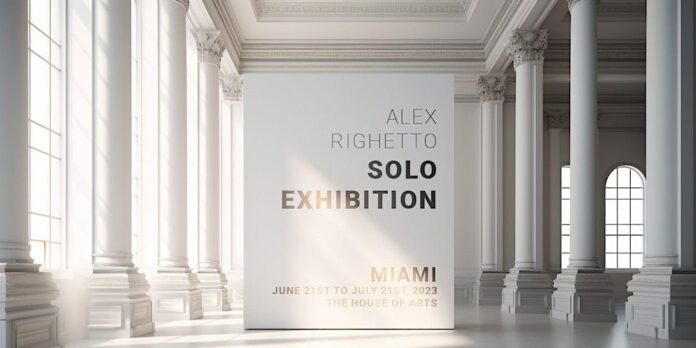
Alex Righetto Solo Exhibition

Alex Righetto Solo Exhibition

Miami Art Exhibits: Alex Righetto Solo Exhibition

The House of Arts 100 Northwest 36th Street Miami, FL 33127

I am excited to introduce my upcoming exhibition in Miami, which will be running from June 21st to July 21st, 2023.

I am grateful for the opportunity to showcase my new work during this exhibition. It’s a wonderful chance to share my artistic vision and connect with others through my creations.

The exhibition will be held in Miami from June 21st to July 21st, 2023, and I look forward to welcoming visitors to experience and engage with my art.

From Alex:

Hey everyone!

I’m super pumped to see you all in Miami!

And guess what? You’re in for a treat because my solo exhibition is

happening at the awesome House of Arts.

I just had to give you an update. The opening show date got pushed back

from June 10th to June 21st.

So now, mark your calendars because the

exhibition will be running from June 21st to July 21st.

I’ve been busy working on expanding my Radiance Collection specifically

for this show. Let me tell you, the piece I’m currently working on has taken

me over 100 hours to create.

Keeping it under wraps and not sharing it on social media has been a real challenge. I’ve been itching to show it off! But

don’t worry, I’m saving it as a special surprise for my dedicated supporters

who come to see my pieces in person.

And guess what? You guys will be the very first to see my new creations!

Once you’ve experienced them firsthand, you can share them on social

media on my behalf for the whole world to see.

Crafting an Effective Art Statement

Mary Magdalene
Mary Magdalene

Crafting an Effective Art Statement

An artist statement is a written description of your artistic practice. It can be used to accompany your artwork in a gallery or exhibition, or to submit to a grant or fellowship program. An effective artist statement will help viewers understand your work and why you create it.

Here are some tips for crafting an effective artist statement:

Be specific. Don’t just say that you are a painter or a sculptor. What kind of work do you make? What materials do you use? What are your influences?
Be personal. Your artist statement should reflect your own unique voice and perspective. Don’t be afraid to share your personal experiences and emotions in your writing.
Be concise. Your artist statement should be no more than a few pages long. Get to the point quickly and clearly.
Be honest. Your artist statement should be an honest reflection of your work and your artistic process. Don’t try to be someone you’re not.
Here is an example of an effective artist statement:

I am a painter who works primarily in acrylics. My paintings are often large and abstract, and they explore themes of memory, loss, and identity. I am drawn to the expressive possibilities of paint, and I use color, texture, and form to create works that are both visually arresting and emotionally resonant.

My work is influenced by a variety of sources, including my own personal experiences, the work of other artists, and the natural world. I am particularly interested in the way that memory can be both a source of pain and a source of beauty. My paintings often depict landscapes that are both familiar and strange, and they invite viewers to explore their own memories and emotions.

I believe that art has the power to connect people and to make them think about the world in new ways. I hope that my work will inspire viewers to reflect on their own lives and experiences.

This artist statement is specific, personal, concise, and honest. It provides a clear and concise overview of the artist’s work, and it invites viewers to explore the work in more depth.

An artist statement is a written description of your artistic practice. It can be used to accompany your artwork in a gallery or exhibition, or to submit to a grant or fellowship program. An effective artist statement will help viewers understand your work and why you create it.

Here is an example of an effective artist statement:

I am a painter who works primarily in acrylics. My paintings are often large and abstract, and they explore themes of memory, loss, and identity. I am drawn to the expressive possibilities of paint, and I use color, texture, and form to create works that are both visually arresting and emotionally resonant.

My work is influenced by a variety of sources, including my own personal experiences, the work of other artists, and the natural world. I am particularly interested in the way that memory can be both a source of pain and a source of beauty. My paintings often depict landscapes that are both familiar and strange, and they invite viewers to explore their own memories and emotions.

I believe that art has the power to connect people and to make them think about the world in new ways. I hope that my work will inspire viewers to reflect on their own lives and experiences.

This artist statement is specific, personal, concise, and honest. It provides a clear and concise overview of the artist’s work, and it invites viewers to explore the work in more depth.

Writing an Effective Art Statement: 18 Essential Guidelines

Writing an engaging and concise artist statement is vital for effectively communicating your artistic vision to the world. To help you master this skill, we have compiled a list of ten essential guidelines to enhance the quality and impact of your art statement.

#1 Advice: Get help from an art critic or a curator.

How, What, Why

The “how” of your artist statement should explain your artistic process. How do you create your work? Explain the methods, materials, and mediums you use to bring your artistic vision to life. Discuss any unique approaches or innovative techniques and creative skills that set your work apart. By sharing insights into your creative process, you offer readers a glimpse into the craftsmanship and technical aspects of your art.

The “what” of your artist statement should describe the subject matter of your work. What are your goals and objectives? What do you hope to achieve with your art? Define the central themes, concepts, or subjects that define your artwork. Clearly articulate the ideas or narratives that you explore through your creative practice. Discuss the recurring motifs or visual elements that are integral to your work. By providing a clear understanding of what your art encompasses, you invite viewers to engage with the content and symbolism embedded in your pieces.

The “why” of your artist statement should explain your motivation and inspirations for creating art. Why do you make art? why you create, what drives you, and what you hope to achieve through your work? What does art mean to you? What do you hope to communicate through your art? Share the emotions, experiences, or observations that influence and shape your artistic expression. By revealing the underlying intentions and personal connections, you deepen the connection between your art and its audience.

Here are some examples of how to answer the “how,” “what,” and “why” questions in your artist statement:

How: I create my paintings using a variety of materials, including acrylics, oil paints, and watercolors. I often use a combination of techniques, such as painting, drawing, and collage.


What: My paintings explore themes of memory, loss, and identity. I am drawn to the expressive possibilities of paint, and I use color, texture, and form to create works that are both visually arresting and emotionally resonant.


Why: I make art because it is a way for me to express myself and to explore the world around me. I believe that art has the power to connect people and to make them think about the world in new ways.
Your artist statement should be tailored to your specific work and your individual artistic goals. There is no one right way to write an artist statement, but by following these tips, you can create a statement that is clear, concise, and effective.

Here are some additional tips for writing an artist statement:

Tips:

Start by brainstorming: What are your goals for your art? What do you hope to achieve with your work? What are your influences and inspirations?
Write in the first person: Your artist statement should be a personal statement, so use the first person pronoun “I.”
Be specific: Don’t be afraid to get specific about your work. What materials do you use? What techniques do you employ? What are your themes and motifs? Don’t just say that you are a painter or a sculptor. What kind of work do you make? What materials do you use? What are your influences?
Be concise: Your artist statement should be no more than a few pages long, much better a few lines long. Get to the point quickly and clearly.
Get feedback: Once you have a draft of your artist statement, get feedback from friends, family, or other artists. Ask them for their honest opinions on how well your statement communicates your work and your artistic goals.
Be personal. Your artist statement should reflect your own unique voice and perspective. Don’t be afraid to share your personal experiences and emotions in your writing.
Be honest. Your artist statement should be an honest reflection of your work and your artistic process. Don’t try to be someone you’re not.

Mistake to avoid

Do state what you’re making:
Clearly articulate the mediums, techniques, and themes that define your artistic practice. Provide a brief overview of your artwork, offering readers a glimpse into your creative world.

Don’t have an unclear thesis:
Ensure that your art statement has a clear and focused central idea. Avoid ambiguity or excessive abstraction that may confuse the reader. Develop a coherent thesis that anchors your artistic exploration.

Don’t use qualifying language:
Be confident in your artistic voice and avoid using qualifying language that weakens the impact of your statement. Instead, assert your ideas and convey the strength of your artistic practice.

Don’t reference something without naming it:
When referring to influences, inspirations, or concepts, be specific and provide clear references. Avoid vague allusions that leave the reader guessing. Naming and acknowledging sources adds credibility to your statement.

Don’t use self-deprecating language:
Demonstrate self-assurance and belief in your artistic abilities. Avoid self-deprecating language that undermines the value of your work. Present your art with pride and conviction.

Don’t repeat yourself:
Ensure your art statement is concise and avoids unnecessary repetition. Each sentence should contribute new information or offer a fresh perspective. Edit your statement to maintain a clear and engaging flow.

Don’t be too abstract:
While art can be abstract, your statement should strike a balance between accessibility and conceptual depth. Avoid excessive abstract language that may alienate or confuse your audience. Make your ideas relatable and comprehensible.

Don’t use passive verbs:
Employ active verbs to describe your artistic process and intentions. Active language adds dynamism and energy to your statement, engaging the reader and conveying your artistic agency.

Do point to examples in the work:
Support your art statement with specific examples from your artwork. Reference notable pieces or series that illustrate the concepts, techniques, or themes you discuss. Concrete examples strengthen your argument and provide visual references for readers.

Do use metaphors that logically connect:
Metaphors can enhance understanding and make complex ideas more accessible. Ensure that your metaphors are logical and resonate with your artistic practice. Metaphorical language should enrich your statement without overshadowing its clarity.

Crafting an effective art statement is a skill that can elevate your artistic career. By following these ten guidelines, you can create a compelling and coherent statement that captivates readers and invites them to explore your art more deeply. Embrace the power of words to articulate your creative vision and connect with your audience.

Remember, an art statement should be concise, engaging, and authentic. Avoid excessive jargon or technical language that might alienate readers. Instead, focus on communicating your artistic vision with clarity and passion. Your art statement should invite viewers to explore and interpret your work, fostering a deeper understanding and appreciation of your creative journey.

Your art statement is an opportunity to express your artistic identity and engage others in meaningful dialogue about your work.

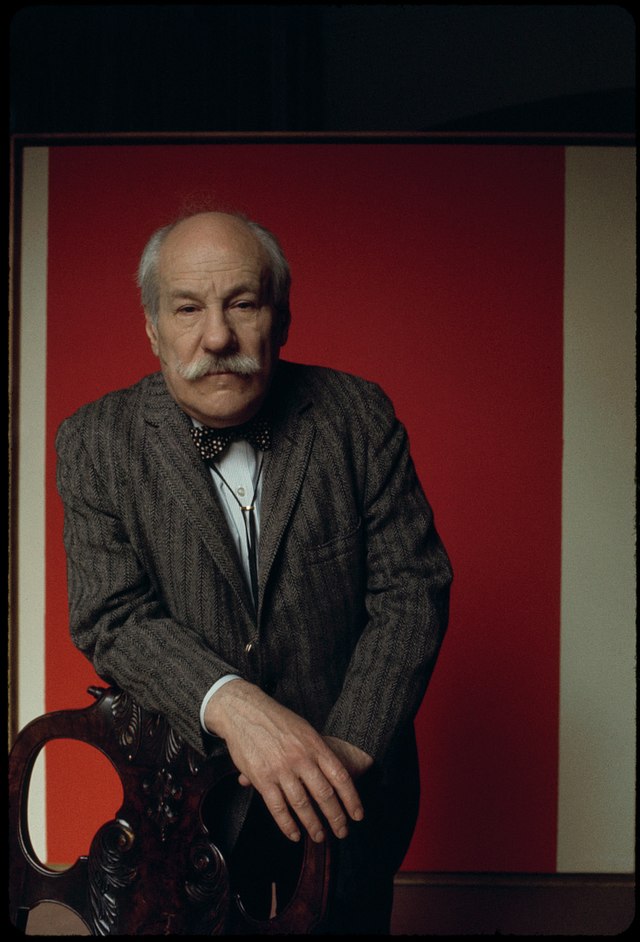
Barnett Newman

barnett newman
barnett newman

Barnett Newman

Barnett Newman (1905-1970) studied at the Art Students League for much of the 1920s. Shortly after the beginning of World War II, he stopped painting and destroyed his early paintings. He resumed his search for what he termed “the tragic and timeless” in 1948; by the time of his first one-person exhibition at Betty Parsons Gallery (1950) he was forty-five years old. Newman used scale (his 1951 painting Cathedra is eighteen feet long) and sensual color to create pictorial envelopes that could overwhelm and transform the viewer.

Of all the abstract expressionists, only Newman and Robert Motherwell seriously explored printmaking, and both worked at ULAE. Newman viewed printmaking as a series of challenges. Not only did the relatively small size of lithographic stones require a substantial adjustment from his grandly scaled canvases, but he initially found it difficult to achieve his trademark sense of floating luminosity via ink-on-paper. In 18 Cantos, 1963-1964, he succeeded by exploiting accidents that occurred during the printmaking process, and by taking advantage of the way the margin of a sheet of paper naturally divided space. Newman’s respect for lithography is evident in his preface to 18 Cantos. “For me, it [lithography] … is like a piano or an orchestra, and as with an instrument, it interprets. And as in all the interpretive arts, so in lithography, creation is joined with the ‘playing;’ in this case not of bow and string, but of stone and press.”

Newman shared the Abstract Expressionists’ interests in myth and the primitive unconscious, but the huge fields of color and trademark “zips” in his pictures set him apart from the gestural abstraction of many of his peers. The response to his mature work, even from friends, was muted when he first exhibited it. It was not until later in his career that he began to receive acclaim, and he would subsequently become a touchstone for both Minimalists and a second generation of Color Field painters. Commenting on one of Newman’s exhibitions in 1959, critic Thomas B. Hess wrote, “he changed in about a year’s time from an outcast or a crank into the father figure of two generations.”

  • Newman believed that the modern world had rendered traditional art subjects and styles invalid, especially in the post-World War II years shadowed by conflict, fear, and tragedy. Newman wrote: “old standards of beauty were irrelevant: the sublime was all that was appropriate – an experience of enormity which might lift modern humanity out of its torpor.”
  • Newman’s pictures were a decisive break with the gestural abstraction of his peers. Instead, he devised an approach that avoided painting’s conventional oppositions of figure and ground. He created a symbol, the “zip,” which might reach out and invoke the viewer standing before it – the viewer fired with the spark of life.
  • He thought that humans had a primal drive to create, and one could find expressions of the same instincts and yearnings locked in ancient art as one would find in modern art. He saw artists, and himself, as the creators of the world.

Childhood

Barnett Newman was born in 1905 to Jewish parents who had immigrated to New York from Russian Poland five years earlier. Barney, as his family and friends called him, grew up in Manhattan and the Bronx with three younger siblings. He started drawing at the Art Students League during high school, continuing to take classes there while earning a philosophy degree from City College of New York. It was at the Art Students League that he would meet and befriend Adolph Gottlieb, who would introduce him to important New York artists and gallery owners.

Early Training

Following his college graduation, Newman worked for his father’s clothing manufacturing business until it failed a few years after the 1929 stock market crash. During the next few years, his disparate pursuits included substitute art teaching (despite failing the art teacher qualification exam many times), running as a write-in candidate for mayor in 1933, and creating a short-lived magazine advocating civil service workers’ rights. In 1936, he married Annalee Greenhouse, a teacher. During the early 1940s, he gave up painting entirely. Instead, he studied natural history, ornithology, and Pre-Columbian art, wrote museum catalogue essays and art reviews, and organized exhibitions. His interest in ornithology would later inform his famous quote, “Aesthetics is for the artist as ornithology is for the birds.” During this time, he began a friendship with gallery owner Betty Parsons, for whom he organized several exhibitions. She soon began representing Mark Rothko, Clyfford Still, and Jackson Pollock, all close friends of Newman.

By 1944, Newman had returned to art practice, inspired in part by Surrealism. Dissatisfied with his earlier figurative work, he destroyed everything he had previously made, and he would continue to destroy work that failed to please him throughout his career. In 1946, the Betty Parsons Gallery began representing him.

Mature Period

The year 1948 was a major turning point in Newman’s career. He began developing a pictorial device he called a “zip,” a vertical stripe of color running the length of the canvas, and this led to the painting Onement I(1948). The device would become the trademark of all his work to come. With it, he suspended a painting’s traditional opposition of figure and ground and created an enveloping experience of color in which the viewer herself, physically and emotionally, is invoked by the zip – gestured to as a being filled with the original spark of life, just like Newman’s mythical “first man” (see “Writings and Ideas” below). He touched on some of these ideas in explaining how viewers should read his much larger 1950 canvas Vir heroicus sublimis: “It’s no different, really, from meeting another person. One has a reaction to the person physically. Also, there’s a metaphysical thing, and if a meeting of people is meaningful, it affects both their lives.”

The new work, including Onement I (1948), was first shown at Betty Parsons Gallery in 1950. The response, however, was chiefly negative; one painting was even defaced, and Newman’s works would continue to excite violent reactions from audiences, being slashed on several occasions in subsequent years. The following year, Parsons showed him again, yet the response was little better and it drove Newman to withdraw from the gallery scene. Throughout this time he continued writing, producing several philosophical essays about art. Most notably, he wrote “The Sublime Is Now,” in which he stated, “I believe that here in America, some of us, free from the weight of European culture, are finding the answer, by completely denying that art has any concern with the problem of beauty and where to find it.”

His work was not shown anywhere between 1951 and 1955; he even bought back a painting he no longer wanted on view. And throughout these early years, he sold very few paintings. It was not until the early 1960s – and following a heart attack in 1957 – that some of his most ardently negative critics began to shift their viewpoints.

Late Period

With the critical tide gradually changing, many began to consider Newman an important artist within Abstract Expressionism, particularly after Clement Greenberg organized his 1959 solo show at French & Company. In the 1960s, Newman expanded his work into lithographs and sculpture, which he had only delved into earlier in his career. His work appeared in several important museum exhibitions on Abstract Expressionism, securing his significant place within the movement. Despite this broader recognition, however, many still misinterpreted his work; Newman would repeatedly dispute such misunderstandings throughout his career. He would even do this at considerable cost to himself; at a time when few museums were interested in his work, he refused an offer to be in the 1962 Whitney exhibit on Geometric Abstraction.

In 1966, the Guggenheim gave Newman his first solo museum exhibition, displaying his Stations of the Cross, a series of fourteen pictures executed between 1958 and 1966. Although this show also received many negative reviews, it expanded his recognition within the art world. Over the next few years, he continued creating some of his most important work. Among these included his largest painting, Anna’s Light (1968), the series Who’s Afraid of Red, Yellow and Blue (1966-68) and the monumental sculpture Broken Obelisk (1963-69). On July 4, 1970, Newman died of a heart attack in New York.

The Legacy of Barnett Newman

Although largely unappreciated during his life, Barnett Newman is now viewed as crucial to the Abstract Expressionist movement and as a precursor to Minimalism. Yet he never considered himself a part of any particular movement, nor a contrast to one. He rejected comparisons to geometric painters as well as comments that named him a progenitor of the Minimalist movement. Unlike those more stark canvases that focused on non-representational meaning of shapes and colors, Newman brought a more philosophical edge to his paintings, infusing them with his own self, and inviting the audience to experience them with both their bodies and their psyches.

Writings and Ideas

Introduction

Newman stands out among artists of the New York School for the quantity of writing he produced, particularly in the early to mid 1940s. Discussion and ideas remained important to him, and he likened abstract thought to the non-objective forms of “primitive” art – both, he believed, were aimed at generalization and classification. However, as an artist, Newman claimed to have never approached any painting with a plan. “I am an intuitive painter,” he wrote, one who is concerned with the “immediate and particular.” In this respect, Newman’s ideas about art were romantic. He believed that a maker of abstract art was harnessing the most basic human emotions, but wasn’t bound by any mythology or ancient standard for making art, or even for viewing it.

In a 1962 interview Newman gave to Art in America magazine, he remarked, “The central issue of painting is the subject matter… My subject is antianecdotal.” An anecdotal painting, he believed, was like an episode or a piece in a longer sequence. Newman believed that if a painting is antianecdotal, then it somehow becomes more whole, self-sufficient and independent. He also believed that whatever a painting’s meaning, it would come out in the viewing of the work, not through discussion.

MOST IMPORTANT WRITINGS

‘The First Man Was an Artist’
Tiger’s Eye
October 1947
Newman worked as an associate editor for Tiger’s Eye, and ‘The First Man Was an Artist’ was published in the magazine’s first year. In the essay, Newman asserted the priority of the aesthetic over the social: “The human in language is literature,” he wrote, “not communication.” Humans were artists before they were hunters, he claimed, and were storytellers before they were scientists. “Just as man’s first speech was poetic before it became utilitarian, so man first built an idol of mud before he fashioned an axe.”
Newman also questioned the benefits of scientific advancements on the mind of modern man. His position was not that science was particularly malevolent, but rather that it had become a strict form of theology that restricted the creative spirit. “The domination of science over the mind of modern man,” he wrote, “has been accomplished by the simple tactic of ignoring the prime scientific quest; the concern with its original question What?”

According to Newman, once this question of “what?” ceases to be at the forefront, advancements in the arts and sciences are no longer possible; they became merely the practice of reaffirming old and tried ideas.
In this, perhaps Newman’s most famous essay, he examined the work of several 20th-century European artists who, he believed, destroyed old standards of beauty. He also briefly touched on the standards of beauty in art established by the ancient Greeks and examined the ways in which influential philosophers – particularly 19th-century Germans – reconciled these ideas with the advent of new modern styles. The key struggle, according to Newman, was that which occurs between ideas of beauty and ideas of the sublime. Newman concluded that artists had finally succeeded in creating a new standard of beauty and the sublime. Not since the Renaissance, he claimed, had a melding of those two concepts occurred with such force. Before Abstract Expressionism, some of the greatest modern artists had only succeeded in challenging old ideas about beauty in the visual arts: “Picasso’s effort may be sublime,” he wrote, “but there is no doubt that his work is a preoccupation with the question of what is the nature of beauty.” He believed his own generation was a new breed – artists who didn’t simply question or even challenge old standards, but rather created entirely new and consequently sublime ideas about beauty.

On Abstract Art

Newman considered himself a pure artist, working with pure forms. For a 1947 exhibition at Betty Parsons Gallery, entitled The Ideographic Picture, he wrote, “The basis of an aesthetic act is the pure idea. But the pure idea is, of necessity, an aesthetic act.” Newman affirmed his belief that authentic, expressive abstract art was void of symbolism or illusion and that the purest living form in an abstract painting was its shape. “[A] shape [is] a living thing,” he wrote, “a vehicle for an abstract thought-complex, a carrier of the awesome feelings [the artist] felt before the terror of the unknowable.”

On Art and Inquiry

For the first issue of Tiger’s Eye, in October 1947, Newman wrote one of his most famous essays, ‘The First Man Was an Artist’. In it he sought to establish a rather unorthodox link between art and science; “For there is a difference between method and inquiry,” he wrote. “Scientific inquiry, from its beginnings, has perpetually asked a single and specific question, What? What is the rainbow, what is an atom, what is a star [sic]?” This basic and instinctive question of “what?” was what made all art into a science – not a science that set out to prove something, but rather a science that simply sought new knowledge and experience.

On Beauty

According to Newman, all of modern art had been a quest to negate the classical standards of beauty established during the Renaissance. The early Modernists – artists such as Édouard Manet and the Impressionists – had failed to fully achieve this, and the task of completion was left to his own generation. “I believe that here in America,” he wrote in 1948, “some of us, free from the weight of European culture, are finding the answer, by completely denying that art has any concern with the problem of beauty and where to find it… We are reasserting man’s natural desire for the exalted, for a concern with our relationship to the absolute emotions.”

Barnett Newman vs. Ad Reinhardt

In 1956, Ad Reinhardt wrote an article in College Art Journal entitled ‘The Artist in Search of an Academy’, in which he derided Barnett Newman as “the artist-professor and traveling-design-salesman, the Art-Digest-philosopher-poet and Bauhaus-exerciser, the avant-garde-huckster-handicraftsman and educational-shop-keeper, the holy-roller-explainer-entertainer-in-residence.”

Newman was enraged and sued Reinhardt for libel. When the case reached the New York Supreme Court, it was dismissed and subsequently rejected again upon appeal. But Newman was often similarly criticized by fellow artists for being overly romantic – Pollock reportedly called him a “horse’s ass” at one gallery opening.

In Discussion with Hess on Stations of the Cross

In a public conversation between Thomas B. Hess and Newman, staged at the Guggenheim Museum on May 1, 1966, Newman was asked a series of questions regarding his Stations of the Cross series (1958-66), which were exhibited at the museum in Newman’s very first solo exhibition at a public gallery.

“When I call them Stations of the Cross,” he said, “I am saying that these paintings mean something beyond their formal extremes…What I’m saying is that my painting is physical and what I’m saying also is that my painting is metaphysical…that my life is physical and my life is also metaphysical.” Hess later asked Newman about the absence of color in the pictures – something that was unusual in his work. Newman responded, “Tragedy demands black, white, and gray. I couldn’t paint a green passion, but I did try to make raw canvas come into color. That was my color problem – to get the quality of color without the use of color. A painter should try to paint the impossible.”

Source: https://www.theartstory.org/artist/newman-barnett/

How to Grow a Gallery Relationship

Courtesy of the artist and Roberts Projects, Los Angeles, California. Photo Peter Mauney.

How to Grow a Gallery Relationship

Growing a gallery relationship and advancing your career as a contemporary artist requires a strategic approach and consistent effort. Building lasting relationships with galleries can be essential for success.  Here are some steps you can take to foster gallery relationships and enhance your artistic career:

  1. Do your research: Before you approach any galleries, it’s important to do your research and find ones that are a good fit for your work. Consider the gallery’s location, size, and focus. You want to find a gallery that will be able to properly represent your work and help you reach your target audience. Begin by researching galleries that align with your artistic style, medium, and career goals. Look for galleries that exhibit similar artists and have a reputation for promoting emerging talents.
    Attend Gallery Openings and Art Events: Visit gallery openings, art fairs, and other art events to familiarize yourself with the local art scene and establish connections.
    Engage with gallery owners, curators, and fellow artists to build relationships and learn about potential exhibition opportunities. After you selected them, cultivate Personal Relationships. Building personal relationships with gallery owners and curators can significantly enhance your chances of representation. Attend artist talks, workshops, and networking events to connect with industry professionals on a personal level. Building trust and rapport can lead to long-term gallery relationships.
    Maintain Professionalism: Approach gallery relationships with professionalism and reliability. Be punctual for meetings and deadlines, communicate effectively, and honor agreements. Demonstrating your commitment and professionalism will help galleries see you as a reliable and serious artist.
    Remember, building gallery relationships and advancing your career as a contemporary artist takes time, perseverance, and dedication. Stay committed to your artistic practice, continuously promote your work, and seize opportunities for growth and exposure.
  2. Be prepared to present your work: When you do approach a gallery, be prepared to present your work in a professional manner. This means having high-quality images of your work, as well as a well-written artist statement. You should also be able to answer any questions the gallery may have about your work. Develop a Professional Portfolio: Prepare a high-quality portfolio that showcases your best artwork. Include an artist statement, CV/resume, and high-resolution images of your work. Your portfolio should be visually compelling and provide comprehensive information about your artistic practice. Submit Your Work: Submit your portfolio and exhibition proposals to galleries that you have identified as potential partners. Follow their submission guidelines and tailor your application to their specific requirements. Be prepared for rejection and maintain a persistent and professional approach.
  3. Be persistent: It may take some time to find the right gallery for you. Don’t get discouraged if you don’t get a yes right away. Keep submitting your work to galleries and eventually you will find one that is a good fit.
  4. Be supportive of the gallery: Once you have a relationship with a gallery, it’s important to be supportive of them. This means attending their events, promoting their shows, and buying work from other artists they represent. By being supportive of the gallery, you are showing them that you are a valuable asset to their team.
  5. Be yourself: The most important thing is to be yourself and to create work that you are passionate about. If you do that, you will eventually find the right gallery for you and you will be on your way to a successful career.
  6. Connect and cultivate personal relationships with curatos, art critics: Collaborate with other artists, curators, and institutions to expand your network and visibility. Participate in group shows, art competitions, and art residencies to gain exposure and establish yourself within the art community.
  7. Stay Active Online: Utilize social media platforms, your website, and online art platforms to showcase your work and engage with a wider audience. Actively share your artistic process, upcoming exhibitions, and achievements. Develop an online presence that reflects your artistic vision and attracts potential gallery representatives.
  8. Continuous Growth and Professional Development: Strive for continuous growth as an artist. Attend workshops, artist retreats, and educational programs to further develop your skills and broaden your artistic horizons. This commitment to self-improvement will make you more attractive to galleries.
  9. Seek Professional Advice: Consider seeking professional advice from art consultants, art coaches, curatos or art critics who can provide guidance and support in navigating the art world. They can offer valuable insights and help you make informed decisions about your career path.

Here are some additional tips for growing your career as a contemporary artist:

  • Network with other artists and professionals in the art world. Attend art fairs, exhibitions, and other events. Get to know other artists, curators, collectors, and gallery owners.
  • Promote your work online and offline. Create a website and social media accounts to showcase your work. Write articles or blog posts about your art. Submit your work to juried exhibitions.
  • Take risks and experiment with new ideas. Don’t be afraid to try new things. The more you experiment, the more you will learn and grow as an artist.
  • Be patient and persistent. It takes time to build a successful career as an artist. Don’t give up on your dreams. Keep creating and keep believing in yourself.

MASTERS THAT CHANGED THE CITY

A Tribute to Jesús Rafael Soto and Carlos Cruz Diez on Their Centennial

MASTERS THAT CHANGED THE CITY

A Tribute to Jesús Rafael Soto and Carlos Cruz Diez on Their Centennial

Carole A. Fewell Gallery |  June 2 – October 22, 2023
Curated by Yuni Villalonga, Director of Curatorial Programs

This exhibition celebrates the centenary of world-renowned artists Jesús Rafael Soto (b. 1923, Ciudad Bolívar, Venezuela – d. 2005Paris, France)  and Carlos Cruz-Diez (b. 1923, Caracas, Venezuela – d. 2019, Paris, France.) Visionaries of their time, these artists redefined the relationship between art and architecture, as well as the art experience in the public space. Their explorations are key to the Kinetic and Op Art movements, and influenced many other generations of artists, internationally.

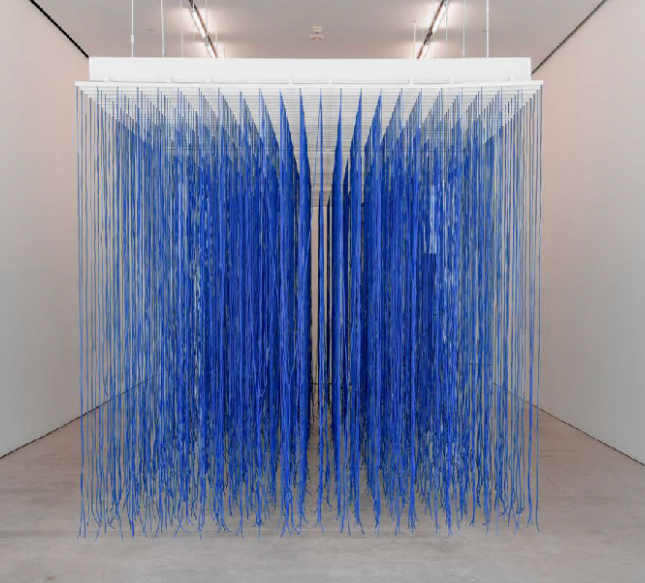
Masters that Changed the City… features a selection of iconic works by the artists that are a clear testament to their significant contributions to the Op and Kinetic Art movements, globally. Visitors will have the opportunity to immerse themselves in a world of movement, light and optical illusion, from Cruz Diez’s “chromosaturations” to one of Soto’s penetrables. The exhibition conveys these artists’ ability to create immersive environments that challenge our perception and invite us to engage in a unique and profound way. It also provides a historical context for their work, highlighting them as pioneers in the integration of the arts, the architecture, and the urban fabric.

Through educational panels, documentary films, and curator presentations, visitors will gain a deeper understanding of the artists’ legacy and their ongoing influence on contemporary art.

This exhibition is organized in collaboration with Logistic Fine Arts, Miami and Atelier Soto, Caracas-Paris. With it, the Coral Gables Museum joins the international celebrations of the legacy of maestros Cruz Diez and Soto in their centennial.

The Power of Consistency

Become a Highly Paid Artist
Chandan Sojitra - Become a Highly Paid Artist

The Power of Consistency: Cultivating a Sustainable Art Network

What is one practice that artists can use to increase the sustainability of their careers?

Alessandro Levato 

Artworkarchive.com

We’ll let you in on one simple practice that has the power to build successful art careers. 

Keep your art network up to date alongside your art practice.

The art world has developed to connect artists, art professionals, and art viewers through a variety of online and in-person platforms. For artists, it’s important for your network to build and grow with you.

Below, we have gathered some tips, tricks, and professional advice to ensure the sustainability of your artistic career.

Divide your studio practice into administrative work and creative work.

This is essential for a healthy balance in your art career.

Without the stress of outreach and communication hovering over you, that extra time will be used exclusively to work in the studio.

Using quick-update platforms such as Instagram stories may be beneficial to providing short glimpses into your studio life without much pressure on you. They’re also a great way to have your audience involved in your creative process!

You can pose questions and polls to get more engagement with your audience.

Show part of an artwork instead of the whole; think about the process over the final image! Give sneak peeks on your techniques to show your audience the steps that go into creating works. Viewers will feel like they have special insight into your creative practice, which will make them more likely to feel connected to you. 

Consider if social media is right for you (it doesn’t have to be).

Posting monthly updates of your studio, resources, or events on a blog or website are standard options, but there are a variety of other ways you can keep your following engaged.

Keep a growing list or Contact Group on Artwork Archive. This allows you to send updates or event emails If you are participating in events such as shows, group exhibitions, or open studios—plus, you can quickly send off updates to these groups using Artwork Archive.

Update your network in relation to your artwork.

To find what works for you, think about your goals—then, work backward to see what best fits your needs.

Start small! Building a network doesn’t have to be intimidating. You probably already have contact information for family, colleagues, friends, and other artists in your life. This is the starting point for your network. 

Gather contact info from people within your community to gain peer-related inspiration, knowledge, and struggles. These relationships tend to lead to opportunities like group shows, critiques, and additional resources.

Learn more here: How to Network for Your Art Business

Absorb advice from art world professionals.

Artwork Archive spoke with the International Studio and Curatorial Program (ISCP) in Brooklyn, New York, to learn more about how artists can network for their careers.

ISCP programming for their artists and curators includes public-facing events such as open studios and exhibitions in their two gallery spaces. They encourage open doors for a collaborative environment and conduct various social meet-ups and gallery visits each month. 

They emphasized the importance of starting your network with your artistic contemporaries. This comes into practice with artist residencies and the networks that you build in these programs.

How do they suggest doing this? ISCP generously provided advice on how artists can best grow their network.

First, don’t be hard on yourself. Allowing flexibility within your practice and knowing that there is a range of ways to network is critical to finding what works best for you. Some important factors to keep in mind while getting started are to ask other artists who they have connections with. Many opportunities come from artists mentioning other artists they are familiar with to a gallery owner or curator.

Have a mailing list and send out quarterly newsletters to keep your network up to date, without forcing the connection. 

Develop your elevator pitch for brief moments of interaction—break it down, practice it, and gather feedback.

Don’t forget to mention artists you like in conversation to provide opportunities for others. Lifting each other up is essential to a support network. For example, ISCP has an entire studio floor for NYC-based artists to maintain a continual conversation with their community. This produces a reciprocal exchange between New York mentorship and international contemporary dialogue.

Build out your professional art network.

Build out your professional art network with connections with a variety of art professionals. Consider a wide range of professionals like art shippers, framers, curators, art gallery consultants, art administrators at art organizations or non-profits, art handlers, researchers, art historians, and the like as part of your extended art network. All of these people within the field will get your name around.

Plus, this can increase your credibility; the more people are mentioning you, the more opportunities will open up in the future. As your network starts growing, develop a process for evaluating what is working for you. Maybe you need to work on growing more general contacts or look towards a more niche field.

Be sure to always check in about why you are doing this kind of networking and how you measure your success.

As you grow these contacts, you can start looking for client relationships.

Your client relationships are your art buyers or collectors. They are clients who want to follow and support you throughout your art career. These contacts are your last focus because they slowly build out from keeping your other networks consistent.

Clients may be interested in your work and follow you for ten years before they decide which work they want. Your relationship with potential clients is slow and nurtured within the confines of your own comfort. You already created the work and sustained your network, now let the rest come naturally. Ask questions, provide updates consistently, and give your work the under arching administrative support it deserves. 

Leverage your contacts with a CMS platform like Artwork Archive.

Don’t just collect contacts, use them to grow your art business!

You have spent time and energy collecting contacts, but the payoff comes from following through. As you divide your studio work, sharing updates and posting becomes a part of your scheduled administrative time. Creating new contacts on Artwork Archive is a part of that too—that means going to gallery openings, museums, art fairs or other artists’ studio visits and collecting emails from people you want to foster relationships with. As you visit more places and see more art, your network will grow with you. 

Dividing up your network has never been easier.

You can use Contact Groups to organize your contacts into specific categories like Gallery Connections, Artist Studio Colleagues, Art Fair Interactions, or even more specific such as Digital Work Lovers.

If that’s not enough, you can opt to create a Public Profile to share your artwork through an online presence. You can choose to have your profile on Artwork Archive’s Discovery Platform where people can come to learn more about you and your artwork. This can also benefit you to find other artists who are like-minded in the ways they are choosing to manage, document, and share their works.

Make sure to share your Artwork Archive Public Profile URL in your emails so people can be directed to your page! 

Setting up the booth is the beginning of The Makers Market Day, photo by Artist Antje Roitzsch


Nurture your art community.  

Your network is a huge part of maintaining a consistently growing group of supporters. Bring out those nurturing feelings and keep those connections alive.

There is a wide variety of artistic collectives that began on the foundations provided above. Starting a network is only half of it;  keeping your community updated on what you are doing encourages growth and follow-through. Participatory culture literally means to participate in culture. Keep expanding your resources and searching for new art organizations and programs that you could possibly become a part of.

Platforms such as Now Be Here went through many collaborations, realizations, and iterations to develop into their digital resource today. Encourage a slow sustainable growth that healthily tends to your needs as an artist. 


Artist communities and networks have the power to influence the art world.

Remember, Artwork Archive is a part of your community already. We provide a variety of resources, webinars, and questionnaires to help sustain community dialogue. You can use Artwork Archive’s Discovery Platform to connect with artists, collectors, and arts organizations who share similar views about archiving their works. 

Plus, stay up to date with the latest art news and get art career advice like this sent to your inbox once a week by joining our free newsletter here.

With a bit of conversation, time, and consistency, you will be on your way to sustaining your career!

Page 186 of 276
1 184 185 186 187 188 276

Recent Posts