At the New World Center, the concert hall is not only a place where music is performed. It is a living instrument—one made of sound, architecture, light, projection, camera movement, digital storytelling, and community. Experiencing the New World Symphony’s performance of Beethoven’s Ninth Symphony is already entering one of music’s great statements of joy and shared humanity. But seeing what happens behind the scenes with Clyde Scott, Senior Vice President and Creative Director of NWS Media, shows that the New World Symphony experience is also shaped by another kind of performance: the invisible choreography of media.
This became especially clear during a recent tour of the New World Center’s control booth, where Scott walked me through the audiovisual infrastructure that supports NWS’s concerts, WALLCAST® presentations, livestreams, projection designs, recordings, and digital storytelling. The room feels cinematic—part broadcast studio, part spacecraft, part conductor’s desk for the building’s visual life. I told him it looked like the Millennium Falcon, and the comparison felt right: screens, cameras, consoles, cue sheets, score readers, projection systems, and a team tracking every measure with astonishing precision.
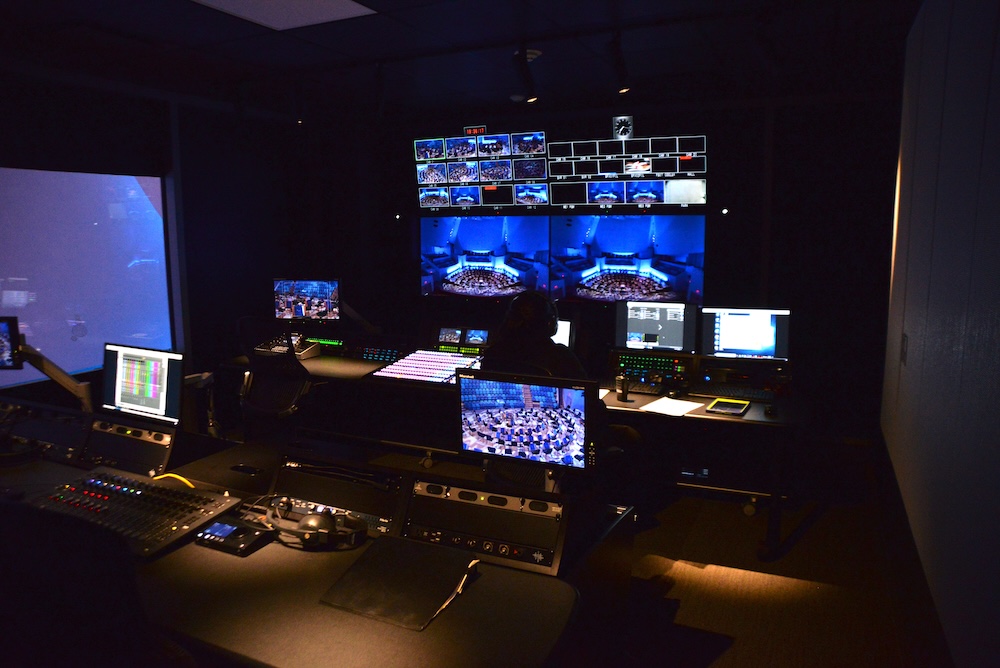
Scott describes the New World Center as one of the world’s most technologically advanced concert halls, and after standing in the control booth, it’s hard to disagree. The hall contains a robust 4K ultra-high-definition video infrastructure, a sophisticated projection system, extensive theatrical lighting, and cameras positioned throughout the space to capture the orchestra from perspectives most audiences never see. Some cameras are permanently installed; others are movable. Smaller cameras can be placed deep inside the orchestra, creating viewpoints that feel almost impossible—as if the viewer were sitting beside the basses, tucked between woodwinds, or breathing with the second violins.
For every WALLCAST® or webcast, the NWS Media team creates a detailed shooting script. This is not casual documentation. It is planned measure by measure, shot by shot. A single WALLCAST® concert may involve hundreds of individual shots, each coordinated with the score, conductor, orchestra, and emotional architecture of the music. Every camera move, every zoom, every transition must serve the sound rather than distract from it.
That principle—the music comes first—is central to Scott’s philosophy. Whether the team is working with projection, video, or livestream, the goal is never to force the orchestra to follow technology. Instead, technology follows the musicians. If the conductor moves slightly faster or slower, the media team adjusts. Score readers cue the director and camera operators. The projectionist follows the conductor. The visuals stay in sync not because the music is fixed to a machine, but because human beings listen, watch, and respond in real time.
This is where NWS Media’s artistry becomes most visible. It is not simply technical excellence. It is an interpretation.
The New World Center was designed with this kind of experimentation in mind. From the earliest conversations around the building, Scott explained, projection inside the concert hall and projection outside in SoundScape Park were part of the vision. At the Lincoln Theatre, NWS had already experimented with projection and early webcasts, but the New World Center allowed those ideas to expand dramatically. Frank Gehry’s architecture, Yasuhisa Toyota’s acoustic design, and Michael Tilson Thomas’ belief in experimentation helped create a space where media could become fully integrated into the concert experience.
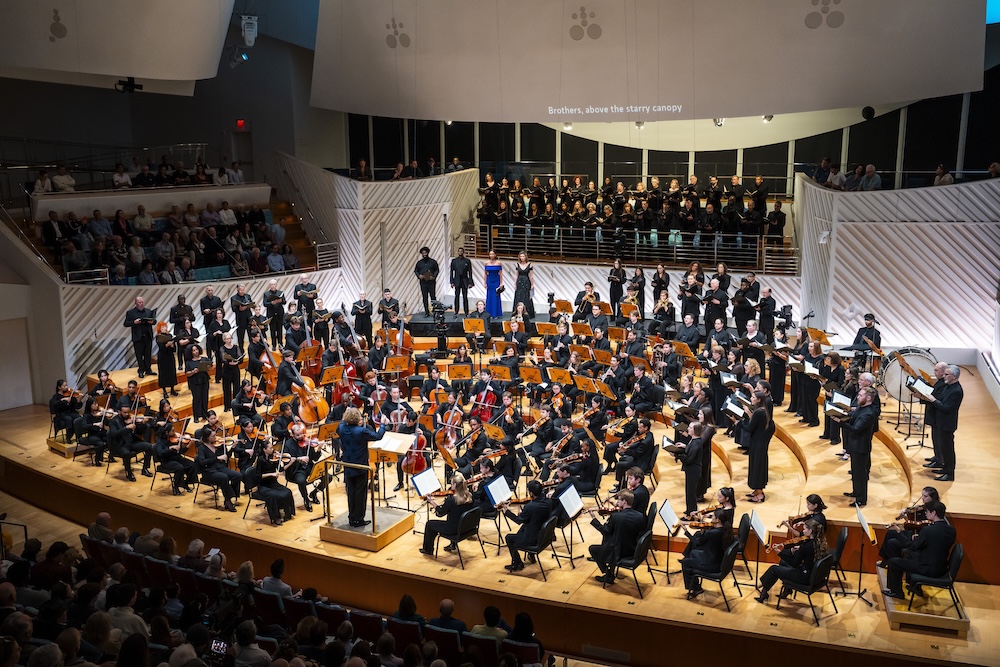
The hall’s five acoustic “sails” are central to this identity. They are not only sculptural and acoustic surfaces; they are also projection canvases. NWS can cover all five with one continuous massive image, or use them more subtly for text, program notes, atmosphere, or visual transitions. Audiences encounter the sails as soon as they enter the hall. Before a performance begins, the space is already active. The lighting, projection, and atmosphere begin shaping the evening before the first note is played.
This matters because it changes the concert ritual. The audience is not simply waiting for the music to start. They are already being drawn into an environment.
That sense of environment was central to NWS’s 2026–27 season opening under Artistic Director Stéphane Denève. The season began with a program that brought together Latin American and French masterworks, including Gabriela Ortiz’s Kauyumari, Arturo Márquez’s Fandango, Debussy’s Ibéria, and Ravel’s Boléro. For Boléro, NWS Media created custom visuals featuring Miami City Ballet principal dancers Stanislav Olshanskyi and Macarena Giménez, performing choreography by Natalia Arja. As Ravel’s hypnotic crescendo steadily expanded, the visuals offered their own counterpoint—drawing the eye closer, slowing the body down, and deepening the sense of ritual inside the music.
This kind of work reveals how NWS Media thinks. Projection is not decoration. It is visual composition.
The same care carried over into the following week’s performance of Beethoven’s Ninth Symphony, led by Denève with the Master Chorale of South Florida and soloists Ellie Dehn, Tamara Mumford, Sean Panikkar, and Dashon Burton. Beethoven’s Ninth carries its own monumental weight: a revolutionary celebration of equality, joy, and shared humanity. At NWS, the performance felt not only grand, but communal—an evening filled with emotion and an overwhelming sense of unity.
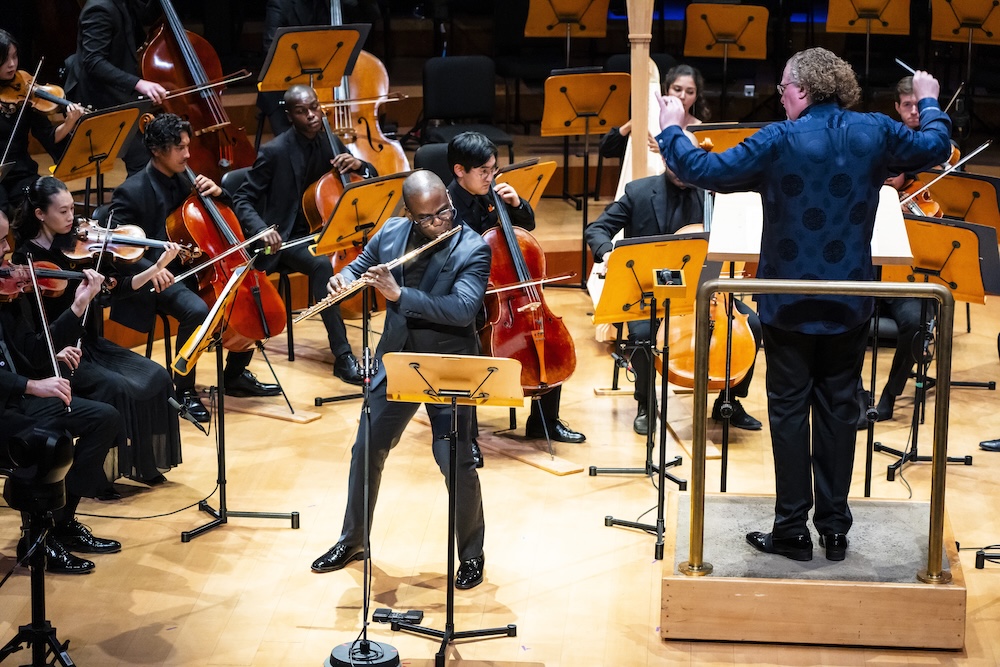
Yet one of the most breathtaking moments came before Beethoven, through the program’s tribute to Michael Tilson Thomas, NWS’s cofounder and Artistic Director Laureate, who died in April 2026 after nearly four decades devoted to New World Symphony, its Fellows, and the Miami Beach community. The program opened with MTT’s Notturno, performed by flutist Demarre McGill, followed by Mahler’s Adagietto from Symphony No. 5. During the Mahler, archival footage of MTT conducting was projected onto the hall’s sails, creating a poignant visual and musical dialogue between past and present. Denève conducted from the podium, effectively conducting alongside his dear friend and colleague.
The moment was deeply moving. The tribute did what the best media work does: it deepened the emotional experience without overwhelming it. It allowed memory to enter the room. It reminded the audience that the New World Symphony is not only an academy or orchestra, but a living archive of mentorship, experimentation, friendship, and artistic inheritance.
That inheritance is now being recognized well beyond Miami. NWS Media recently received 11 Suncoast Emmy Award nominations, an extraordinary acknowledgment of the team’s range and craft. The nominations span documentary, arts and entertainment content, directing, audio recording and mixing, musical composition, photography, and digital series. Scott’s work earned recognition across several categories, including Modern Masterworks: Blue Cathedral, My Miami, and Chasing Crescendos. Other team members including Roberto Toledo, Weronika Wrzosek, Justin Trieger, and Abdiel Thorne—were also recognized for their contributions.
What is striking about these nominations is not only the number, but the range. They recognize NWS Media as a multidisciplinary creative force. This is a team that records sound, builds visual worlds, captures concerts, produces documentaries, creates digital series, designs projections, and helps translate the emotional power of orchestral music for audiences inside and outside the hall.
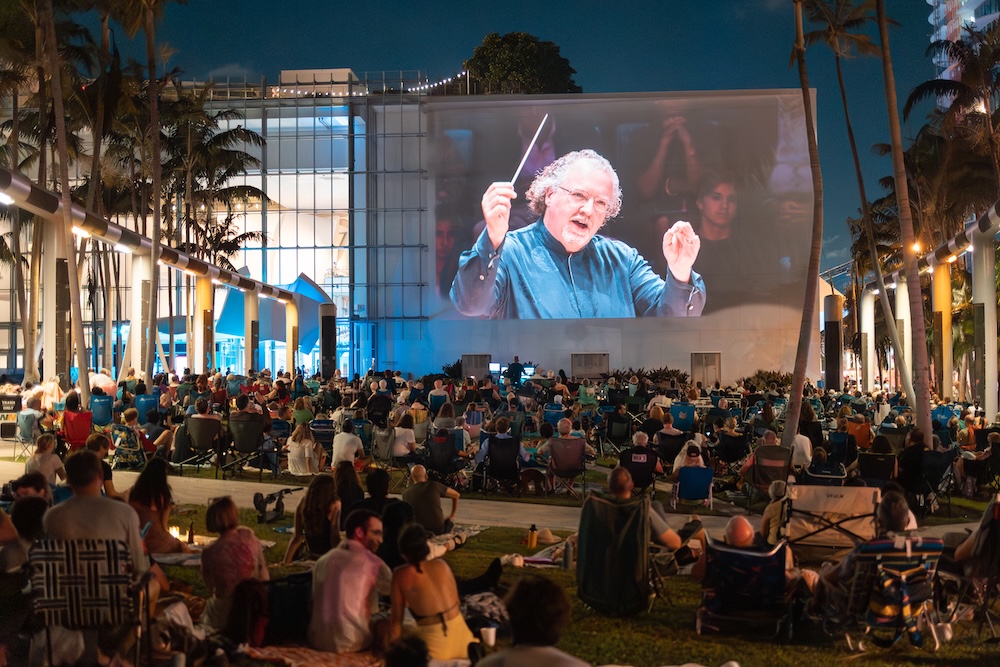
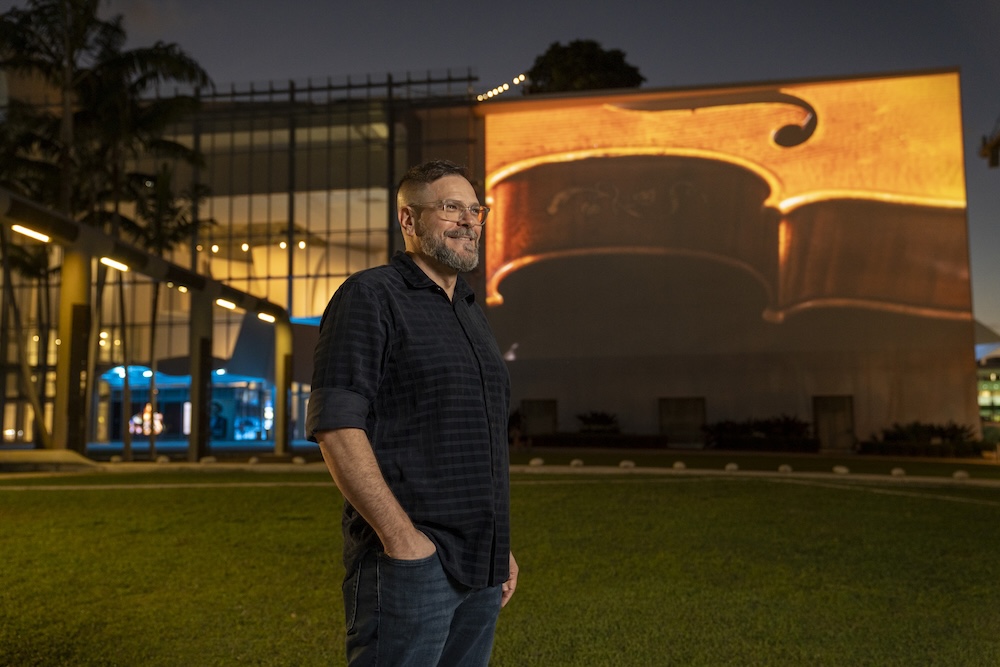
That translation is especially important in SoundScape Park. The WALLCAST concerts are one of Miami’s great cultural gifts: free outdoor presentations that let audiences experience live concerts projected onto the exterior wall of the New World Center’s exterior wall. Inside the hall, only a limited audience can be seated. Outside, the reach expands dramatically, opening the performance to families, students, passersby, music lovers, tourists, and Miami Beach residents who may never have bought a traditional concert ticket.
This is not merely outreach. It is a reimagining of access.
The control booth makes that access possible. During a WALLCAST®, the team not only directs cameras inside the hall; it also produces a live experience for park and online audiences. The sound must be mixed for the hall, the broadcast, and the outdoor environment. The image must be cinematic but faithful. The camera work must reveal the orchestra without turning the music into spectacle for spectacle’s sake.
That balance is delicate. Too much visual intervention, and the music becomes secondary. Too little, and the audience outside loses the intimacy of the live event. NWS Media’s achievement lies in finding the middle ground: using technology to bring listeners closer to the music’s inner life.
The building itself supports that philosophy through extraordinary flexibility. Scott explained that the stage risers can be raised or lowered, the entire stage can be brought down to audience level, and the seats can collapse to create a large flat space. This allows NWS to experiment with configurations that radically change the relationship between musician and audience. In projects like Neon Nights, audiences could gather close to the ensemble and experience chamber music almost physically. In collaborations with Miami City Ballet, the stage can be transformed to accommodate dancers, orchestra, sprung flooring, and entirely different spatial relationships.
This flexibility, like the media infrastructure, is built into the New World Center’s DNA. It allows the institution to ask a question most concert halls cannot: what else can an orchestral experience become?
That question seems to guide much of Scott’s work. He is not interested in technology for its own sake. He is interested in possibilities. What can projection reveal? What can a camera teach us about listening? What happens when an audience outside the hall experiences Beethoven under the open sky? What happens when archival footage allows a tribute to become part of the present tense? What happens when a concert hall behaves less like a fixed container and more like a responsive instrument?
For Art Miami Magazine readers, the story becomes especially compelling here. NWS Media operates at the intersection of performance, cinema, installation, architecture, and public art. It is not visual art in the gallery sense, but it is deeply visual. It is not theater, but it understands theatricality. It is not a film alone, but it uses filmic language. It is not simply documentation, but interpretation.
In that sense, Scott’s work expands what an orchestral institution can produce. A concert becomes not only a sonic event, but an integrated cultural experience. The camera, the sail, the park wall, the archive, and the livestream all become extensions of the orchestra’s reach.
What moved me most during the tour was realizing that every seemingly effortless moment the close-up of a soloist, the fade between cameras, the projection that dissolves at exactly the right instant, the lighting that shifts the emotional temperature of the hall comes from tremendous labor. A team plans, rehearses, adjusts, and performs it, and its work must remain nearly invisible to succeed.
That invisibility is its own kind of artistry.
As NWS celebrates its Emmy nominations and continues to develop new formats under Denève’s leadership, Scott and his team stand at the center of one of the institution’s most important creative frontiers. They help ensure orchestral music doesn’t remain locked inside old models of presentation. Instead, they are opening it outward—toward screens, parks, digital platforms, archives, and immersive visual environments.
At the Beethoven performance, the final movement’s call to joy felt especially resonant. In the hall, in the park, and through the cameras, that message traveled. It moved through voices, instruments, architecture, projection, and memory. It reminded us that music’s power doesn’t diminish when we share it through technology. In the right hands, it can be amplified.
Clyde Scott and NWS Media are proving that the future of orchestral music isn’t just something we hear. It is something we can see, inhabit, and share.