Color, Femininity, and the Language of Emotion
Alix Goor’s practice unfolds at the intersection of intuition, memory, color, femininity, and the natural world. Painting, for her, is not simply a means of representation but a process of discovery—one through which emotions, sensations, and aspects of identity can emerge before they are fully understood. Color operates as both material and psychological language, carrying associations that move between personal memory, cultural experience, and sensory perception.
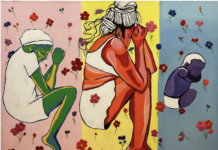
Across her work, the female figure becomes more than a subject. It functions as an archetype through which Goor explores strength, vulnerability, sensuality, transformation, resilience, and spirituality. At the same time, her imagery repeatedly brings the human body into dialogue with animals and nature, challenging hierarchies between species and proposing a more interconnected understanding of existence.
Her recent experiments with large-scale painting, textiles, curtains, and spatial installation extend these concerns beyond the canvas. Increasingly, Goor is interested in transforming painting into an environment—one that viewers can enter physically as well as emotionally. In this interview with Art Miami Magazine, she reflects on intuition, color, self-discovery, the feminine, nature, spirituality, and her evolving desire to turn painting from an image into an immersive experience.
AMM. You have said that art did not enter your life as a choice, but rather that it has always been present as part of your nature. When you create, do you feel that you are expressing something you already know about yourself, or does painting function as a process of discovery capable of revealing emotions, memories, or aspects of your identity that you had not yet been able to name?
AG. When I paint, it is first and foremost something very intuitive and instinctive. I have been painting since I was a child, and it has always been a very natural way for me to express myself, much more instinctive than writing, music, or anything else. Painting inevitably brings something out of me: emotions, sensations, memories, colors.
But it is also a real journey of self-discovery. I don’t always consciously know what I am looking for when I begin a painting. In fact, I would say that creation often comes before the idea and its understanding. I can finish a painting and think, “Oh, I hadn’t thought about that at all.” Then, when I try to understand why I painted it that way, I discover things about myself, my environment, or the world around me.
Sometimes it can take weeks or even months for me to understand what I was feeling when I first started a painting. And when a work takes a long time to complete, my emotional state can change between the beginning and the end. Even once a painting is finished, my relationship with it continues to evolve.
AMM. Color has a powerful visual intensity in your work, but it also seems to function as a psychological language. To what extent do you consciously choose a color combination, and at what point do you allow color to respond intuitively to your emotional state? Can color communicate something that verbal language cannot?
AG. I usually have an initial intuition about the colors I want to use, but I do very little preparation before painting. I leave a lot of room for experimentation. A color might seem right at first, and then stop working once another color is placed next to it. I adjust, change, and adapt, and the harmony gradually reveals itself through the process.
For me, color is deeply sensory. It is connected to memories, emotions, sensations, places, and moments. I experience it a little like a smell: it can bring something back to you without going through words.
I also believe that our relationship with color is shaped both by cultural associations and by our personal history. The same color can therefore create completely different emotions in different people.
I don’t consciously try to impose a particular emotion on the viewer. I paint for myself first, and then the viewer’s perspective completes the work. Color can speak just as much as words can, but everyone has their own sensitivity to that language.
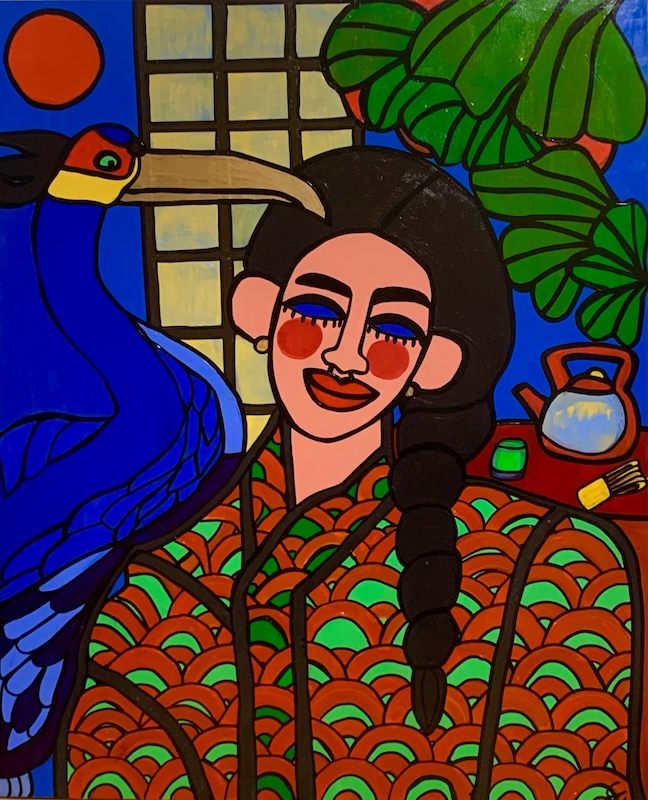
AMM. In works such as The Eye of the Toucan, you speak of an invisible connection between woman, animal, nature, and the spiritual world. How do you translate into painting something that, by definition, cannot be seen? Do you consider that one of art’s functions may be to make certain intuitive, emotional, or spiritual realities perceptible—realities that exist beyond rational perception?
AG. In my artistic practice, I am looking for a reconnection with raw, almost primitive sensations. I like bringing humans, animals, and nature back together and seeing them as different parts of the same whole, communicating with and enriching one another.
In The Eye of the Toucan, for example, the animal has a presence just as strong as the human figure. I don’t want to present human beings as superior to other species, but rather as part of a larger whole.
I don’t necessarily try to represent or illustrate a spiritual idea. I am more interested in creating a feeling. The figures, the colors, the symbols, and even the title, which I usually find at the end, all contribute to the meaning of the work.
I strongly believe that art can make us perceive things that cannot be explained rationally. This is particularly evident in abstract art: when there are no concrete references to hold on to, we are forced to listen to our own sensations. For me, art allows us to question ourselves and the world in a different way, by reconnecting with our most fundamental sensations rather than constantly trying to intellectualize everything.
AMM. The female figure holds an important place in your work, and you have described it in terms of its diversity, strength, and sensitivity. What does the female figure represent for you? Is it primarily an exploration of identity, personal experience, and emotional states, or does it also function as a symbolic language through which you address broader themes in your work?
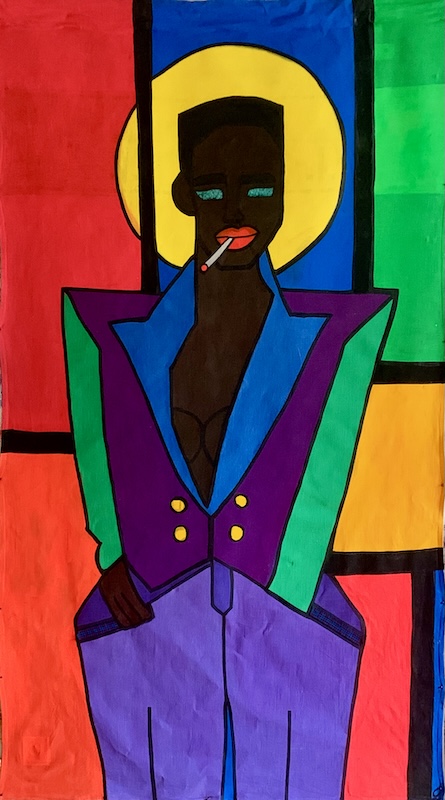
AG. The female figure represents many things to me at once. It comes from the women I observe around me, women I admire, women in my family, personalities who have inspired me since childhood, but also complete strangers.
And even when I am not consciously trying to represent myself, there is always something of me within these figures. They are like fragments of different women that also exist within me. In that sense, they become a kind of self-portrait, without being a literal portrait of myself.
The woman has also become an archetype in my work. She can represent softness, strength, freedom, anger, sensuality, motherhood, spirituality, transformation, or resilience. Some of my figures almost become tarot cards.
So I am not simply painting a woman for the sake of painting a woman. What interests me is everything that exists through her. And ultimately, because every creation begins with me, these figures also allow me to understand myself better.
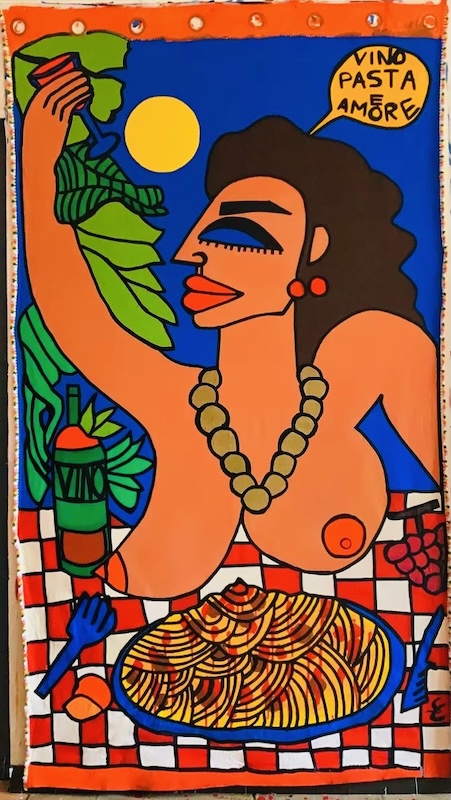
AMM. At the Hangar de Paimbœuf, you began taking painting beyond the canvas, working with large-scale formats, textiles, curtains, architecture, and a direct relationship with the surrounding landscape. When the work begins to physically occupy the viewer’s space, does it cease to be simply an image and become an experience? Are you interested in moving toward a practice in which painting, body, architecture, and nature can become part of a single work?
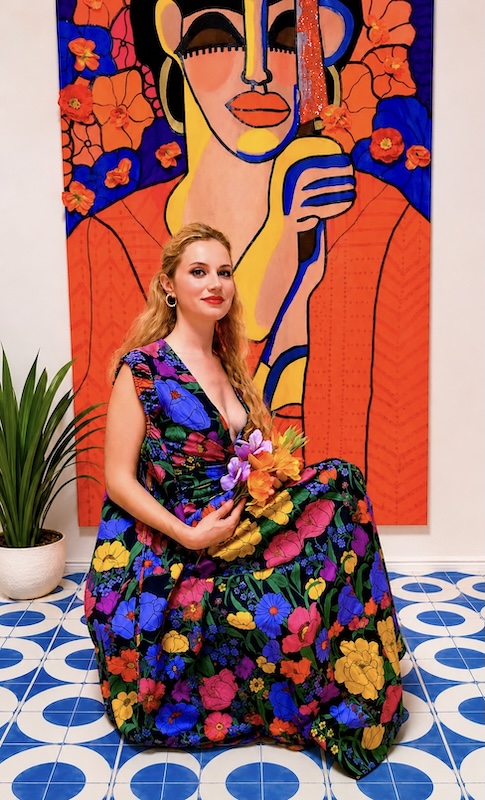
AG. Paradoxically, I feel much more comfortable working on very large formats than on small ones. The gesture, the use of space, and the intensity of my colors can really expand and take their place.
I started experimenting with textiles because canvas can sometimes feel too fixed to me. I wanted to see how my painting would react to a different material, but also to create works that are lighter, more nomadic, and more adaptable. A curtain, for example, can be rolled up, transported easily, and installed in many different ways.
Ultimately, I would like to be able to place these works in the middle of a space, allowing the viewer to walk around them or even through them. I love the idea of painting becoming a kind of portal into another world.
I would like to take this even further: painting walls, creating sets, using curtains, and completely transforming a space so that the viewer truly enters my universe rather than simply looking at a work.
Nature is an endless source of inspiration in this process. It has incredible colors and patterns, but it also represents something that carries and sustains us. I would like to convey the idea that we should learn to respect nature and live in harmony with it, rather than seeing ourselves as superior to it.
And above all, I don’t want to dictate what the viewer should understand. Even if what they feel is completely different from what I intended to say, that’s perfectly fine. In fact, that’s what makes the experience interesting.