Mangroves, Memory, and Myth: Lea Nickless’s The Magic of Miami Beach
Written By Olga Garcia-Mayoral
Miami Beach is often seen through its most recognizable images: pastel Art Deco façades, palm-lined streets, luminous sand, hotels, nightclubs, and the glittering mythology of leisure. It is a place marketed as paradise, endlessly photographed and immediately legible to the world. Yet beneath that familiar surface lies another Miami Beach—older, stranger, more complex, and far less often acknowledged. In The Magic of Miami Beach, artist and researcher Lea Nickless invites viewers to look beyond the postcard image and into the deeper histories embedded in the land itself.
Opening Saturday, August 8, 2026, at the Miami Beach Regional Library, the exhibition explores the hidden ecological, geological, and human narratives that shaped one of America’s most iconic destinations. Through watercolor, mixed media, artist books, historical photographs, textile works, sound, and archival research, Nickless constructs a layered meditation on place—one that asks us to reconsider what Miami Beach was, what it became, and whose labor made that transformation possible.
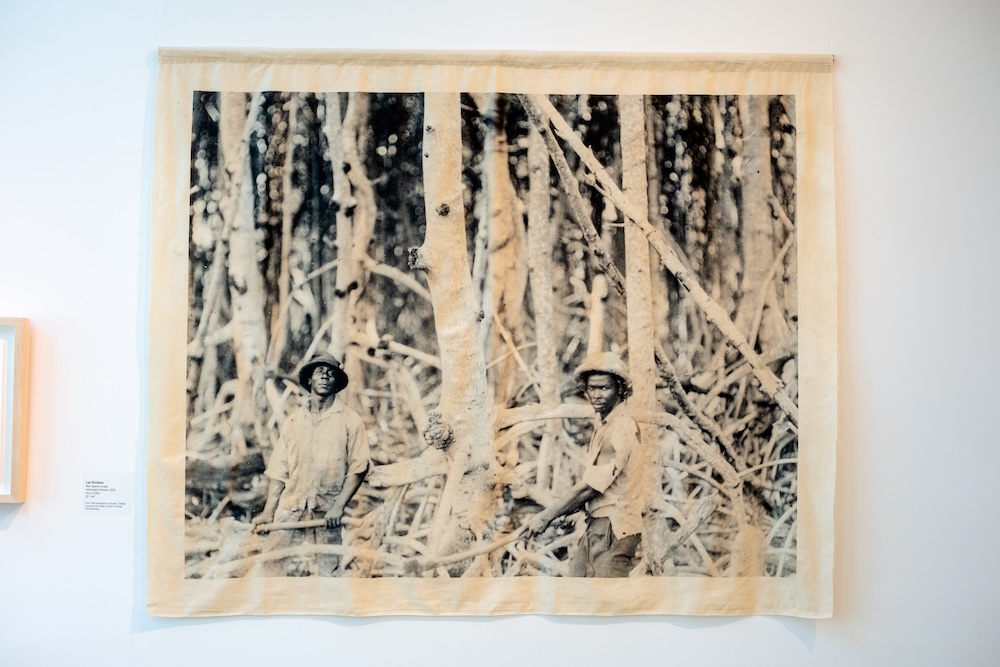
Placement: After the section discussing the 1938 book The Magic of Miami Beach, the 1924 photograph, Bahamian laborers, mangroves, and the hidden labor behind Miami Beach’s transformation.
Caption: Nickless revisits archival imagery of laborers clearing mangroves, restoring visibility to the overlooked workers whose labor helped shape modern Miami Beach. Photo by Laura Varon.
Before the luxury hotels, before the tourist fantasy, before the rise of Art Deco as a defining visual identity, Miami Beach was a barrier island of mangroves, coral, water, and thriving biodiversity. Its landscape was not empty, waiting to be improved. It was alive. Dense mangrove forests stabilized the island’s ecology, providing habitat, protection, and an intricate root system that connected land and sea. To early developers, however, this environment represented an obstacle. The making of modern Miami Beach required clearing, dredging, filling, importing materials, reshaping shorelines, and transforming subtropical wilderness into an engineered destination.
Nickless approaches this history not as a conventional historian, but as an artist attentive to traces. Her work asks what remains visible in the present if we learn how to look. The exhibition takes Collins Park as a point of departure, connecting the surrounding landscape to broader narratives of development, extraction, memory, and displacement. The familiar beauty of Miami Beach becomes complicated—not diminished, but deepened. Its magic, Nickless suggests, is not found only in glamour, but in the convergence of geology, ecology, imagination, labor, and memory.
A key catalyst for the project is a 1938 book titled The Magic of Miami Beach, which celebrated the city’s transformation as a triumph of vision and engineering. Among its images of hotels, beaches, and boulevards is a 1924 photograph of a Black laborer holding an axe, set against a backdrop of mangroves. That image became a point of rupture. Instead of accepting the official narrative of progress, Nickless began to ask who was present in the making of Miami Beach but absent from its celebrated history.
The exhibition brings renewed attention to the workers—many of them Bahamian—whose labor helped clear, build, and sustain the emerging city. Their presence is often pushed to the margins of public memory, yet their work was foundational. By reimagining archival images through contemporary materials and processes, Nickless restores visibility to those who were historically overlooked. She does not use the past as illustration; she treats it as an unresolved force still shaping the present.
This is where the exhibition becomes especially powerful. Nickless does not present Miami Beach as a simple before-and-after story: nature replaced by development, wilderness transformed into city. Instead, she examines the tensions that persist within the built environment. The fossilized coral limestone used in the Bass Museum, for example, becomes more than architectural material. It becomes a portal into deep time. The stone carries the skeletal remains of ancient reef-building corals, placing prehistoric marine life into conversation with modern design. A building associated with Art Deco elegance suddenly becomes an archive of geological memory.
This attention to material history is central to Nickless’s practice. Her works connect the visible and invisible: mangrove roots, coral patterns, archival photographs, built structures, erased labor, and underwater sound. The result is an exhibition that feels both researched and poetic. It asks viewers to move slowly, to notice what is usually backgrounded, and to understand landscape as something shaped by both natural process and human ambition.
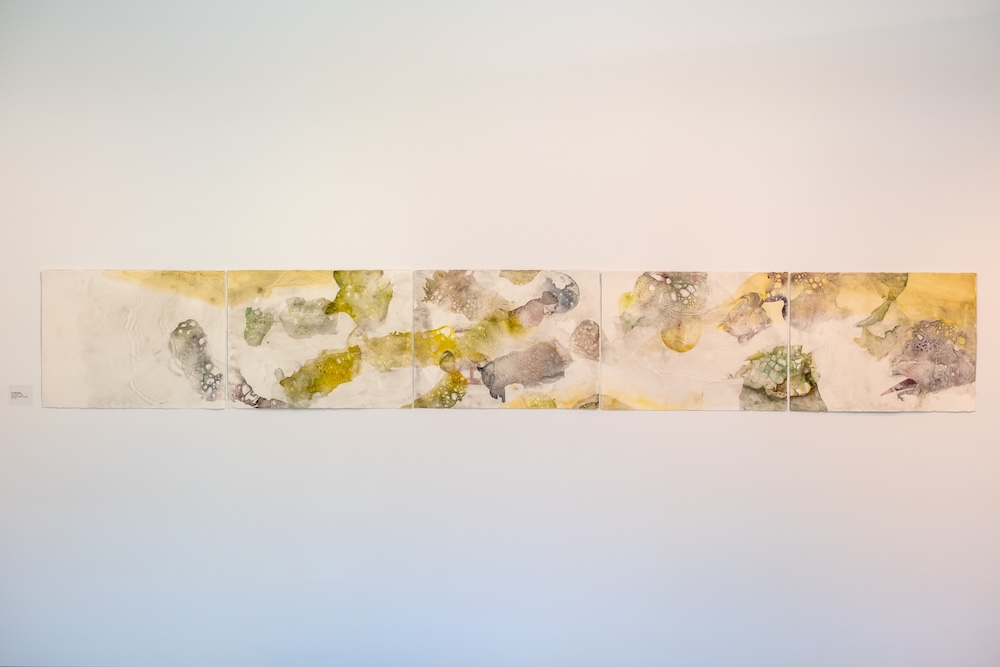
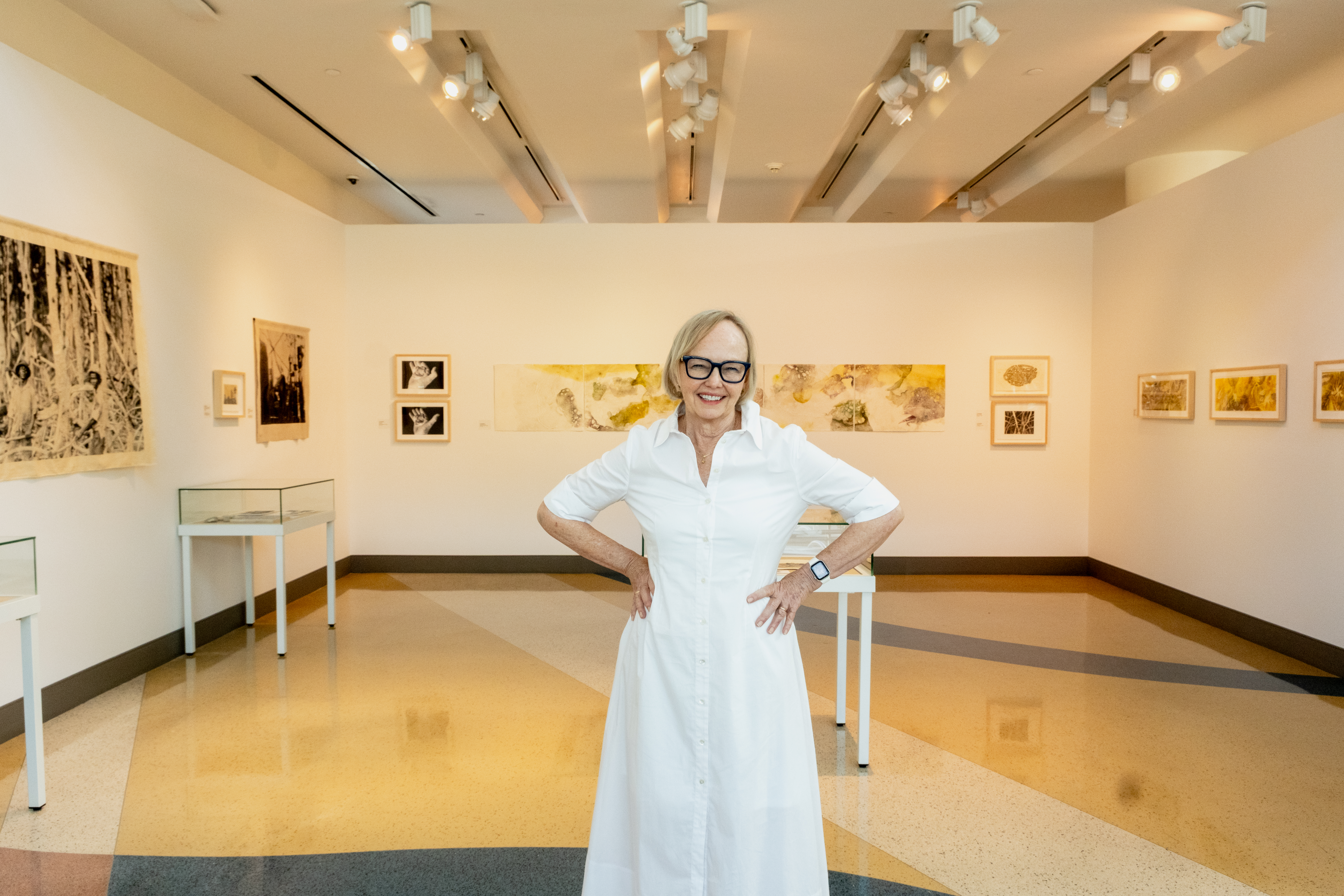
Placement: Near the end of the article, after the paragraph discussing mangroves, coral, landscape memory, and the ecological traces still embedded in Miami Beach.
Caption: Through layered materials and organic forms, Nickless evokes the submerged histories and ecological traces still embedded in Miami Beach’s landscape. Photo by Laura Varon.
The mangrove recurs throughout the exhibition as both an ecological structure and a metaphor. Its roots suggest resilience, interdependence, and survival. Mangroves hold land together; they create shelter; they thrive in transitional spaces where fresh and salt water meet. In Nickless’s hands, they also become symbols of belonging and buried connection. Their near-erasure from Miami Beach’s built mythology raises urgent questions about environmental memory. What happens when a landscape forgets the ecosystems that once protected it? What happens when beauty is built on removal?
One of the exhibition’s most meditative components is an underwater sound recording captured within a mangrove forest. Sound allows Nickless to expand the experience beyond the visual, inviting visitors into an atmosphere that feels intimate, submerged, and alive. It is a reminder that ecosystems are not silent backdrops. They have rhythm, movement, vibration. They are presences. In a city shaped by visual consumption, this sonic element asks the audience to listen—to the land, to the water, and to histories that do not always announce themselves loudly.
Nickless’s background as a curator informs the structure of the exhibition. After more than four decades working with archives, images, and overlooked histories, she brings a curator’s discipline to the artist’s studio. Her works are grounded in research, but they are not confined by documentation. She translates archival material into sensory experience, making historical inquiry visual and emotional. The exhibition feels like a conversation between scholarship and intuition, between evidence and imagination.
At the Miami Beach Regional Library, this project gains additional resonance. A library is a place of memory, access, and public knowledge. It is also a place where communities encounter themselves through records, images, books, and stories. Presenting The Magic of Miami Beach in this context underscores the exhibition’s civic importance. It is not only an art exhibition; it is an invitation to rethink a city’s origin story.
For visitors familiar with Miami Beach, the show offers a profound shift in perception. After seeing Nickless’s work, the city’s architecture, parks, beaches, and stone surfaces may feel different. The landscape becomes layered. A façade becomes a fossil. A park becomes a site of ecological transformation. A tourist image becomes a question. The past is not gone; it is embedded.
What makes The Magic of Miami Beach so compelling is its refusal to flatten beauty into myth. Nickless does not deny the enchantment of Miami Beach. Instead, she expands the meaning of that enchantment. The magic is not simply in the fantasy of paradise, but in the survival of traces—in coral, roots, labor, memory, and the stories still waiting beneath the surface.
The Magic of Miami Beach is on view through November 5, 2026, at the Miami Beach Regional Library, located at 227 22nd Street, Miami Beach. The exhibition opened on Saturday, August 8, 2026, and continues to invite visitors to reconsider the city’s iconic landscape through the layered histories of ecology, geology, labor, and memory. Admission is free and open to the public.