
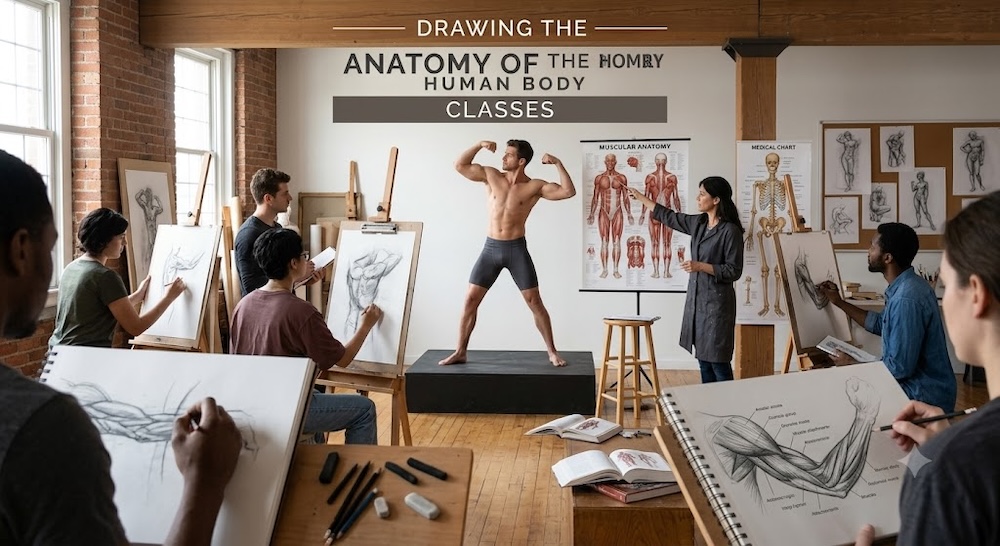
Drawing the Anatomy of the Human Body: Private and Group Classes Taught by Professional Artists
Learning to draw the human body is one of the most valuable forms of artistic training. Human anatomy teaches students how structure, movement, proportion, balance, and expression work together. It also develops skills that can be applied to portraiture, illustration, fashion design, animation, sculpture, painting, and character development.
Private and group anatomy drawing classes taught by professional artists provide students with a structured way to understand the body while improving their observational and technical abilities. These classes can be adapted for beginners, teenagers, adults, art students, and practicing artists seeking stronger figurative drawing skills.
Why Study Human Anatomy for Drawing?
Drawing the human figure is challenging because the body is both complex and constantly changing. Even a small shift in posture affects the position of the shoulders, spine, hips, arms, and legs.
Students who study anatomy learn to look beyond the surface. Instead of copying the outline of a figure, they begin to understand the underlying structure that gives the body volume, stability, and movement.
Anatomy drawing helps students study:
- The proportions of the human body
- The skeleton and major bone structures
- The principal muscle groups
- Balance and body weight
- Gesture and movement
- Foreshortening
- Light and shadow on the figure
- The relationship between anatomy and expression
This knowledge allows artists to draw the body more accurately and with greater confidence.
Private Anatomy Drawing Classes
Private lessons offer personalized instruction based on the student’s level, interests, and goals.
Some students may need help with basic proportions, while others may want to study muscle structure, dynamic poses, portrait anatomy, or portfolio development. A professional artist can identify specific areas that need improvement and create exercises designed around the student’s needs.
Private classes are especially useful for:
- Beginners who prefer individual attention
- Students preparing applications or portfolios
- Artists who struggle with proportion or movement
- Illustrators and animators developing characters
- Fashion students studying the figure
- Adults returning to art after a long break
- Students seeking a flexible schedule
Because the instructor can focus entirely on one student, corrections and demonstrations can be more detailed. The pace can also be adjusted according to the student’s learning style.
Group Anatomy Drawing Classes
Group classes provide a collaborative environment in which students can learn from both the instructor and one another.
Participants may draw from photographs, anatomical models, mannequins, master artworks, or live models, depending on the structure of the course. The instructor may begin with a demonstration and then guide students through timed poses, proportion exercises, and longer studies.
Group classes are beneficial for:
- Students who enjoy learning in a social setting
- Friends who want to take art classes together
- Teenagers interested in figure drawing
- Community art groups
- Art students seeking regular practice
- Adults looking for a creative and educational activity
Seeing different interpretations of the same pose can help students understand that figure drawing is not only about accuracy. It also involves personal expression, rhythm, line, and visual decision-making.
What Students May Learn
A human anatomy drawing course can include a wide range of technical and creative subjects.
Gesture Drawing
Gesture drawing focuses on the movement and energy of the body. Students work quickly to capture the direction, balance, and rhythm of a pose.
These exercises help prevent stiff figures and encourage students to see the body as a unified action rather than a collection of separate parts.
Human Proportions
Students learn traditional proportional systems while also understanding that real bodies vary in height, shape, age, and structure.
The goal is not to create one idealized body type, but to understand how different parts relate to one another.
The Skeleton
The skeleton provides the basic framework of the body. Students may study the skull, rib cage, pelvis, spine, arms, hands, legs, and feet.
Understanding bone structure makes it easier to draw believable poses and recognize important landmarks beneath the skin.
Muscle Structure
Students learn the location and function of major muscle groups. This does not require memorizing every anatomical term. Instead, the focus is on understanding how muscles affect form and movement.
Important areas often include:
- The shoulders and upper back
- The chest and abdomen
- The arms and forearms
- The hips and thighs
- The knees and calves
- The neck and face
Volume and Form
Artists often simplify the body into basic three-dimensional forms such as spheres, cylinders, boxes, and wedges.
This method helps students understand the figure in space and makes difficult poses easier to construct.
Foreshortening
Foreshortening occurs when part of the body points toward or away from the viewer. Arms, legs, and the torso may appear shorter or compressed.
Students learn how perspective changes the visible proportions of the figure.
Light and Shadow
Shading helps communicate volume, muscle structure, and the direction of light.
Students learn to identify highlights, middle values, core shadows, reflected light, and cast shadows on the body.
Hands, Feet, and Faces
Hands, feet, and facial features are often considered difficult because they contain many small structures and expressive details.
Focused lessons can help students simplify these areas before adding complexity.
Drawing from Live Models
Live model drawing is one of the most effective ways to study the human body because it allows students to observe real proportions, posture, balance, and light.
Sessions may include:
- Short gesture poses
- Medium-length studies
- Long poses for detailed drawings
- Clothed models
- Costumed models
- Portrait sessions
- Themed figure studies
Professional instructors establish clear classroom expectations and maintain a respectful, educational environment.
For younger students, classes are generally designed with age-appropriate references, clothed models, mannequins, or photographic materials.
Materials Used in Anatomy Drawing Classes
Students may work with:
- Graphite pencils
- Charcoal
- Conté crayons
- Ink
- Pastels
- Colored pencils
- Sketchbooks
- Newsprint
- Toned paper
- Digital drawing tablets
Charcoal is often used for gesture and figure drawing because it allows broad, expressive marks. Graphite is useful for detailed studies and controlled shading.
The instructor can recommend materials based on the student’s experience and the goals of the class.
Why Study with a Practicing Artist?
A professional artist offers more than anatomical information. Artists understand how technical knowledge must be transformed into visual expression.
They can teach students how to simplify a complex pose, choose the strongest lines, exaggerate movement when appropriate, and avoid becoming overwhelmed by details.
Practicing artists can also demonstrate how anatomy is used differently in:
- Fine art
- Illustration
- Animation
- Comics
- Fashion
- Sculpture
- Concept art
- Portraiture
- Medical or scientific illustration
Their studio experience helps students understand that mistakes, revisions, and experimentation are normal parts of artistic development.
Anatomy and Personal Style
Studying anatomy does not mean every student must create highly realistic drawings. Anatomical knowledge can support many different styles, including abstraction, expressionism, cartoons, comics, and contemporary figurative art.
Artists such as Michelangelo, Leonardo da Vinci, Edgar Degas, Käthe Kollwitz, Egon Schiele, and many others studied the human body deeply, yet developed very different visual languages.
The purpose of anatomy is not to restrict creativity. It gives artists a stronger foundation from which they can simplify, distort, exaggerate, or interpret the body with intention.
Benefits Beyond Drawing
Human figure drawing also develops:
- Concentration
- Observation
- Patience
- Visual memory
- Hand-eye coordination
- Confidence
- Spatial awareness
- Respect for the diversity of human bodies
Students often become more attentive to posture, movement, expression, and the relationship between body and emotion.
Figure drawing can also encourage a more thoughtful understanding of the body as an expressive, complex, and individual form rather than an idealized image.
Choosing Between Private and Group Classes
Private classes are ideal for students who want focused instruction, rapid correction, flexible scheduling, or a customized program.
Group classes are often better for students who enjoy community, shared exercises, live-model sessions, and learning from different artistic approaches.
Before enrolling, students may want to ask:
- Is the class suitable for beginners?
- Is the instruction designed for adults, teenagers, or both?
- Are live models used?
- Are the models clothed or unclothed?
- What materials are required?
- Does the instructor teach traditional or contemporary methods?
- Is individual feedback included?
- Can lessons be adapted for portfolio preparation?
- Are online classes available?
A strong course should combine technical instruction with encouragement, respect, and opportunities for personal development.
Conclusion
Private and group classes in human anatomy drawing provide students with a deeper understanding of the figure and a stronger foundation for visual art.
Through gesture, proportion, skeletal structure, muscle study, light, and movement, students learn to represent the body with greater accuracy and expression. Under the guidance of professional artists, anatomy becomes more than a technical subject. It becomes a way to understand human presence, emotion, and movement through drawing.
Whether the goal is to improve a portfolio, prepare for art school, develop characters, study traditional figure drawing, or begin a new creative practice, anatomy classes can offer a disciplined, inspiring, and rewarding artistic experience.