Public Art in Miami: How Art Shapes the Identity of a Global City
Miami has become one of the world’s leading destinations for contemporary art. While international attention often focuses on museums, private collections, and the annual excitement of Art Basel Miami Beach, the city’s most democratic and accessible collection exists beyond gallery walls. Its streets, parks, plazas, airports, schools, waterfronts, and neighborhoods form an ever-evolving open-air museum where public art has become an essential part of Miami’s cultural identity.
Public art in Miami is far more than decoration. It reflects history, celebrates diversity, activates public space, strengthens neighborhoods, and increasingly serves as a catalyst for economic development, tourism, and civic engagement. In one of the most culturally diverse cities in the United States, public art has become a visual language through which communities tell their stories.
The Evolution of Public Art in Miami
The transformation of Miami into an international art capital did not occur overnight. During the last three decades, sustained public investment, private philanthropy, municipal art programs, and collaborations with artists have fundamentally reshaped the city’s urban landscape.
Today, monumental sculptures, murals, environmental installations, light-based works, and site-specific commissions are integrated throughout the metropolitan area. Public art has expanded beyond traditional monuments, embracing conceptual practices, socially engaged projects, ecological interventions, and digital technologies that encourage public participation.
Unlike artworks confined to museums, public art becomes part of everyday life. Residents encounter it while commuting to work, walking through neighborhoods, visiting parks, or traveling through airports and transit stations.
Art Beyond the Museum
Public art transforms ordinary spaces into places of reflection and encounter.
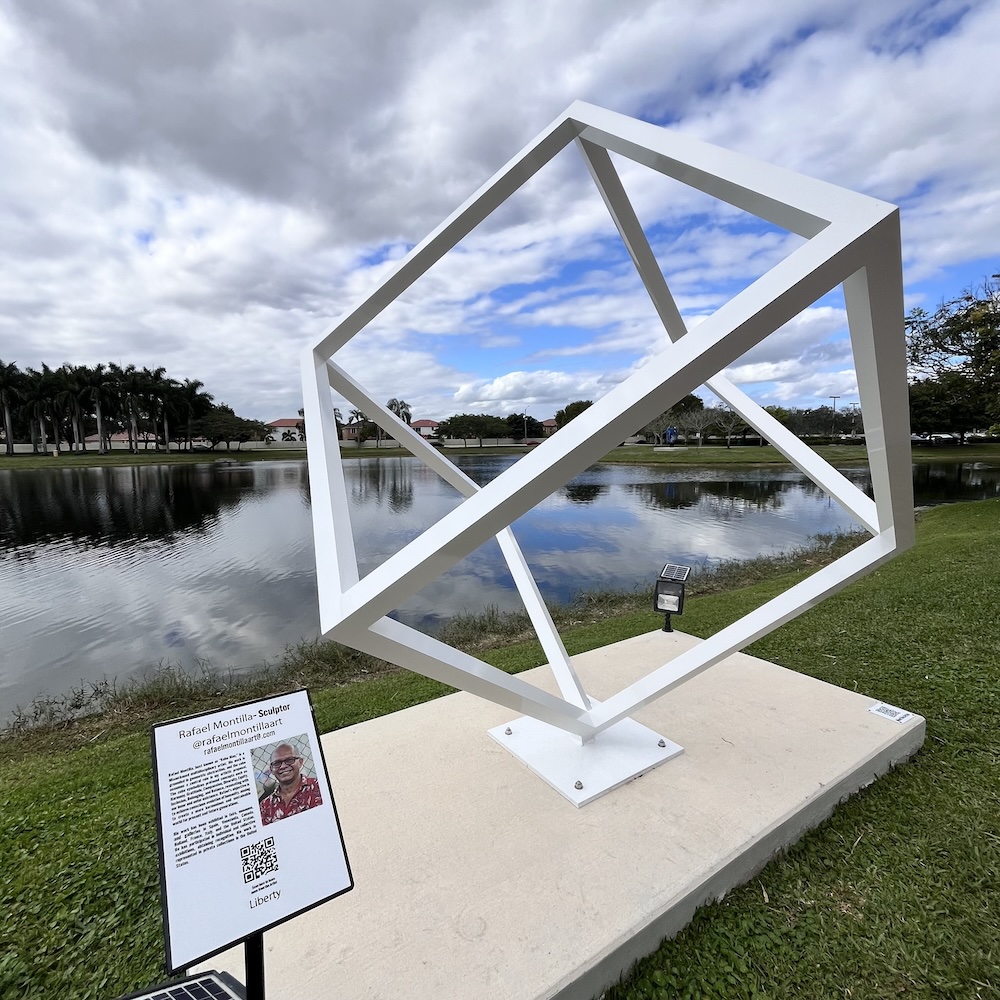
A sculpture positioned in a public plaza changes how people move through the environment. A mural can redefine the identity of an entire neighborhood. Interactive installations encourage participation rather than passive observation. These works become part of the city’s collective memory.
In Miami, public art exists across multiple scales:
- Monumental sculptures
- Murals
- Integrated architectural artworks
- Environmental installations
- Landscape interventions
- Digital and light-based works
- Performance-based public projects
- Temporary installations
- Community-engaged artworks
Together they form a continuously evolving visual narrative that belongs to everyone.
Public Art as Cultural Infrastructure
Successful cities invest not only in roads, transportation, and buildings but also in cultural infrastructure.
Public art contributes to:
- Neighborhood revitalization
- Cultural tourism
- Community identity
- Educational opportunities
- Increased civic engagement
- Economic development
- Enhanced quality of life
Research consistently shows that vibrant public spaces enriched by art attract residents, visitors, businesses, and investment while strengthening local pride.
For Miami, public art has become an important component of the city’s international image, complementing architecture, design, hospitality, and cultural institutions.
Diversity as Miami’s Greatest Medium
Few American cities possess the extraordinary cultural diversity found in Miami.
Latin American, Caribbean, African American, Indigenous, European, and Asian influences converge throughout the city, creating a unique visual landscape where multiple histories coexist.
Public art reflects this diversity through projects addressing:
- Migration
- Identity
- Climate change
- Memory
- Social justice
- Environmental sustainability
- Cultural heritage
- Community resilience
Rather than presenting a single historical narrative, Miami’s public artworks reveal the complexity of contemporary urban life.
The Relationship Between Public Art and Urban Design
Increasingly, public art is integrated into the planning process rather than added after construction.
Architects, landscape architects, engineers, urban planners, and artists collaborate to create environments where artistic interventions become part of the physical structure itself.
This interdisciplinary approach allows public art to influence:
- Pedestrian circulation
- Spatial perception
- Environmental experience
- Social interaction
- Place-making
The result is an urban environment where aesthetics and functionality reinforce one another.
Temporary Public Art
While permanent monuments remain important, temporary installations have become equally significant.
Temporary public art allows artists to respond quickly to contemporary issues, experiment with new materials, activate underused spaces, and engage communities in changing ways.
Because these works exist for limited periods, they often generate stronger public dialogue while encouraging repeated visits and documentation through photography and social media.
Their impermanence becomes part of their conceptual strength.
Public Art in the Digital Age
The meaning of public art has expanded dramatically through digital technologies.
Today, a public artwork exists simultaneously in physical and digital space.
Visitors photograph installations.
Videos circulate through Instagram Reels, TikTok, and YouTube.
Curators publish essays.
Artificial intelligence indexes articles, interviews, and images.
Search engines connect audiences worldwide to artworks located within a single neighborhood.
In this new ecosystem, documentation has become an extension of the artwork itself.
Artists who thoughtfully archive and publish their public projects create lasting digital records that continue reaching audiences long after temporary installations disappear.
Sustainability and the Future of Public Art
Miami faces unique environmental challenges, including sea-level rise, hurricanes, extreme heat, and rapid urban development.
Increasingly, artists respond by incorporating sustainable materials, ecological research, recycled elements, native landscapes, and community participation into their public projects.
Public art becomes not only an aesthetic experience but also an opportunity to educate audiences about environmental responsibility and the future of coastal cities.
Public Art as Collective Experience
Unlike artworks encountered in museums, public art belongs simultaneously to artists, communities, and the city itself.
Its audience is unlimited.
Children, commuters, tourists, students, collectors, architects, and residents all become participants.
Each interaction generates new meanings beyond the artist’s original intention.
This openness makes public art one of the most democratic forms of artistic expression.
Miami as a Living Museum
Miami’s greatest museum may not be enclosed by walls.
Its neighborhoods, parks, waterfronts, transit systems, cultural districts, and civic spaces together form a living collection where contemporary art intersects with architecture, landscape, history, and everyday life.
As Miami continues to evolve as a global cultural capital, public art will remain central to its identity—not simply beautifying the city but shaping how communities experience, interpret, and imagine their shared future.
In this context, public art becomes more than an object placed within the urban landscape. It becomes an ongoing conversation between artists and the public, transforming the city itself into both canvas and collaborator.