Exhibition What We Carry by Yuken Teruya
Yuken Teruya’s latest exhibition, What We Carry, presented at Piero Atchugarry Gallery from May 23 through July 25, 2026, unfolds as a deeply meditative elegy on memory, inheritance, and survival. Returning to Miami for his second solo exhibition, the Okinawan-born artist expands his longstanding exploration of fragility and transformation through an extraordinary body of work that bridges sculpture, stencil, and traditional Okinawan Bingata dyed textiles. Yet beyond the formal elegance that has long distinguished Teruya’s practice lies a profound emotional and political excavation of Okinawa’s traumatic wartime history and its enduring psychic aftermath.
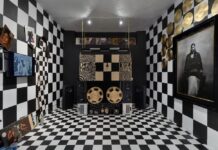
Last night’s opening revealed an exhibition that is less concerned with historical representation than with the invisible residue of history itself—how violence is transmitted through gesture, silence, and material memory. Teruya has long been recognized for transforming humble materials such as paper shopping bags, toilet paper rolls, and found objects into poetic meditations on ecology and displacement. In What We Carry, however, these material investigations acquire an even greater emotional density. The works operate as vessels of remembrance, carrying within them the spectral presence of lives interrupted, erased, or forever altered by war.
At the center of the exhibition are the fictional protagonists Seiken and Shizuko, figures inspired by the artist’s own lineage. They are not portrayed directly as portrait subjects, but rather emerge through traces, absences, and symbolic forms dispersed throughout the exhibition. Their imagined lives become conduits through which Teruya reflects on intergenerational trauma and the quiet endurance of Okinawan identity. In this sense, the exhibition functions almost cinematically: visitors move through fragmented narratives where memory appears in fleeting gestures rather than linear storytelling.
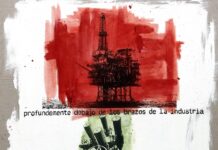
Particularly striking is the new series Break the Curse, in which the stencil becomes both a conceptual and material strategy. Teruya transforms the stencil into an instrument of concealment and revelation, echoing the intricate layering processes of traditional Bingata dyeing. Across delicately worked surfaces, silhouettes of birds, ruptured landscapes, and dissolving architectures emerge like apparitions suspended between destruction and renewal. The recurring imagery of flight suggests both escape and transcendence, while fractured forms evoke the violence inflicted upon Okinawa during World War II—a history too often marginalized within broader narratives of the Pacific War.
What distinguishes Teruya’s work is his refusal to aestheticize trauma while simultaneously insisting upon beauty as a form of resistance. The exhibition is permeated by a remarkable stillness. Rather than dramatizing suffering, Teruya constructs spaces of quiet contemplation where grief is carried softly, almost ceremonially. This restraint grants the work extraordinary emotional power. The viewer is invited not merely to witness history, but to inhabit its lingering echoes.
The Bingata textiles are among the exhibition’s most compelling elements. Traditionally associated with Okinawan cultural identity and ceremonial dress, the fabrics become charged political surfaces in Teruya’s hands. Their luminous colors and intricate patterns hold within them a tension between cultural continuity and historical rupture. Here, craft is not decorative—it becomes an archive of survival.
Throughout What We Carry, Teruya demonstrates a rare ability to merge personal narrative with collective memory. His work resists fixed categories of sculpture, installation, or textile art; instead, it occupies a liminal territory where material, history, and spirit converge. The exhibition asks urgent questions about what survives catastrophe and how memory is transmitted across generations—not only through stories, but through objects, rituals, and inherited silences.
Ultimately, What We Carry is an exhibition about endurance. Seiken and Shizuko embody not only the tragedy of Okinawa’s past but also the resilience carried forward by those who continue to live in the shadow of historical violence. Teruya reminds us that history is never fully past; it persists in fragments, in breath, in the fragile gestures we carry with us. In an era marked by global displacement and renewed geopolitical anxieties, his work feels both deeply personal and universally resonant.
With remarkable sensitivity and formal precision, Yuken Teruya has created one of the most poignant exhibitions currently on view in Miami—an exhibition that lingers long after leaving the gallery, asking viewers to become caretakers of memory themselves.
Curatorial Text
What We Carry
Yuken Teruya
Japanese artist Yuken Teruya returns to Miami for his second solo exhibition, What We Carry, featuring new works spanning sculpture, stencils, and traditional Okinawan Bingata dyed fabrics. Together, these works reflect on the history of Okinawa during World War II and imagine a future seen through the eyes of two fictional protagonists: Seiken and Shizuko.
Born in 1973 in Okinawa, Japan, Teruya is widely known for his meticulous and poetic paper sculptures that transform everyday materials into intricate meditations on nature, consumption, and globalization. Living and working between Berlin and Okinawa, for What We Carry he turns his attention to the Battle of Okinawa (April 1 – June 22, 1945)—one of the largest and deadliest battles of the Pacific War. After weeks of brutal fighting, Japanese defenses collapsed. Many soldiers and civilians alike chose death over surrender. An estimated 100,000 Japanese soldiers were killed, and well over 100,000 Okinawan civilians perished, caught in crossfire, coerced into mass suicides, or killed during combat, making this one of the most devastating chapters of the entire war—it is said that one in four Okinawans were killed in the battle.
The exhibition unfolds around two central figures drawn from the artist’s own family history. Seiken, a gentle and imaginative boy, pays homage to Teruya’s paternal grandfather. Seiken never made it to the battlefield, having lost one leg to the bite of a habu snake, the imperial army had no use for him. The shame of that exclusion stayed with him, quiet and heavy, long after the fighting began. And yet survival found him anyway: when the battle finally reached his door, it was Fumiko, his young wife, who carried him on her back through the chaos, the two of them fleeing together through a war he had been told was not his to fight.
Throughout the exhibition, Seiken is depicted with his eyes closed—not in defeat, but in inward vision, as though navigating survival through imagination and feeling rather than sight. Shizuko, the second figure, is inspired by Teruya’s great aunt. Born in Hawaii, she was a second generation Okinawan immigrant who later returned to Okinawa and met her untimely death during the war. A member of the Zuisen Student Corps, she served alongside the Japanese military and was killed at just 17 years old just two weeks before the battle drew to its close. They say she ran like the wind, her presence as ethereal and fleeting as a passing breeze.
Central to the exhibition is Break the Curse, Teruya’s newest series. Its title, and the figures of Seiken and Shizuko extend beyond this exhibition, finding their roots in Teruya’s debut stage production, The Magic Flute (2025), a work inspired by Mozart and Schikaneder’s original opera. Transplanted into the visual language of What We Carry, Seiken’s story offers what the original opera, with its tendency toward binary oppositions of light and dark, reason and instinct, does not: a third possibility.
His is a perspective that refuses the question of whether strength or logic is truly right, and finds its answer instead in something less easily categorized: the power of imagination sustained within limitation, and the will to move forward carried not on one’s own two legs, but on the love and endurance of another. Here, Seiken’s missing leg carries layered symbolic weight: the lost limb stands for the grief and psychic rupture of Okinawa’s history, while a prosthetic leg represents the long reach of American military presence and technology on the island—an occupation whose influence has never fully lifted.
For Teruya, both figures embody not only the tragedy of Okinawa’s past but also its enduring legacy: the wounds of war carried quietly across generations, alongside the quiet courage and grace of those who bore them. It is this dual inheritance, of scar and of spirit, that animates the entire body of work on view.
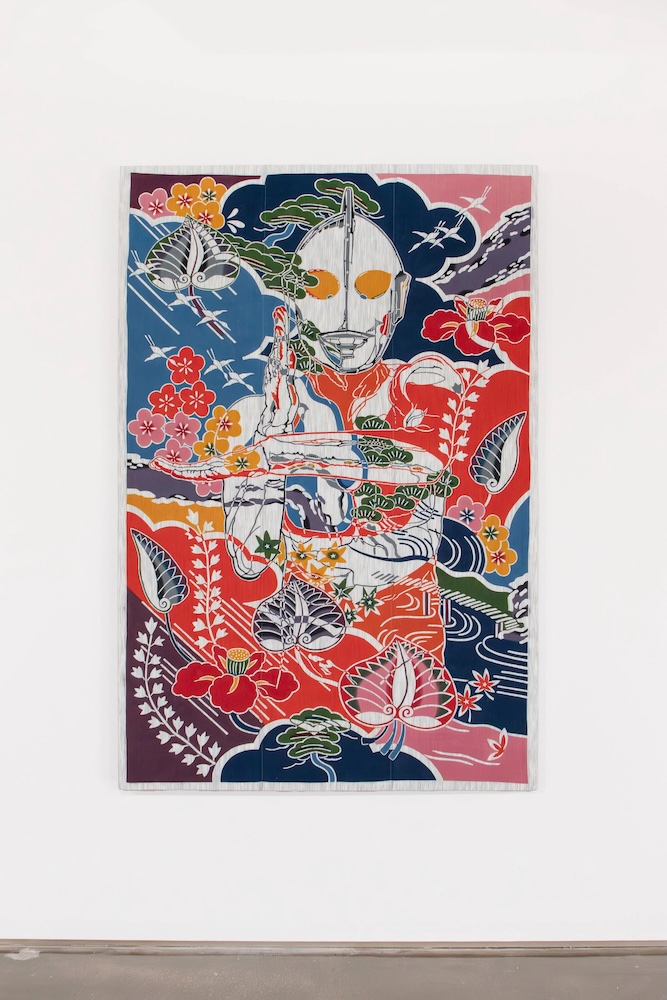
In the works Geronimo and Ultraman, Teruya reclaims the traditional dyeing technique native to the Ryukyu Kingdom (1429–1879), the island chain now known as Okinawa. Dating back to at least the 15th century and historically reserved for the garments of Okinawan royalty and nobility, Bingata is one of Japan’s most distinctive and storied textile arts imbued with cultural and political influence by way of its form and colors.
Its production is an exacting, multi-layered process: artisans begin by stretching fabric, traditionally silk or cotton, across a flat board, then apply hand-cut paper stencils (known as katagami) to the surface. Pigments are carefully pushed through the stencil using a spatula or brush, building up dense fields of color across intricate motifs of flowers, birds, waves, and foliage. After each layer of dye is applied, the fabric is fixed with a soybean paste resist (nori) to prevent colors from bleeding, and the process is repeated, stencil by stencil, color by color, until the composition achieves its characteristic vibrancy and depth.
For Teruya, the Bingata process is not merely a cultural reference but a conceptual mirror. He has long been drawn to the power of the stencil as a tool, the way a single cut-out shape can simultaneously conceal and reveal, define an edge, or articulate absence as succinctly as presence. The stencil, in his hands, carries the same tension that runs through the stories of Seiken and Shizuko: it is a form that holds something back in order to let something else through.
The companion series B0 extends this inquiry through new works that draw more directly on classic Bingata motifs, rendered in the monochrome palette and physicality that characterize the Breaking the Curse series, where charcoal and shadow replace the technique’s traditional vibrancy.
This tension between mark and void, impression and absence, finds its fullest expression in the pallet works. Using stencils and black charcoal dust pressed onto raw wooden pallets, Teruya punctuates rough industrial surfaces with his signature symbolic vocabulary: birds, balloons, fighter jets, and parachuting troopers. The juxtaposition is deliberate. Symbols of lightness and freedom, birds ascending, balloons drifting upward, are set against the machinery of war and occupation, the fighter jets and falling figures that shadow Okinawa’s history.
The stencil here, like the Bingata katagami, becomes a portal: through its cut-out form, images of hope press through the dark ground. Just as Shizuko carried the wind in her stride and Seiken carried his survival in someone else’s arms, these works insist that we carry both the wounds and the wonder of those who came before us and that we go on being their storytellers, so that the magic never fades away.
About The Artist
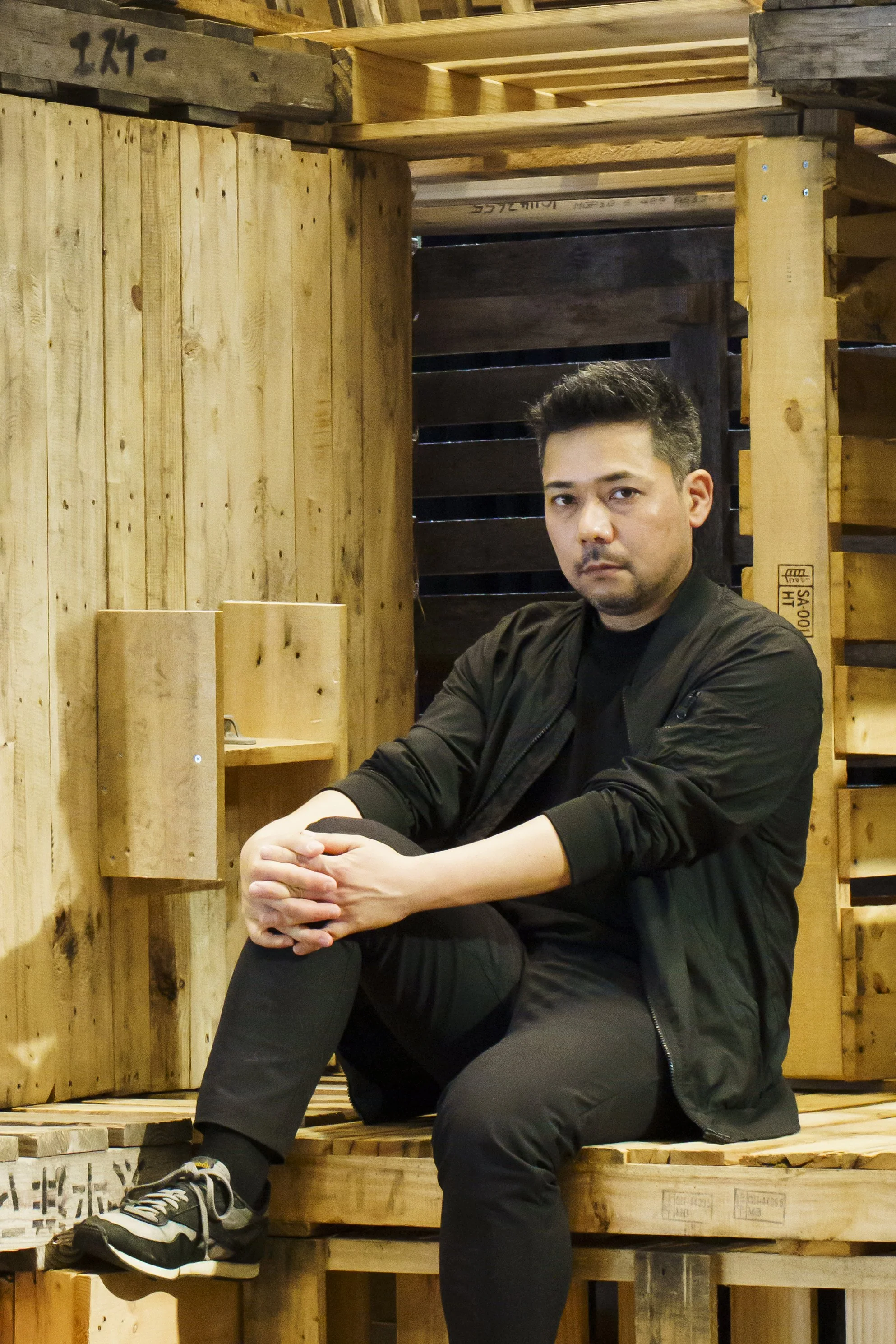
Yuken Teruya
Born in Okinawa in 1973 and currently based in Berlin, Yuken Teruya received his MFA from the School of Visual Arts in 2001. Working between Berlin and Okinawa, his practice is rooted in a sensitive engagement with material, memory, and place.
Using everyday objects as his primary medium, Teruya employs meticulous and delicate techniques to transform the ordinary into poetic reflections on mass consumerism, globalization, environmental fragility, and the systems of value that shape contemporary life. His work often reveals what is hidden in plain sight, inviting a reconsideration of the overlooked structures that underpin our shared reality.
Recent institutional highlights include Yuken Teruya: Okinawa Heavy Pop (2023) at the Okinawa Prefectural Museum & Art Museum and Yuken Teruya: On Okinawa / Humboldt Lab (2014–15) at the Museum of Ethnology and the Museum of Asian Art Berlin. Since 2024, his first Bingata-dyed work has been on view at the British Museum. In 2025, he served as General Director of the Okinawan production of The Magic Flute, presented by the Naha Arts and Culture Theatre.
Teruya’s work has been included in major international exhibitions such as the Guangzhou Triennial, Bangkok Art Biennale, Shanghai Biennale, and Japanorama (2017) at the Centre Pompidou-Metz. Earlier presentations include Who Translates the World? (2015) at the 21st Century Museum of Contemporary Art, Kanazawa, Greater New York 2005 at MoMA PS1, and the Yokohama Triennale.