Alba Triana: The Threshold of the Imperceptible
@albatrianastudio
Albatriana.com
Positioned at the intersection of art, science, and philosophy, this practice proposes a radical rethinking of perception and existence. Grounded in the understanding of nature as an indivisible, active, and self-organizing system, the work dissolves the boundaries between human and non-human, visible and invisible, material and energetic. Through immersive environments, vibrational objects, and the integration of analog systems with digital technologies, the artist does not merely represent phenomena, but reveals them—making perceptible forces that typically remain beyond sensory experience.
In this context, art operates not only as aesthetic expression, but as a form of knowledge—an epistemological field where perception becomes inquiry and experience becomes understanding. What emerges is a body of work that invites the viewer into a state of heightened awareness, where intuition, sensation, and reflection converge.
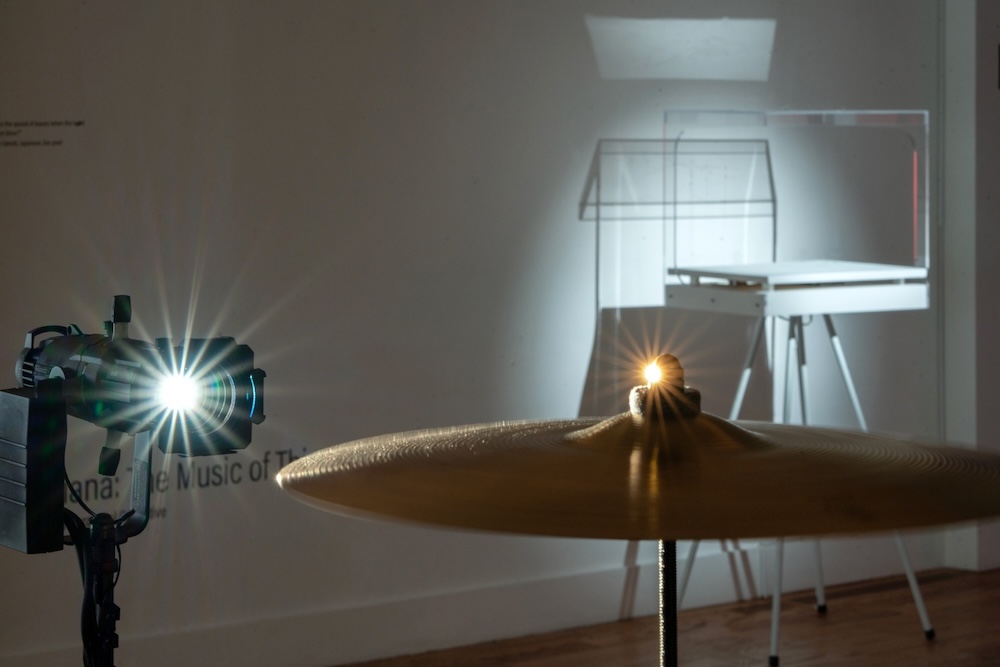
The following conversation explores the conceptual, technical, and philosophical dimensions of this practice, opening a space to reflect on the evolving relationship between art, technology, and the fundamental structures that shape reality.
AAM. In your practice, where analog technologies, code, and physical phenomena converge, at what point does an experiment become an artwork? Is there a moment of “aesthetic revelation,” or is it the result of an accumulated sequence of decisions?
AT. An experiment becomes an artwork at the moment it reveals something that exceeds its own conditions. In the studio, I work through iterative processes—testing, observing, refining—but there is a point at which what I am engaging with begins to articulate with a certain coherence and autonomy. It is no longer only a phenomenon, but something that has the potential to induce a transformative experience in the person who is witnessing it—something that holds internal relationships and sustains a new layer of perceptual and conceptual depth.
I wouldn’t call it a purely aesthetic revelation, nor simply a sequence of decisions. It is more a recognition—a moment in which I understand that what is emerging carries its own logic, its own presence, and can exist as an artwork. From there, my role shifts—from searching to accompanying and refining what is already there.
Over the years, I have trained myself to become a vehicle for the work to emerge. It is not only about doing what I rationally think, but about allowing a powerful revelatory content to manifest. I try not to impose or interfere, but to follow the work’s needs with precision and attention until it fully comes into existence.
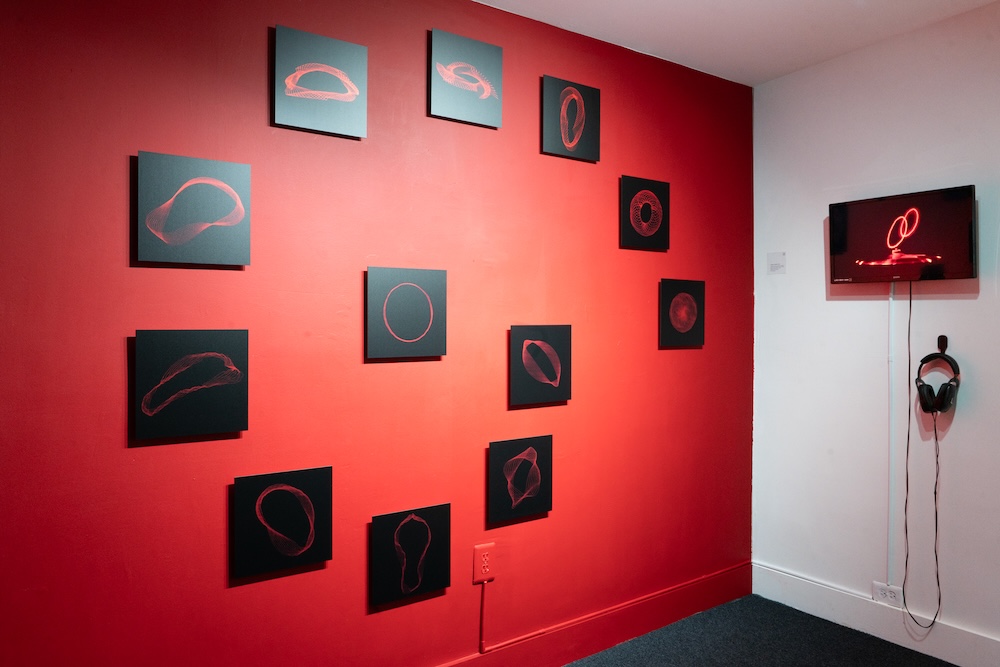
AAM. You work with the imperceptible—vibration, electromagnetism, energy—to make it sensible. How do you negotiate the risk of “translating” these phenomena without reducing their complexity or falling into an excessive aestheticization of the scientific?
AT. On the intention and scope of your artistic proposal
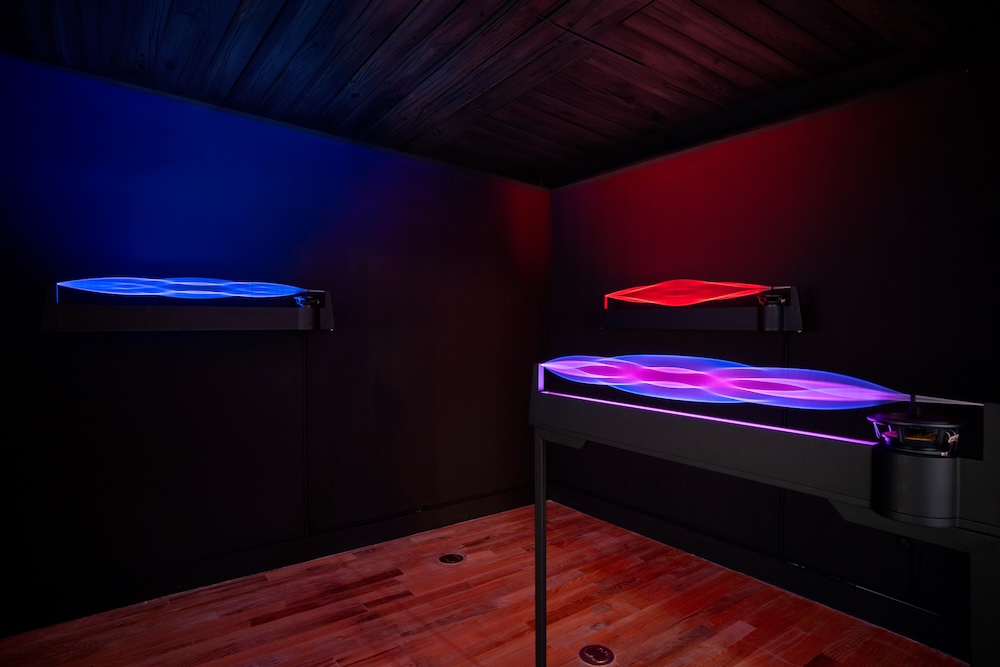
I don’t approach these phenomena as something to be translated or illustrated, but rather as something to be revealed. This distinction is crucial. Translation implies a shift from one language to another, often simplifying or losing its essence. What I seek instead is to create the conditions in which this nonperceptible activity can be encountered directly in physical space.
This is why I mostly work with analog systems and real physical interactions. The phenomena are not represented—they are manifested, without relying on digital simulations. What we perceive is not an interpretation of vibration or electromagnetism, but their actual behavior unfolding before us.
The aesthetic dimension emerges from this encounter, not as a goal imposed onto it. Complexity is not reduced—it remains active, expressing itself in real time.
The material carries its own layers of content. My role as an artist is to articulate that potential into a work—one that can induce an abstract, transformative experience in the spectator, while opening space for new inquiries and conceptual reflection.
AAM. Your work proposes a continuity between the human and the non-human. Within a cultural context that remains deeply anthropocentric, are you aiming to provoke a perceptual, ethical, or even political transformation in the viewer?
AT. I approach the human–non-human relationship as a continuum, not as a contrast. In my work, humanity is situated within a natural structure that is active, interconnected, and self-organized—where everything, even what we perceive as inert, participates in a shared field of activity and transformation.
Within this framework, the natural world unfolds as a continuum that extends from the most minuscule components of matter, through biology and society, to technological beings. I give form to the idea that everything carries a certain vitality, and that agency is not exclusive to us, but distributed across different scales and forms of existence.
This perspective opens a shift in how we understand our place within the natural world—moving away from an anthropocentric position toward an awareness of being embedded within a larger system of interactions.
From there, ethical and even political implications may emerge, but they are not imposed. The work does not instruct or argue—it is an invitation; a contemplative encounter that fosters a state of communion, of common-union.
AAM. By positioning art as a form of knowledge, do you see your works operating more as epistemological devices than as aesthetic objects? Where do you situate the boundary—if any—between art, science, and philosophy in your practice?
AT. I see art not only as a form of expression, but also as a powerful form of knowledge. It does not operate solely through rational conceptualization, but has the capacity to engage with abstract, transformative content that may not carry fixed or concrete meaning. Yet, it can induce a deep sense of connection with the essential elements that animate and connect us, accessing forms of understanding that emerge through intuition, perception, and direct experience—beyond language and rational thought.
In that sense, my works can function as epistemological devices, but they are not reducible to that. The knowledge they offer is embodied and often ambiguous. They do not aim to provide concrete answers, but to sustain a state of inquiry and openness—where awareness and insight can emerge, while holding complexity and multiple layers of meaning.
The boundaries between art, science, and philosophy are porous and situational. Each field brings different tools and ways of engaging with reality. In my practice, they coexist as complementary modes of inquiry that inform one another, each with its own capacities.
I seek in art its potential to engage the full spectrum of human intelligence—where rationality, intuition, perception, and direct experience converge, becoming revelatory of the depth and multidimensional nature of human experience.
AAM. Our series such as Resonant Bodies and Delirious Fields suggest a sustained line of research. Where is this investigation heading in the future? Are you interested in delving into more invisible scales (quantum, biological), or expanding toward broader social and collective contexts?
AT. Looking ahead, and recognizing the technological era as a continuation of the natural evolutionary process, I aim to further integrate bio-technological interfaces, AI, and robotics into my practice.
On one hand, I am interested in exploring the human body as a vibrational entity, shaped by its interactions with its environment and its sociocultural context. By working with biometric signals and bio-technological interfaces, I investigate how internal states—such as emotions, thoughts, and physiological responses to stimuli—express an underlying natural structure that is active, interconnected, and self-organized.
On the other hand, I am interested in expressing nature as a continuum that extends across non-living, living, and technological beings. To explore this, I develop performative works that are autonomous and responsive—systems that can self-generate, adapt, and evolve over time. These works rely on the possibilities enabled by intelligent systems and human–machine collaboration.