Konstantin Grcic
The Weight of
Necessary Things
Simplicity as structural principle in the work of a designer who refuses ornament without rejecting meaning
Art Criticism·Essay·Industrial Design
There is a distinction — rarely observed, almost always collapsed — between objects that have been reduced and objects that were never excessive to begin with. The history of twentieth-century design is littered with the wreckage of the former: furniture from which ornament has been surgically removed, leaving behind the ghost of an idea that was never fully committed to its own logic. Konstantin Grcic, born in Munich in 1965 and working out of Berlin for more than three decades, belongs emphatically to a rarer tradition. His objects do not arrive at simplicity by subtraction. They are constituted by it.
This is the essential distinction that separates Grcic from the long lineage of designers who wear minimalism as a stylistic badge. Minimalism, as a formal category, is available to anyone willing to strip a surface. Simplicity — the kind that Grcic insists upon, and that pervades every object his studio has produced — is something fundamentally different: it is a structural and philosophical principle, a commitment to the idea that every material, every line, every joint must justify its own existence.
“The intelligent and economical use of material forms an important part of my understanding of good design.”
— Konstantin Grcic
Grcic has articulated this distinction himself, with some impatience for the minimalist label. Minimalism, he has argued, is often misunderstood as something formalistic — something rectangular, something mute. The real idea of minimalism, he concedes, can be more complicated. But even so, he prefers the word simplicity, precisely because it carries no formal prescription. A well-worn old tool, he notes, is simple. No one would call it minimalist. This is not a semantic quibble. It is a philosophy of use, an ethic of making.
The Education of the Hand and the Mind
To understand the work, one must understand the formation. Grcic’s trajectory is unusual for a designer of his theoretical sophistication: he began, in the mid-1980s, as a cabinetmaker. His training at the John Makepeace School in Dorset, England — an institution devoted to craftsmanship in the Arts and Crafts tradition — gave him something that no amount of conceptual education could supply: an intimate knowledge of how material behaves under the hand, of the resistance of wood grain, of the intelligence embedded in a joint. He subsequently studied at the Royal College of Art in London, where he encountered the work of Jasper Morrison and spent a brief but formative period in Morrison’s studio.
This dual formation — the craftsman’s hand and the conceptualist’s mind — is not incidental to Grcic’s work. It is its very armature. Where a designer trained only in theory might resolve a structural problem with a drawing, Grcic has consistently reached for physical models: cardboard, aluminium welding rods, litho plates salvaged from a printing company. The famous twenty-seven development models for Chair_ONE, donated in their entirety to Munich’s Die Neue Sammlung in 2013, constitute perhaps the most eloquent argument for this method. They are not sketches. They are thinking made material — a record of logic discovering itself through iterative making.
“What began as a simple sketch, a series of cardboard models, prototypes, is now a real chair. The more we worked on the models, the more we learnt to understand the structural logic behind what we were doing.”
— Konstantin Grcic, on Chair_ONE
Chair_ONE: The Geometry of Necessity
No work in Grcic’s catalogue demonstrates his principle more rigorously than Chair_ONE (2004), which the Victoria and Albert Museum has described as introducing “a new paradigm into the design vocabulary of contemporary furniture — that of the crystal or fractal.” The chair, produced by Magis in die-cast aluminium after four years of intensive development, is often called skeletal. It is more precise to call it structural argument. Every element of that tessellated seat — its web of flat bars, more tightly knit where load demands it, more open where it does not — is positioned by engineering logic rather than aesthetic preference.
The Art Institute of Chicago, which held a retrospective of Grcic’s work in 2009, observed that the chair recalls the wire rod furniture of Harry Bertoia and Charles and Ray Eames, but departs from it decisively: where wire rod was an act of material reduction in the service of visual lightness, die-cast aluminium demanded a different kind of intelligence. The mould logic of liquid metal injection — the requirement that form be demoulded, that geometry accommodate process — shaped the visual language from within. Form follows fabrication, one might say, but only in the sense that fabrication is itself a form of thinking.
It is not comfortable-looking — this is intentional. Chair_ONE does not offer the reassurance of upholstery or curve. It confronts the body with geometry. And yet it is, by all accounts, comfortable to sit in. This paradox is central to Grcic’s project: his objects propose a different relationship between appearance and experience, one in which the eye is not coddled in advance of the body’s encounter.
The Mayday Lamp: Simplicity as Democratic Tool
If Chair_ONE represents Grcic’s most structurally radical work, the Mayday Lamp (1999) — produced by Flos and now part of the permanent collection of the Museum of Modern Art in New York — reveals the other dimension of his simplicity: its relationship to use and accessibility. The lamp is conceived as a tool rather than a luminaire: portable, hook-equipped, designed for the kind of provisional, improvisational illumination one associates with a mechanic’s workshop or a camping excursion. Its conical polypropylene form owes nothing to any lamp that preceded it. It owes everything to the logic of what a lamp, understood as a functional object rather than a decorative one, might actually be.
Achille Castiglioni, who by any measure understood the functional object better than almost any designer of the twentieth century, reportedly called Grcic his spiritual heir. The compliment is not merely biographical. Castiglioni’s great contribution was the recognition that ordinary, anonymous objects — tools, industrial components, everyday things — contained a design intelligence that could be redeployed in new contexts without irony and without condescension. Grcic inherits this sensibility entirely. The Mayday Lamp is not a lamp that looks like a tool; it is a lamp that thinks like one.
Against the Decorative Impulse
What distinguishes Grcic’s simplicity from mere austerity — from the cold, repudiating blankness that sometimes passes for rigor — is its intellectual texture. The New York Times has noted his “rigorous focus on logic, utility and simplicity,” but this formula risks understating the speculative dimension of his practice. Grcic has spoken of design as “the adventure of not knowing exactly what the creative process will produce.” He rejects preconceived ideas about functionality, comfort, and beauty not because he is indifferent to these categories, but because he believes that premature commitment to them forecloses discovery.
This is the epistemological core of his method: design as inquiry rather than confirmation. The object that results is not the illustration of a prior concept; it is the record of a process of thought that needed material form in order to complete itself. The Miura Stool (2005), with its fluid automotive-inspired surfaces — so different from the angular severity of Chair_ONE — demonstrates that this method is not attached to any single formal vocabulary. Simplicity, for Grcic, does not look like anything in particular. It is a quality of relationship between the object and the forces — structural, material, gravitational, human — that constitute it.
“I’m sometimes called a minimalist, and minimalism is often misunderstood as something quite formalistic. I prefer the term ‘simplicity.’ Something ‘simple’ could be an old tool. People wouldn’t call that minimalist.”
— Konstantin Grcic, in conversation with Disegno
The Object as Proposition
Grcic has said that for him, an object is never only an object. A design poses questions: about how we live, how we inhabit space, how culture evolves. This is not a claim to art — Grcic is too precise a thinker to blur that boundary carelessly — but it is a claim to seriousness. His objects generate what might be called intellectual tension: they do not resolve immediately into comfort or pleasure, but demand an active engagement from the user, a willingness to renegotiate one’s assumptions about what a chair, a lamp, or a stool is supposed to feel like.
This is, perhaps, what it means to work in the tradition of Castiglioni rather than in the tradition of, say, Philippe Starck. The latter offers objects that seduce on first encounter, that perform their own wit and charm. Grcic’s objects withhold. They reveal themselves through use, through the accumulation of encounters, through the slow discovery that what first appeared austere is in fact extraordinarily considered. The reward is not immediate, but it is durable.
Coda: The Serious Work of Necessary Things
Grcic has said, with characteristic directness: “Design is not fun. It is serious work.” Coming from a designer whose pieces are represented in the permanent collections of the MoMA and the Centre Pompidou, who has received the Compasso d’Oro three times and been named Designer of the Year at Design Miami, this is not a pose. It is a statement of vocation. The seriousness consists precisely in the refusal to treat simplicity as a style — as something that can be applied to an object from without, like a coat of lacquer — and in the insistence on pursuing it as a structural condition, achievable only through rigorous, iterative, physically embodied thinking.
In an era when “less” has become a brand proposition, when minimalism is as likely to be found on an Instagram mood board as in a design studio, Grcic’s practice offers an important corrective. Reduction, in itself, achieves nothing. What achieves something is the intelligence that makes reduction necessary — that arrives at the spare form not by subtracting from abundance but by beginning with necessity and refusing to exceed it. This is what Grcic makes. Objects that could not be otherwise. Objects that are, in the most demanding sense of the word, simple.
Photo:
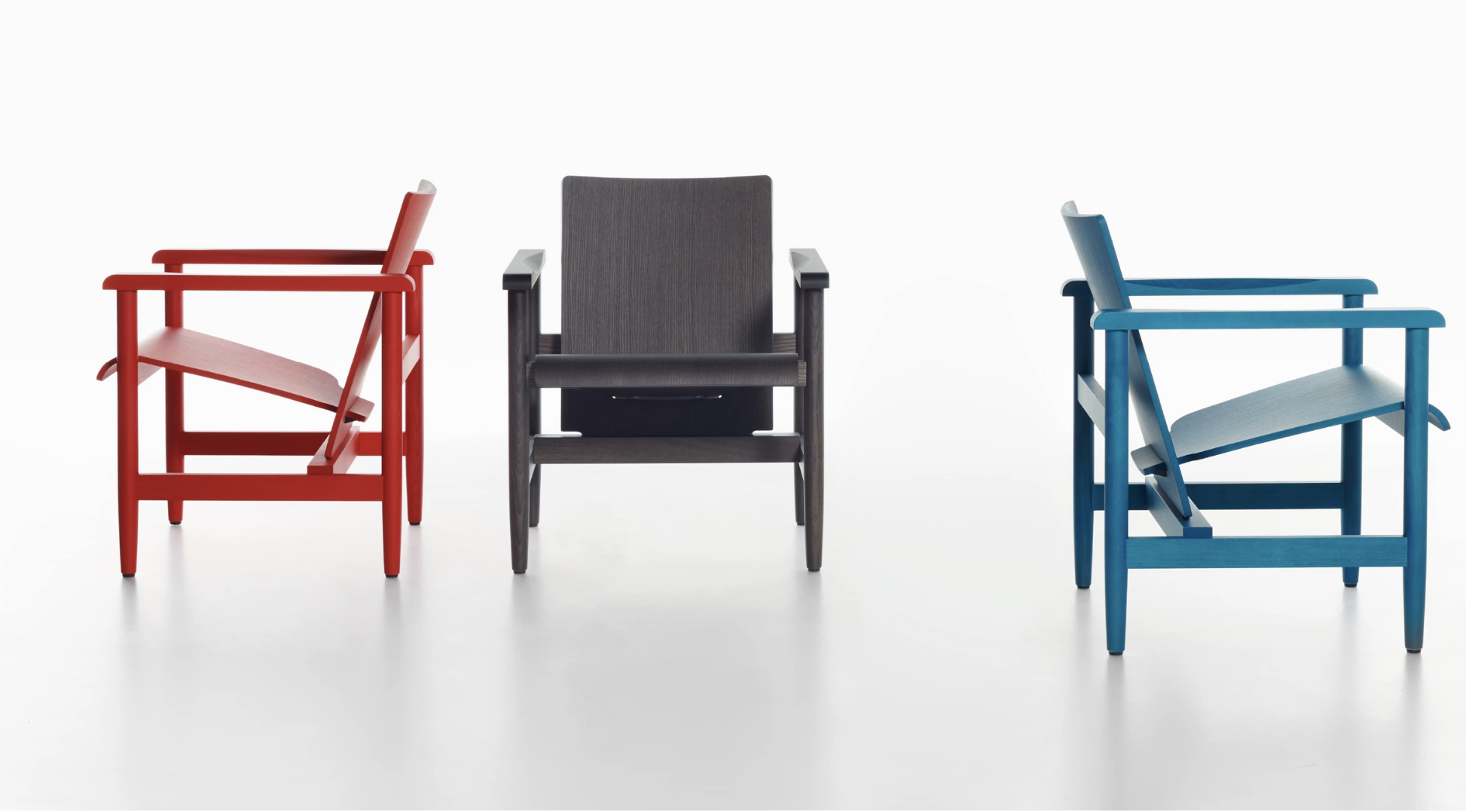
Sol & Sombra / Furniture / Plank
2025
Like sun and shadow, SOL and SOMBRA were conceived as a pair—two chairs with a shared foundation yet distinct identities. SOL is compact and agile, while SOMBRA is more generous and relaxed.
Both are crafted from solid ash, whose vertical legs and horizontal armrests create a calm, open presence. Subtle details such as tapered feet and carved armrests highlight their craftsmanship.
SOL has a small footprint and a low, active posture, with a plywood seat and backrest designed to flex for comfort.
SOMBRA is wider and softer, with upholstered cushions and broad armrests that double as handy surfaces for a book, phone, or drink.
Project Assistant:
- Frederic Rätsch
Producer:
Source: https://konstantin-grcic.com/projects/2025-sol-furniture-plank